 English
 Le français
 Türkçe


Stop and idle times are the part of a savings calculation most people skip, because a motor does not fully disconnect from energy even when it is not doing useful work. For a correct figure you need to know the hours under load, the hours idling, and the hours fully stopped separately. Lump all three into a single "running time" and your consumption estimate drifts off easily.
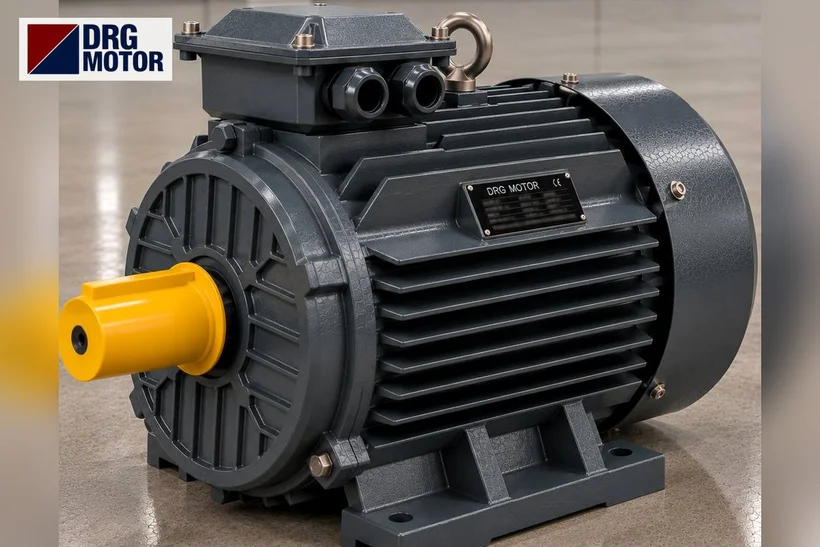
DRG Motor is a manufacturer, supplier and seller of electric motors. It is based in İzmir and ships quickly across all of Türkiye, that province included. Once you have your time breakdown, compare the right power and speed in the online electric motor shop and see the same range together in the three-phase asynchronous electric motors category.
Stopped, idling, under load: not the same thing
On site people often say "the motor starts in the morning and stops at night", and count every hour in between as running. But the day splits three ways. Under load: the motor does real work and its current rises with the load. Idling: the motor turns but the driven machine does nothing; an empty conveyor runs, a pump pushes against a closed valve, a fan runs with a shut damper. Stopped: the motor is de-energised and the shaft is still. Consumption differs clearly across these three states. Any estimate made without separating them into three buckets may look tidy on paper, yet never matches the real meter reading.
Why does idling enter the calculation?
An asynchronous motor turning with no load does not draw zero energy. Even unloaded, the windings are magnetised, bearing and fan friction take work, and heating continues. So "the machine is not producing" does not mean "no energy is spent". Long idle periods build up quietly inside the monthly total. If a machine stays energised through the shift but produces only half that in real work, the gap is usually the real subject of the savings discussion. Claiming "a new motor would cut this much" without measuring idle time often means expecting savings from the wrong place; the real gain comes from stopping needless idling.
How do you measure the times?
The practical way to separate the three is to track time, not just energy. An hour counter, a counter on the contactor coil, or a PLC log tells you how long the motor stays energised. To split load from idle, look at current: idle current is low and almost flat, and it rises when load comes on. A simple rule: hours below a chosen current threshold count as "idle", hours above it as "under load". Set the threshold from the motor nameplate and the on-site reading. Sampling a single day is misleading; a log covering a typical week shows the stop-and-wait pattern far more honestly.
Click to see current electric motor prices and order nowSEE PRICES →
How does it show up in the consumption figure?
The calculation follows a simple logic: a separate power and a separate number of hours for each state. Multiply the power drawn under load by the load hours; multiply the low idle power by the idle hours; take the stopped hours as zero. The sum of the three gives the monthly energy. Multiply everything by one average power and you make the idle and stopped hours look more or less costly than they are. For pumps and fans this split matters even more, because their behaviour at idle and part load is very different from full load. To keep the calculation fair, take the powers from measurement, not assumption.
Time split and consumption logic — summary table
| State | Shaft | Energy | Effect on figure |
|---|---|---|---|
| Under load | Turning, doing work | High, load-dependent | Main consumption item |
| Idling | Turning, no work | Low but not zero | Hidden build-up |
| Stopped | De-energised | None | Zero in the figure |
Example: reference values on DRG three-phase asynchronous motors
When you set up the time calculation, your reference is the motor nameplate: power, speed, frame and voltage. DRG's aluminium-frame three-phase asynchronous range covers common ratings at 1500 rpm. The nominal values below are the references against which you compare your measured load and idle powers:
| Model | Power (kW) | Speed (rpm) | Voltage |
|---|---|---|---|
| DRG-90L-4-AL | 1.5 | 1500 | 230/400 V |
| DRG-112M-4-AL | 4 | 1500 | 400/690 V |
| DRG-132S-4-AL | 5.5 | 1500 | 400/690 V |
| DRG-132M-4-AL | 7.5 | 1500 | 400/690 V |
| DRG-160M-4-AL | 11 | 1500 | 400/690 V |
The safest route when ordering is to match the existing nameplate to these values. Browse the models by power and speed in the electric motor shop.
Common mistakes and safety
Current measurement inside a panel may mean working near live parts. Let qualified electrical personnel do the job; de-energise wherever possible and confirm the absence of voltage. When setting a threshold to separate idle from stopped, do not impose an exact number; set it from the motor nameplate and the device documentation. Common mistakes: counting idle hours as running hours, generalising one day to the whole month, assuming idle power is zero, and keeping no time log at all.
Browse the models to pick the three-phase motor at the right power and speedSEE PRICES
Send a photo of your current motor nameplate and we will find the suitable DRG model together.Send on WhatsApp
Frequently asked questions
Does an idling motor really spend energy?
Yes. Even with no shaft load the windings are magnetised and bearing and fan friction take work. Idle power is low but not zero, and over time it enters the figure.
Should I include stopped time in the calculation?
If the motor is fully de-energised, those hours count as zero consumption. What matters is separating stopped from idle; in most losses the problem is not stopping but needlessly long idling.
How do I tell idle from under load?
By current. Idle current is low and steady and rises when load comes on. Below a chosen current threshold counts as idle, above it as under load; set the threshold from the on-site reading.
What happens if I use one average power?
You misrepresent the idle and stopped hours. Using a separate power and a separate number of hours for each state brings the monthly figure much closer to the real meter reading.
Electric Motors Related to This Topic — Models and Current Prices
Suitability is not decided by power alone: compare the speed, voltage, mounting, shaft and fixing dimensions of your machine with the product data; if unsure, send us the nameplate of your current motor.
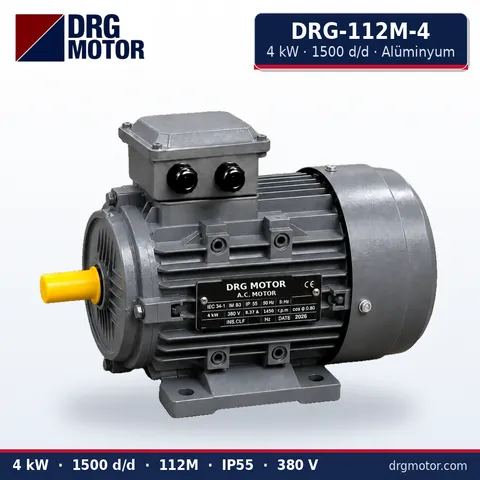
4 kW Three-Phase Motor 1500 rpm – DRG-112M-4 Aluminium
- 4 kW · 1500 rpm (4 poles)
- Aluminium frame · IEC 112M
- Shaft: 28 × 60 mm
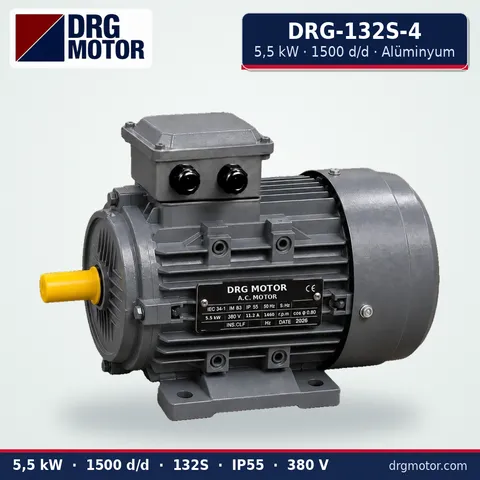
5.5 kW Three-Phase Motor 1500 rpm – DRG-132S-4 Aluminium
- 5.5 kW · 1500 rpm (4 poles)
- Aluminium frame · IEC 132S
- Shaft: 38 × 80 mm
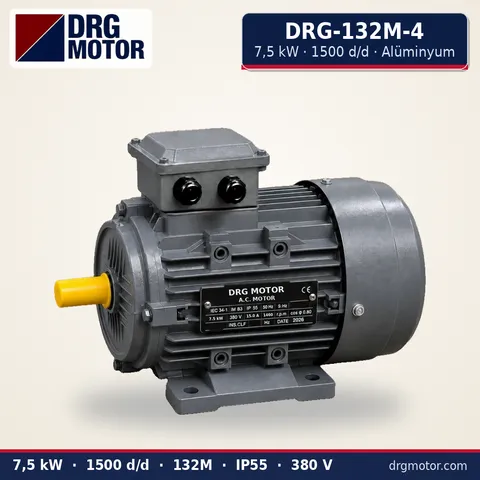
7.5 kW Three-Phase Motor 1500 rpm – DRG-132M-4 Aluminium
- 7.5 kW · 1500 rpm (4 poles)
- Aluminium frame · IEC 132M
- Shaft: 38 × 80 mm
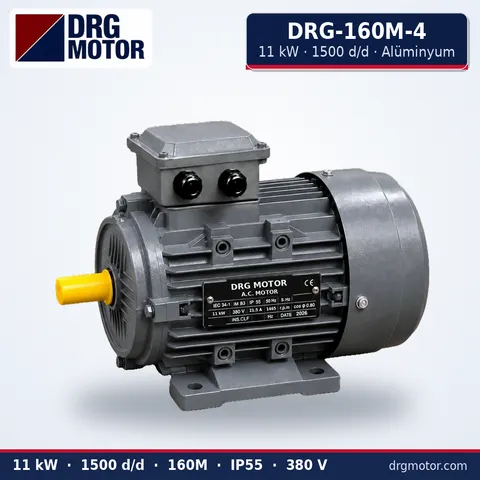
11 kW Three-Phase Motor 1500 rpm – DRG-160M-4 Aluminium
- 11 kW · 1500 rpm (4 poles)
- Aluminium frame · IEC 160M
- Shaft: 42 × 110 mm
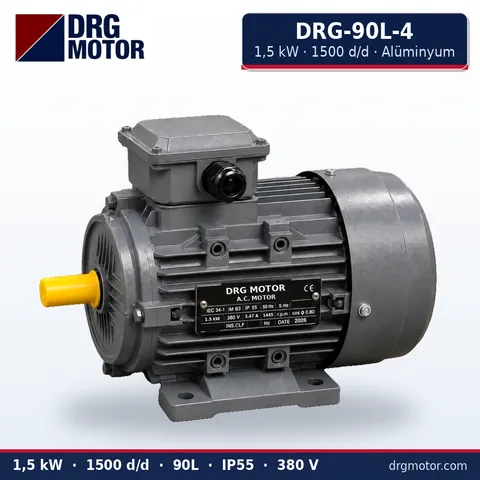
1.5 kW Three-Phase Motor 1500 rpm – DRG-90L-4 Aluminium
- 1.5 kW · 1500 rpm (4 poles)
- Aluminium frame · IEC 90L
- Shaft: 24 × 50 mm