 English
 Le français
 Türkçe




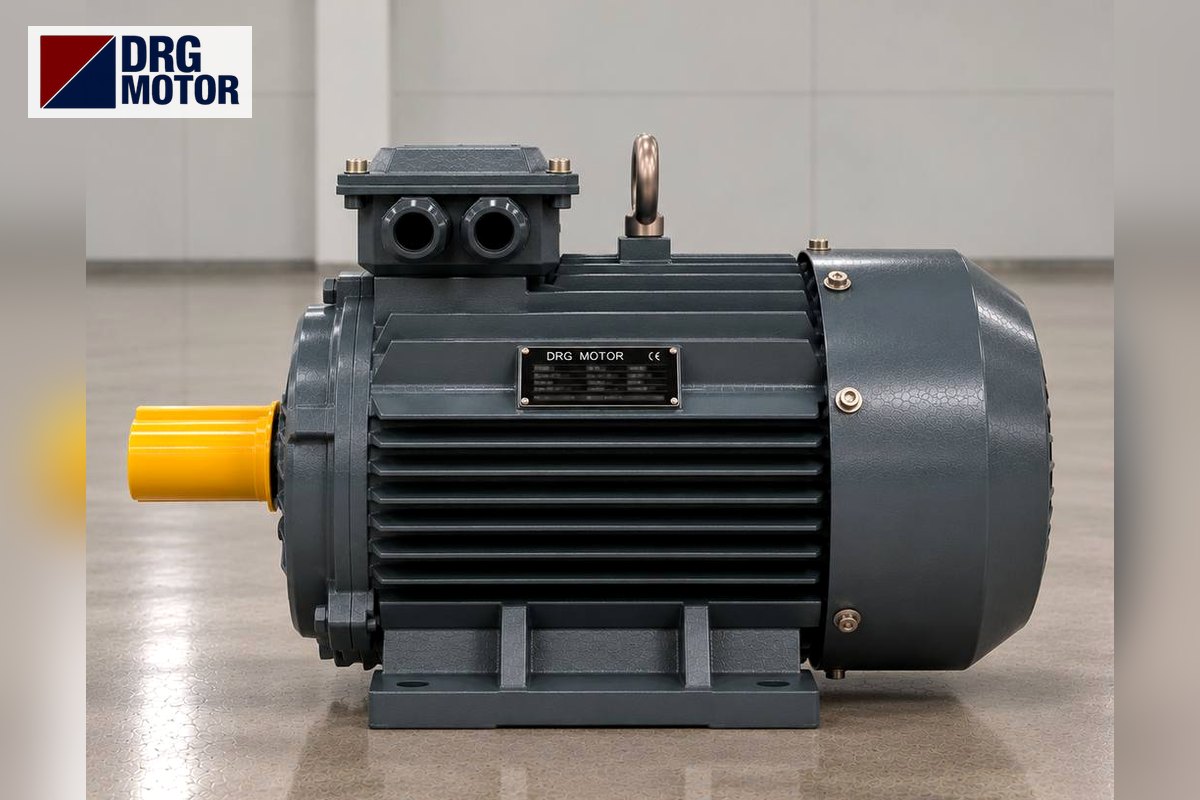

Short answer: even a small change in fan speed moves the drawn power by a much larger amount. In centrifugal and axial fans the shaft power rises with the cube of speed, so a five percent increase in speed pushes power up by roughly sixteen percent. That is why, when you set the speed of the electric motor driving a fan, even small speed differences clearly change the consumption over time.
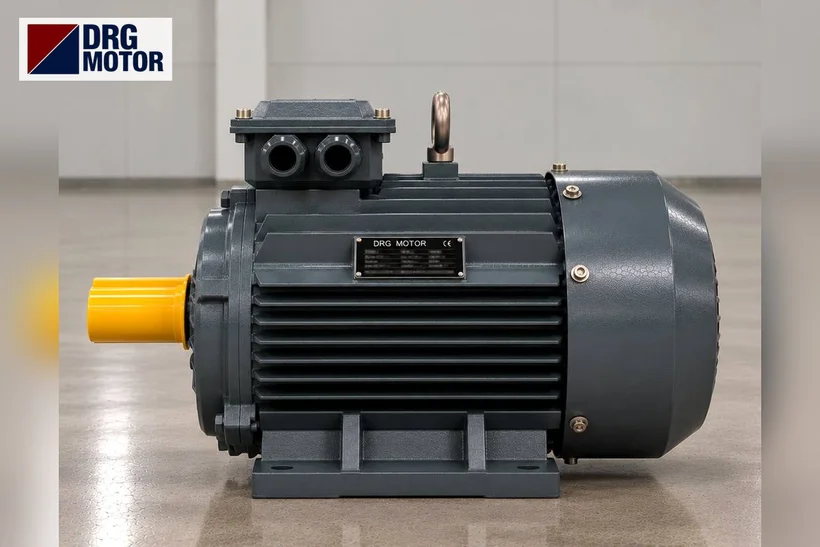
DRG Motor is a manufacturer, supplier and seller of electric motors. It is based in İzmir and ships quickly across all of Türkiye. You can review three-phase asynchronous models suited to fan drives by power and speed in the online electric motor shop, and see the same products together in the three-phase asynchronous electric motors category.
Fan laws: why does power grow with the cube of speed?
When you spin the same fan, with the same blade and duct layout, at different speeds, three things change together. Air flow rises in direct proportion to speed. The pressure the fan produces rises with the square of speed. Shaft power rises with the cube of speed. On the floor people keep it in mind as "flow one, pressure squared, power cubed". This relationship comes from the fan itself; the electric motor only has to meet that demand.
If we call the speed ratio r (new speed / old speed): flow scales as r, pressure as r², and shaft power as r³. The formula is simple but the result is striking; the table below shows how small speed differences grow into power differences.
How much does a small speed difference cost in consumption?
| Speed change | Air flow | Pressure | Shaft power |
|---|---|---|---|
| 5% lower (r=0.95) | ~0.95x | ~0.90x | ~0.86x |
| Reference (r=1.00) | 1.00x | 1.00x | 1.00x |
| 5% higher (r=1.05) | ~1.05x | ~1.10x | ~1.16x |
| 10% higher (r=1.10) | ~1.10x | ~1.21x | ~1.33x |
The table shows what matters: a five percent difference in speed turns into about a sixteen percent difference in shaft power. If the fan runs for most of the day, that power gap is written straight onto the electricity used. The reverse holds too: when you do not need extra air, trimming the speed a little saves on consumption at a cubic rate.
Click to see current electric motor prices and order nowSEE PRICES →
Where does the speed difference come from?
In practice, even two products you call "the same motor" can spin a fan at different speeds. The main reasons:
- Number of poles: at 50 Hz, 2 poles give ~3000, 4 poles ~1500, 6 poles ~1000 rpm synchronous speed. Choosing 2 poles instead of 4 spins the fan at nearly double the speed and sends the power demand soaring.
- Slip: an asynchronous motor runs slightly below synchronous speed under load. As load rises the speed drops a little; that is why the loaded speed on the plate reads, say, around 1450 rpm rather than 1500.
- Frequency: speed is proportional to frequency; a 60 Hz supply instead of 50 Hz, or a frequency changed by a drive, shifts fan speed and therefore power directly.
- Pulley/coupling ratio: with belt-and-pulley drive the ratio of pulley diameters sets the fan speed; even a few millimetres of diameter create a small speed difference.
DRG three-phase motors used on fan drives
Across the DRG range, 4-pole (1500 rpm) aluminium-frame three-phase asynchronous models are the most common choice for fan drives. Below are a few power steps as examples; you pick the one that matches the power and speed your fan needs.
| Model | Power (kW) | Speed (rpm) | Frame |
|---|---|---|---|
| DRG-90L-4 | 1.5 | 1500 | Aluminium |
| DRG-112M-4 | 4 | 1500 | Aluminium |
| DRG-132S-4 | 5.5 | 1500 | Aluminium |
| DRG-132M-4 | 7.5 | 1500 | Aluminium |
| DRG-160M-4 | 11 | 1500 | Aluminium |
You can find all of these, and other power steps, on the buy electric motors online page. Going one size up "to be safe" usually means needless power and needless consumption on a fan; it is better to pick the value that sits on the fan's curve.
What to check, in order, when choosing the motor
- Know the flow and pressure demand at the fan's operating point; the required shaft power follows from it.
- Decide the fan speed you want and pick the matching number of poles (on most fans 4 poles, 1500 rpm).
- In direct coupling the motor speed is the fan speed; with belt-and-pulley, work out the pulley ratio for the target speed. The pulley-belt calculator makes this easier.
- Confirm the supply voltage and connection (230/400 V or 400/690 V on the plate) against your panel; the electric motor calculator and the motor current table let you see the drawn current in advance.
Common mistakes
- Underrating the speed difference: "it spins a touch faster, so what" creates a far-from-small gap in consumption because of the cubic relationship.
- Wrong pole count: fitting a 3000 rpm motor to a fan that needs 1500 rpm means both noise and multiplied power.
- Needless oversizing: a motor with more power than the fan curve asks for brings idle load and extra current.
- Skipping the pulley/coupling ratio: a drive fitted without working out the mechanical ratio spins the fan at an unexpected speed.
If you are going to change anything on your setup, switch off the power, verify it is dead, and let qualified electrical personnel do the wiring. For exact speed, current and connection values, follow the motor's nameplate and the equipment documentation.
Send a photo of your current motor nameplate and we will find the suitable DRG model together.Send on WhatsApp
To pick the right three-phase electric motor for your fan by power and speedSEE PRICES
Frequently asked questions
Does lowering the fan speed really reduce consumption?
Yes. When extra air is not needed, dropping the speed a little cuts the power demand with the cube of speed; a small speed reduction turns into a proportionally much larger power saving. It works as long as you make sure the flow stays sufficient.
What happens if a 2-pole motor is fitted to a fan?
A 2-pole motor spins the fan at nearly double the speed. Flow doubles, pressure quadruples and power grows close to eightfold. Most ventilation fans neither need nor want that load, which is why fan drives usually use a 4-pole (1500 rpm) motor.
Why does the plate read around 1450 rather than 1500 rpm?
An asynchronous motor runs slightly below synchronous speed (1500 rpm) under load, by the amount of slip. The loaded speed therefore reads around 1450 rpm on the plate; it is more accurate to base the fan calculation on this real speed.
Does changing the frequency with a drive make sense?
On fans with a changing air demand, varying the frequency pulls the speed, and therefore the power, down by the cubic relationship; this is a general technical method. DRG supplies the three-phase asynchronous motor for this; evaluate the drive choice separately according to the system's needs.
Electric Motors Related to This Topic — Models and Current Prices
Suitability is not decided by power alone: compare the speed, voltage, mounting, shaft and fixing dimensions of your machine with the product data; if unsure, send us the nameplate of your current motor.

4 kW Three-Phase Motor 1500 rpm – DRG-112M-4 Aluminium
- 4 kW · 1500 rpm (4 poles)
- Aluminium frame · IEC 112M
- Shaft: 28 × 60 mm

5.5 kW Three-Phase Motor 1500 rpm – DRG-132S-4 Aluminium
- 5.5 kW · 1500 rpm (4 poles)
- Aluminium frame · IEC 132S
- Shaft: 38 × 80 mm

7.5 kW Three-Phase Motor 1500 rpm – DRG-132M-4 Aluminium
- 7.5 kW · 1500 rpm (4 poles)
- Aluminium frame · IEC 132M
- Shaft: 38 × 80 mm

11 kW Three-Phase Motor 1500 rpm – DRG-160M-4 Aluminium
- 11 kW · 1500 rpm (4 poles)
- Aluminium frame · IEC 160M
- Shaft: 42 × 110 mm

1.5 kW Three-Phase Motor 1500 rpm – DRG-90L-4 Aluminium
- 1.5 kW · 1500 rpm (4 poles)
- Aluminium frame · IEC 90L
- Shaft: 24 × 50 mm





