English
 Le français
 Türkçe




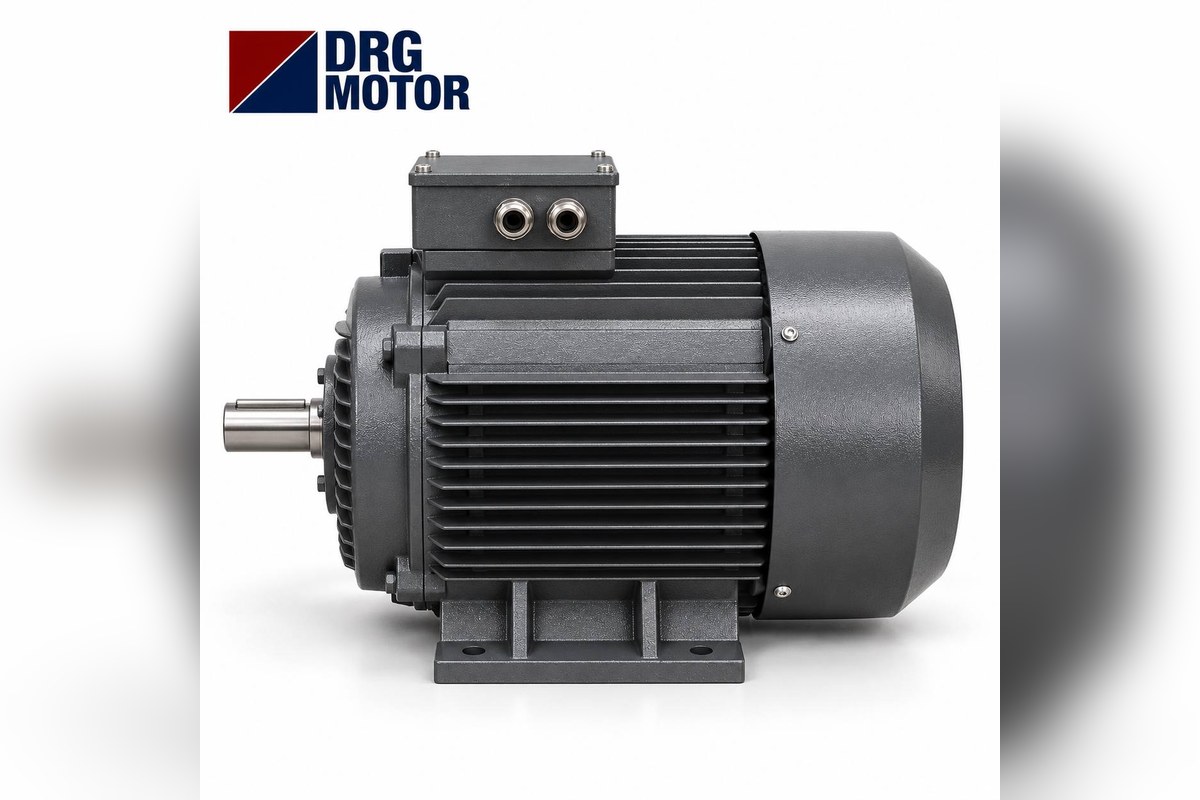

A lobe pump is usually driven by a 4-pole motor plus a gearbox that brings the speed down to a few hundred rpm or less, with an inverter for flow adjustment; motor power is calculated not from the pump’s flow but from the pump shaft torque, either given by the pump maker or found from displacement and pressure. For example, a lobe pump with 1 litre/rev displacement at 5 bar differential pressure needs about 93.6 Nm; with a gearbox of ratio i = 10 the pump turns at 145 rpm and the motor side needs 10.4 Nm and 1.58 kW — the 2.2 kW DRG-100L1-4 (rated torque 14.5 Nm) is a suitable match.
The real strength of a lobe pump is product care: the lobes turn without touching and move shear-sensitive products such as yoghurt, cream, fruit pieces and cheese curd with little damage. The condition is low speed; at high speed the pump "whips" the product. That is why motor and gearbox are chosen together. Inverter and panel connections must be made by a qualified electrician. You can see suitable motors and current prices among the 120 models on the Buy Electric Motors Online page.
The 3 most common mistakes in lobe pump drives
- Reading power straight from flow: a lobe pump is a constant-torque load; required torque is set by differential pressure and product consistency. Choosing a small motor from the flow figure stalls it when a thick product starts.
- Lowering speed with the inverter alone: taking a 4-pole motor down to a tenth of its speed with an inverter almost stops the motor’s own fan and strains its torque capacity. Most of the reduction should come from the gearbox, the fine adjustment from the inverter.
- Forgetting CIP speed: during CIP the pump moves a thin solution at higher speed. Choose the gear ratio so that, at the highest inverter frequency, the pump’s upper speed limit is not exceeded.
Which product needs which speed?
On a lobe pump, speed directly affects product quality. The pump catalogue gives the permitted speed range for each product group; the general trend:
| Product type | Lobe pump concern | Drive tendency |
|---|---|---|
| Yoghurt, cream, ayran | Loss of body through shear | Low speed, inverter |
| Fruit pieces, jam | Crushing of pieces | Very low speed, gearbox |
| Cheese curd | Breaking up the curd | Low speed, soft start |
| CIP solution | Thin fluid, high flow | Speed up to pump limit |
This table is a guide. For highly shear-sensitive products, turning a larger pump slowly gives better results than turning a small pump fast; on the motor side this means more torque and a higher gear ratio.
Torque-based calculation: motor and gearbox together
On a lobe pump the calculation starts from torque. If the pump maker gives shaft torque for the differential pressure, use it; otherwise an approximate value is found from displacement and pressure:
Tp (Nm) = V (cm³/rev) × Δp (bar) / (20π × η), then Tm = Tp / (i × ηr) and P = Tm × nm / 9550
Here η is the mechanical pump efficiency (assumed 0.85 in the example), ηr the gearbox transmission factor (assumed 0.9) and i the gear ratio. Example: V = 1000 cm³/rev, Δp = 5 bar, motor DRG-100L1-4 (1450 rpm):
| Step | Operation | Result |
|---|---|---|
| 1 · Pump torque | V × Δp / (20π × η) | 93.6 Nm |
| 2 · Gear ratio | nm / np | i = 10 |
| 3 · Pump speed / flow | 1450 / 10 | 145 rpm / 145 l/min |
| 4 · Motor torque | Tp / (i × 0.9) | 10.4 Nm |
| 5 · Motor power | T × n / 9550 | 1.58 kW |
| 6 · Torque margin | Tn / Tm | 14.5 / 10.4 = 1.39 |
Flow at this operating point is about 8.7 m³/h. The torque margin is 1.39, which keeps the motor comfortable when starting with cold, thick product and as consistency varies. The motor’s starting torque is also 2.3 times rated. You can check gearbox output speed and torque with your own ratio in the gearbox output speed and torque calculator.
Click to see current electric motor prices and order nowSEE PRICES →
Flow control by inverter: what does the motor face at constant torque?
On a lobe pump flow is proportional to speed, so an inverter is the most practical flow control. But the load is constant-torque: when you halve the frequency (25 Hz), the pump drops to 72.5 rpm and flow to about half, yet the motor must still deliver 10.4 Nm. Power falls to 0.79 kW. The problem is heat: the fan on the motor’s own shaft slows too, and the current for the same torque has to be carried with reduced cooling.
- Take most of the reduction through the gearbox; keep the inverter operating range narrow (for example 25–50 Hz).
- If the motor will run at very low frequency for long periods, consider a separately powered (forced) fan or a larger frame.
- If you go above 50 Hz for CIP, check the upper speed limits of pump and gearbox.
- In the inverter parameters, enter the motor nameplate current and select constant-torque mode (linear V/f or vector); check torque demand with the VFD frequency-torque-power calculator.
Gearbox and motor connection: flange, shaft and mounting
The most common lobe pump drive layout is a foot- or flange-mounted gearbox, a motor attached to the gearbox input with an IEC B5 flange, and a flexible coupling from the gearbox output to the pump shaft. The gearbox input flange and the motor’s B5 flange must match. For example, for frame 100L the DRG catalogue B5 values are P / M / N = 250 / 215 / 180 mm and shaft 28 × 60 mm; 100L and 112M share these dimensions, so moving from 2.2 kW to 4 kW can use the same gearbox input flange (the gearbox’s own torque capacity is checked separately). See the technical drawings page for all dimensions.
In a food plant the motor and gearbox sit in the wash-down area together with the pump. An IP55 motor is protected against splashing water; point the cable gland downwards and do not wash the motor directly with a pressure jet. Motor selection logic for centrifugal food pumps is completely different (there power changes with the cube of speed); for that subject see our article on motor selection for centrifugal pumps.
Pre-order checklist
- Pump displacement (cm³/rev or l/rev) and the permitted speed range in its catalogue.
- Product: consistency, whether it contains pieces, starting temperature.
- Differential pressure (suction + discharge line, including filter and heat exchanger).
- Shaft torque given by the pump maker (if available, use it instead of the formula).
- Gearbox: ratio, input flange (IEC frame), output torque capacity.
- Inverter: frequency range, highest frequency used during CIP.
- Direction of rotation: lobe pumps are mostly bidirectional; direction decides which port is suction and which discharge.
- Overload/protection setting to the motor nameplate current (overload and fuse selection tool).
Which DRG motor should you buy?
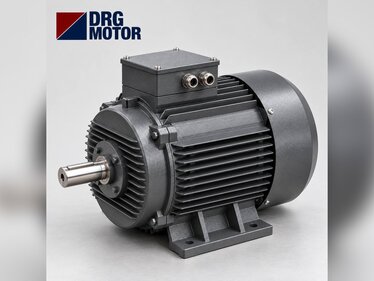
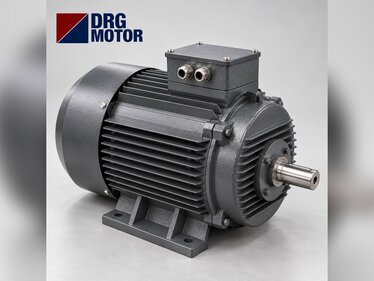
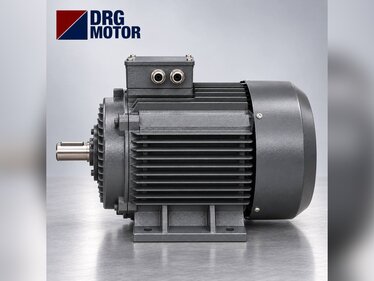
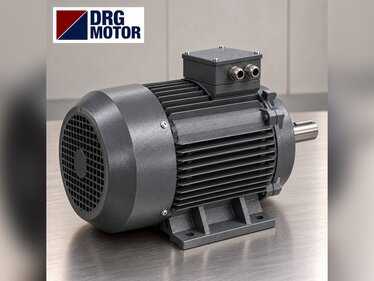
The motors most used with a gearbox on lobe pump drives are 4-pole units of 1.1–5.5 kW. The models below have aluminium housings (cast iron versions of the same powers are also in the store). Choose by the motor torque from the calculation above, not by kW.
| Model | Power / speed | Frame | Current 400 V |
|---|---|---|---|
| DRG-90S-4 | 1.1 kW / 1445 rpm | 90S · aluminium | 2.48 A |
| DRG-90L-4 | 1.5 kW / 1445 rpm | 90L · aluminium | 3.3 A |
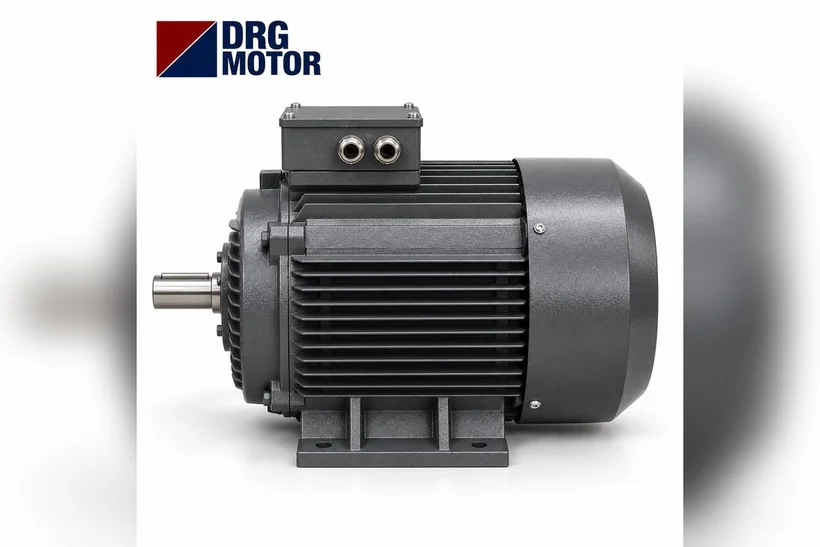
| DRG-100L1-4 | 2.2 kW / 1450 rpm | 100L · aluminium | 4.52 A |
| DRG-100L2-4 | 3 kW / 1450 rpm | 100L · aluminium | 6.02 A |
| DRG-112M-4 | 4 kW / 1450 rpm | 112M · aluminium | 7.95 A |
| DRG-132S-4 | 5.5 kW / 1460 rpm | 132S · aluminium | 10.7 A |
Technical summary of the model matching the example calculation:
- Power: 2.2 kW
- Rated speed: 1450 rpm
- Frame: 100L · aluminium
- Current 400 V: 4.52 A
- cos φ: 0.81
- Rated torque: 14.5 Nm
- Starting torque: 2.3 × Tn
- Starting current: 7.6 × In
- Shaft D × E: 28 × 60 mm
- B5 flange P / M / N: 250 / 215 / 180 mm
- Bearing (drive end): 6206-ZZ-C3
- Voltage: 230/400 V (Δ/Y)
DRG Motor is an electric motor manufacturer, supplier and seller; DRG MOTOR motors are guaranteed against material and manufacturing defects for 2 years from the delivery date (warranty certificate).
Motors in this power range
- DRG-90S-4 – 1.1 kW – 1445 rpm – 90S aluminium
- DRG-90L-4 – 1.5 kW – 1445 rpm – 90L aluminium
- DRG-100L1-4 – 2.2 kW – 1450 rpm – 100L aluminium
- DRG-100L2-4 – 3 kW – 1450 rpm – 100L aluminium
- DRG-112M-4 – 4 kW – 1450 rpm – 112M aluminium
- DRG-132S-4 – 5.5 kW – 1460 rpm – 132S aluminium
Click to see current prices and order these motors nowSEE PRICES →
Frequently Asked Questions
What speed does a lobe pump run at?
Lobe pumps generally run at a few hundred rpm or less; for shear-sensitive products the speed is lower still. The exact range is in the pump catalogue. This speed is obtained with a 4-pole motor plus gearbox, with fine adjustment by inverter.
How is lobe pump motor power calculated?
First find the pump shaft torque: T = V × Δp / (20π × η). Then the motor torque via the gear ratio, and power with P = T × n / 9550. In the 1 l/rev, 5 bar example with i = 10, about 1.58 kW is needed at the motor.
Can an inverter alone replace the gearbox on a lobe pump?
Not recommended. Taking the motor to a very low frequency slows the fan and heats the motor under a constant-torque load. Most of the speed reduction should come from the gearbox, with the inverter used over a narrow range for flow adjustment.
How many amps does a 2.2 kW lobe pump motor draw?
The 4-pole DRG-100L1-4 draws 4.52 A at 400 V and 4.76 A at 380 V; its rated torque is 14.5 Nm.
Send us your pump displacement, product, differential pressure and gear ratio, and we will confirm the right DRG motor with you. Phone +90 (542) 666 11 11, e-mail [email protected], contact page. For all models and current prices, see Buy Electric Motors Online.