English
 Le français
 Türkçe




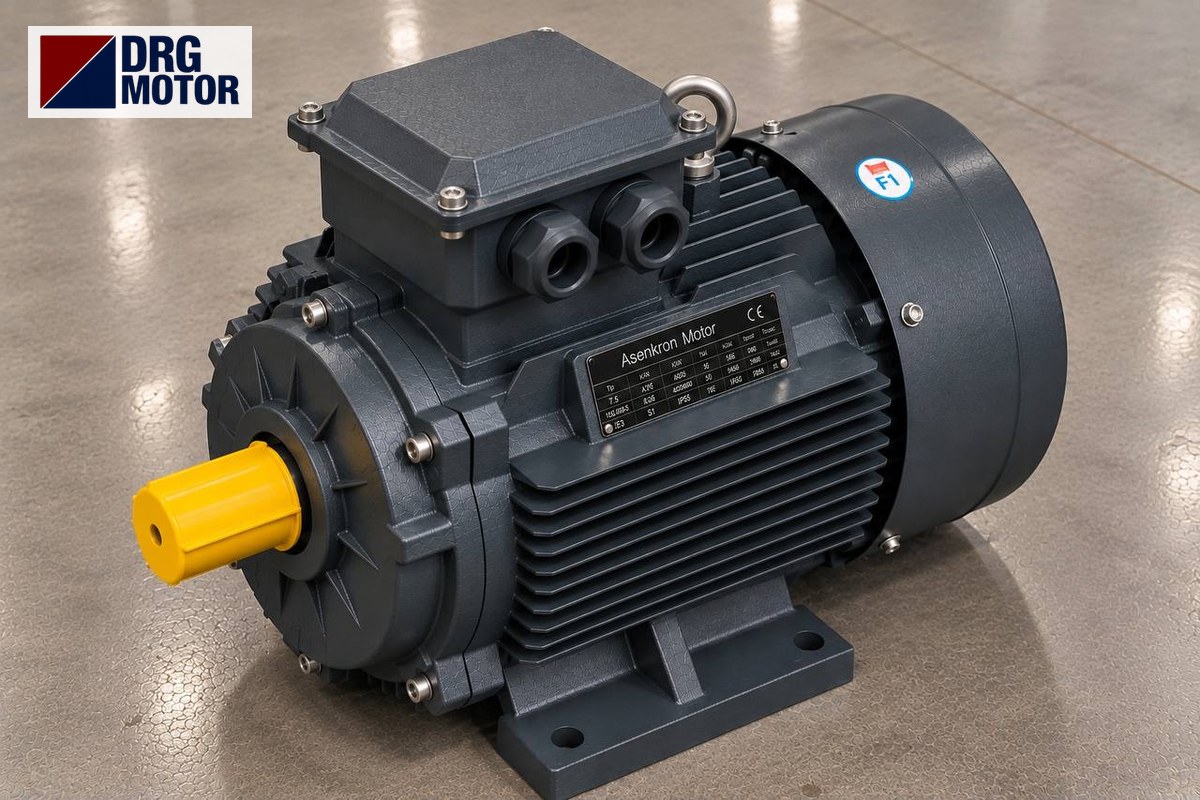

When choosing a boiler fan motor, first define the fan's job: the FD fan (forced draft) blows cold, clean combustion air into the burner or grate, and the ID fan (induced draft) draws hot flue gas out of the boiler and sends it up the stack. Motor power is calculated with P = Q · Δp / ηfan; for the ID fan, however, the real criterion is not operation in hot gas but the load at cold start. For example, an ID fan that needs 23.8 kW in hot gas requires about 36.8 kW if it starts with the damper open while the boiler is cold; so a 30 kW DRG-200L-4 (1475 rpm, 53.8 A at 400 V) is sufficient only if the damper is throttled at cold start or the fan is driven by a VFD.
In this article you will find the difference between FD and ID fans, a power calculation with stated assumptions, how to position the motor against hot gas and how to control flow by damper or VFD. The exact kW per fan comes from the fan manufacturer's characteristic curve and nameplate; the figures here are worked examples. You can see suitable 2- and 4-pole models among the 120 on our Buy Electric Motors Online page. The connection and protection settings of a motor tied into boiler controls must be done by a qualified electrician.
How does the difference between FD and ID fans change motor selection?
Although both fans work on the same boiler, the medium they handle, its temperature and their starting behaviour differ. Motor selection is directly affected by these differences:
| Feature | FD fan (forced draft) | ID fan (induced draft) | Effect on motor |
|---|---|---|---|
| Medium handled | Clean, cold combustion air | Hot, dusty flue gas | ID: motor kept off the gas |
| Location | Before burner / grate | Between boiler and stack | ID: heat and soot |
| Volume flow | Lower | Higher (gas expands) | ID usually more powerful |
| Cold start | Load unchanged | Cold air is heavy: load rises | ID: overload risk |
| Flow control | Damper or VFD | Damper or VFD | With VFD power ~ n³ |
In balanced-draft boilers both fans run together: the FD fan pushes air in, and the ID fan extracts enough gas to keep the furnace at a slight vacuum. That is why on the same boiler the ID fan usually needs a larger flow and a larger motor; the gas occupies more volume than the air because of combustion products and heating.
Boiler fan motor power calculation: flow, pressure and fan efficiency
Fan shaft power is P = Q · Δp / ηfan (Q: m³/s, Δp: Pa, result in W). ηfan is read from the fan manufacturer's curve; 0.70 is assumed in the examples below.
Example 1: FD fan
- Assumption: 12,000 m³/h combustion air, 2500 Pa total pressure, fan efficiency 0.70.
- Q = 12,000 / 3600 ≈ 3.33 m³/s → P = 3.33 × 2500 / 0.70 ≈ 11.9 kW.
- 15% for belt losses and burner adjustment margin: 11.9 × 1.15 ≈ 13.7 kW → 15 kW.
- If the impeller is direct-coupled, choose by impeller speed: the DRG-160M2-2 (15 kW, 2945 rpm) or the DRG-160L-4 (15 kW, 1465 rpm).
Example 2: ID fan and cold start
- Assumption: 20,000 m³/h flue gas, 180 °C, 3000 Pa in hot gas, fan efficiency 0.70.
- Q ≈ 5.56 m³/s → Phot = 5.56 × 3000 / 0.70 ≈ 23.8 kW.
- At the same speed the fan moves the same volume, but cold air is denser. Density is inversely proportional to absolute temperature: (273 + 180) / (273 + 20) ≈ 1.55.
- At cold start with the damper open: Pcold ≈ 23.8 × 1.55 ≈ 36.8 kW.
A 30 kW motor (DRG-200L-4) chosen for hot operation runs about 23% overloaded if it starts cold with the damper open, and the overload trips or the winding overheats. There are three solutions: throttle the ID fan damper at cold start and open it as the boiler warms up; drive the fan with a VFD and reduce speed while cold; or size the motor for the cold-air load (37 kW in this example, the DRG-225S-4). You can run the calculation with your own values in our pump and fan motor power calculator.
Hot gas and the motor: why the ID fan motor stays outside
The ID fan impeller sits in the hot gas; the motor must not. The motor should stand within the ambient temperature limit stated on its product page, away from the gas and from the boiler's radiant heat. In practice:
- Pedestal shaft + coupling or belt: the impeller is mounted on a separate shaft with its own bearing pedestal; the motor is connected to this shaft by a flexible coupling or belts. If the impeller is fitted directly on the motor shaft, gas heat travels along the shaft to the motor bearing.
- Cooling disc: a cooling disc on the fan shaft dissipates heat coming from the casing before it reaches the bearing and coupling.
- Heat shield and airflow: the motor's own fan must be able to draw cool air; do not place the motor in a closed corner facing the hot boiler wall.
- Insulation: the models in our store have class F insulation; this is a thermal margin for the winding, not permission to place the motor next to hot gas.
- Soot and dust: soot around the ID fan clogs the cooling fins; the IP55 frame keeps dust out, but the outer surface must be kept clean.
Damper or VFD: flow control with the fan laws
As boiler load changes, the combustion air and flue gas flows change too. A damper keeps the fan at full speed and reduces flow by throttling; a VFD lowers fan speed. According to the fan laws, flow varies with speed, pressure with the square of speed and power with the cube of speed (P ~ n³). See our article on affinity laws in pump and fan systems for a detailed explanation. For the 23.8 kW ID fan of Example 2 with a 4-pole motor:
| Frequency | Motor speed | Flow ratio | Fan power (example) |
|---|---|---|---|
| 50 Hz | ≈ 1475 rpm | 100% | ≈ 23.8 kW |
| 45 Hz | ≈ 1328 rpm | 90% | ≈ 17.4 kW |
| 40 Hz | ≈ 1180 rpm | 80% | ≈ 12.2 kW |
| 35 Hz | ≈ 1032 rpm | 70% | ≈ 8.2 kW |
At 80% flow the power theoretically drops to 23.8 × 0.8³ ≈ 12.2 kW; with damper throttling the power does not fall nearly as much because the fan keeps running at full speed. The table values follow the ideal fan law; system resistance and the fan curve change the real value. A VFD also solves the cold-start problem: you can start at low frequency and raise the speed as the boiler warms. See the frequency–torque–power relationship in our VFD frequency, torque and power calculator.
DRG motor options for boiler fans
If the impeller is direct-coupled, the number of poles is set by impeller speed; with belts, either 2 or 4 poles can be chosen via the pulley ratio. The values in the table are DRG catalogue data:
| Model | Power / speed | Frame | Current 400 V |
|---|---|---|---|
| DRG-160M1-2 | 11 kW · 2945 rpm | Cast iron 160M | 19.6 A |
| DRG-160M2-2 | 15 kW · 2945 rpm | Cast iron 160M | 26.5 A |
| DRG-180M-2 | 22 kW · 2955 rpm | Cast iron 180M | 38.5 A |
| DRG-160L-4 | 15 kW · 1465 rpm | Cast iron 160L | 27.3 A |
| DRG-180L-4 | 22 kW · 1470 rpm | Cast iron 180L | 39.7 A |
| DRG-200L-4 | 30 kW · 1475 rpm | Cast iron 200L | 53.8 A |
| DRG-225S-4 | 37 kW · 1485 rpm | Cast iron 225S | 66.1 A |
Example: technical summary of a 30 kW ID fan motor
- Power: 30 kW (40 HP)
- Synchronous / rated speed: 1500 / 1475 rpm
- Current 380 V / 400 V: 56.6 A / 53.8 A
- cos φ: 0.86
- Rated torque: 194.2 Nm
- Ts/Tn · Tmax/Tn: 2 · 2.3
- Is/In: 7.3
- Shaft D × E: 55 × 110 mm
- Frame: Cast iron IEC 200L
- Voltage: 400/690 V (Δ/Y)
- Cable entry: 2 × M50×1.5
- Bearing: 6312-C3
On a 380 V supply this motor is connected in delta (Δ); with direct-on-line starting the starting current is 7.3 times rated. For overload relay setting and contactor selection use our overload relay, fuse and contactor selection tool.
Boiler fan motor installation and commissioning checklist
- Note flow, pressure, impeller speed and gas temperature from the fan nameplate; check motor power separately for hot and cold conditions.
- On the ID fan, confirm the motor is away from hot gas and the boiler wall, in a place where it can draw cool air.
- For coupled drives check angular and axial alignment with a dial gauge; for belt drives check pulley alignment with a straightedge.
- Compare the direction of rotation with the arrow on the scroll casing; a radial fan running backwards loses much of its flow but keeps drawing current.
- Check that the damper is closed or throttled at cold start and that the controls ensure this.
- With a VFD, monitor that the motor's own fan provides enough cooling at minimum frequency.
- At first commissioning record motor current separately in cold and hot operation.
- Soot build-up on the impeller causes imbalance and vibration; during periodic cleaning listen to the motor bearings as well.
Motors in this power range
The 2- and 4-pole cast iron models most often asked about for boiler FD and ID fans:
- DRG-160M1-2 – 11 kW – 2945 rpm – Cast iron 160M
- DRG-160M2-2 – 15 kW – 2945 rpm – Cast iron 160M
- DRG-180M-2 – 22 kW – 2955 rpm – Cast iron 180M
- DRG-160L-4 – 15 kW – 1465 rpm – Cast iron 160L
- DRG-180L-4 – 22 kW – 1470 rpm – Cast iron 180L
- DRG-200L-4 – 30 kW – 1475 rpm – Cast iron 200L
Click to see current prices and order these motors nowSEE PRICES →
Frequently Asked Questions
What kW should a boiler fan motor be?
It is calculated with P = Q × Δp / ηfan and rounded up to the next standard rating. For example, 12,000 m³/h, 2500 Pa and an assumed ηfan = 0.70 give about 11.9 kW; with margin a 15 kW motor is chosen. For an ID fan the cold-start load must also be checked.
Why does the induced draft fan motor trip when cold?
Cold air is denser than hot flue gas; because the fan moves the same volume at the same speed, it needs more power. An ID fan sized for 180 °C can draw about 1.55 times the power in 20 °C air. The fix is to throttle the damper at cold start, use a VFD or size the motor for the cold load.
Should a boiler fan use a 2-pole or a 4-pole motor?
On a direct-coupled fan the impeller speed decides: 2 poles if the impeller runs at 2-pole motor speed (e.g. DRG-160M2-2: 2945 rpm), 4 poles if it runs at 4-pole speed (DRG-160L-4: 1465 rpm). With belts either can be used via the pulley ratio; for dusty ID fans a lower-speed solution is often preferred to reduce impeller wear.
How many amps does a 30 kW fan motor draw?
The DRG-200L-4 (30 kW, 1475 rpm) draws 56.6 A at 380 V and 53.8 A at 400 V at full load. With the damper throttled or at reduced speed on a VFD the current stays below this; at cold start with the damper open it can exceed rated.
Send us your machine's nameplate or dimensions and we will match the right DRG model with you: +90 (542) 666 11 11 · [email protected] · Contact page. All models: Buy Electric Motors Online.