English
 Le français
 Türkçe




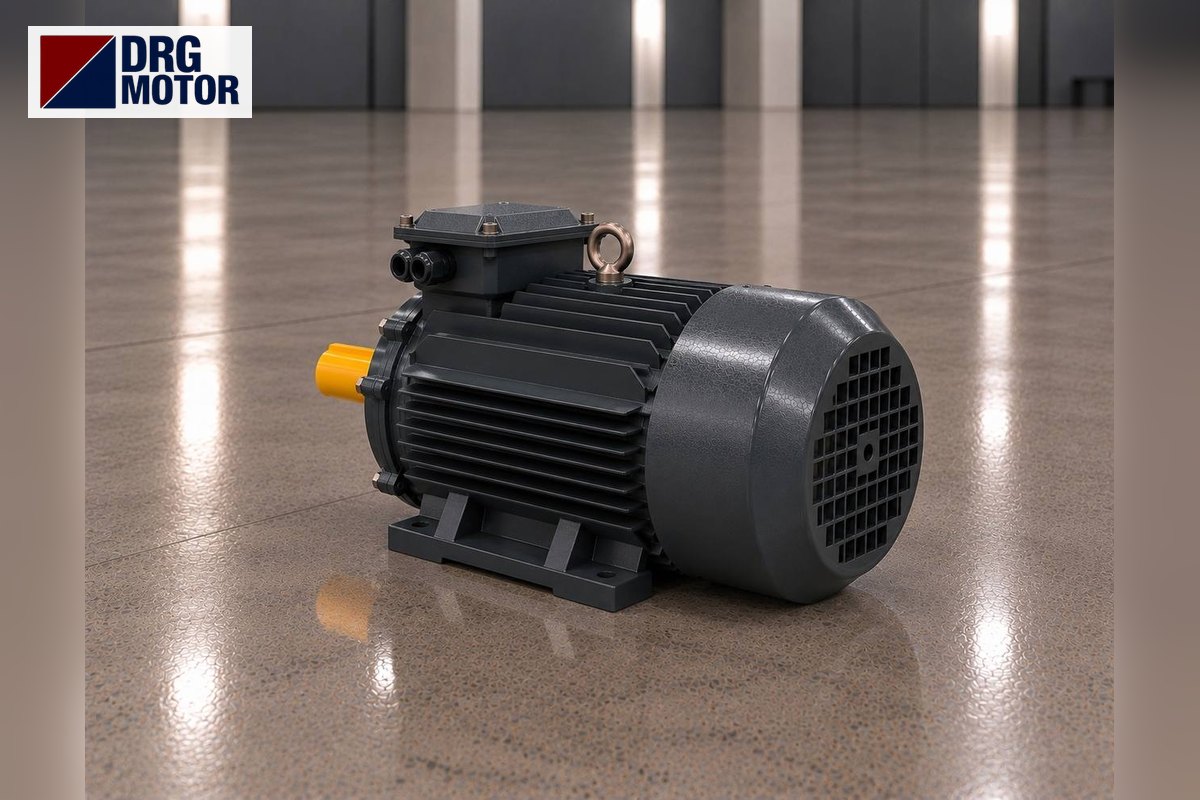

A pulper motor turns the rotor in the bottom or side wall of the pulper and breaks baled pulp or waste paper down into fibres in water. It is one of the heaviest drives in the stock preparation area of a paper mill: a large rotor has to start inside a tank full of tonnes of water and fibre. Two things decide the motor: torque when starting with a full tank, and the continuous power that changes with stock consistency.
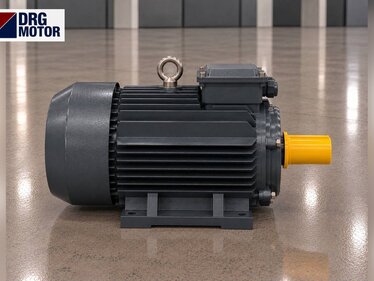
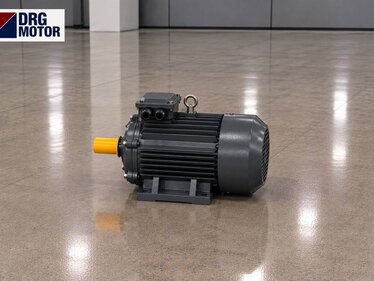
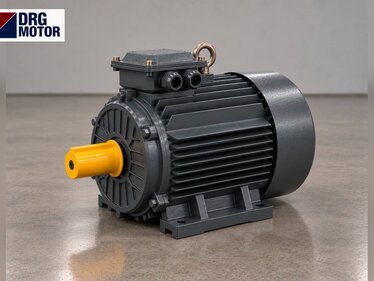
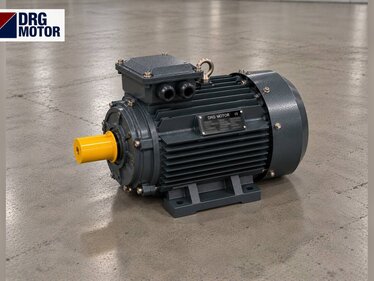
DRG Motor is a manufacturer, supplier and seller of electric motors. It supplies not the pulper tub, rotor, screen plate or gearbox, but the three-phase IEC asynchronous motor that drives the rotor through belts or a bevel gearbox; the range goes up to 355 kW. Large cast iron motors are listed on the buy electric motors online page.
How Does Pulping Work, and Where Does the Load Come From?
Water is fed into the tub first, the rotor starts, then bales or a paper charge are added. The rotor vanes set the suspension into a circular and vertical flow; fibres separate both by striking the vanes and by rubbing against each other. Pulped stock passes through the perforated plate under the rotor and is drawn off, while coarse contaminants such as wire, plastic and tape stay in the tub and are removed by a ragger or junk trap.
The load the motor sees depends largely on stock consistency. As consistency rises the suspension thickens, and the mass moved by the rotor on each revolution and the friction both grow. The first minutes after a bale drops into the tub are also hard: the undispersed block comes in front of the rotor and current peaks briefly.
Low- and High-Consistency Pulpers: What Sets the Motor Apart?
From the motor's point of view, pulper types differ clearly. The table summarises the general trends; tub volume, rotor diameter and motor power are in the machine builder's catalogue.
| Pulper type | Typical consistency | Rotor and drive | Motor-side focus |
|---|---|---|---|
| Low consistency, continuous | About 4–6 per cent | Flat rotor, belt or gearbox | Long-cycle running, heating |
| High consistency, batch | About 12–18 per cent | Helical rotor, bevel gearbox | High starting and batch torque |
| Side-rotor (D-type) | Low to medium | Horizontal shaft, belt and pulley | Belt tension, bearing load |
| Secondary (reject) pulper | Low | Small rotor, belt | Shock load, wire and plastic |
The power range is wide too: a small laboratory or reject pulper may stay at a few tens of kW, while large line pulpers reach hundreds of kW. The figures in this article are examples only; the exact value is the one on your machine's nameplate.
Click to see current electric motor prices and order nowSEE PRICES →
Starting with a Full Tub: Why Star-Delta Is Often Not Enough
After a power cut or emergency stop the tub stays full. Still stock begins to settle and pack around the rotor. On restart the motor must set this mass in motion. The calculation below is an example; a 75 kW pulper motor is assumed.
- Model: DRG-280S-4, 75 kW, 1486 rpm
- Rated torque: 482.0 Nm; Ts/Tn 2.0 → about 964 Nm on direct-on-line start
- In star connection: torque drops to one third, about 321 Nm, i.e. 0.67 times rated
- Current: 129 A at 400 V, Is/In 6.9 → about 890 A on direct-on-line start
Since star torque stays below rated torque, the motor may fail to accelerate in star with a full tub, and the changeover to delta then causes a current and torque surge. Star-delta is therefore safe only when starting with an empty or water-only tub. Where starting with a full tub is required, a soft starter or inverter is preferred; this is the machine builder's decision, and DRG does not sell drives. The 890 A starting current also matters for cables and the transformer; check the supply cable with the motor cable size calculator.
Operating habits that ease starting
- Adding water to lower consistency before restarting after a power cut
- Running the rotor on water alone for a while to empty the batch before stopping
- Clearing rope and wire wound round the rotor during maintenance stops
Belt or Bevel Gearbox? How the Motor Is Connected
On bottom-rotor (vertical shaft) high-consistency pulpers, the motor usually sits horizontally and drives the rotor through a bevel helical gearbox. The motor connects to the gearbox input with a B5 flange, or foot-mounted through a coupling. For motors connecting to such gearboxes, see electric motors for bevel helical gearboxes. On side-rotor types the motor is foot-mounted on a baseplate and connected to the rotor by V-belts; here the motor bearing also carries the belt pull.
When changing a belt-driven motor, pulley position on the shaft matters: the further the pulley slides towards the shaft end, the higher the bending moment on the drive-end bearing. Seat the pulley close to the shaft shoulder and keep belt tension at the builder's value. On large cast iron motors the shaft diameter grows too; for example the shaft is 75 × 140 mm on DRG-280S-4 and 85 × 170 mm on DRG-315S-4. If the old pulley or coupling hub does not fit the new shaft, it must be re-machined.
The Motor's Surroundings in the Wet Stock Area
The pulper area is full of water splash, steam (on lines using hot water) and fibre dust. DRG motors are IP55, which protects against water jets, but does not make it right to place the motor under stock splash. A layer of fibre on the fan cowl blocks cooling air and heats the winding of a motor running in long cycles. Include cleaning of the fan cowl and fins in the maintenance plan.
Condensation is also an issue on large motors. In winter or after long stops, moisture can collect in a cold motor frame; a sound terminal box gasket and cable glands and plugged unused entries matter for this reason. If the motor will be used in an area outside −15…+40 °C ambient, state this on the order.
Energy and Power Monitoring: What Does Current Tell You?
Pulper motor current is a simple indicator of how pulping is going. In a batch pulper, current starts high at the beginning of a batch, falls as fibres separate and then settles. If current stays high longer than expected, consistency is too high, water temperature is low or the screen plate is blinded. A sudden rise and fluctuation of current shows that a large foreign object or a wound rope has reached the rotor.
Example energy calculation: a motor rated 75 kW drawing an average of 60 kW uses about 20 kWh in a 20-minute batch. Changing consistency or speed to shorten the batch depends on the tub design; a larger motor does not by itself shorten the batch.
Note these before replacing a pulper motor:
- Nameplate: power, speed, voltage, current, connection (delta at 400 V?)
- Drive: belt and pulley or bevel gearbox; gear ratio
- Mounting: B3 foot, B5 flange or B35; shaft height and foot holes
- Shaft diameter and length, key; pulley or coupling hub size
- Starting: direct, star-delta, soft starter or inverter
- Pulper type, tub volume and stock consistency
- How the failure happened: at start, after long running, after a foreign object
DRG Motors for Pulper Drives
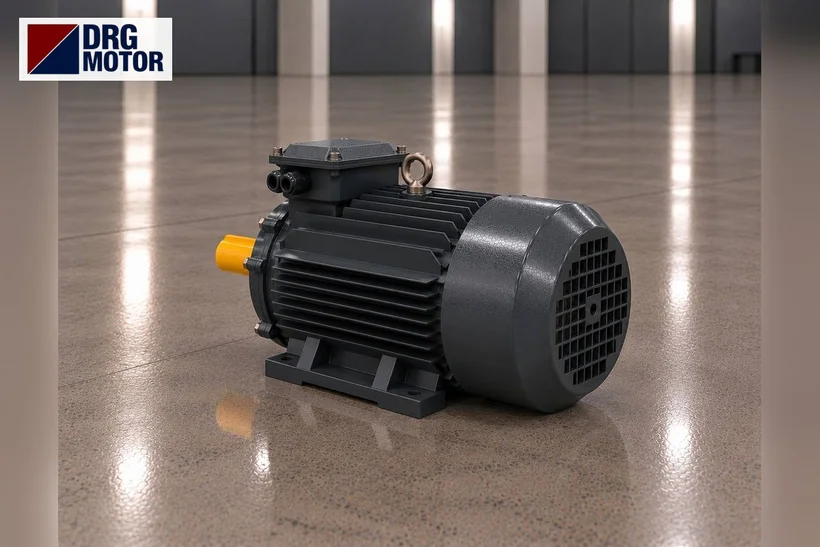
4-pole, large-frame cast iron motors are common on pulpers in both belt and gearbox arrangements. The models below cover 55–110 kW; for higher powers the range extends to 355 kW.
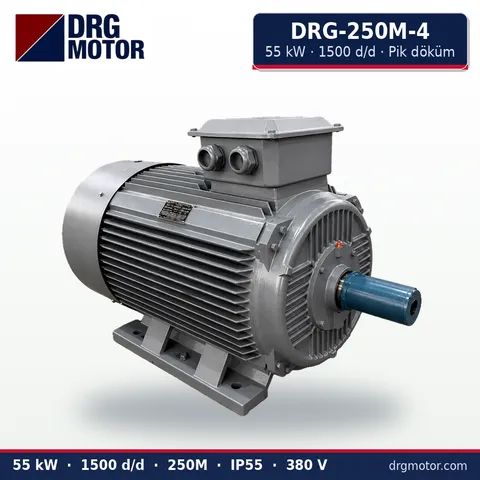
55 kW Three-Phase Motor 1500 rpm – DRG-250M-4 Cast Iron
- 55 kW · 1500 rpm (4 poles)
- Cast iron frame · IEC 250M
- Mounting: B3 · B5 · B14 · B35
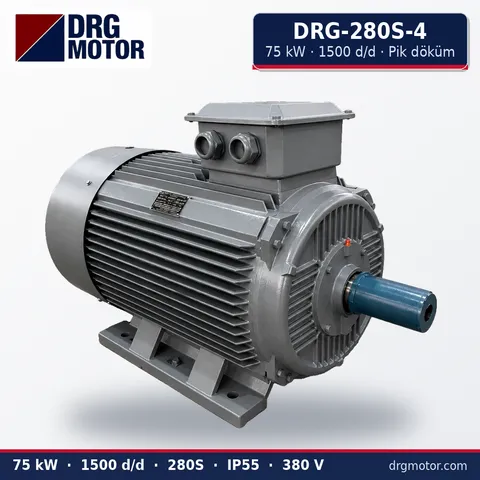
75 kW Three-Phase Motor 1500 rpm – DRG-280S-4 Cast Iron
- 75 kW · 1500 rpm (4 poles)
- Cast iron frame · IEC 280S
- Mounting: B3 · B5 · B14 · B35
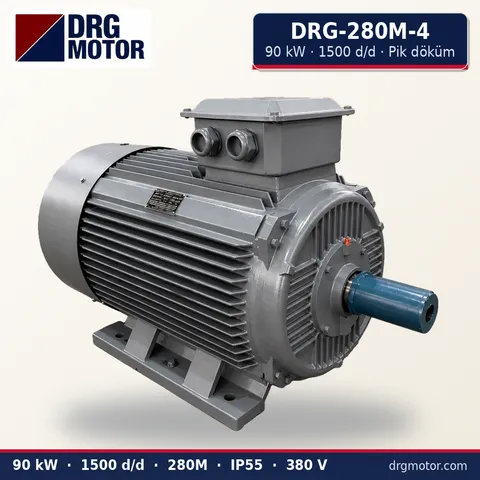
90 kW Three-Phase Motor 1500 rpm – DRG-280M-4 Cast Iron
- 90 kW · 1500 rpm (4 poles)
- Cast iron frame · IEC 280M
- Mounting: B3 · B5 · B14 · B35
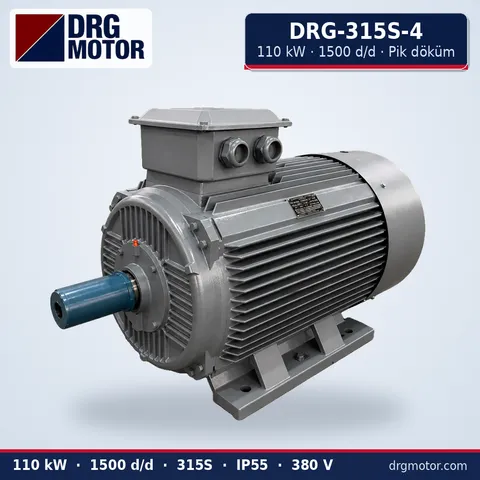
110 kW Three-Phase Motor 1500 rpm – DRG-315S-4 Cast Iron
- 110 kW · 1500 rpm (4 poles)
- Cast iron frame · IEC 315S
- Mounting: B3 · B5 · B14 · B35
Click to see current prices and order these motors nowSEE PRICES →
Pulper Motor FAQ
Why won't the pulper motor start with a full tub?
Still stock thickens around the rotor and the torque needed to start rises. With star-delta starting, torque in star may not cover it. Add water to lower consistency or use a soft start.
Should a pulper use a 4-pole or a 6-pole motor?
Rotor speed is set by the belt or gear ratio, so either can be used; keep the old motor's number of poles when replacing. A 6-pole motor of the same power has a larger, heavier frame.
Why does pulper motor current fluctuate?
A bale dropping in, rope or wire caught on the rotor and a blinded screen plate all make current fluctuate. Continuously high current shows that consistency or water temperature has drifted from the recipe.
Can a pulper motor run on an inverter?
Yes, DRG motors can run on a drive; if it will stay at low speed for long, allow for reduced cooling from the motor fan. Drive selection is the machine builder's job.
To request a quotation, send a photo of the pulper motor nameplate with power, speed, mounting (foot or flange), shaft size, drive arrangement and tub volume via WhatsApp, or use the quote list. Phone: +90 (542) 666 11 11 · e-mail: info@drgmotor.com · contact. For other motors on stock preparation and recycling lines see paper and cardboard recycling machine motors, and for all models the online store.