English
 Le français
 Türkçe




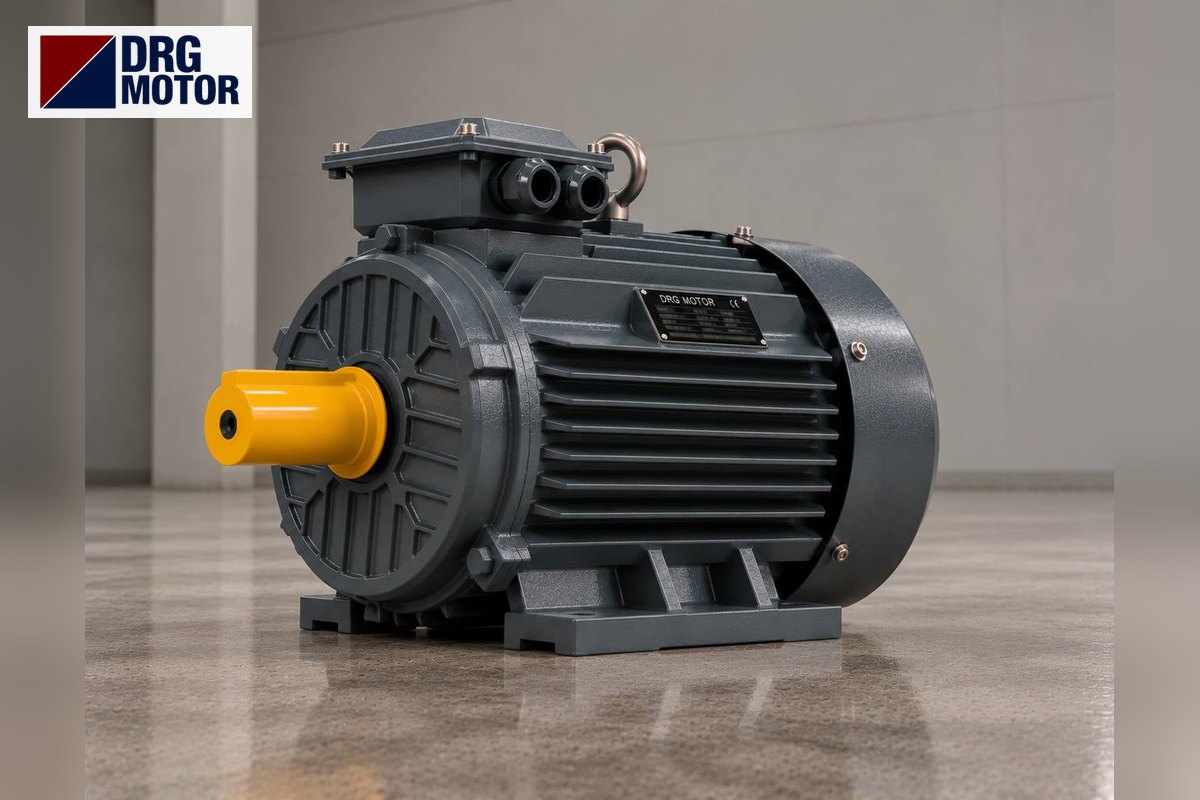

In a rendering cooker (a horizontal, steam-jacketed vessel with a paddle shaft turning inside), the agitator motor has to deliver, through a gearbox, enough torque to turn that shaft at low speed while the vessel is full and the product has thickened. What decides the selection is less the motor's kW rating than the torque at the gearbox output, restarting a full vessel and the hot surroundings right next to the cooker end plate. The drive is usually a 4- or 6-pole cast iron three-phase motor plus a gearbox; the motor sits on a base by its feet (B3) or is flanged to the gearbox (B5).
Below you will find how the load changes over a cooking cycle, the calculation from gear ratio to shaft torque and what to measure before removing the old motor. You can browse cast iron models in our online electric motor store and see our electric motors for gearboxes page for motors that connect to a gearbox input.
What Happens Inside the Cooker: From Raw Material to Dry Cracklings
Crushed animal by-products (bone, offal, fatty tissue) are loaded into the vessel. The steam jacket heats the vessel wall and the material cooks in its own water. The paddles keep sweeping the mass against the hot wall; this transfers heat and stops the product from sticking and scorching on the bottom.
As water evaporates, the mass gets heavier, fat is released and finally a brown, dry, crumbly solid remains. For the motor, this single cycle means three different loads:
- Start: high water content, fluid mixture; moderate load.
- Middle phase: protein coagulates and the mass becomes sticky and doughy; this is the heaviest moment.
- Drying: loose crumbs; the load falls but the product is abrasive and wears paddle tips and seals.
Power and the overload setting are decided by the current in the middle phase. The current read in the first minutes or at no load is misleading; do not downsize the motor on that basis.
From Gear Ratio to Shaft Torque: A Worked Example
Depending on vessel diameter, the paddle shaft turns at a few tens of rpm. That is why there is always a gearbox between motor and shaft, sometimes with an extra chain or belt stage. DRG does not sell gearboxes; it supplies the motor that connects to your existing gearbox.
The table below is an example: a gear ratio of i = 50 is assumed, with gearbox efficiency taken as 0.94. Shaft speed is n2 = n1 / i and shaft torque T2 = Tn × i × 0.94; motor values come from the DRG catalogue.
| Motor | Power / speed | Shaft speed | Shaft torque |
|---|---|---|---|
| DRG-180L-4 | 22 kW / 1470 rpm | 29.4 rpm | ≈ 6716 Nm |
| DRG-200L-4 | 30 kW / 1475 rpm | 29.5 rpm | ≈ 9127 Nm |
| DRG-225S-4 | 37 kW / 1485 rpm | 29.7 rpm | ≈ 11181 Nm |
| DRG-225M-6 | 30 kW / 980 rpm | 19.6 rpm | ≈ 13738 Nm |
What the table shows: at the same 30 kW, a 6-pole motor on the same gearbox turns the shaft about one third slower but with higher torque. Changing the pole count changes paddle speed, and with it how long the product stays on the wall and how easily it scorches. Keep the replacement at the same pole count as the old motor; if you want to test a different ratio, check the result first with our gearbox output speed and torque calculator.
Be cautious about power: agitator power grows with vessel volume and charge; small cookers may stay below a few tens of kW, while large ones reach several tens of kW. The exact value is the cooker builder's nameplate and catalogue. Vessels mixing more fluid foods have a very different load profile; we covered that in our article on mixing kettle motors.
Click to see current electric motor prices and order nowSEE PRICES →
Restarting a Full Vessel After a Power Cut
If the power fails or the overload trips, the product cools and compacts around the paddles. On restart, the motor must deliver enough starting torque to break the stationary mass loose. In a cooker, the moment that strains the motor is often not full load but this restart.
With catalogue values, the DRG-200L-4 gives about 388.4 Nm on direct-on-line starting, from a rated torque of 194.2 Nm and a Ts/Tn ratio of 2.0. With star-delta starting, torque in the star stage drops to one third: about 129.5 Nm, which is below rated torque. In a full vessel the shaft may not move in star; the motor hums and the change to delta brings a large current surge.
On direct-on-line starting the same motor's current rises to 53.8 A × 7.3 ≈ 392.7 A; check with the plant electrician whether the transformer and panel can take it. A soft starter also lowers torque together with voltage. Starting from low speed with full torque requires an inverter; DRG does not sell inverters, but the standard motor can be driven by a suitably selected one. Not leaving the vessel full during long stops is the simplest precaution.
Conditions Next to the Cooker End Plate: Heat, Steam and Gases
The motor usually sits at the front end of the vessel, very close to the steam jacket and the warm gearbox. DRG motors are rated for −15…+40 °C ambient and altitudes up to 1000 m. If the air drawn in by the shaft-mounted fan (IC411) is hotter than 40 °C, the motor cannot cool itself. The fix is then to move the motor away from the heat source (belt or intermediate shaft) and ventilate the area.
IP55 protects against dust and water splashes. Washing the motor directly with pressurised hot water and foam during vessel cleaning needs a stainless, washdown-resistant housing; DRG does not offer that type of housing, so cover the motor during washing. If ammonia and sulphurous gases are present, keep the terminal box gasket and cable glands tight. If the area is classified as an explosive atmosphere because of fat vapour or organic dust, a standard motor must not be used; an Ex-protected special motor is required.
What to Measure Before Removing the Old Motor
On motors flanged to a gearbox, flange size and shaft end must match exactly. As an example, the catalogue values of the DRG-200L-4:
- Power: 30 kW – 1475 rpm
- IEC frame: 200L, shaft height H = 200 mm
- Foot hole spacing (A × B): 318 × 305 mm, holes 4–Φ18.5
- Shaft (D × E): 55 × 110 mm, key width 16 mm
- B5 flange (M / N / P): 350 / 300 / 400 mm
- Current (400 V): 53.8 A, voltage 400/690 V (Δ/Y)
On 4- and 6-pole motors in 225S and 225M frames, the B5 flange is 400 / 350 / 450 mm and the shaft 60 × 140 mm. Note the following before the swap:
- Nameplate kW, speed, current and voltage connection (on a 400 V supply a 400/690 V motor is connected in delta).
- Mounting: feet on a base or B5 flange on the gearbox; if flanged, the M and N dimensions.
- Shaft diameter, shaft length, key width and the bore of the coupling hub.
- Shaft height H on foot-mounted motors: coupling alignment must hold without changing the base.
- Starting method in the panel: star-delta, direct-on-line or soft starter.
- Whether the agitator runs in reverse for discharge.
- Ambient temperature at the motor and the terminal box orientation.
DRG Motors Suitable for Rendering Cooker Agitators
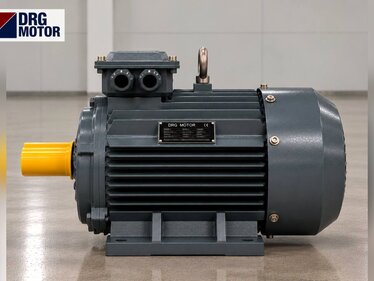
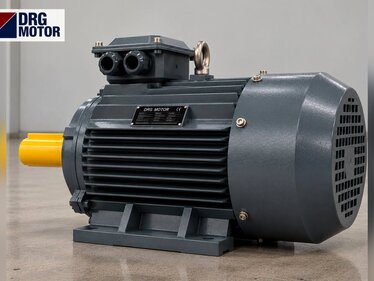
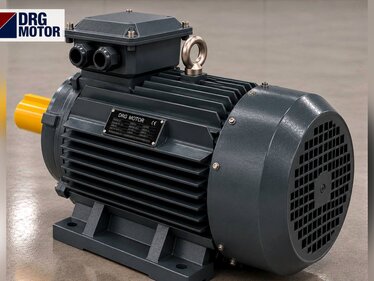
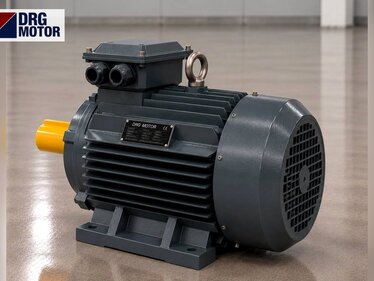
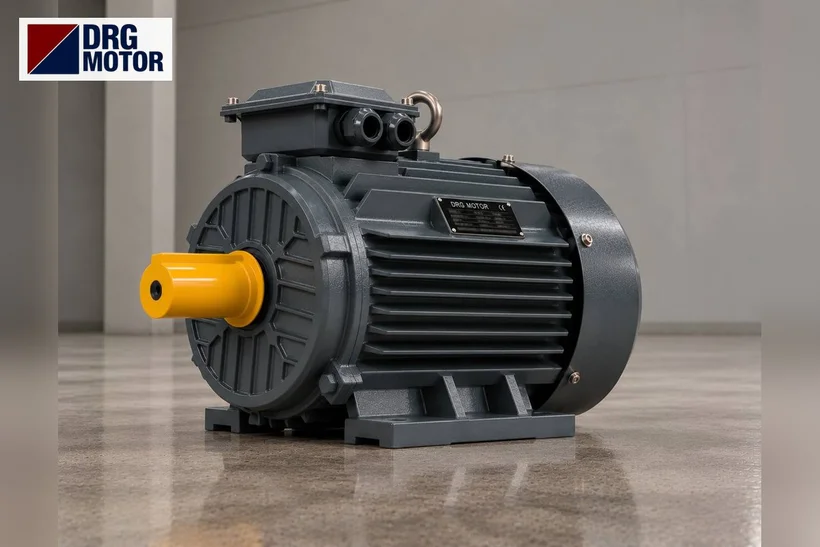
These models are 4- and 6-pole with cast iron frames; they can be connected to a gearbox input by feet or by B5 flange and cover power steps often seen on heavy cooker drives. Choose by the power and pole count on the old motor's nameplate.
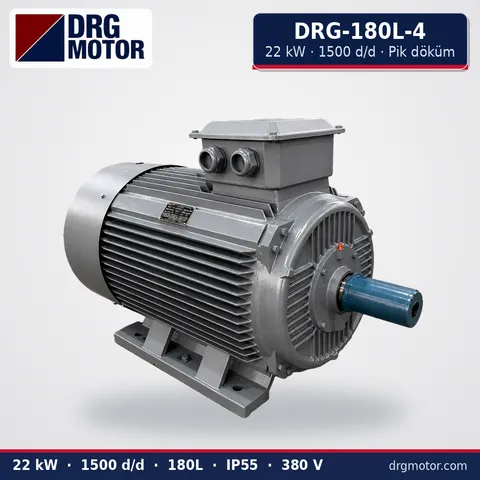
22 kW Three-Phase Motor 1500 rpm – DRG-180L-4 Cast Iron
- 22 kW · 1500 rpm (4 poles)
- Cast iron frame · IEC 180L
- Mounting: B3 · B5 · B14 · B35
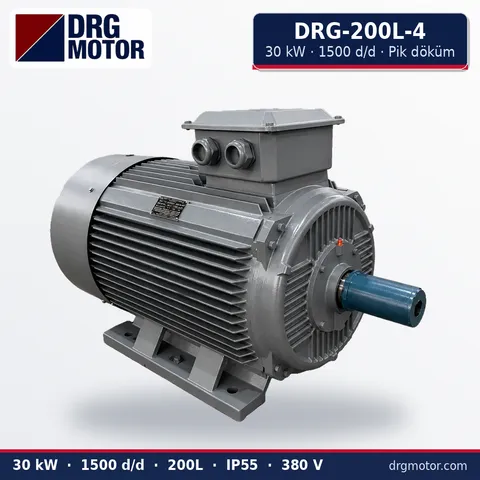
30 kW Three-Phase Motor 1500 rpm – DRG-200L-4 Cast Iron
- 30 kW · 1500 rpm (4 poles)
- Cast iron frame · IEC 200L
- Mounting: B3 · B5 · B14 · B35
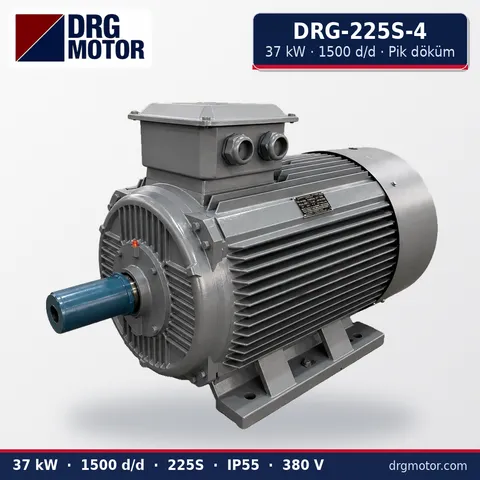
37 kW Three-Phase Motor 1500 rpm – DRG-225S-4 Cast Iron
- 37 kW · 1500 rpm (4 poles)
- Cast iron frame · IEC 225S
- Mounting: B3 · B5 · B14 · B35
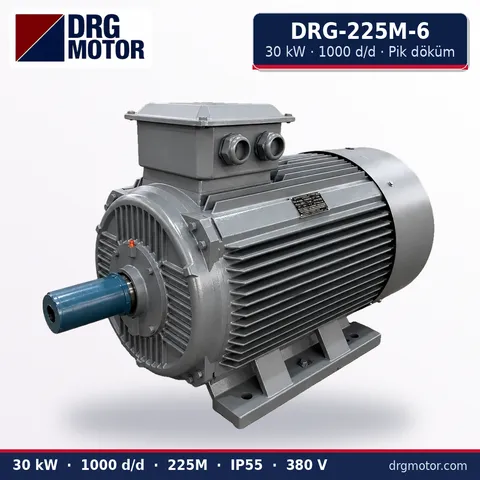
30 kW Three-Phase Motor 1000 rpm – DRG-225M-6 Cast Iron
- 30 kW · 1000 rpm (6 poles)
- Cast iron frame · IEC 225M
- Mounting: B3 · B5 · B14 · B35
Click to see current prices and order these motors nowSEE PRICES →
Rendering Cooker Motor: Frequently Asked Questions
What kW motor does a rendering cooker agitator need?
It depends on vessel volume, charge and gear ratio; there is no single figure. Use the nameplate of the burnt-out motor or the cooker builder's catalogue. Going below the nameplate value makes the overload trip in the middle phase.
Why does the cooker motor trip in the middle of the cycle?
While protein coagulates, the mass is at its stickiest and current peaks. If a crust has built up on the jacket wall, the gearbox oil is low or the bearings are worn, the load climbs further. Set the overload to the nameplate current; do not downsize the motor.
Can I fit a 6-pole motor instead of a 4-pole one?
On the same gearbox, paddle speed drops by about 34 percent (980 rpm instead of 1475 rpm). This changes heat transfer and cycle time. It is not recommended before the gear ratio is recalculated and the cooker builder is consulted.
Why will a star-delta cooker not start when full?
In the star stage the motor gives one third of its torque; with a Ts/Tn ratio of 2.0 that is about two thirds of rated torque. It may not be enough to break loose a full vessel that has cooled and compacted. Check whether direct-on-line starting is possible for the panel and transformer, or avoid leaving the vessel full.
DRG Motor is a manufacturer, supplier and seller of electric motors. To prepare a quotation for a cooker motor, this is enough: a photo of the removed motor's nameplate, its power and speed, whether it is foot- or flange-mounted, the shaft size and the gearbox nameplate or ratio. Send these to our WhatsApp line or add the models you like to the quote list. Phone: +90 (542) 666 11 11, e-mail: info@drgmotor.com; all channels are on our contact page. Current prices are in our online store.