English
 Le français
 Türkçe




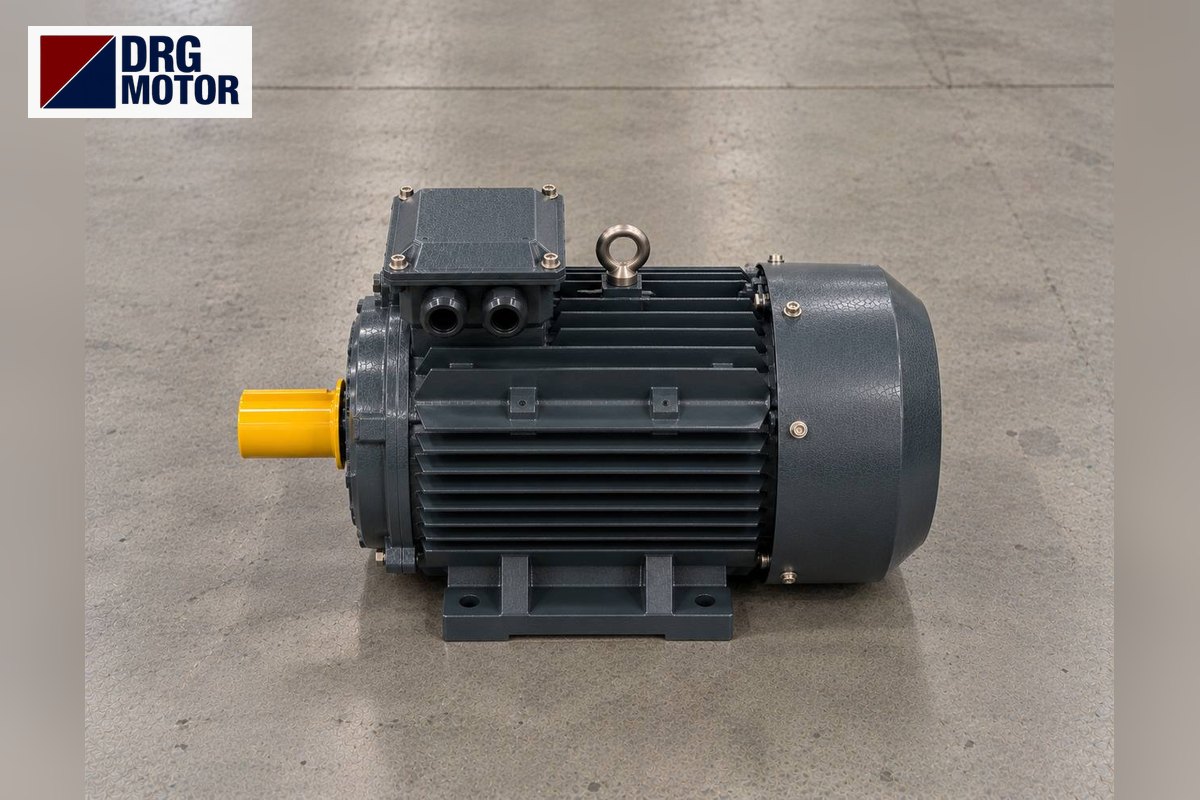

In a cotton bale press the electric motor drives the hydraulic pump feeding the main press cylinder; the force that compresses lint to bale density comes from the cylinder and pressure. Motor power is set not by the press tonnage but by the flow the pump delivers and the pressure it delivers it at. In large ginning plants this motor is in the tens-of-kW class, and the real limit on power is the pressure at which the large pump is unloaded. The exact value is on the press builder's plate.
Presses for waste paper, cardboard and plastic are covered separately on the recycling baling press motors page. This article is about the cotton press at the end of a gin line, which works in step with the lint flow. You can find suitable 4-pole cast iron motors by power in our online motor store.
From Gin to Bale: Who Does What on the Press Line
Lint leaving the gin stands and lint cleaners falls from the condenser into the press box. The tramper above the box presses the lint down again and again until the box is full. On double-box revolving presses one box fills while the other sits under the main press cylinder; when the box is full the press turns and the filled box moves into the compression position.
The main cylinder compresses the lint to its final height, the bale is tied with straps or wire, the cylinder retracts and the bale is taken out. Meanwhile the tramper keeps packing lint into the other box. The rhythm of the press is set by the lint output of the gin: the press must finish a bale before the other box is full.
This line has several motors: the main press pump motor, the motor or separate hydraulic unit driving the tramper, the box turning drive, the bale conveyor and the hydraulic oil cooler fan. When a motor burns out, establish which one it is; this article focuses on the main press pump motor.
Pressure Sets Tonnage, Flow Sets Speed
Cylinder force is F = p · A. Example and assumption: a single 400 mm main cylinder. Piston area is 1256.6 cm²; at 250 bar the force is about 3141.6 kN, around 320 tonnes. Your own press's cylinder diameter and maximum pressure are on the machine plate or in its hydraulic diagram.
Ram speed depends on flow: v = Q / A. On the same cylinder 330 l/min moves the ram at about 4.38 cm/s, and 40 l/min at 0.53 cm/s. While loose lint is being compressed the pressure is low and speed is what counts; as the bale nears its final height the pressure rises quickly and speed becomes secondary.
In the example the ram's first 150 cm take about 34.3 seconds at 330 l/min, and the last 30 cm of compression 56.5 seconds at 40 l/min. If the line turns out 12 bales an hour there is a 300-second window per bale; return, tying and turning must fit into it. If capacity is to be raised, the first question is whether the pump flow, and therefore the motor, can deliver it.
Click to see current electric motor prices and order nowSEE PRICES →
One Pump or Two? The Effect on Motor Power
Pump power is P = Q · p / (600 · η) (Q in l/min, p in bar, P in kW). The table below compares three pump arrangements for the press above. Assumptions: total approach flow 330 l/min, final compression 40 l/min at 250 bar, pump efficiency 0.88. In the two-pump arrangement the large pump is opened to tank by an unloading valve at a set pressure and only the small pump does the final compression.
| Pump layout (example) | Power on approach | Power at final squeeze | Motor needed |
|---|---|---|---|
| Single pump up to 250 bar | 156.2 kW | 156.2 kW | 160 kW class |
| Two pumps, unloading at 85 bar | 53.1 kW | 18.9 kW | 55 kW – DRG-250M-4 |
| Two pumps, unloading at 70 bar | 43.8 kW | 18.9 kW | 45 kW – DRG-225M-4 |
The practical lesson of the table: on a two-pump press it is not 250 bar that loads the motor but the unloading pressure of the large pump. If the unloading valve is raised from 70 to 85 bar to compress bales sooner, the same 45 kW motor now meets a 53.1 kW load and exceeds its current limit on every bale. Compare with the motor's plate power before touching the valve setting.
That is why large presses are often built with several pumps and sometimes several motors. On units with variable displacement pumps the power regulator plays the same role, and its setting must also match the motor power.
A Motor That Turns All Season: Idling and Starting
During the ginning season a plant runs day and night for months. The main press motor does not stop and start for every bale; it starts once at the beginning of the shift and idles between bales while the pump returns oil to tank at low pressure. About 91 seconds of the 300-second window in the example go to compression; for the rest the motor is lightly loaded.
In this long-cycle operation oil temperature also affects motor heating. If the oil cooler is undersized or its fan has failed, the oil thins, pump leakage rises, the press takes longer to make the same bale and the motor stays loaded longer. If the motor runs hot, check oil temperature and the cooler first.
At powers such as 45 kW the motor is usually started star-delta or with a soft starter. The pump must not build pressure during starting; the directional valve must be in its centre position or the unloading valve open. DRG motors of 4 kW and above are wound for 400/690 V and suit star-delta starting on a 400 V network. See our star-delta starting page for details.
Where Motor Meets Pump: Bell Housing, Coupling and Shaft
On a cotton press hydraulic unit the motor and pump are usually mounted horizontally beside the tank or on a separate base frame. The motor can hang from a bell housing on its B5 flange, be held by feet and flange as B35, or be foot-mounted (B3) and joined to the pump with a flexible coupling. On 225 and 250 frames the motor is heavy, and a long arrangement hanging only from the flange will vibrate.
In the DRG catalogue B5 dimensions, the 225 frame has a flange bolt circle (M) of 400 mm, spigot (N) 350 mm, flange outside diameter (P) 450 mm and 18.5 mm holes. On the 250 frame these rise to 500, 450 and 550 mm. One detail to watch: in the 225M frame the 2-pole motor has a 55 × 110 mm shaft while the 4-pole motor has 60 × 140 mm. Choose the coupling hub accordingly.
- Model: DRG-225M-4, 45 kW – 1485 rpm
- Rated torque: 289.4 Nm
- Current (400 V): 80.2 A
- Shaft (D × E): 60 × 140 mm, key width 18 mm
- Foot holes (A × B): 356 × 311 mm, 4–Φ18.5
- Voltage: 400/690 V (Δ/Y)
The direction of rotation must match the arrow on the pump body. A gear or piston pump turning backwards does not deliver and can be damaged quickly; at first start, bump the motor briefly and check the direction.
Lint and Heat in the Press Room; Pre-Replacement Data
The press area is one of the dustiest places in a gin: the tramper throws up lint with every stroke. This lint felts up on the motor fins and fan cowl, reduces cooling and creates a fire risk on hot surfaces. IP55 protection seals the motor interior; cleaning the outside belongs in the maintenance plan.
DRG motors are rated for −15 to +40 °C ambient and altitudes up to 1000 m. If the press room and the area next to the hydraulic unit can exceed 40 °C in a season that starts in late summer, state this in the order; in hotter surroundings the motor may not deliver its rated power. Place the oil cooler fan so that it does not blow warm air into the motor's cooling air.
Information to Gather Before Replacing the Press Motor
- Plate of the main press pump motor: kW, rpm, voltage, connection (photo).
- Pump layout: single, double or variable displacement; unloading pressure of the large pump, if any.
- Mounting: flanged to a bell housing (B5), foot + flange (B35) or foot-mounted with coupling (B3).
- Shaft diameter and length; bore and key size of the coupling hub.
- Starting method: star-delta, soft starter or drive.
- The rotation arrow on the pump.
- Highest ambient temperature in the press room and the position of the oil cooler.
DRG Motors Suited to Cotton Bale Press Pumps
4-pole cast iron models in the power steps common on large press pumps; the choice should follow the pump layout and the plate of the old motor.
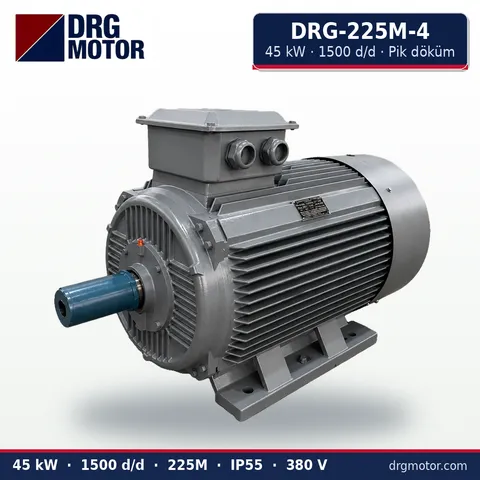
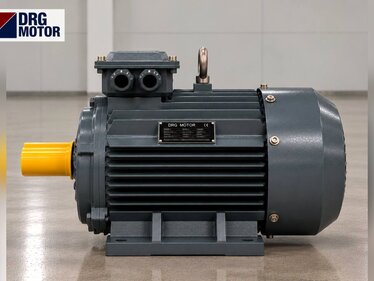
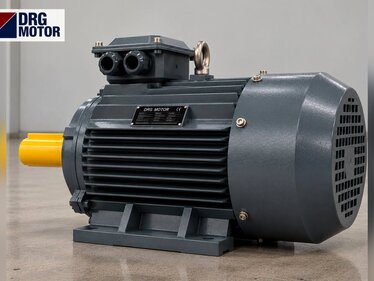
45 kW Three-Phase Motor 1500 rpm – DRG-225M-4 Cast Iron
- 45 kW · 1500 rpm (4 poles)
- Cast iron frame · IEC 225M
- Mounting: B3 · B5 · B14 · B35
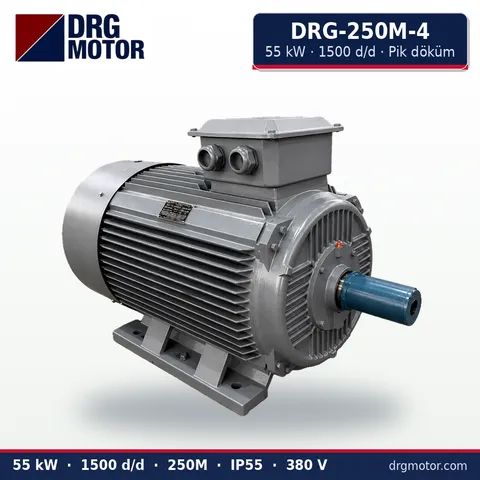
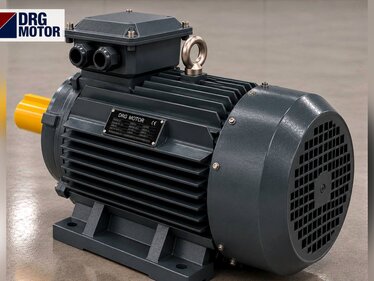
55 kW Three-Phase Motor 1500 rpm – DRG-250M-4 Cast Iron
- 55 kW · 1500 rpm (4 poles)
- Cast iron frame · IEC 250M
- Mounting: B3 · B5 · B14 · B35
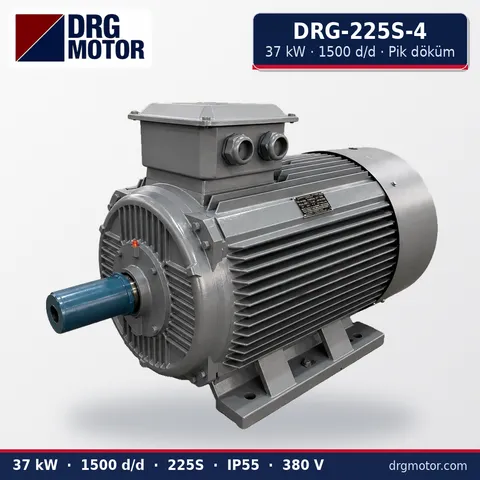
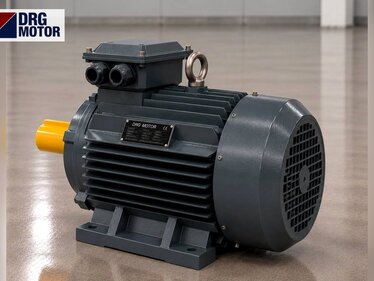
37 kW Three-Phase Motor 1500 rpm – DRG-225S-4 Cast Iron
- 37 kW · 1500 rpm (4 poles)
- Cast iron frame · IEC 225S
- Mounting: B3 · B5 · B14 · B35
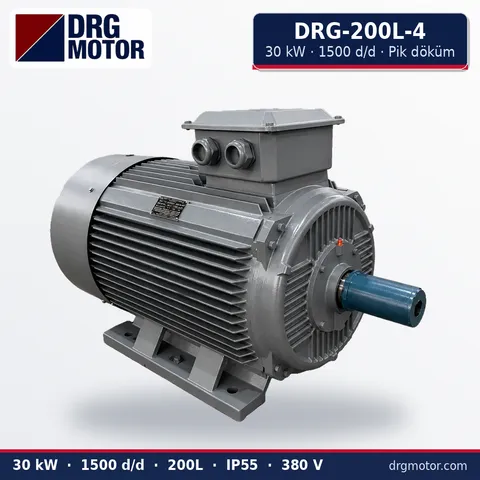
30 kW Three-Phase Motor 1500 rpm – DRG-200L-4 Cast Iron
- 30 kW · 1500 rpm (4 poles)
- Cast iron frame · IEC 200L
- Mounting: B3 · B5 · B14 · B35
Click to see current prices and order these motors nowSEE PRICES →
Cotton Bale Press Motor: Frequently Asked Questions
What kW is a cotton bale press motor?
It depends on cylinder diameter, pump layout and the bale rhythm of the line. Large ginning plants use motors of tens of kW for the main press pump, and some presses have more than one pump motor. The exact value is on the press builder's plate.
Why does the press motor struggle on every bale?
On a two-pump press, if the unloading pressure of the large pump has been raised or the unloading valve sticks, a load above motor power appears. Leakage from a worn pump and hot oil also lengthen the compression time. Check the valve setting and oil temperature first.
Is a bigger motor enough for faster bales?
No. Ram speed is set by pump flow; enlarging the motor alone does not raise speed. More flow means a different pump, and then motor power must be recalculated.
Is the tramper motor the same motor?
On most presses it is not. The tramper runs from a separate hydraulic unit or a mechanical drive, and its power is lower than the main press motor. When replacing, send the plates of the two motors separately.
DRG Motor is a manufacturer, supplier and seller of electric motors. For a press motor quotation, share: a photo of the motor label, its power and speed, the mounting (foot, flange or both), the shaft size and the pump layout. Write via WhatsApp or collect the models in the quote list. Phone +90 (542) 666 11 11, e-mail info@drgmotor.com, other channels on the contact page. You can see current prices in our electric motor store. For the other drives on the line, our agricultural machine electric motors page also helps.