 English
 Le français
 Türkçe


No, they are not the same. Fitting a more efficient electric motor makes the same job use less electricity, but it does not by itself raise the power at the shaft, and therefore not how many parts your machine turns out per hour. Capacity is about how much you produce; efficiency is about the energy you spend producing it. Two different questions.
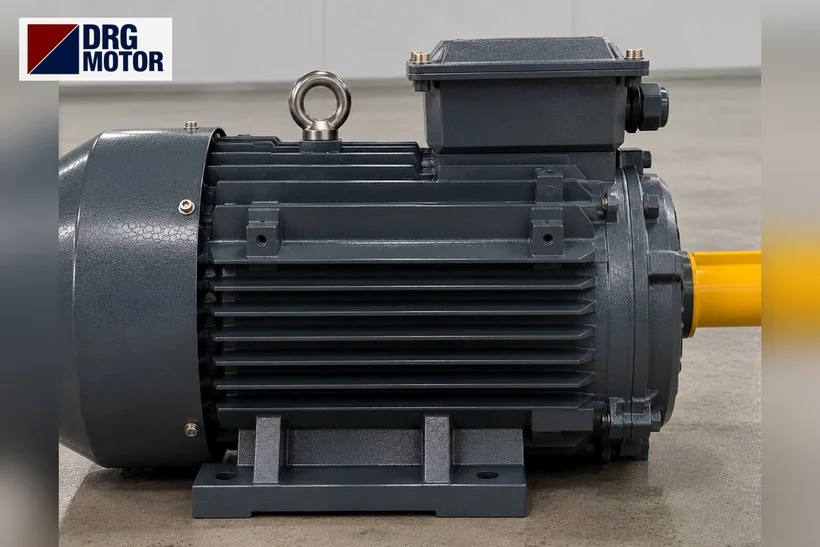
DRG Motor is a manufacturer, supplier and seller of electric motors. It is based in İzmir and ships quickly across all of Türkiye, that province included. Choose the power you need by speed in the online electric motor shop and see the same models together in the three-phase asynchronous electric motors category.
Capacity versus efficiency: two separate questions
A line's capacity answers "how much do I make in a given time". That is limited by the power, torque and speed the shaft has to deliver. Efficiency answers "how much do I draw from the grid for the same output". Swapping a motor for a more efficient one improves the second question, not the first. The bill at the panel drops; the conveyor runs at the same speed.
What a more efficient motor changes, and what it doesn't
Replacing a motor of the same kW with a more efficient one does not change the power at the shaft; that figure is what the nameplate states. What changes is the loss turned into heat while producing that power. Your monthly energy use may fall and the motor may run a touch cooler, but the pump gives the same flow and the crusher the same tonnage. To raise output, look at the mechanical power the job needs, not at efficiency.
The energy gain is real — but it is not capacity
None of this means a more efficient motor is worthless. Doing the same work with less energy pays back over time at the panel; because the motor runs cooler inside, bearings and windings have an easier life and the service interval can stretch. On a fan or pump that turns all day, that difference adds up. But every one of these is a gain on the energy and durability side; it does not change how many parts the line turns out per hour. "The bill went down" and "I made more" are two separate ledgers. Improving one does not hand you the other. When you weigh the investment, be clear which ledger you are opening: is the aim to cut running cost, or to grow output volume? The quantity to look at changes with the answer.
What actually raises capacity?
Mechanical power at the shaft depends on three quantities: power, torque and speed. A practical formula ties them together: T = 9550 × P / n (P in kilowatts, n in rpm, T in newton-metres). Hold the speed and raise the power and torque goes up, so you can turn a heavier load at the same speed. That is usually the route to more capacity: moving to a motor whose torque and speed suit the job, a size up if needed. Sometimes the fix is not the motor at all but the gear ratio or a bottleneck on the line, which should be measured first.
Click to see current electric motor prices and order nowSEE PRICES →
Is the bottleneck the motor, or somewhere else?
Before you enlarge the motor, answer this: is the motor really what slows the line? Usually it is not. If the motor turns the load comfortably, runs at a normal temperature and does not lose speed under load, the trouble is probably elsewhere — the supply line, the gear ratio, the mould, the cutting tool or a manual step in the middle can all hold the line back. Fitting a bigger motor to such a line does not raise output; it merely feeds spare power that sits idle. A simple check: if the motor's speed drops noticeably at full load, its body overheats or the protection trips often, the power may be short. If none of that happens, look for the bottleneck elsewhere. Before deciding, measure the load, time the cycle with a stopwatch and find the slowest step; that step sets capacity, and most of the time it is not the motor.
At the same speed, torque grows with power
The table below shows the shaft power and approximate torque of a few DRG aluminium-body three-phase models in the 1500 rpm class. Torque values are rounded figures from the formula; for exact numbers read the motor nameplate. Note that the table shows power and torque, which set output, not efficiency.
| Model | Shaft power | Speed | Approx. shaft torque |
|---|---|---|---|
| DRG-90L-4 | 1.5 kW | 1500 rpm | 9.5 Nm |
| DRG-112M-4 | 4 kW | 1500 rpm | 25 Nm |
| DRG-132S-4 | 5.5 kW | 1500 rpm | 35 Nm |
| DRG-132M-4 | 7.5 kW | 1500 rpm | 48 Nm |
| DRG-160M-4 | 11 kW | 1500 rpm | 70 Nm |
As you can see, moving from a 1.5 kW motor to an 11 kW one multiplies the torque several times. That mechanical jump is what grows capacity, not keeping the same power and merely changing the motor type.
Choosing a motor to grow production
If you decide to step up a size, check these in order:
- Determine the power and speed the machine truly needs from a load calculation, not a guess.
- Verify that the frame size (IEC), shaft diameter, flange type (B3/B5/B35) and foot holes fit the new motor.
- Check voltage and connection: on DRG aluminium bodies, 230/400 V up to 3 kW and 400/690 V from 4 kW up.
- A larger motor draws more current; make sure the supply cross-section and protective device suit it.
For cable sizing and drawn current, the motor cable size calculator and the motor current table make the job easier.
Common mistakes
The most common error is expecting a production increase from a motor change meant to cut the energy bill. The second is jumping to an oversized motor to grow capacity while skipping shaft, flange and supply compatibility. The third is enlarging the motor on a line where the bottleneck is elsewhere; then the new motor wastes energy and output still does not rise.
Pick the three-phase motor that matches your project's power and speed andSEE PRICES
Send a photo of your current motor nameplate and we will find the suitable DRG model together.Send on WhatsApp
Frequently asked questions
Will an efficient motor raise my production?
No. An efficient motor of the same power delivers the same shaft power, so output stays the same; only the electricity spent to produce it goes down.
What does it take to raise capacity?
The mechanical power the job needs has to go up. That usually means more torque and/or speed, i.e. a size up in motor, but the line's bottleneck must be measured first.
If I move to a larger motor, what else changes?
The drawn current grows, and with it the supply cross-section, protective device and connection gear. The frame size, shaft diameter and flange must also fit the machine.
If I only change the motor at the same kW, is there a difference?
Since shaft power stays the same, production is the same. There may be a gain in energy use and heating, but none in capacity.
Electric Motors Related to This Topic — Models and Current Prices
Suitability is not decided by power alone: compare the speed, voltage, mounting, shaft and fixing dimensions of your machine with the product data; if unsure, send us the nameplate of your current motor.
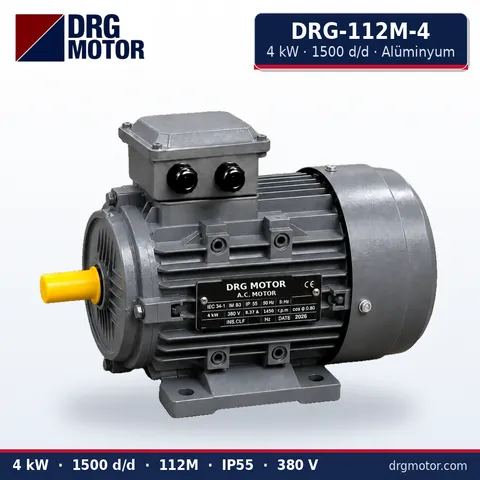
4 kW Three-Phase Motor 1500 rpm – DRG-112M-4 Aluminium
- 4 kW · 1500 rpm (4 poles)
- Aluminium frame · IEC 112M
- Shaft: 28 × 60 mm
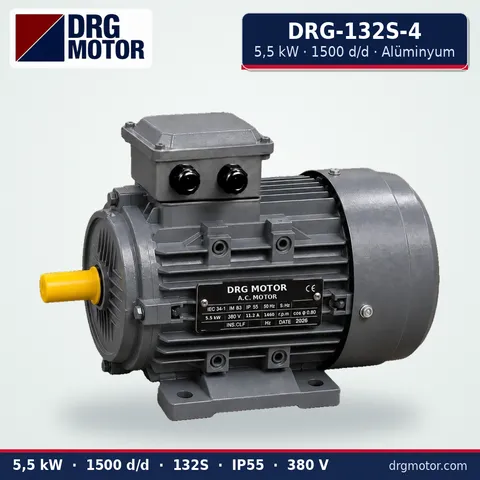
5.5 kW Three-Phase Motor 1500 rpm – DRG-132S-4 Aluminium
- 5.5 kW · 1500 rpm (4 poles)
- Aluminium frame · IEC 132S
- Shaft: 38 × 80 mm
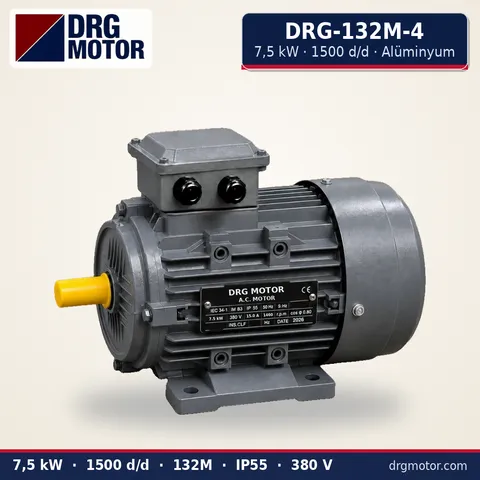
7.5 kW Three-Phase Motor 1500 rpm – DRG-132M-4 Aluminium
- 7.5 kW · 1500 rpm (4 poles)
- Aluminium frame · IEC 132M
- Shaft: 38 × 80 mm
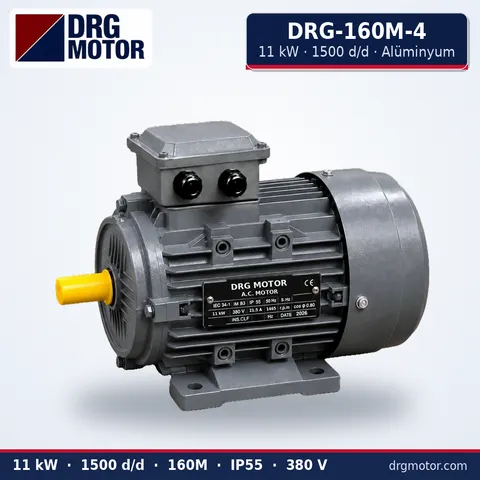
11 kW Three-Phase Motor 1500 rpm – DRG-160M-4 Aluminium
- 11 kW · 1500 rpm (4 poles)
- Aluminium frame · IEC 160M
- Shaft: 42 × 110 mm
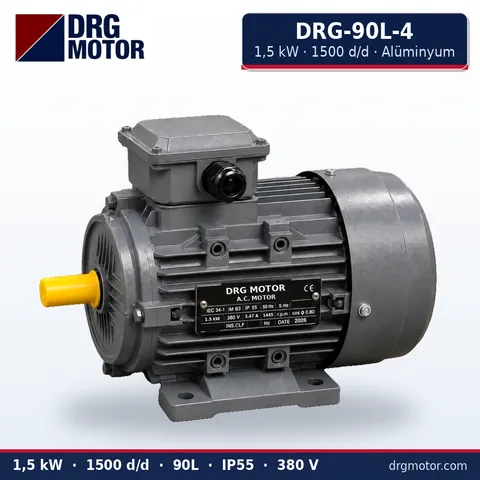
1.5 kW Three-Phase Motor 1500 rpm – DRG-90L-4 Aluminium
- 1.5 kW · 1500 rpm (4 poles)
- Aluminium frame · IEC 90L
- Shaft: 24 × 50 mm