 English
 Le français
 Türkçe




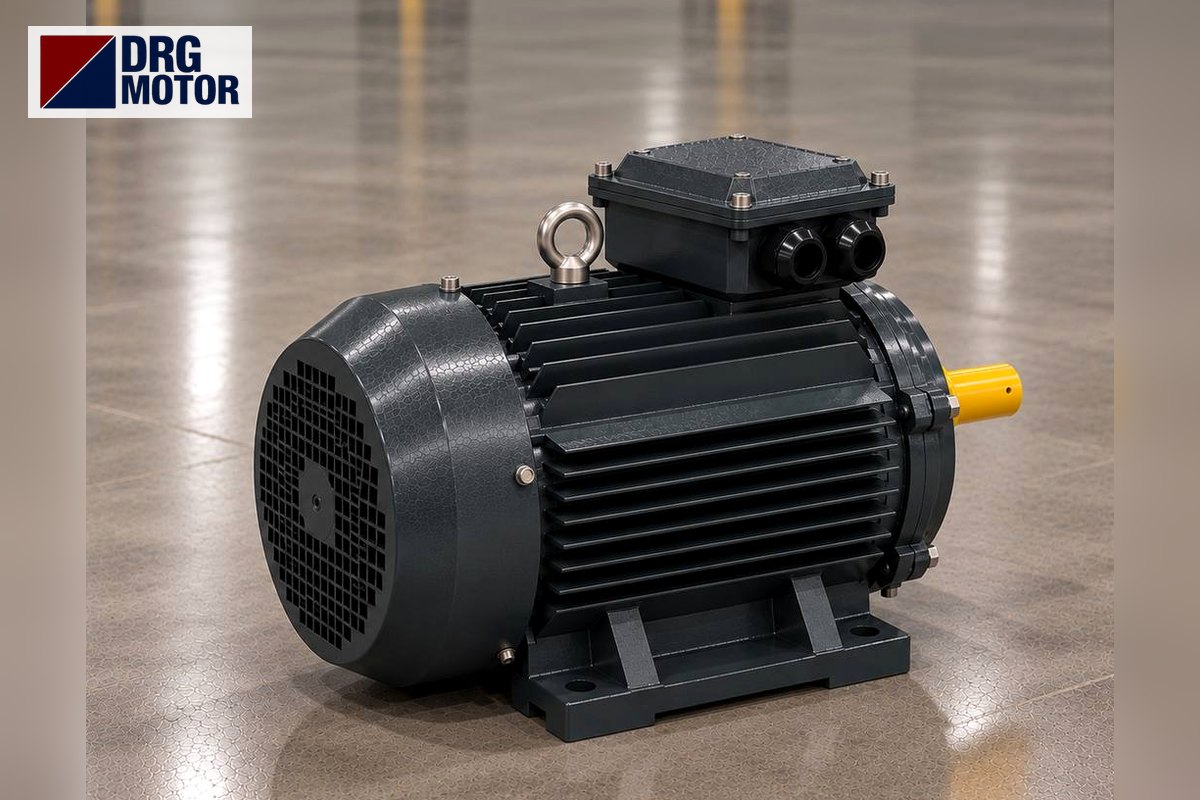

You set a per-unit energy target by first measuring where you stand: take the total energy the electric motor draws over a period (kWh) and divide it by the number of units you produced in that same period. The resulting kWh/unit or kWh/tonne is your baseline. The target is to pull that baseline down by a realistic amount; in short, don't write a target before you answer "what am I using right now" with a real number.
DRG Motor is a manufacturer, supplier and seller of electric motors; it is based in İzmir and ships quickly across all of Türkiye. Once you have your figure, find models at the right power and speed for your line in the online electric motor shop by power, and review the same group together in the three-phase asynchronous electric motors category.
What does energy per unit mean?
The total kWh a machine runs up is misleading on its own. Energy rises as output rises; that is normal. What matters is the energy spent on each unit you produce. Whatever a press, a compressor or a pump line draws per day, dividing that energy by the number of units gives you a single comparable figure. Did one month climb above the next, did a new setting help? You see it all on the same scale. On the floor it is the "per-piece" energy that is discussed, not the total bill.
Pick the unit to suit your work. For items counted by piece, kWh/unit; for bulk, granular, flour or feed products sold by weight, kWh/tonne fits better. The key is to use the unit you choose consistently.
How do you establish the baseline?
Record two things for the same period: energy used and units produced. Read the energy from the panel; a kWh meter on the motor or line supply is the cleanest route. With no meter, take the period consumption from a panel analyser or automation (PLC/SCADA) logs. Gather the output from production records, weighbridge tickets or the shift book.
Choose a period long enough to be little affected by season, stoppages and product mix; not a single shift but at least a few weeks of regular production represents your work better. Then the division: period kWh over period units (or tonnes). That gives your first baseline.
A worked example
Say a line showed 9,600 kWh on the panel over four weeks and produced 32,000 pieces in the same time. Unit energy is 9,600 / 32,000 = 0.30 kWh/unit. Put a few periods side by side and the trend is obvious:
| Period | Energy (kWh) | Output (pcs) | Unit energy (kWh/pc) |
|---|---|---|---|
| Month 1 | 9,600 | 32,000 | 0.30 |
| Month 2 | 9,800 | 35,000 | 0.28 |
| Month 3 | 10,200 | 30,000 | 0.34 |
Total kWh seems to climb every month, yet the per-piece energy fell in month two and rose in month three. The total bill won't tell you that; unit energy will. And that is the column where you set the target.
Click to see current electric motor prices and order nowSEE PRICES →
How do you set the target?
The target is not a percentage plucked from the air but a number derived from your own baseline. The order is:
- Fix the baseline: average the kWh/unit of several periods; don't hang on the luck of one month.
- Find the best period: the lowest unit energy you have already hit proves it is achievable. Setting the target near that value is usually realistic.
- Reduce it to one number: write a clear threshold such as "bring per-piece energy down to this kWh/unit", with a date.
- Keep measuring: recalculate each period with the same meter, unit and production record; only this shows whether the target holds.
If you want a rough advance estimate of expected energy, you can work one out from the motor's shaft power and running hours; an electric motor calculation tool helps with that rough estimate. The real target is still set by the kWh you measure on site.
The main things that move the value
Unit energy depends not only on the motor but on how the line runs:
- Idle time: a machine turning without producing swells the kWh but not the count; unit energy jumps.
- Load state: a machine with real work on the shaft and one running half-loaded most of the time give very different per-piece energy.
- Process setting: needlessly high speed, a binding drive, a misaligned belt-pulley — all mean extra kWh for the same output.
- Motor size: a motor chosen too big or too small for the job runs the line at an inefficient point.
The part a correctly sized motor plays
One of the surest steps to lower unit energy is running a motor whose power genuinely suits the machine. Read power and speed from the nameplate and match a model of the same class. A few examples from DRG's 1500 rpm (4-pole) aluminium-frame three-phase asynchronous range:
| Model | Power | Speed | Voltage |
|---|---|---|---|
| DRG-90L-4 | 1.5 kW | 1500 rpm | 230/400 V |
| DRG-112M-4 | 4 kW | 1500 rpm | 400/690 V |
| DRG-132S-4 | 5.5 kW | 1500 rpm | 400/690 V |
| DRG-132M-4 | 7.5 kW | 1500 rpm | 400/690 V |
| DRG-160M-4 | 11 kW | 1500 rpm | 400/690 V |
The same power is also made at other speeds; confirm the speed the machine needs from the nameplate and choose accordingly. Mismatching power and speed pushes unit energy up from day one.
Choose the three-phase motor at the right power and speed for your lineSEE PRICES
Send a photo of your current motor nameplate and we will find the suitable DRG model together.Send on WhatsApp
Common mistakes
- Judging by total kWh: if output changed, the total misleads; look per piece.
- Switching units: kWh/unit one month, kWh/tonne the next, and the comparison breaks. Stay on one unit.
- Too short a period: setting a target on the luck of one shift; look at a few weeks of regular production.
- Ignoring idle time: if the machine turns without producing, your baseline is inflated.
Frequently asked questions
Should I use kWh/unit or kWh/tonne?
Whichever way your product is counted. For items counted by piece, kWh/unit; for bulk products sold by weight, kWh/tonne is more meaningful. Keep the unit you pick across all later periods.
Can I work out the figure for a single motor?
Yes. Fit a kWh meter on that motor's or line's supply and divide by the output over the same period. That lets you track one machine on its own rather than the whole line.
Should I write the target as a percentage?
A percentage is handy for communication, but always back it with a clear threshold in kWh/unit (or kWh/tonne). Without a number a percentage can't be tracked.
Does fitting a bigger motor lower unit energy?
Not automatically. A motor too big for the job often runs at a worse point. The right move is choosing a model that matches the power and speed the machine actually needs.
Electric Motors Related to This Topic — Models and Current Prices
Suitability is not decided by power alone: compare the speed, voltage, mounting, shaft and fixing dimensions of your machine with the product data; if unsure, send us the nameplate of your current motor.

4 kW Three-Phase Motor 1500 rpm – DRG-112M-4 Aluminium
- 4 kW · 1500 rpm (4 poles)
- Aluminium frame · IEC 112M
- Shaft: 28 × 60 mm

5.5 kW Three-Phase Motor 1500 rpm – DRG-132S-4 Aluminium
- 5.5 kW · 1500 rpm (4 poles)
- Aluminium frame · IEC 132S
- Shaft: 38 × 80 mm

7.5 kW Three-Phase Motor 1500 rpm – DRG-132M-4 Aluminium
- 7.5 kW · 1500 rpm (4 poles)
- Aluminium frame · IEC 132M
- Shaft: 38 × 80 mm

11 kW Three-Phase Motor 1500 rpm – DRG-160M-4 Aluminium
- 11 kW · 1500 rpm (4 poles)
- Aluminium frame · IEC 160M
- Shaft: 42 × 110 mm

1.5 kW Three-Phase Motor 1500 rpm – DRG-90L-4 Aluminium
- 1.5 kW · 1500 rpm (4 poles)
- Aluminium frame · IEC 90L
- Shaft: 24 × 50 mm





