 English
 Le français
 Türkçe


There is one rule for a fair before-and-after comparison: take both readings under the same conditions. Run the same load at the same speed and output point, for the same length of time; log any voltage and ambient differences and convert the result to kWh per unit of work. Measure the old motor on a random day and the new one under a different load, and the gap you see comes from shifting conditions, not from the motor.
Once you have chosen the right motor, you still have to set up the measurement correctly. Browse models at the matching power and speed in the online electric motor shop and see the whole group in the three-phase asynchronous electric motors category. DRG Motor is a manufacturer, supplier and seller of electric motors, based in İzmir and shipping quickly across all of Türkiye.
Why "equal conditions" decide everything
The power an electric motor draws depends on the load on its shaft. A motor spinning free and a motor driving a tensioned conveyor do not pull the same current. So before you say "the new motor used less," the new reading has to come from the same operating point as the old one. Supply voltage at the panel, ambient temperature, coupling adjustment, even the quantity produced that day all move consumption. Two numbers taken without fixing these variables cannot be compared.
Before: establish your reference
Before the swap, take a typical working day with the existing motor as your reference. Run the machine at normal production pace, have a calibrated power analyser or kWh meter connected at the panel, and record consumption over a set period. At the same time note the supply voltage, the current drawn, the speed, and the amount of parts processed or material moved. This record is the baseline that later lets you compare like with like. Choose a window long enough to cover normal fluctuation rather than a single instant reading.
Same load, same time: how to lock the measurement
After fitting the new motor, run the machine on exactly the same job: the same belt-pulley or coupling ratio, the same product recipe, the same shift pace. Equalise the duration too — if you measured four hours before, measure four hours after. Check the coupling and alignment; misalignment or an over-tight belt draws extra power independently of the motor and distorts the comparison. The goal is to put both motors through exactly the same "exam question."
Click to see current electric motor prices and order nowSEE PRICES →
Normalisation: the corrections that make it fair
Matching conditions perfectly is not always possible in the field, so turn the raw kWh into work done. The soundest metric is total consumption divided by output: kWh per unit produced, kWh per cubic metre, or kWh per tonne. That way the comparison holds even if one day runs 100 parts and the next 120. Note it down if voltage changed noticeably; when supply drops, the current for the same work changes. Record ambient temperature and cooling conditions as well. Without normalisation, two kWh figures describe two different days, not two motors.
Example models by power
In a replacement the power and speed are usually kept the same; as long as the load is unchanged, the shaft power needed for the same job does not change either. Below are some 1500 rpm four-pole DRG models. Use the one closest to the kW and speed on your current motor's nameplate as your reference.
| Model | Power (kW) | Speed (rpm) | Product page |
|---|---|---|---|
| DRG-90L-4 | 1.5 | 1500 | View |
| DRG-112M-4 | 4 | 1500 | View |
| DRG-132S-4 | 5.5 | 1500 | View |
| DRG-132M-4 | 7.5 | 1500 | View |
| DRG-160M-4 | 11 | 1500 | View |
Each model's product page lists frame size, connection and mounting; match the power and speed to your nameplate and pick the right row.
Measurement window and data collection
Shoot a film, not a single frame. If production varies through the day, cover at least a full shift — several days if you can — and repeat the same window on the new motor. Have the analyser connected with the correct current transformer and ratio; a wrong CT ratio scales every number. Keep the data written down: date, time, duration, kWh, output quantity. When the two tables sit side by side on paper, the difference shows itself clearly.
Common mistakes
The most common error is measuring the old motor on a winter day and the new one on a summer day and comparing the two. The second is comparing raw kWh even though the load changed. The third is measuring without checking coupling alignment or belt tension. The fourth is generalising from a single instant reading. Avoid these four and the figure in your hands really tells the motor's story.
Safety: a warning before you measure
Before preparing any measurement inside the panel, cut the power and verify the absence of voltage with a suitable tester. Current transformer, analyser connection and terminal work should be done only by authorised electrical personnel. Do not set thermal protection current or similar protection values by guesswork; set them according to the nameplate and the device documentation. Keep guards in place when taking readings around a rotating shaft, coupling or belt.
Compare three-phase models at the power and speed that suit your before-and-after testSEE PRICES
Send a photo of your current motor nameplate and we will find the suitable DRG model together.Send on WhatsApp
Frequently asked questions
Do before and after have to be measured on the same day?
Not the same day, but the same conditions. Even on different days the comparison is sound if you equalise load, duration, voltage and output — or convert to kWh per unit of work.
What should I compare instead of raw kWh?
Where possible, consumption per unit of output: kWh per part, per tonne or per cubic metre. Then the comparison survives day-to-day changes in production volume.
Should I keep the same power and speed in a replacement?
As long as the load and machine stay the same, the shaft power needed stays the same, so the nameplate kW and speed are usually kept. If unsure, photograph the existing plate and ask us.
Which instrument should I measure with?
A calibrated power analyser or kWh meter connected at the panel gives the most reliable result. Have the connection made by authorised personnel and enter the current transformer ratio correctly.
Electric Motors Related to This Topic — Models and Current Prices
Suitability is not decided by power alone: compare the speed, voltage, mounting, shaft and fixing dimensions of your machine with the product data; if unsure, send us the nameplate of your current motor.
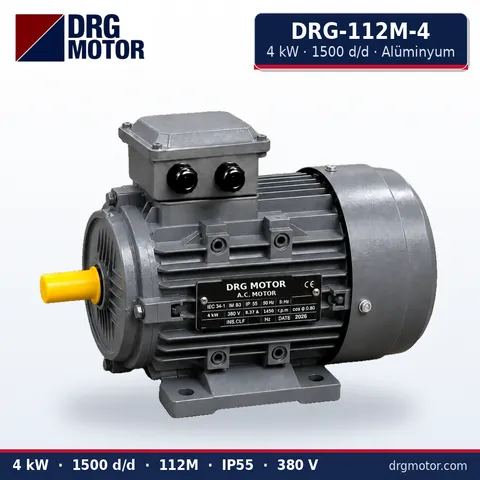
4 kW Three-Phase Motor 1500 rpm – DRG-112M-4 Aluminium
- 4 kW · 1500 rpm (4 poles)
- Aluminium frame · IEC 112M
- Shaft: 28 × 60 mm
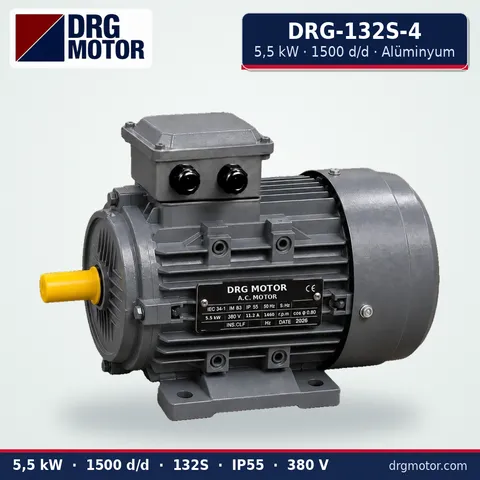
5.5 kW Three-Phase Motor 1500 rpm – DRG-132S-4 Aluminium
- 5.5 kW · 1500 rpm (4 poles)
- Aluminium frame · IEC 132S
- Shaft: 38 × 80 mm
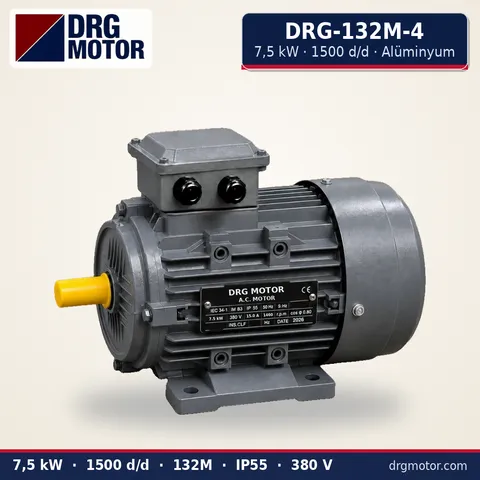
7.5 kW Three-Phase Motor 1500 rpm – DRG-132M-4 Aluminium
- 7.5 kW · 1500 rpm (4 poles)
- Aluminium frame · IEC 132M
- Shaft: 38 × 80 mm
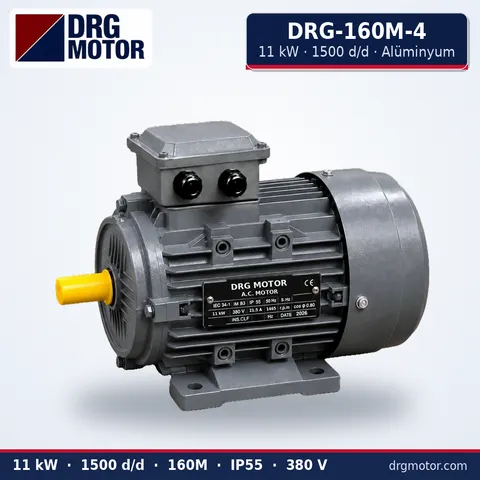
11 kW Three-Phase Motor 1500 rpm – DRG-160M-4 Aluminium
- 11 kW · 1500 rpm (4 poles)
- Aluminium frame · IEC 160M
- Shaft: 42 × 110 mm
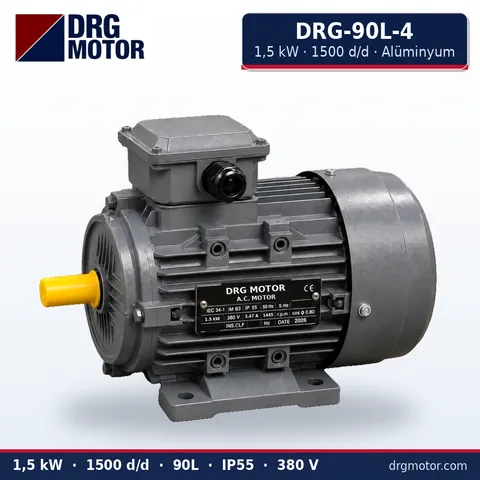
1.5 kW Three-Phase Motor 1500 rpm – DRG-90L-4 Aluminium
- 1.5 kW · 1500 rpm (4 poles)
- Aluminium frame · IEC 90L
- Shaft: 24 × 50 mm