 English
 Le français
 Türkçe


In a system where an electric motor and a drive (inverter) work together, the total efficiency is found by multiplying the efficiency of each stage: first the drive's input-to-output efficiency, then the motor's grid-to-shaft efficiency. In short, ηtotal = ηdrive × ηmotor. The most reliable approach is not juggling percentages but measuring the real power drawn at the input (kW) and the work taken at the shaft, then comparing the two.
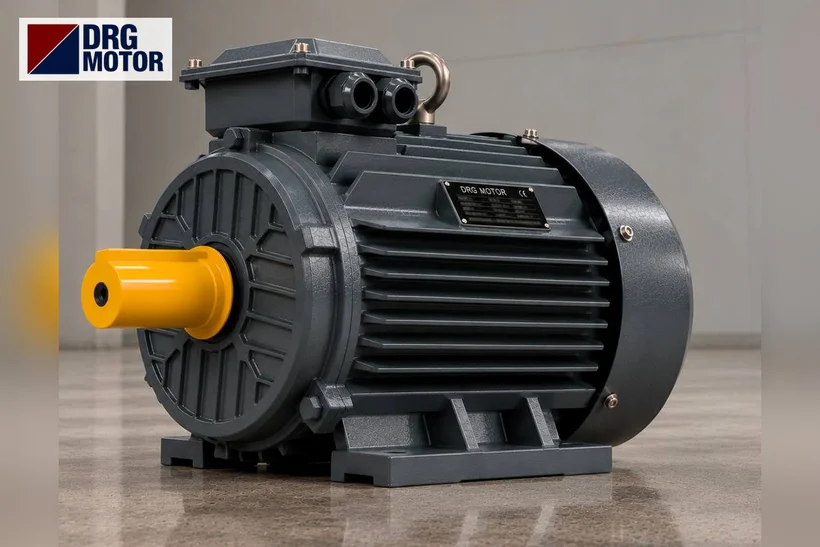
DRG Motor is a manufacturer, supplier and seller of electric motors. It is based in İzmir and ships quickly across all of Türkiye. This article explains the logic of the calculation, not how to pick a drive brand. Drives/inverters are not part of the DRG range, so what you find here is neutral technical information. On the motor side you can choose the right three-phase asynchronous model by power and speed in the online electric motor shop and see similar products together in the three-phase asynchronous electric motors category.
Why the motor's efficiency alone is not enough
Energy leaves the grid, passes through the drive, travels down the cable to the motor, and the motor turns it into shaft work; the shaft is usually linked to the machine through a coupling, belt or gearbox. Something is lost at every stop. If you look only at the motor's efficiency, you ignore all those stops. "System efficiency" means how much of the power drawn from the grid actually becomes useful work — the performance of the whole chain, not a single part.
Where the losses sit in the chain
In practice, losses on a motor-drive line build up in four places:
- Drive (inverter): switching and conduction losses in the power semiconductors.
- Cable: power lost as heat over a long run or a thin cross-section.
- Motor: winding (copper) loss, core (iron) loss, friction and ventilation.
- Mechanical transmission: friction in any coupling, belt-pulley or gearbox.
Total efficiency is the product of these links; the weakest link pulls the whole chain down.
Click to see current electric motor prices and order nowSEE PRICES →
Calculating total efficiency: formula and example
A single stage is simple: efficiency = output power / input power. To get the chain, you multiply the stages. Instead of memorising percentages, it is far more reliable to measure the power (kW) at each point.
Consider an example measurement (the numbers only illustrate the method and do not belong to any specific model): you measure 10 kW drawn from the grid, 9.7 kW reaching the motor at the drive output, and 9 kW of work taken by the machine at the motor shaft. Then the drive-stage ratio is 9.7 / 10 and the motor-stage ratio is 9 / 9.7. The total efficiency is simply the shaft work divided by the grid draw: 9 / 10. As you can see, without computing any intermediate percentage, measuring just the two powers (input and output) lets you judge the whole system.
You can also derive the shaft work from speed and torque: P = T × n / 9550 (P in kW, T in Nm, n in rpm). To try these values quickly, the electric motor calculation tool helps.
Measuring the input power correctly
On a three-phase line the real power is P = √3 × U × I × cosφ. Here cosφ (power factor) changes with load and speed; for industrial motors it is often quoted around 0.8 depending on load, but it must be measured. Reading current alone with a clamp meter is misleading: current is not power, and leaving out cosφ makes the system look different from what it is.
Before any measurement, switch off the power, verify it is dead, and have the measurement done by a qualified electrician. Set in-panel values (overload setting, power-analyser connection) according to the nameplate and the device documentation; this article is not a field wiring instruction.
What DRG offers
The DRG range covers three-phase asynchronous IEC motors; in aluminium frames from 0.25 to 11 kW, with 1000/1500/3000 rpm options. You source the drive separately; it is enough to pass the voltage and current on the motor nameplate to the team choosing the drive. The few 1500 rpm models below show what information you order with:
| Model | Power | Speed | Voltage |
|---|---|---|---|
| DRG-90L-4-AL | 1.5 kW | 1500 rpm | 230/400 V (Δ/Y) |
| DRG-112M-4-AL | 4 kW | 1500 rpm | 400/690 V (Δ/Y) |
| DRG-132S-4-AL | 5.5 kW | 1500 rpm | 400/690 V (Δ/Y) |
| DRG-132M-4-AL | 7.5 kW | 1500 rpm | 400/690 V (Δ/Y) |
| DRG-160M-4-AL | 11 kW | 1500 rpm | 400/690 V (Δ/Y) |
You can review the full lineup by power and speed in the online shop.
Common mistakes
- Looking only at the motor efficiency and ignoring the drive and mechanical transmission losses.
- Treating current directly as power; leaving out cosφ.
- Using example/catalogue percentages in place of a real measurement.
- Forgetting that efficiency at part load differs from full load.
Frequently asked questions
Are drive and motor efficiency added or multiplied?
Multiplied. Because energy passes through the two stages in sequence, ηtotal = ηdrive × ηmotor; adding them gives a result that does not exist in reality.
Are cosφ and efficiency the same thing?
No. cosφ is the power factor (how much of the drawn current turns into real work); efficiency is the ratio of output power to input power. They are separate concepts and are measured together.
What is the total efficiency of a motor running straight from the grid, without a drive?
There is no drive stage in the chain; the total efficiency then comes down to roughly the motor efficiency times the mechanical transmission efficiency. The drive's own loss disappears.
Which power should I measure?
The two ends: the real power drawn from the grid (kW) and the work taken at the shaft. The ratio of these two gives you the whole system; if you also want the intermediate stages, record the input/output power at each point.
Browse the shop to choose a three-phase asynchronous electric motor matched to your power and speed.SEE PRICES
Send a photo of your current motor nameplate and we will find the suitable DRG model together.Send on WhatsApp
Electric Motors Related to This Topic — Models and Current Prices
Suitability is not decided by power alone: compare the speed, voltage, mounting, shaft and fixing dimensions of your machine with the product data; if unsure, send us the nameplate of your current motor.
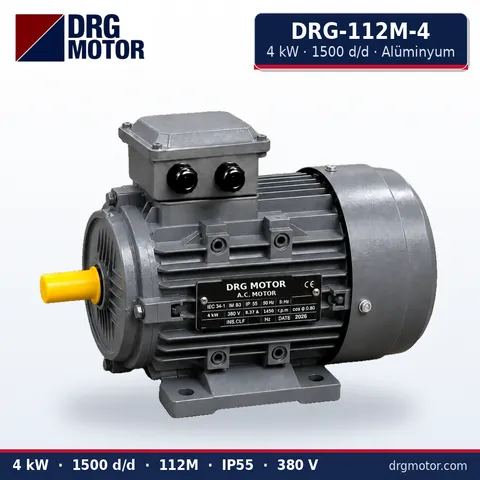
4 kW Three-Phase Motor 1500 rpm – DRG-112M-4 Aluminium
- 4 kW · 1500 rpm (4 poles)
- Aluminium frame · IEC 112M
- Shaft: 28 × 60 mm
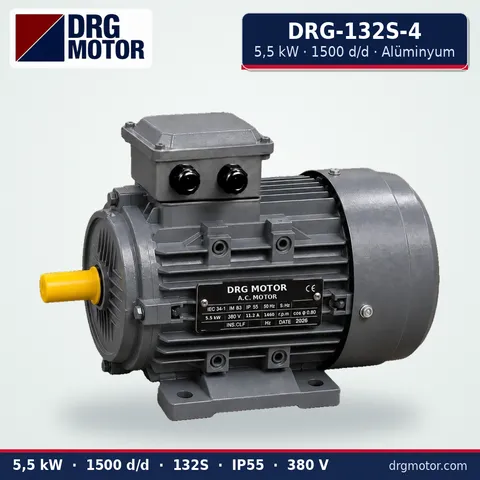
5.5 kW Three-Phase Motor 1500 rpm – DRG-132S-4 Aluminium
- 5.5 kW · 1500 rpm (4 poles)
- Aluminium frame · IEC 132S
- Shaft: 38 × 80 mm
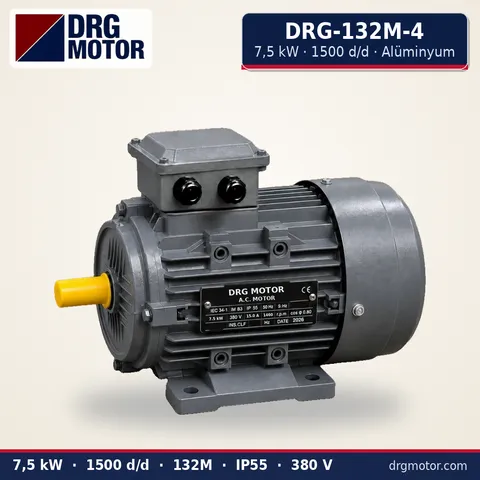
7.5 kW Three-Phase Motor 1500 rpm – DRG-132M-4 Aluminium
- 7.5 kW · 1500 rpm (4 poles)
- Aluminium frame · IEC 132M
- Shaft: 38 × 80 mm
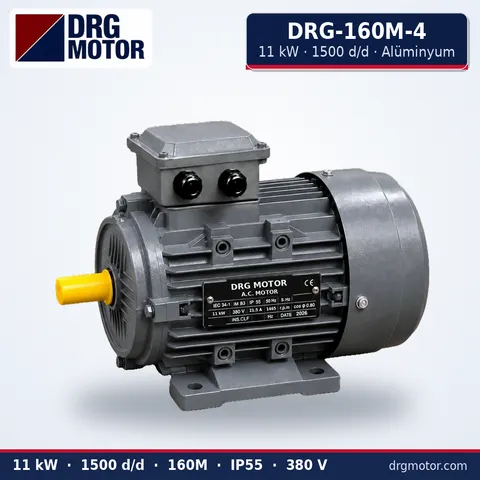
11 kW Three-Phase Motor 1500 rpm – DRG-160M-4 Aluminium
- 11 kW · 1500 rpm (4 poles)
- Aluminium frame · IEC 160M
- Shaft: 42 × 110 mm
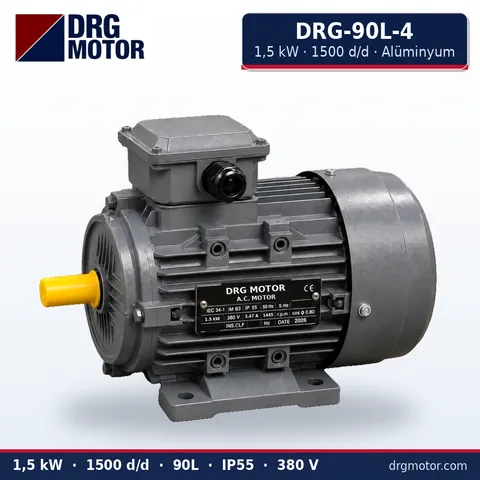
1.5 kW Three-Phase Motor 1500 rpm – DRG-90L-4 Aluminium
- 1.5 kW · 1500 rpm (4 poles)
- Aluminium frame · IEC 90L
- Shaft: 24 × 50 mm