English
 Le français
 Türkçe




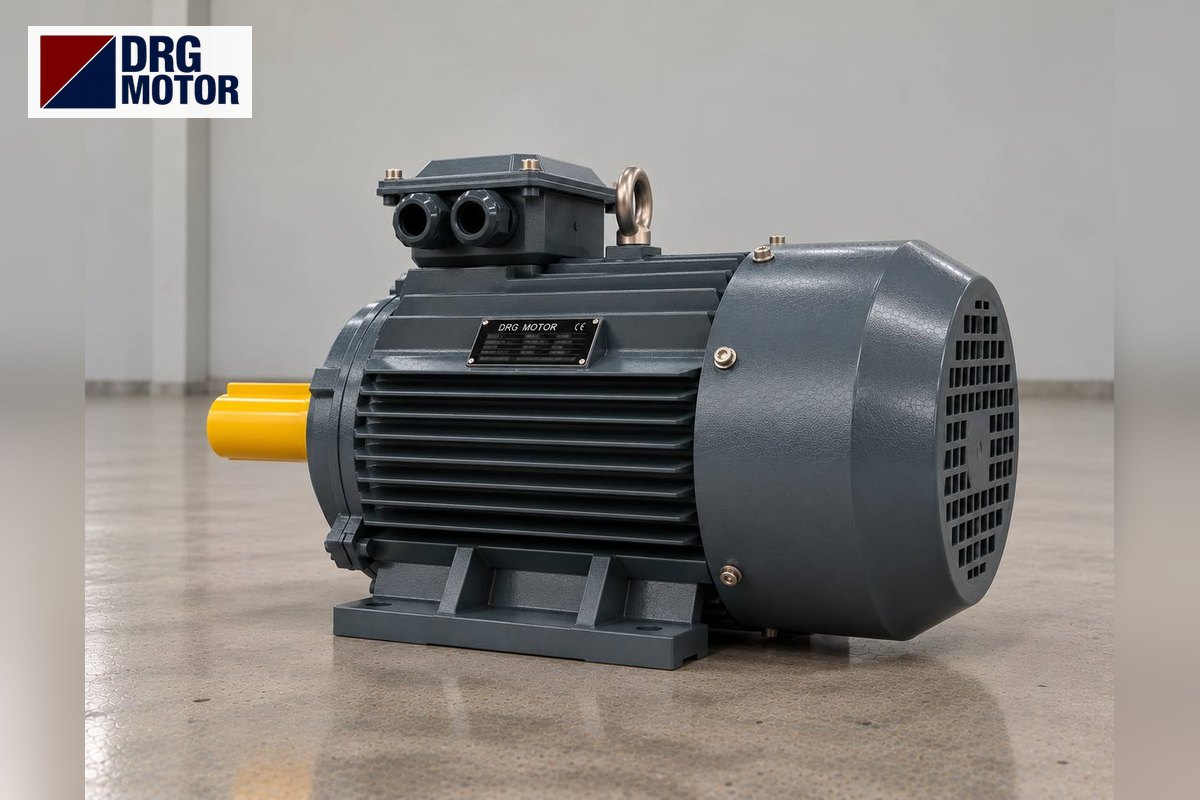

The grinder on a fish meal line is usually a hammer mill that turns dried and cooled press cake into meal. What strains the motor is not the hardness of the product but its fat: oil left in the cake smears the screen holes, the mill fills up and current rises. Motor selection is therefore based on feed control, salty and ammonia-laden air and the rotor's peripheral speed. The power value is taken from the machine builder's nameplate.
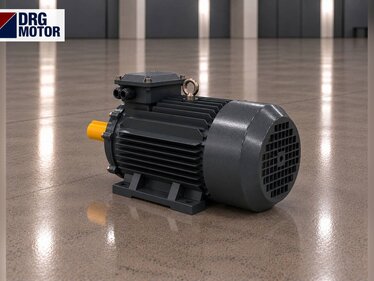
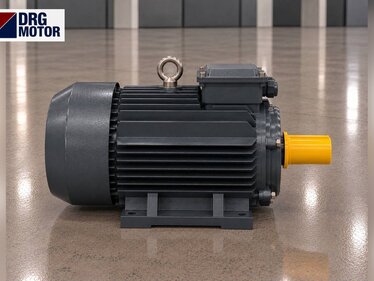
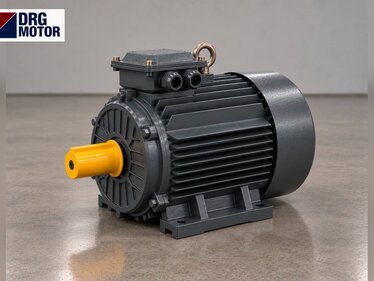
A hammer mill is driven by a 2-pole, foot-mounted (B3) cast iron motor coupled directly to the rotor. Suitable models in the 18.5–37 kW range are available in our online motor store.
From Cooker to Bag: Where Is the Grinder?
Fish is first cooked with steam, then a twin-screw press removes water and oil. The press cake, together with the concentrate recovered from the press liquor, is dried to about 8–10 percent moisture in a rotary-disc or steam-tube dryer, passes through a cooler and enters the grinder. The ground meal is screened, dosed with antioxidant and bagged.
Some lines have a second breaker for wet cake before the dryer; that machine is a low-speed, high-torque shredder and should not be confused with the grinder discussed here. This article covers the mill motor after drying, where dry cake is ground. Skipping the dryer and cooler and feeding hot cake straight into the mill both spoils meal quality and heats up the mill area.
How Fatty Cake Loads the Mill
Even after pressing, some oil remains in the cake. As the hammers throw the cake against the screen, friction produces heat, the fat softens and sticks to the screen surface along with fine meal. As the screen opening narrows, meal cannot leave, the material circulating inside the mill increases and motor current rises. This can build up within minutes and goes unnoticed until the overload trips.
The cause and the sign on the motor side match up as follows:
| Product condition | What happens in the mill? | Trace in the current |
|---|---|---|
| High-fat cake | Screen smears, meal recirculates | Slow, steady rise |
| Under-dried, moist cake | Lumping, screen blockage | Fluctuating, sudden jumps |
| Hot, uncooled cake | Fat turns fluid, sticks | Rise and housing heat |
| High bone content | Faster hammer and screen wear | Average creeps up over time |
| Tramp metal | Impact, broken hammer | Single sudden peak |
This is why a magnet at the mill inlet matters for the motor too. Hammer and screen condition should be checked before the replacement interval: worn hammers deliver the same fineness more slowly and load the motor harder.
Click to see current electric motor prices and order nowSEE PRICES →
Feed Control: Setting by Motor Current
What sets a hammer mill's power is the amount of product fed to it. On well-built lines the feed screw or rotary valve is inverter-driven and speeds up or slows down according to the mill motor's current. The target current is usually kept slightly below rated current.
Example / assumption: the mill is driven by a 22 kW DRG-180M-2, rated current 38.5 A at 400 V. If the feed control target is set at 0.9 times rated, i.e. about 34.6 A, feed automatically drops when the screen starts to smear, and the operator is alerted before the motor is overloaded. If capacity falls while current stays below this target, the problem lies with the screen or hammers, not the motor.
On mills without feed control, the operator sets the slide gate by watching the ammeter. A larger motor is not the answer here; a smeared screen smears with a bigger motor too, the fault is simply noticed later.
Rough power estimate
Example / assumption: if 3 tonnes per hour of dry cake are ground with 6 kWh of grinding energy per tonne, average shaft power is 18 kW. Adding a 20 percent margin for fat and moisture swings gives 21.6 kW, so a 22 kW motor fits. Actual specific energy varies with screen opening, cake fat and bone content; the exact value is the mill builder's data.
Rotor Speed, Pole Count and Direction of Rotation
A hammer mill's ability to grind fine depends on the peripheral speed of the hammer tips: v = π·D·n/60. For example, a 550 mm rotor turning at 2955 rpm gives a tip speed of about 85 m/s. To reach the same tip speed with a 4-pole motor (1470 rpm), the rotor diameter would have to grow to about 1.1 metres. This is why most fish meal mills are 2-pole; on an existing machine the pole count is never changed, because the rotor and hammers are balanced for a given speed.
On many hammer mills the hammers are symmetrical, and when one face wears the motor is reversed to use the other face. This is done by swapping two phases; on star-delta panels the change must be made at the main contactor input, not by altering two separate links at the motor terminal board. Direction is changed only after the motor has come to a complete stop.
Salty Air, Ammonia and Fish Meal Dust
Fish meal plants usually stand next to harbours. Salty sea air and the ammonia and amines released by decaying raw material quickly corrode unpainted steel surfaces, terminal screws and cable glands. The gaskets of an IP55 housing protect the terminal box, provided all cover screws are fitted and unused cable entries stay plugged. Spots where the paint has come off around the motor should be repaired periodically.
Because fish meal dust is oily, it sticks to the motor fins and fan cover and is harder to clean than dry grain dust. A dirty housing cools less, leaving the mill motor hotter at exactly the moments when it already runs at high current. The ignition risk of organic dust must be assessed in the plant risk analysis; where a hazardous dust zone is defined, an Ex-protected special motor is required, and it is not in the DRG range.
If the mill is near the dryer, measure the air temperature next to the motor; DRG motors are suitable for ambient temperatures of at most +40 °C.
Checks Before Replacement and Ordering
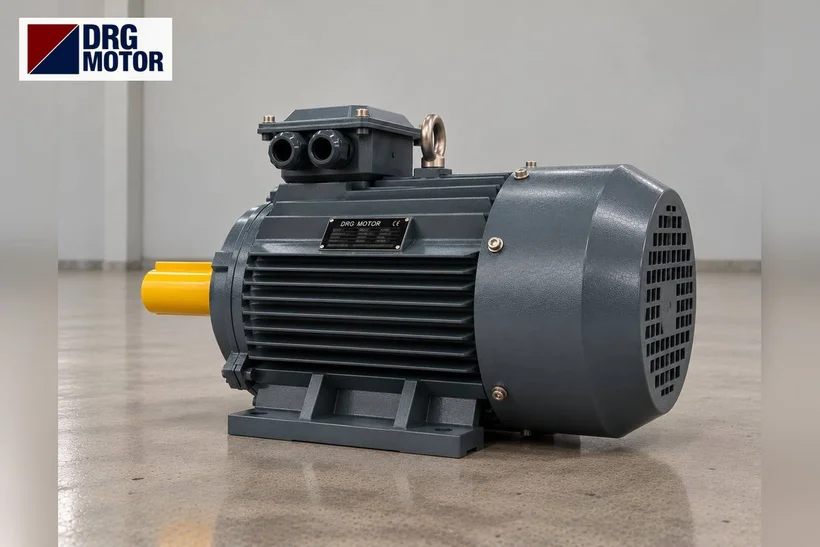
On a directly coupled mill, the motor's shaft height and foot holes must match the mill frame. Catalogue data for the DRG-180M-2:
- Power and speed: 22 kW – 2955 rpm – 38.5 A at 400 V
- Torque: 71.1 N·m; Ts/Tn 2.0; Is/In 8.2
- Housing: 180M cast iron, shaft height H 180 mm
- Feet: A 279 mm, B 241 mm, C 121 mm, 4 holes Φ14.5
- Shaft: 48 × 110 mm, key 14 mm; bearing 6311-C3
Clarify the following before ordering:
- Old motor nameplate: kW, speed (2 or 4 poles), voltage, current.
- Foot hole spacing A × B, shaft height H, shaft diameter and length; coupling hub bore.
- Starting: direct, star-delta or soft starter; does the motor need a 400/690 V winding?
- Is the mill's direction of rotation reversed periodically?
- Is the feed screw or rotary valve controlled by motor current?
- Air temperature measured next to the motor and distance to the dryer.
- Is a hazardous dust zone defined in the plant?
When the motor changes, the supply cable should also be checked against the new current; on long cable runs voltage drop makes starting harder. For the cross-section, use the motor cable size calculator.
DRG Motors for Fish Meal Grinders
2-pole cast iron models with 400/690 V windings, suitable for star-delta starting, for directly coupled hammer mills; they cover the power range from small lines to plants handling several tonnes per hour.
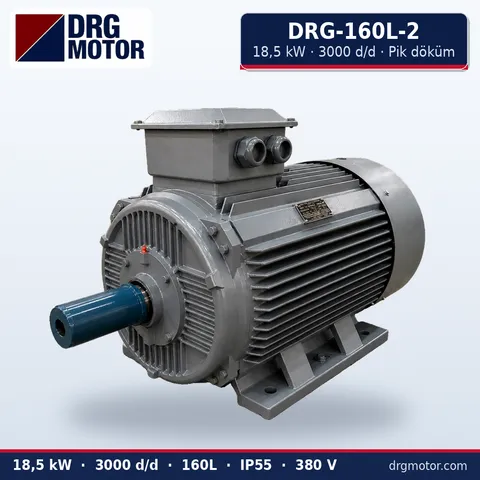
18.5 kW Three-Phase Motor 3000 rpm – DRG-160L-2 Cast Iron
- 18.5 kW · 3000 rpm (2 poles)
- Cast iron frame · IEC 160L
- Mounting: B3 · B5 · B14 · B35
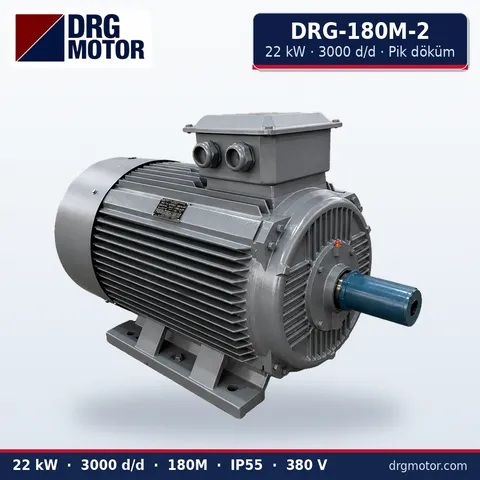
22 kW Three-Phase Motor 3000 rpm – DRG-180M-2 Cast Iron
- 22 kW · 3000 rpm (2 poles)
- Cast iron frame · IEC 180M
- Mounting: B3 · B5 · B14 · B35
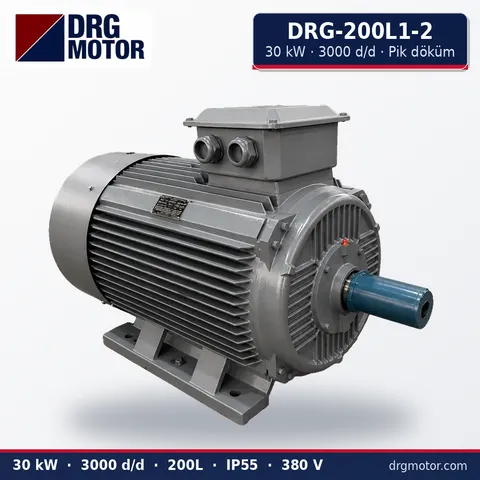
30 kW Three-Phase Motor 3000 rpm – DRG-200L1-2 Cast Iron
- 30 kW · 3000 rpm (2 poles)
- Cast iron frame · IEC 200L
- Mounting: B3 · B5 · B14 · B35
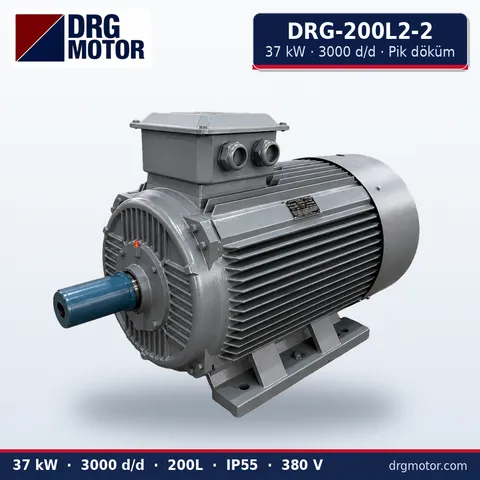
37 kW Three-Phase Motor 3000 rpm – DRG-200L2-2 Cast Iron
- 37 kW · 3000 rpm (2 poles)
- Cast iron frame · IEC 200L
- Mounting: B3 · B5 · B14 · B35
Click to see current prices and order these motors nowSEE PRICES →
Questions About Fish Meal Mill Motors
Why does a fish meal mill motor trip on overload?
Mostly because fatty cake smears the screen, the cake is not dry enough, or it reaches the mill without cooling. If current creeps up slowly, check the screen; if it shows sudden peaks, check the feed and tramp metal.
Can a 4-pole motor replace a 2-pole one on a fish meal grinder?
Not on an existing mill. Rotor and hammers are balanced for a given speed; if speed halves, tip speed drops and the meal does not reach the required fineness. Pole count changes only with the mill builder's design.
Why do motors rust in a fish meal plant?
Salty sea air and ammonia from the raw material corrode terminal screws and unpainted surfaces. Keeping the terminal cover closed with its gasket, plugging unused cable entries and repairing paint extend service life.
What kW motor does a fish meal grinder need?
It depends on capacity, screen opening and cake fat content. Small lines use 15–22 kW, larger plants higher ratings; the exact value is on the mill nameplate.
DRG Motor is a manufacturer, supplier and seller of electric motors. So that we can prepare a quotation for your mill, send a photo of the motor nameplate, its power and speed, whether it is foot- or flange-mounted, the shaft and foot dimensions, the starting method and a short note on the mill via WhatsApp, or add the models through the quote list. You can reach us at +90 (542) 666 11 11 and info@drgmotor.com; address details are on the contact page. Motor groups for grinding machines are on the feed grinding and milling machine motors page, and all models are listed in our electric motor store.