English
 Le français
 Türkçe




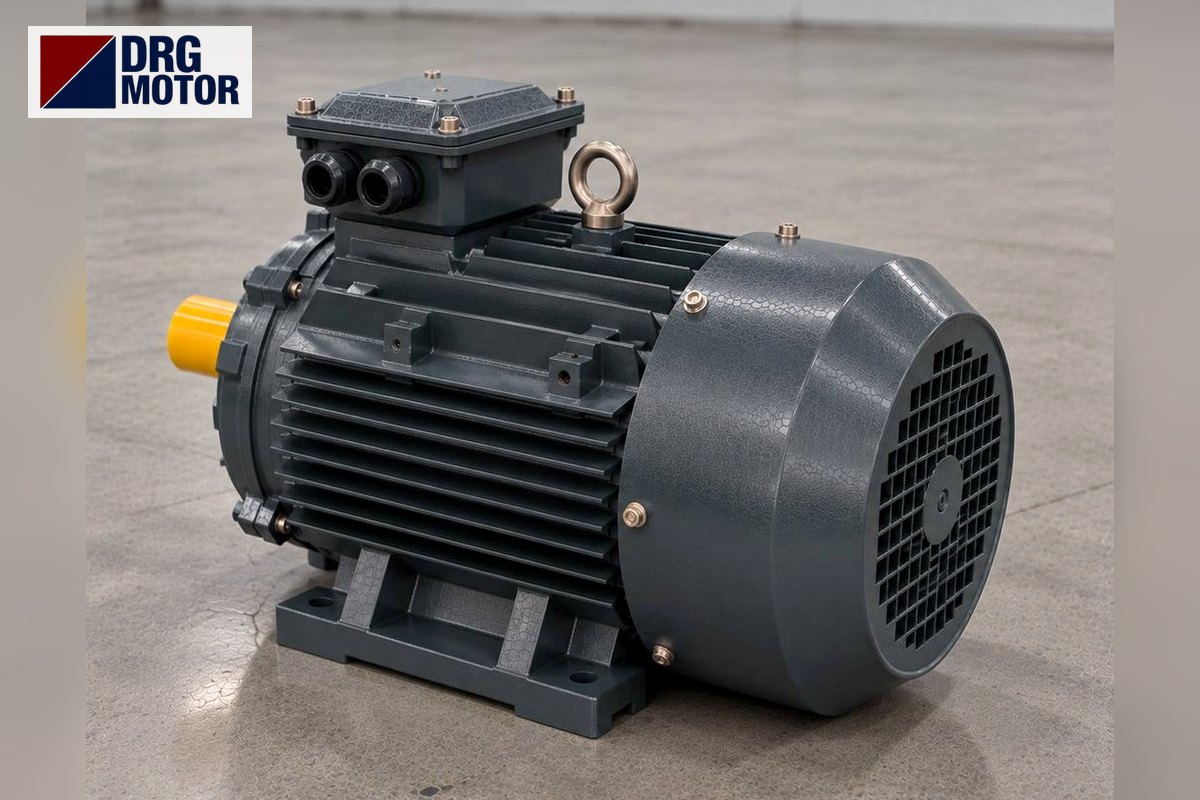

The electrical power a three-phase motor draws from the mains is found with P = √3 · U · I · cosφ, where U is the line-to-line voltage (V), I the line current (A) and cosφ the power factor; the result is in watts, divide by 1000 for kW. The kW on the nameplate is different: it is the mechanical power taken from the shaft.
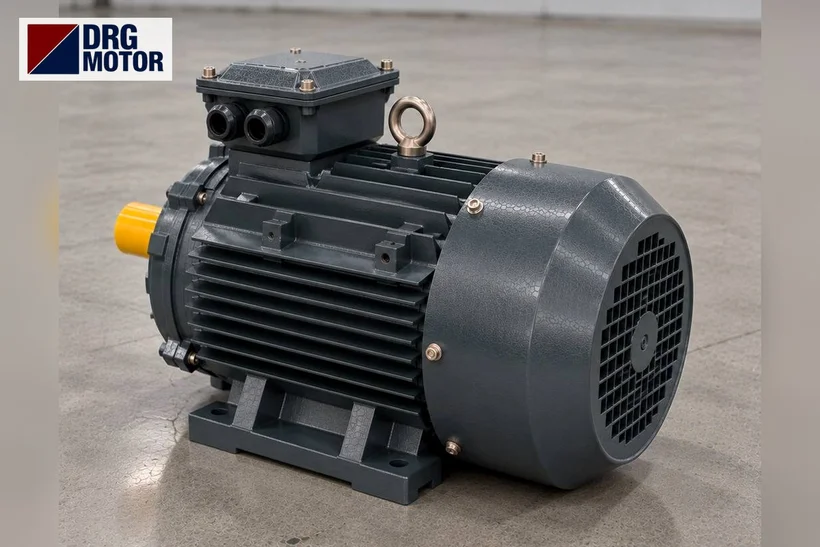
This article explains the three-phase power formula, the difference between the power drawn from the mains and the shaft power, and the concepts of power factor (cosφ) and efficiency (η), step by step with examples. DRG Motor is a manufacturer, supplier and seller of electric motors; to see the formula values on real models, browse every power in the online motor shop.
The three-phase power formula: P = √3 · U · I · cosφ
In three-phase systems the electrical power is the single-phase formula with the factor √3 (about 1.732) added. The parts read as follows:
- U — line-to-line voltage, usually 400 V.
- I — current in each line, in amperes (A).
- cosφ — power factor; the cosine of the phase shift between current and voltage, a dimensionless number between 0 and 1.
- √3 — the fixed factor of a three-phase connection.
The value this formula gives is the active (real) power drawn from the mains, not the apparent power. If you drop cosφ and write only √3·U·I, you get the apparent power (kVA); to get the power actually consumed you must multiply by cosφ.
What is the power factor (cosφ)?
An asynchronous motor also draws a magnetising current from the mains to build its rotating field. Part of the current is therefore a non-working (reactive) component, and a phase shift appears between current and voltage. cosφ measures this shift: the closer it is to 1, the greater the share of the drawn current turned into real work. The value depends on the motor, the load and the speed class; the exact cosφ is always printed on the nameplate. As the load falls cosφ drops, so calculations should use the motor's real operating point.
Power drawn from the mains, or shaft power?
This is the point most often confused: the kW on the nameplate is the mechanical power taken from the shaft (output power). The electrical power drawn from the mains is somewhat higher; the difference is the winding, iron, friction and ventilation losses. The ratio between the two is the efficiency (η):
η = Pshaft / Pmains → Pmains = Pshaft / η
η is dimensionless and always less than 1; the fewer the losses, the closer η gets to 1. So √3·U·I·cosφ gives you the power drawn from the mains; to obtain the shaft power on the nameplate you multiply it by η. In the other direction, to find the current from the nameplate kW the formula becomes:
I = Pshaft / (√3 · U · cosφ · η)
That is why two motors of the same shaft power can draw different currents if their cosφ and η differ.
Click to see current electric motor prices and order nowSEE PRICES →
Worked example: a 4 kW, 400 V motor
Take a 4-pole DRG-112M-4 delivering 4 kW at the shaft. Its nameplate current at 400 V is 7.95 A. Taking the power factor as cosφ = 0.82 for example, the power drawn from the mains is:
P = √3 · 400 · 7.95 · 0.82 ≈ 4.52 kW
So while the shaft power is 4 kW, about 4.52 kW is drawn from the mains; the difference is the losses inside the motor, expressed by η. The cosφ here is only an example; always read U, I and cosφ from your own motor's nameplate. For the reverse question — "how many amps does a motor of this power draw?" — check the ready values in the motor current chart, or the electric motor calculator for combined calculations.
1500 rpm DRG models by power and their currents
The table below lists the shaft power and 400 V rated current of some 4-pole (1500 rpm) DRG models. Using these currents in the formula you can verify each model's drawn power yourself. The model codes link straight to the product page; the whole range is listed in the three-phase asynchronous electric motors category.
| Model | Shaft power | Rated current (400 V) | Speed class |
|---|---|---|---|
| DRG-112M-4 | 4 kW | 7.95 A | 4-pole / 1500 rpm |
| DRG-132S-4 | 5.5 kW | 10.7 A | 4-pole / 1500 rpm |
| DRG-132M-4 | 7.5 kW | 14.3 A | 4-pole / 1500 rpm |
| DRG-160M-4 | 11 kW | 20.4 A | 4-pole / 1500 rpm |
When choosing, say, the DRG-132M-4 (7.5 kW) or the DRG-160M-4 (11 kW), you can predict the current with the same formula and pick the right cable with the motor cable size calculator.
Common mistakes in power calculation
- Forgetting cosφ: writing only √3·U·I gives the apparent power (kVA), not the motor's real power.
- Equating shaft power with drawn power: the nameplate kW is the output; the power drawn from the mains is higher by the losses.
- Wrong voltage: confusing the 400 V line-to-line with the 230 V phase-to-neutral voltage changes the result completely.
- Assuming a fixed cosφ: cosφ varies with load and drops on a lightly loaded motor.
Before any electrical work, switch off the power, verify it is dead, and let only authorised electrical staff do the wiring/measurement. Always compare the current and voltage you measure with the rated values on the motor nameplate.
Send a photo of your current motor nameplate and we will find the suitable DRG model together.Send on WhatsApp
Compare the power, current and speed options of 1500 rpm three-phase asynchronous motors in the shopSEE PRICES
Frequently asked questions
Why is three-phase power multiplied by √3?
In a three-phase system three separate phases carry power at the same time. When total active power is computed from the line-to-line voltage and the line current, the factor √3 (about 1.732) from the geometric sum of the three phases enters the formula. That is why three-phase power is P = √3 · U · I · cosφ.
Is the kW on the nameplate the power drawn?
No. The nameplate kW is the mechanical output power taken from the shaft. The electrical power drawn from the mains is somewhat higher because of the losses inside the motor; the ratio between the two is defined by the efficiency (η).
Where do I find the cosφ value?
The power factor is one of the motor's rated values and is printed on the nameplate. Since cosφ drops as the load falls, precise calculations use the value at the motor's real operating point.
Once I know the drawn power, how do I find the current?
Rearrange the formula for current: I = P / (√3 · U · cosφ). If you start from the shaft power, the efficiency (η) also goes into the denominator. For ready values use the motor current chart.
Electric Motors Related to This Topic — Models and Current Prices
Suitability is not decided by power alone: compare the speed, voltage, mounting, shaft and fixing dimensions of your machine with the product data; if unsure, send us the nameplate of your current motor.

4 kW Three-Phase Motor 1500 rpm – DRG-112M-4 Aluminium
- 4 kW · 1500 rpm (4 poles)
- Aluminium frame · IEC 112M
- Shaft: 28 × 60 mm
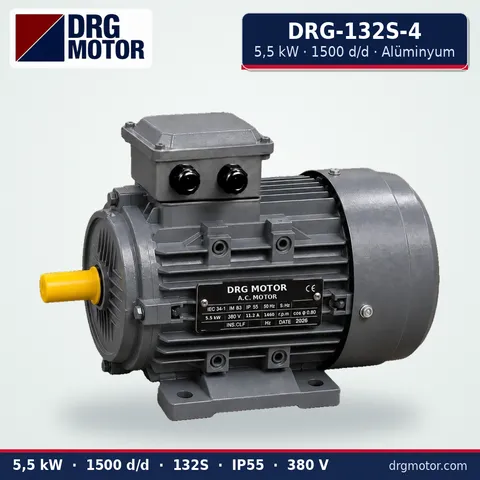
5.5 kW Three-Phase Motor 1500 rpm – DRG-132S-4 Aluminium
- 5.5 kW · 1500 rpm (4 poles)
- Aluminium frame · IEC 132S
- Shaft: 38 × 80 mm
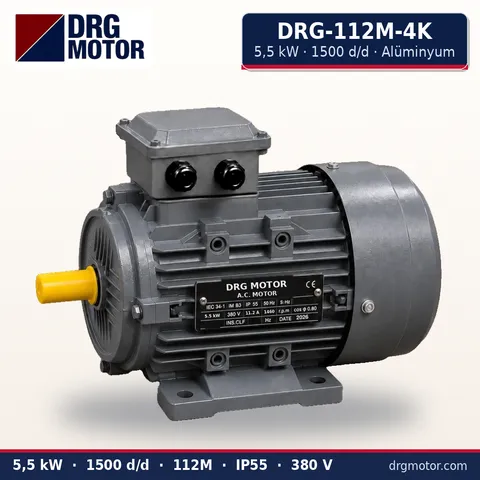
5.5 kW Compact Three-Phase Motor 1500 rpm – DRG-112M-4K Aluminium
- 5.5 kW · 1500 rpm (4 poles)
- Aluminium frame · IEC 112M
- Shaft: 28 × 60 mm
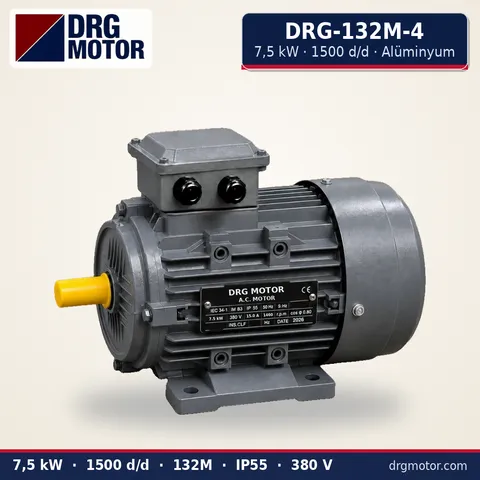
7.5 kW Three-Phase Motor 1500 rpm – DRG-132M-4 Aluminium
- 7.5 kW · 1500 rpm (4 poles)
- Aluminium frame · IEC 132M
- Shaft: 38 × 80 mm
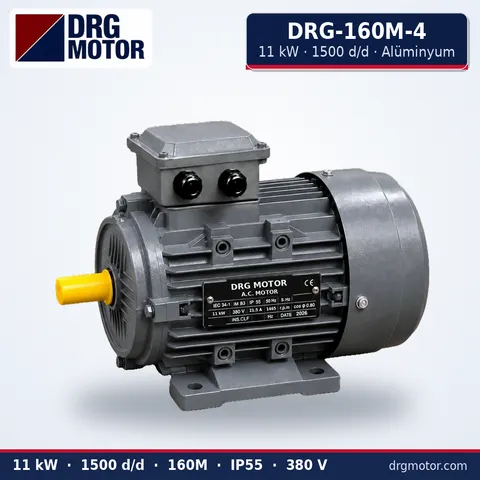
11 kW Three-Phase Motor 1500 rpm – DRG-160M-4 Aluminium
- 11 kW · 1500 rpm (4 poles)
- Aluminium frame · IEC 160M
- Shaft: 42 × 110 mm
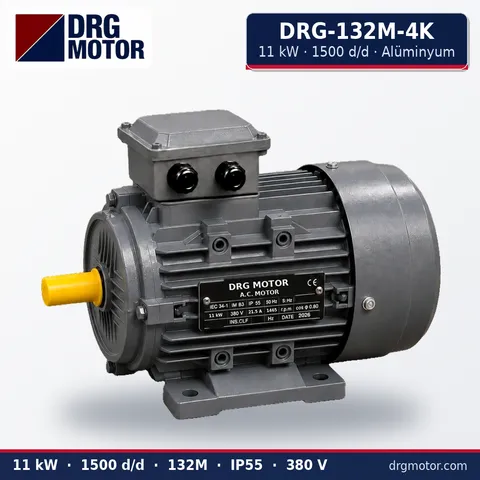
11 kW Compact Three-Phase Motor 1500 rpm – DRG-132M-4K Aluminium
- 11 kW · 1500 rpm (4 poles)
- Aluminium frame · IEC 132M
- Shaft: 38 × 80 mm