English
 Le français
 Türkçe




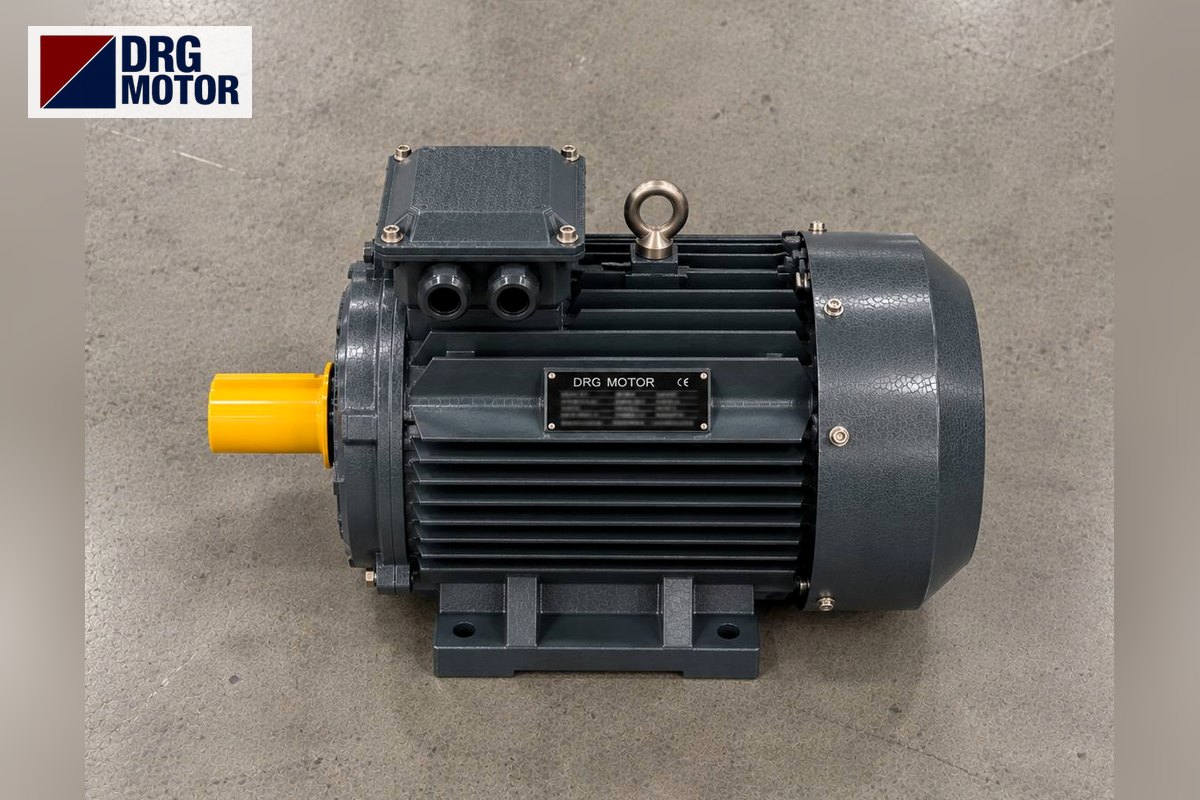

A constant hum, a metallic ticking or a thin whistle from your electric motor usually comes from a bearing. Bearing noise is the first sign that the balls and races are starting to deteriorate — often because the grease has dried out, the load is too high, the coupling is misaligned or moisture has got in. Assessing it and replacing the bearing in good time, before the noise grows and the housing heats up, protects both the motor and the driven machine.
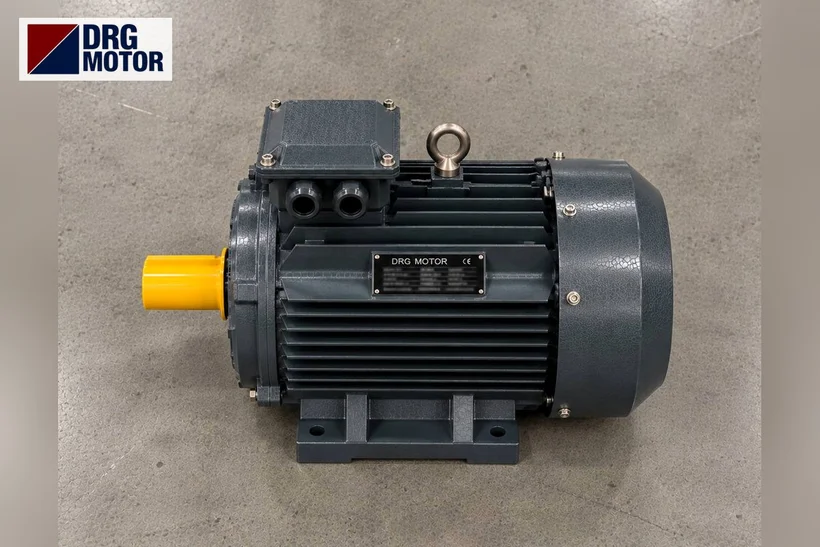
DRG Motor is a manufacturer, supplier and seller of electric motors. You can review suitable three-phase models by power and speed in the online motor shop, and see the same motors together in the three-phase asynchronous electric motors category.
What does bearing noise sound like?
A healthy bearing makes a faint, even whisper. In a failing bearing the sound changes character and grows with load or speed. The three most common sounds separate out like this:
- Hum / rumble: balls rolling roughly over the race as the grease dries out or becomes contaminated. Usually the first sound to appear, rising over time.
- Metallic ticking / crackle: pitting on the race surface or cage damage. It repeats rhythmically, once per revolution.
- Thin whistle / squeal: friction in a bearing that has run dry or sits too tight. It often comes together with clear heating of the housing.
Note whether the noise rises only at no load or under load, and whether it comes from the drive (DE) end or the fan (NDE) end — this makes it easier to find the faulty bearing.
Signs of bearing failure
Noise is never judged alone; as a bearing fails, several signs usually appear together. The table below summarises the most common sign with its likely meaning and urgency.
| Sign | Likely meaning | Urgency |
|---|---|---|
| Steadily rising hum | Grease spent, surfaces roughened | Replace at planned service |
| Heat at the bearing area | More friction, oil film gone | Act soon |
| Vibration felt by hand | Race/ball damage, clearance grown | Act soon |
| Metallic ticking + shaft play | Advanced damage, bearing near collapse | Stop immediately |
If you feel roughness, catching or axial/radial play when you turn the shaft by hand, the bearing has reached the end of its life. When doing these checks, switch off the supply and confirm it is de-energised; the motor must not turn in any way.
Click to see current electric motor prices and order nowSEE PRICES →
Why do bearings fail?
Most bearing failures come not from the bearing itself but from the operating conditions. The most common causes are:
- Lubrication issue: grease drying out or becoming contaminated over time, or the bearing packed with the wrong or too much grease. Lubrication is the first factor that sets bearing life.
- Excessive or wrong load: over-tight belt and pulley, heavy radial load or unexpected axial thrust tire the race surface early.
- Misalignment (coupling): if the motor shaft and the driven machine are not on the same axis, the bearing is constantly stressed. Correct coupling and belt alignment extends bearing life.
- Moisture and dirt: water, dust or chips getting inside break down the grease film; corrosion and wear accelerate. Sealing matters in damp environments.
- High temperature: in a motor that runs hot continuously, the grease loses its properties faster, which shortens bearing life.
If several motors start making bearing noise after the same period, the common cause is usually alignment, belt tension or the environment (moisture, dust, temperature).
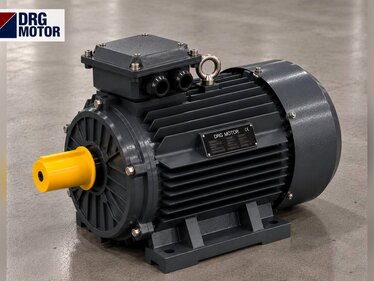
Bearing type and size are read from the nameplate
The most reliable way to find the right spare bearing is to know the motor's details. The bearing type is often printed separately on the motor's nameplate; different sizes may be given for the DE (drive end) and NDE (non-drive end). If there is no bearing code on the plate, the motor's technical document is checked by frame size and shaft diameter. So photographing the nameplate and noting the shaft diameter before dismantling makes the job easier.
For example, on DRG three-phase motors the frame size (IEC) and shaft diameter are clear on the plate: the DRG-112M-4 has a 112M frame and 28 mm shaft, while the DRG-132M-4 comes with a 132M frame and 38 mm shaft. The bearing size follows from this frame family.
Grease care extends bearing life
Most small-frame motors come with lifetime-greased sealed bearings; these are not re-greased, and when the noise rises the bearing is replaced as a unit. Larger frames may have a grease nipple; on these the right amount and type of grease is added periodically. Too much grease is as harmful as too little: it raises the bearing temperature. Decide which grease, how much and at what interval according to the motor's document; do not set exact figures yourself.
Example DRG three-phase motors by power
If you decide to renew an old motor whose bearing has been changed several times, you can continue with a model of the same power and speed. Below are aluminium-frame examples from the 1500 rpm (4-pole) class; each code links to its product page.
| Model | Power | Torque | Rated current (400 V) |
|---|---|---|---|
| DRG-112M-4 | 4 kW | 26.3 Nm | 7.95 A |
| DRG-132S-4 | 5.5 kW | 36.0 Nm | 10.7 A |
| DRG-132M-4 | 7.5 kW | 49.1 Nm | 14.3 A |
| DRG-160M-4 | 11 kW | 71.7 Nm | 20.4 A |
If you need more power you can reach 11 kW models such as the DRG-160M-4, and for other speeds the whole range, in the online motor shop.
Replace the bearing or the motor?
The decision depends on how far the noise has gone and on the motor's history. At an early stage (light hum, no heat) a bearing change is often the economical and sufficient solution. But if the bearing has collapsed and scored the shaft or the bearing seat, if the winding was damaged as well, or if it is an old motor rewound and re-beared many times, moving to a new motor is safer.
Always have the bearing replaced by an authorised service or a properly equipped rewinding/motor workshop. Removing and fitting a bearing needs a proper puller and press; a wrong fit soon ruins the new bearing too. Before the work, switch off the supply, confirm it is de-energised and hand the motor to qualified personnel.
Send a photo of your current motor nameplate and we will find the suitable DRG model together.Send on WhatsApp
Click to see the current price of a new three-phase motor to match your power ratingSEE PRICES
Frequently asked questions
Can I keep running a motor that makes bearing noise?
For a short time it may be possible, but it is not advised. As the noise grows the bearing can collapse; a collapsed bearing scores the shaft and seat and makes the repair costlier. Once the noise is clear, stop the motor in a planned way and have it checked.
Can I change the bearing myself?
Without a proper puller, press and heating, bearing fitting will not be sound; a wrongly fitted bearing soon makes noise again. It is therefore best to leave the replacement to an authorised service.
I fitted a new bearing but the noise continues — why?
Often the real cause is not the bearing but the condition that damaged it: coupling misalignment, over-tight belt or a deformed bearing seat. Unless that cause is removed, the new bearing will soon be noisy too.
How do I find out which bearing to buy?
The most reliable way is the bearing code on the motor nameplate. If it is not there, the motor's technical document is checked by frame size and shaft diameter. If unsure, send us a photo of the nameplate and we will work it out together.
Electric Motors Related to This Topic — Models and Current Prices
Suitability is not decided by power alone: compare the speed, voltage, mounting, shaft and fixing dimensions of your machine with the product data; if unsure, send us the nameplate of your current motor.

4 kW Three-Phase Motor 1500 rpm – DRG-112M-4 Aluminium
- 4 kW · 1500 rpm (4 poles)
- Aluminium frame · IEC 112M
- Shaft: 28 × 60 mm
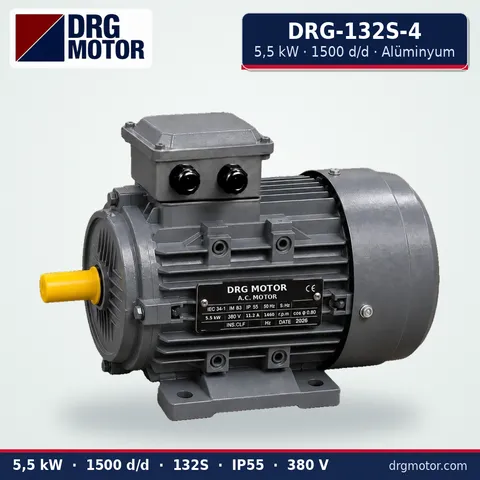
5.5 kW Three-Phase Motor 1500 rpm – DRG-132S-4 Aluminium
- 5.5 kW · 1500 rpm (4 poles)
- Aluminium frame · IEC 132S
- Shaft: 38 × 80 mm
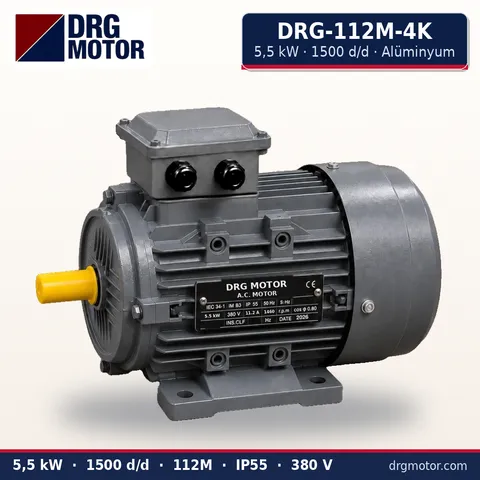
5.5 kW Compact Three-Phase Motor 1500 rpm – DRG-112M-4K Aluminium
- 5.5 kW · 1500 rpm (4 poles)
- Aluminium frame · IEC 112M
- Shaft: 28 × 60 mm
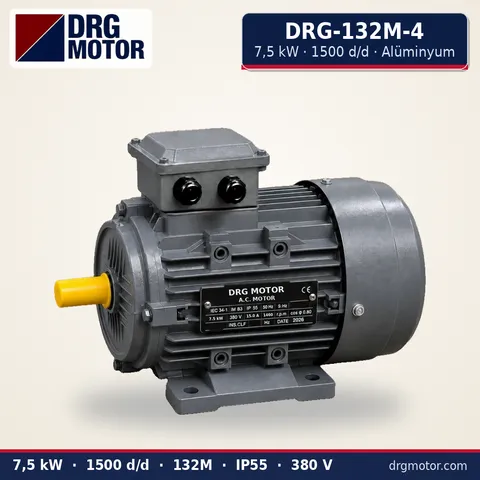
7.5 kW Three-Phase Motor 1500 rpm – DRG-132M-4 Aluminium
- 7.5 kW · 1500 rpm (4 poles)
- Aluminium frame · IEC 132M
- Shaft: 38 × 80 mm
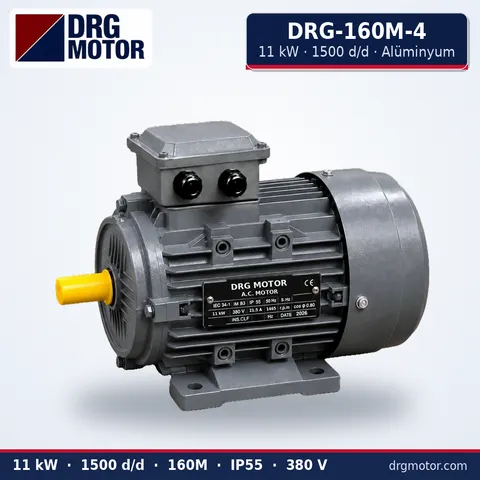
11 kW Three-Phase Motor 1500 rpm – DRG-160M-4 Aluminium
- 11 kW · 1500 rpm (4 poles)
- Aluminium frame · IEC 160M
- Shaft: 42 × 110 mm
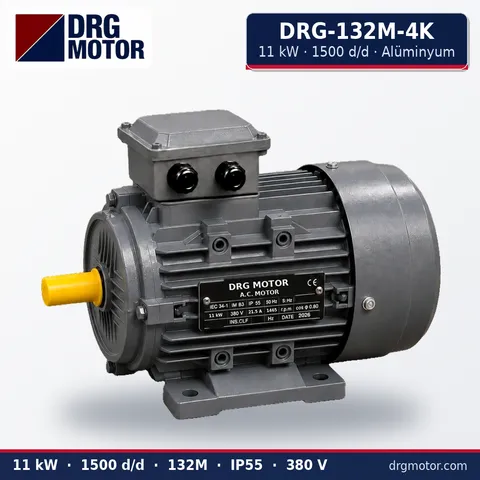
11 kW Compact Three-Phase Motor 1500 rpm – DRG-132M-4K Aluminium
- 11 kW · 1500 rpm (4 poles)
- Aluminium frame · IEC 132M
- Shaft: 38 × 80 mm