English
 Le français
 Türkçe




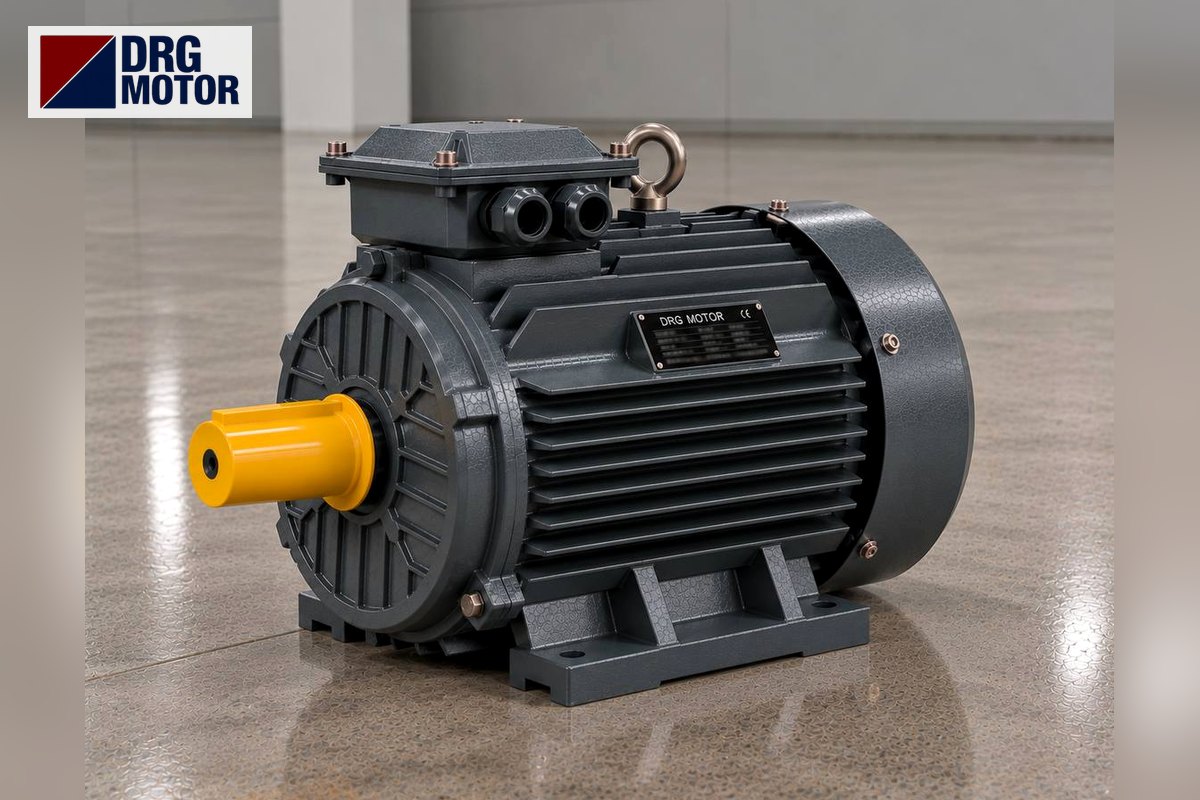

The main difference between a 4-pole and a 6-pole motor is speed: on the same 50 Hz supply the 4-pole motor has a synchronous speed of 1500 rpm and the 6-pole motor 1000 rpm. At the same power the slower 6-pole motor delivers higher torque and is usually built in a one-size-larger frame.
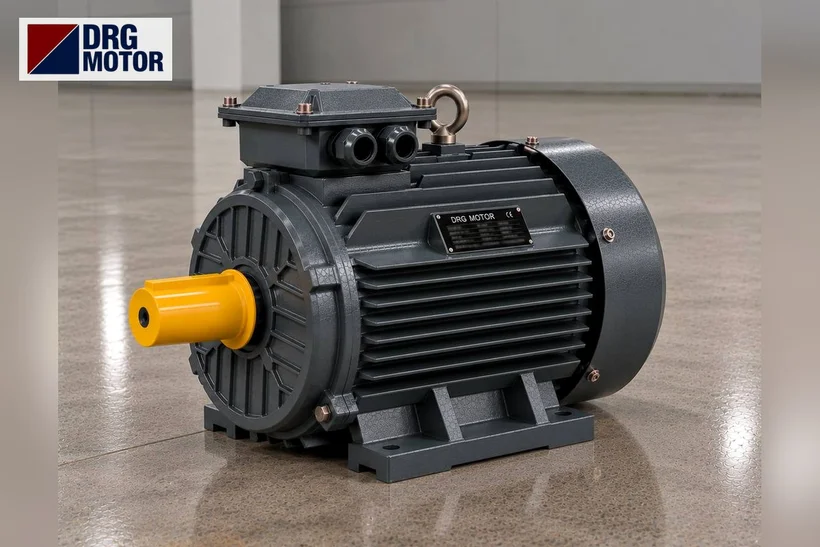
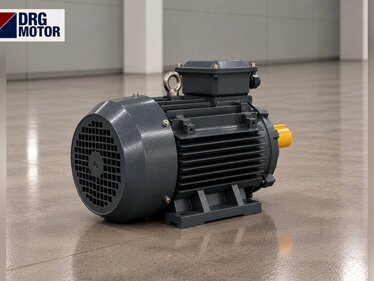
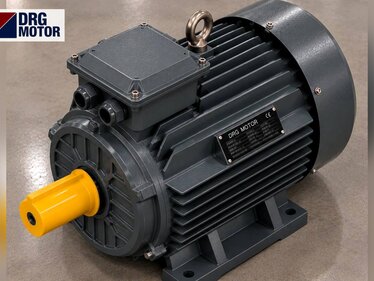
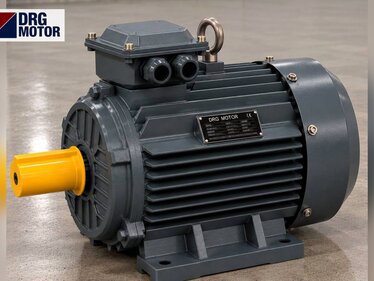
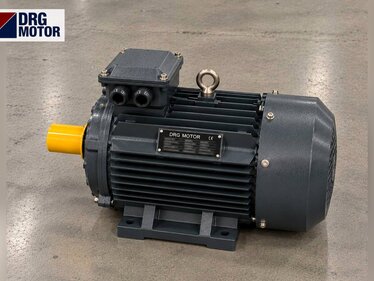
DRG Motor is a manufacturer, supplier and seller of electric motors. You can compare three-phase models of both speed classes by power and speed in the online motor shop, and see them all together in the three-phase asynchronous electric motors category.
How does pole number set the motor speed?
The running speed of a three-phase asynchronous motor depends on how fast the winding's magnetic field rotates, that is, on the synchronous speed. It is found from: n = 120 · f / p, where f is the supply frequency (50 Hz here) and p is the pole number. As the pole number rises, the synchronous speed falls:
- 2 poles: 120 · 50 / 2 = 3000 rpm (synchronous)
- 4 poles: 120 · 50 / 4 = 1500 rpm (synchronous)
- 6 poles: 120 · 50 / 6 = 1000 rpm (synchronous)
An asynchronous motor runs slightly below synchronous speed; this gap is called slip. So the loaded speed on the nameplate is a little under the synchronous value: a 4-pole motor runs at about 1450 rpm and a 6-pole motor at about 968 rpm.
Same power, 4 vs 6 poles: speed and torque
When speed drops, the same power is delivered at higher torque. Thinking of torque as T = 9550 · P / n, with power (kW) fixed, torque rises as speed falls. The table below compares a 4-pole and a 6-pole DRG model of equal power (4,0 kW).
| Property | 4-pole (DRG-112M-4) | 6-pole (DRG-132M1-6) |
|---|---|---|
| Synchronous speed | 1500 rpm | 1000 rpm |
| Loaded speed (approx.) | 1450 rpm | 968 rpm |
| Rated torque | 26.3 Nm | 39.5 Nm |
| Rated current (400 V) | 7.95 A | 8.99 A |
| IEC frame / shaft | 112M / 28x60 mm | 132M / 38x80 mm |
At the same 4,0 kW the 6-pole model produces clearly higher torque (39.5 Nm) than the 4-pole model (26.3 Nm), but in a larger frame (132M) and on a thicker shaft (38x80 mm). Product pages: 4 kW 1500 rpm 4-pole model and 4 kW 1000 rpm 6-pole model.
Click to see current electric motor prices and order nowSEE PRICES →
Why does 6 poles need a larger frame?
The torque a motor transmits sets the mechanical load the shaft and frame must carry. Because a 6-pole motor produces higher torque at the same power, its shaft is thicker and its frame one size larger. In the example above the 4-pole model is 112M with a 28x60 mm shaft, while the 6-pole model rises to 132M with a 38x80 mm shaft. Keep this in mind when planning the mounting: moving from 4 to 6 poles at the same power can change foot/flange dimensions, shaft diameter and the coupling or pulley choice.
Which application suits 4 or 6 poles?
The choice is based not on power but on the speed and torque the application needs:
- 4 poles (about 1500 rpm): the most common medium-speed class. A balanced choice for conveyors, mixers, fans, general drives and most pumps.
- 6 poles (about 1000 rpm): low speed and high torque; preferred for hard-starting mechanisms and applications that must run slowly and smoothly, such as some mixers and handling systems.
As a reference, small pumps and fans that need very high speed use 2-pole (about 3000 rpm) models; for instance the equal-power 4 kW 3000 rpm 2-pole model gives only 13.1 Nm. So as the pole number rises, speed falls and torque increases. If you are replacing a motor, the safest path is to read the speed on its nameplate and keep the same pole number. To check the required power and current, use the electric motor calculator and the motor current chart.
Frame material and connection
Both 4-pole and 6-pole models come in aluminium and cast iron; the electrical values (power, speed, torque, current) do not change with the housing material. Aluminium is lighter and easy to mount; cast iron is heavier and more rugged. For the cast iron version of the same 6-pole model see the cast iron 6-pole model, and for the 4-pole cast iron version the cast iron 4-pole model.
Both classes run on a 400 V three-phase supply. Always wire the motor according to the diagram on its nameplate and the panel documentation. Before any electrical work, switch off the power, verify that it is de-energised, and have the connection made only by qualified electrical personnel. Set protection values such as thermal current from the rated current on the motor nameplate, not from memory.
Send a photo of your current motor nameplate and we will find the suitable DRG model together.Send on WhatsApp
If you are unsure whether 4 or 6 poles suit your application, you can compare all power and speed options in the shop.
See the models and current prices of 4-pole and 6-pole three-phase asynchronous motors in the shopSEE PRICES
Frequently asked questions
How many rpm does a 4-pole motor run at?
On a 50 Hz supply a 4-pole motor has a synchronous speed of 1500 rpm; because of slip it runs at about 1450 rpm under load. The exact value is on the motor nameplate.
Why does a 6-pole motor seem stronger?
It is not more powerful, it has higher torque. Because speed is lower at the same power, torque rises; a 4,0 kW 6-pole model gives about 39.5 Nm while the equal-power 4-pole model gives 26.3 Nm. The power (kW) is the same on both.
Can I replace a 4-pole motor with a 6-pole one?
If your speed need fits 1000 rpm, yes, but always check the mechanical fit because frame size, shaft diameter and foot/flange dimensions can change. If the speed must stay the same, keep the same pole number.
Why do synchronous speed and nameplate speed differ?
An asynchronous motor runs slightly below the field's synchronous speed; this gap is called slip. So a 1500 rpm synchronous motor runs at about 1450 rpm under load and a 1000 rpm synchronous motor at about 968 rpm.
Electric Motors Related to This Topic — Models and Current Prices
Suitability is not decided by power alone: compare the speed, voltage, mounting, shaft and fixing dimensions of your machine with the product data; if unsure, send us the nameplate of your current motor.
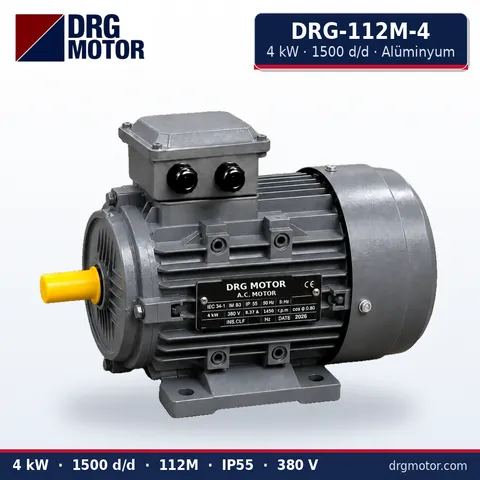
4 kW Three-Phase Motor 1500 rpm – DRG-112M-4 Aluminium
- 4 kW · 1500 rpm (4 poles)
- Aluminium frame · IEC 112M
- Shaft: 28 × 60 mm
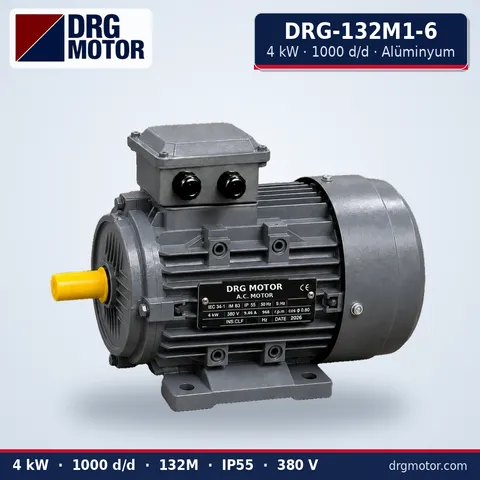
4 kW Three-Phase Motor 1000 rpm – DRG-132M1-6 Aluminium
- 4 kW · 1000 rpm (6 poles)
- Aluminium frame · IEC 132M
- Shaft: 38 × 80 mm
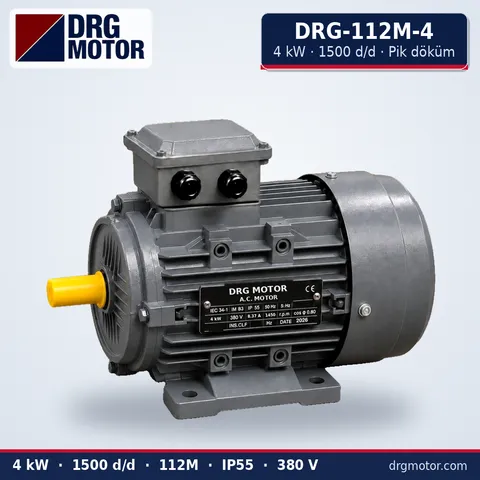
4 kW Three-Phase Motor 1500 rpm – DRG-112M-4 Cast Iron
- 4 kW · 1500 rpm (4 poles)
- Cast iron frame · IEC 112M
- Shaft: 28 × 60 mm
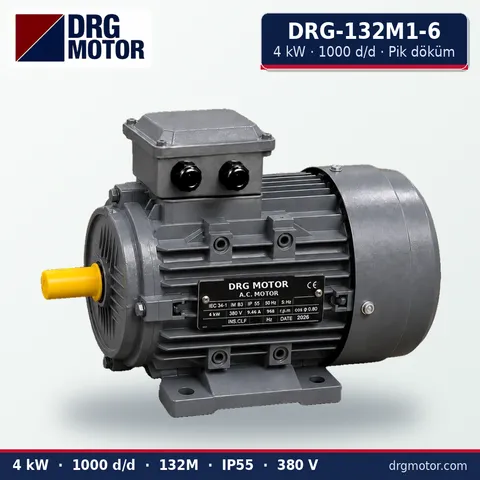
4 kW Three-Phase Motor 1000 rpm – DRG-132M1-6 Cast Iron
- 4 kW · 1000 rpm (6 poles)
- Cast iron frame · IEC 132M
- Shaft: 38 × 80 mm