English
 Le français
 Türkçe




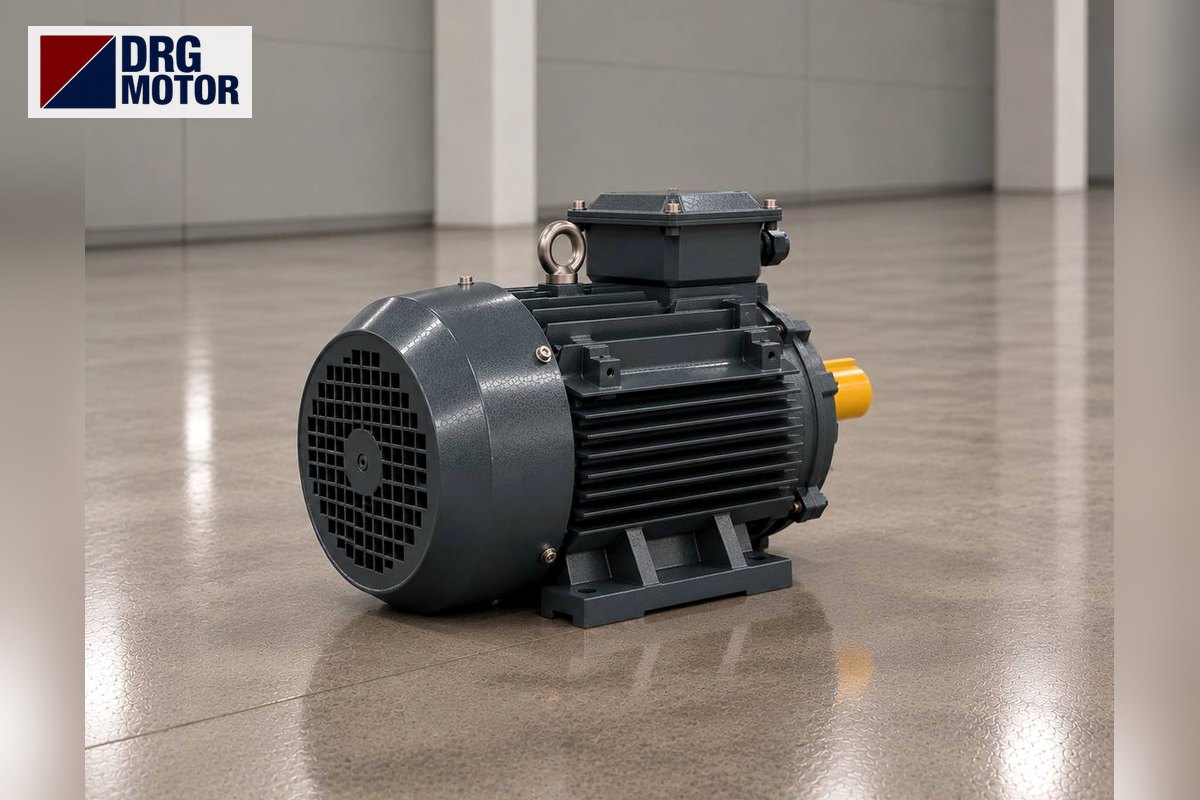

"1 kW electric motor" is a very common search, yet the IEC power steps do not include a three-phase asynchronous motor rated at exactly 1 kW. The closest standard power to that value is 1.1 kW. If your project mentions "1 kW", the motor you actually need is almost always a 1.1 kW three-phase asynchronous motor.
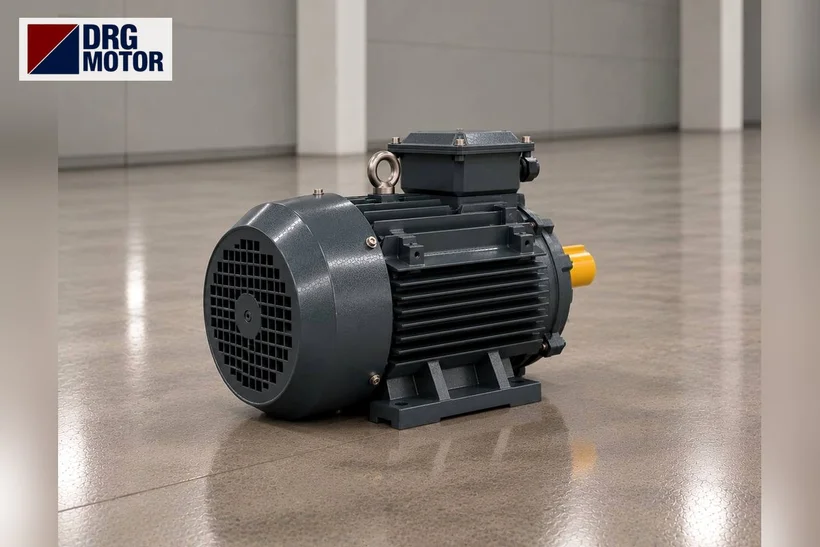
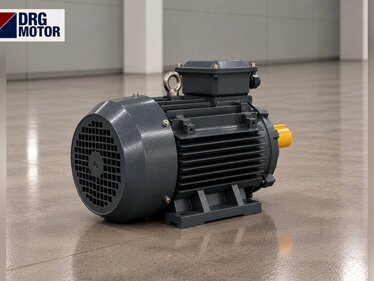
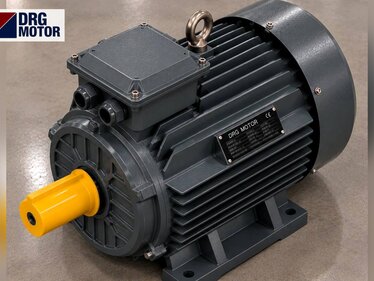
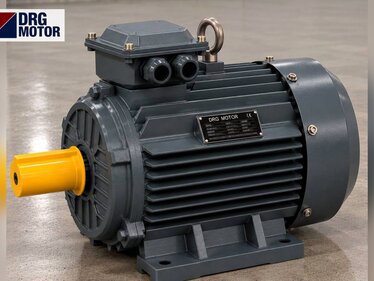
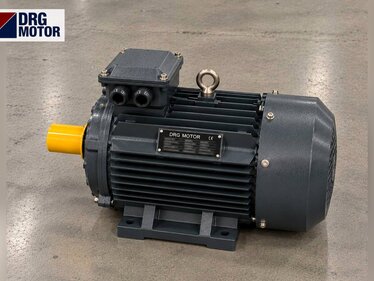
DRG Motor is a manufacturer, supplier and seller of electric motors. You can find every 1.1 kW three-phase model by power and speed in the online motor shop. The same motors are also listed together in the three-phase asynchronous electric motors category.
Why isn't 1 kW on the standard motor list?
Rated motor powers are not arbitrary; they follow internationally agreed steps. On the low-power side these steps run roughly 0.55 – 0.75 – 1.1 – 1.5 – 2.2 kW. Notice that the only intermediate step between 0.75 kW and 1.5 kW is 1.1 kW; there is no separate 1.0 kW rung. That is why a user looking for a "1 kW motor" always meets 1.1 kW in real products.
This small difference works in your favour: 1.1 kW comfortably covers a 1 kW load expectation and leaves a little margin for short load peaks. So the answer to "isn't 1 kW enough?" is simply to choose 1.1 kW as the standard product.
1.1 kW three-phase asynchronous motor: DRG models
In the DRG range 1.1 kW is available in three speed classes (2, 4 and 6 poles) and two housing materials (aluminium and cast iron). The table below shows each model's pole/speed class, rated torque and rated current at 400 V; the model codes link straight to the product page. The voltage on all of them is 230/400 V (Δ/Y).
| Model | Poles / Speed class | Torque | Rated current (400 V) |
|---|---|---|---|
| DRG-802-2-AL (aluminium) | 2-pole / 3000 rpm | 3.65 Nm | 2.31 A |
| DRG-90S-4-AL (aluminium) | 4-pole / 1500 rpm | 7.27 Nm | 2.48 A |
| DRG-90L-6-AL (aluminium) | 6-pole / 1000 rpm | 11.1 Nm | 2.69 A |
| DRG-802-2-GG (cast iron) | 2-pole / 3000 rpm | 3.65 Nm | 2.31 A |
| DRG-90S-4-GG (cast iron) | 4-pole / 1500 rpm | 7.27 Nm | 2.48 A |
| DRG-90L-6-GG (cast iron) | 6-pole / 1000 rpm | 11.1 Nm | 2.69 A |
The torque values can also be checked with T = 9550 · P / n: at constant power (kW) torque rises as speed falls. That is why the 6-pole 1000 rpm model delivers noticeably more torque than the 2-pole 3000 rpm model of the same power.
Click to see current electric motor prices and order nowSEE PRICES →
2, 4 or 6 poles: which speed suits your job?
The same 1.1 kW is offered at different speeds because an application usually needs a certain speed and torque rather than raw power:
- 2-pole (about 3000 rpm): high speed, low torque. Suited to small pumps, fans and high-speed applications.
- 4-pole (about 1500 rpm): the most common medium speed. A balanced choice for conveyors, mixers and general drives.
- 6-pole (about 1000 rpm): low speed, high torque. Preferred where heavy starting or low speed is required.
If you are replacing an existing motor, reading the speed on its nameplate and keeping the same pole count is the safest route. To check the required power and current you can use the electric motor calculator and the motor current chart.
Aluminium or cast iron housing?
In the 1.1 kW class both aluminium and cast iron housings exist, and the electrical figures (power, speed, torque, current) are identical in both. The difference is mechanical:
- Aluminium housing: lighter, easier to carry and mount. Practical for light machines and frequently relocated assemblies. The aluminium options are also grouped on the aluminium housing motors page.
- Cast iron housing: heavier and more robust; preferred where vibration and mechanical stress are high.
The choice is about picking what best fits the need; both housings deliver the same 1.1 kW performance.
230/400 V wiring and points to watch at low power
The 1.1 kW models are wound for 230/400 V (Δ/Y). On a 400 V three-phase supply the motor is connected in star (Y); on a 230 V three-phase supply it is connected in delta (Δ). The nameplate states which connection matches which voltage; always wire according to the motor nameplate and the panel documentation.
Before any electrical work, switch off the supply, confirm it is de-energised, and let only qualified electrical personnel make the connection. Set protection values such as the thermal current from the rated current on the nameplate, not from memory. For the cable cross-section, the motor cable size calculator is a helpful guide.
Choosing 1.1 kW instead of 1 kW: shaft and mounting
Standard 1.1 kW motors come in two IEC frame sizes depending on speed class. The 2-pole model sits in the 80 frame (19×40 mm shaft), while the 4- and 6-pole models sit in the 90 frame (24×50 mm shaft). So when replacing an old motor, compare not only the power but also the shaft diameter, foot/flange dimensions and mounting type (B3 foot, B5/B14 flange). Because couplings, pulleys and gearbox inputs are chosen by shaft diameter, this dimension is critical.
Send a photo of your current motor nameplate and we will find the suitable DRG model together.Send on WhatsApp
Once you have picked the right 1.1 kW model, you can compare all power and speed options and current prices through the shop.
See the models and current prices of 1.1 kW and neighbouring three-phase asynchronous motors in the shopSEE PRICES
Frequently asked questions
Are a 1 kW motor and a 1.1 kW motor the same thing?
In practice, yes. Since 1 kW is not made as a standard product, the answer to a 1 kW need is a 1.1 kW three-phase asynchronous motor; this small difference causes no load problem and even leaves a small margin.
How many horsepower (HP) is a 1.1 kW motor?
As 1 HP is about 0.746 kW, 1.1 kW corresponds to roughly 1.5 HP. Product pages state the power in both kW and HP.
What is the rated current of a 1.1 kW motor?
At 400 V it is about 2.3–2.7 A depending on the model; always check the motor nameplate for the exact value. The table above gives the current of each 1.1 kW DRG model.
Which speed class should I choose?
If you are replacing a motor, follow the speed on its nameplate. For a new application choose 2 poles when speed matters, 4 poles for balance, and 6 poles when high torque is needed.
Electric Motors Related to This Topic — Models and Current Prices
Suitability is not decided by power alone: compare the speed, voltage, mounting, shaft and fixing dimensions of your machine with the product data; if unsure, send us the nameplate of your current motor.
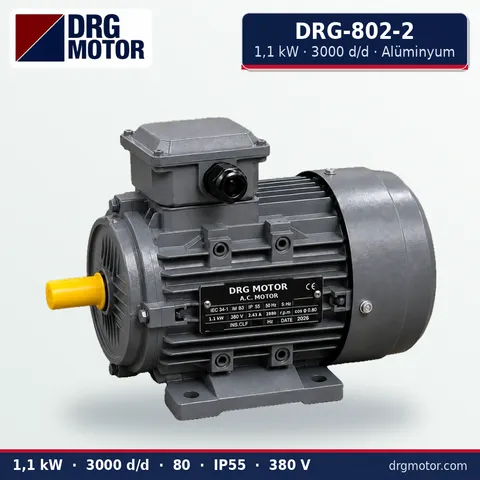
1.1 kW Three-Phase Motor 3000 rpm – DRG-802-2 Aluminium
- 1.1 kW · 3000 rpm (2 poles)
- Aluminium frame · IEC 80
- Shaft: 19 × 40 mm
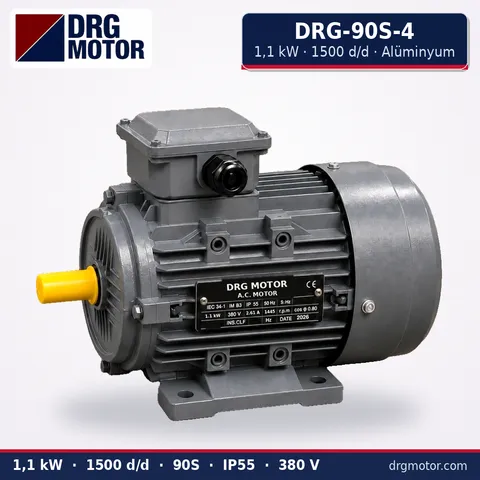
1.1 kW Three-Phase Motor 1500 rpm – DRG-90S-4 Aluminium
- 1.1 kW · 1500 rpm (4 poles)
- Aluminium frame · IEC 90S
- Shaft: 24 × 50 mm
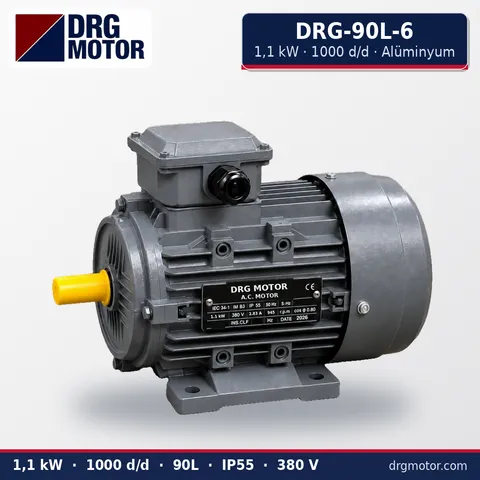
1.1 kW Three-Phase Motor 1000 rpm – DRG-90L-6 Aluminium
- 1.1 kW · 1000 rpm (6 poles)
- Aluminium frame · IEC 90L
- Shaft: 24 × 50 mm
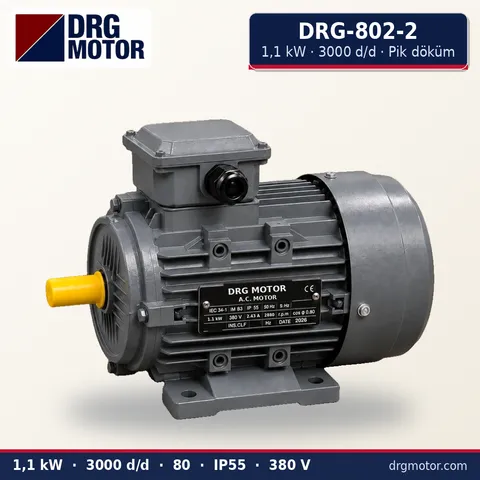
1.1 kW Three-Phase Motor 3000 rpm – DRG-802-2 Cast Iron
- 1.1 kW · 3000 rpm (2 poles)
- Cast iron frame · IEC 80
- Shaft: 19 × 40 mm
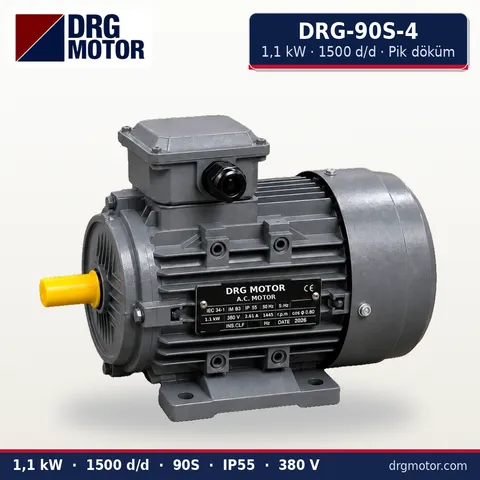
1.1 kW Three-Phase Motor 1500 rpm – DRG-90S-4 Cast Iron
- 1.1 kW · 1500 rpm (4 poles)
- Cast iron frame · IEC 90S
- Shaft: 24 × 50 mm
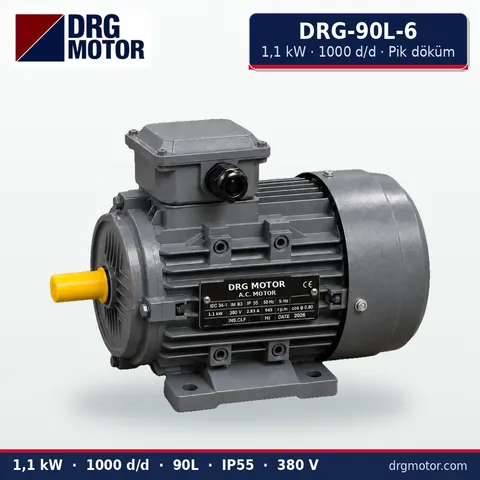
1.1 kW Three-Phase Motor 1000 rpm – DRG-90L-6 Cast Iron
- 1.1 kW · 1000 rpm (6 poles)
- Cast iron frame · IEC 90L
- Shaft: 24 × 50 mm