English
 Le français
 Türkçe




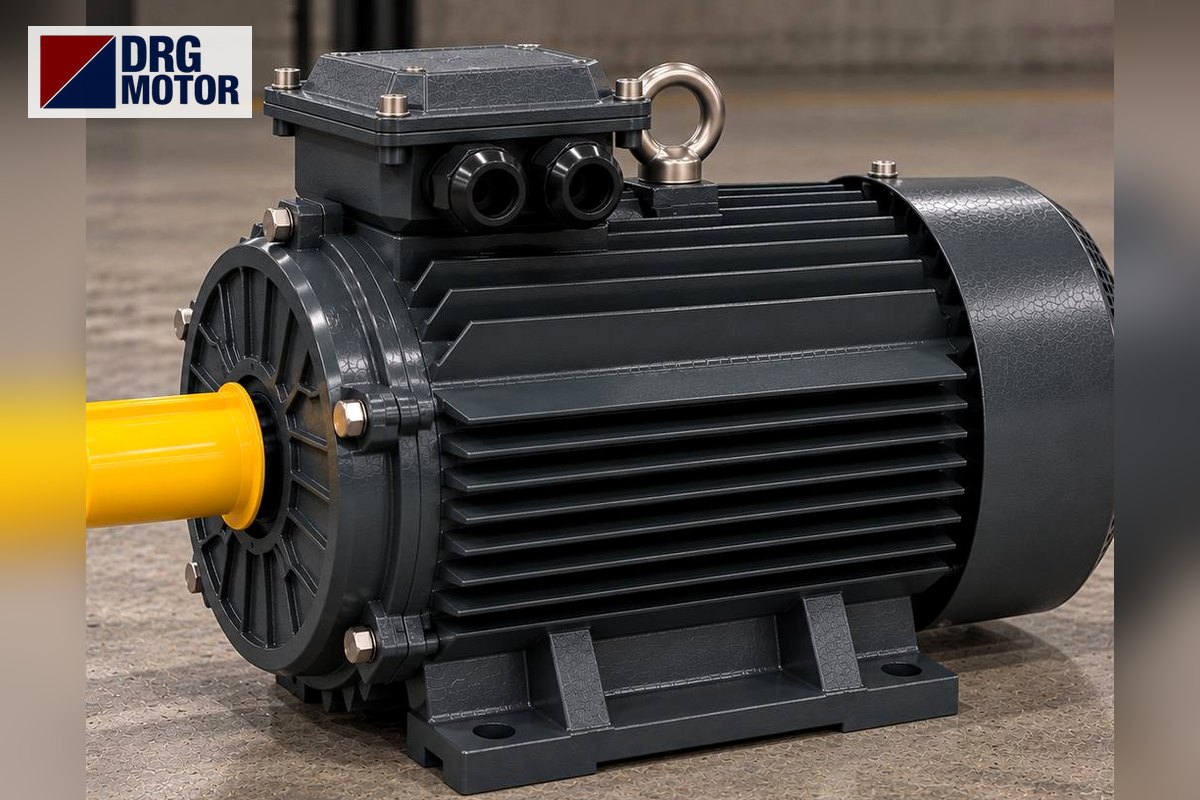

A PTC alarm stays on after the motor is stopped because the PTC thermistor buried in the winding measures the winding's temperature, not whether the motor is turning. The moment the shaft stops, the heat already stored in the winding does not disappear; worse, the cooling fan is mounted on the same shaft, so it stops too and cooling slows abruptly. The temperature can even climb a little during the first minutes. The thermistor's resistance stays high until it drops below the threshold, and because the protection relay usually latches, the alarm will not clear until the winding has cooled enough and the relay is reset by hand.
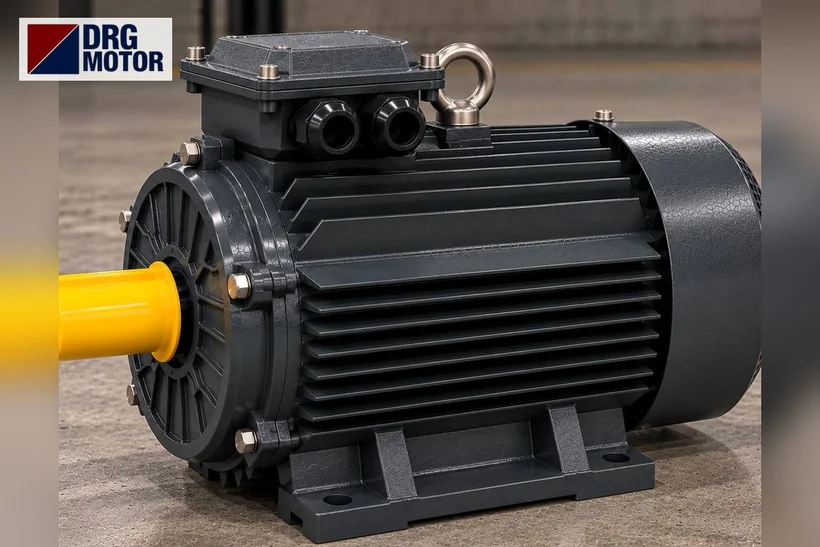
DRG Motor is a manufacturer, supplier and seller of electric motors. It is based in İzmir and ships quickly across all of Türkiye, that province included. Pick the right power for an application that needs winding protection by speed in the online electric motor shop and see the same models together in the three-phase asynchronous electric motors category.
What does a PTC thermistor actually measure?
A PTC is a small semiconductor sensor whose resistance rises with temperature. As a set of three, it is embedded next to the copper during winding, right in the hottest part of the winding. Its job is not to measure current but to watch exactly how hot the winding body becomes. Below a defined threshold its resistance stays low; at the threshold the resistance jumps within seconds. The trip relay in the panel sees that jump and opens the circuit. In other words, the PTC answers "has the winding overheated?", not "is the motor running?". That distinction is the key to understanding why the alarm persists after a stop.
Why doesn't the winding cool down at once?
The copper winding, the lamination stack and the frame are a real mass that releases stored heat only slowly. Running at full load, the winding sits near its highest temperature. Cut the power and heat generation stops, but the heat stored up to that point is still there. The critical point: the cooling fan is fixed to the motor shaft, so when the motor stops the fan stops too. With no forced airflow, cooling is left to still air and conduction through the frame, which is far slower. In fact, during the first moments after a stop the heat at the core migrates outward, so the spot where the thermistor sits can keep warming for a few minutes. Because of this "heat soak", the alarm sometimes becomes firmer after the motor stops.
Why doesn't the alarm clear on its own?
Two separate mechanisms hold the alarm on. The first is physical: the PTC resistance returns to normal only once the winding cools clearly below the threshold (by a set reset margin in most products). The second is logical: most protection relays latch. Even after the trip condition passes, the relay keeps itself open and is freed only when reset by hand or from the control circuit. This is deliberate design; it stops an overheated motor from restarting on its own before an operator sees the situation and removes the cause. So the answer to "I stopped the motor, why is the alarm still on?" is usually one sentence: the winding has not cooled yet, or the relay is still latched.
Click to see current electric motor prices and order nowSEE PRICES →
DRG three-phase models often used here
Winding temperature protection makes sense on any three-phase asynchronous motor, from common frame sizes such as 1500 rpm (4-pole) up to larger ratings; below are a few aluminium-body DRG models from that group as examples. Decide which power fits from the shaft power the load actually demands.
| DRG model | Power (kW) | Speed (rpm) | Voltage (V) |
|---|---|---|---|
| DRG-90L-4 | 1.5 | 1500 | 230/400 V |
| DRG-112M-4 | 4 | 1500 | 400/690 V |
| DRG-132S-4 | 5.5 | 1500 | 400/690 V |
| DRG-132M-4 | 7.5 | 1500 | 400/690 V |
| DRG-160M-4 | 11 | 1500 | 400/690 V |
You can reach each model's detail page from the table above and compare all power and speed options in the electric motor shop.
What really triggers a PTC alarm
The alarm staying on is a symptom; the real task is finding what is heating the winding. The most common causes on the shop floor are:
- Frequent starting: Starting again and again without letting it cool leaves a heat pulse each time and carries the temperature up.
- Overload: Running the motor above its shaft power keeps current, and therefore winding heat, continuously high.
- Poor cooling: A blocked fan cowl, a frame caked with dust or a hot, airless cabinet stops the heat being thrown off.
- Phase imbalance or a lost phase: A supply fault raises current in the remaining phases and heats the winding fast.
- Short cycle time: If the motor is restarted before it can cool, the thermistor never drops below the threshold.
If the alarm becomes persistent, the cause is usually one of these; forcing the relay without cooling the winding only hides the symptom.
A safe approach and the right check
The first thing to do while a PTC alarm is active is to wait: make sure the motor is not turning under load and give the winding time to cool. Judge relay reset values, the thermistor threshold or measurement limits from the information on the motor nameplate and the protection device's document, not from memory. When any check inside the panel is needed, cut the power, confirm it is dead and have qualified electrical personnel do the work. If the alarm comes straight back after cooling, that is a sign of a lasting problem on the supply, load or cooling side rather than the motor, and the root cause must be removed before the motor runs again. If you are unsure of the right model and size, keep the existing motor's nameplate to hand before deciding.
When ordering or assessing a fault, sharing a photo of the nameplate is the surest approach.
Send a photo of your current motor nameplate and we will find the suitable DRG model together.Send on WhatsApp
To pick the right power and speed for a PTC-protected application, browse the three-phase motor range.SEE PRICES
In short, the PTC watches the winding's temperature, not the motor's motion; even when the motor stops the heat lingers, the fan stops so cooling slows, and the latched relay keeps the alarm on until it is reset by hand.
Frequently asked questions
I stopped the motor, why doesn't the PTC alarm clear at once?
Because the winding is still hot. The PTC resistance returns to normal only once the winding cools a set margin below the threshold; on top of that, the latched protection relay stays open until it is reset by hand.
Can the winding heat up more after the motor stops?
Briefly, yes. The fan stops too, so cooling slows, and as heat migrates out from the core the spot where the thermistor sits can warm a little more for the first few minutes. That is why the alarm can firm up right after a stop.
What does it mean if the alarm returns after cooling?
It means there is a lasting cause, not a one-off heat-up: overload, frequent starting, poor cooling or a supply fault. Restarting the motor before the root cause is found and removed is not right; leave the assessment to a qualified person.
Are a PTC and a thermal relay the same thing?
No. A thermal relay protects indirectly by measuring current; a PTC measures the winding temperature directly. They work on different principles and complement each other in many applications.
Electric Motors Related to This Topic — Models and Current Prices
Suitability is not decided by power alone: compare the speed, voltage, mounting, shaft and fixing dimensions of your machine with the product data; if unsure, send us the nameplate of your current motor.

4 kW Three-Phase Motor 1500 rpm – DRG-112M-4 Aluminium
- 4 kW · 1500 rpm (4 poles)
- Aluminium frame · IEC 112M
- Shaft: 28 × 60 mm

5.5 kW Three-Phase Motor 1500 rpm – DRG-132S-4 Aluminium
- 5.5 kW · 1500 rpm (4 poles)
- Aluminium frame · IEC 132S
- Shaft: 38 × 80 mm

7.5 kW Three-Phase Motor 1500 rpm – DRG-132M-4 Aluminium
- 7.5 kW · 1500 rpm (4 poles)
- Aluminium frame · IEC 132M
- Shaft: 38 × 80 mm

11 kW Three-Phase Motor 1500 rpm – DRG-160M-4 Aluminium
- 11 kW · 1500 rpm (4 poles)
- Aluminium frame · IEC 160M
- Shaft: 42 × 110 mm

1.5 kW Three-Phase Motor 1500 rpm – DRG-90L-4 Aluminium
- 1.5 kW · 1500 rpm (4 poles)
- Aluminium frame · IEC 90L
- Shaft: 24 × 50 mm