English
 Le français
 Türkçe




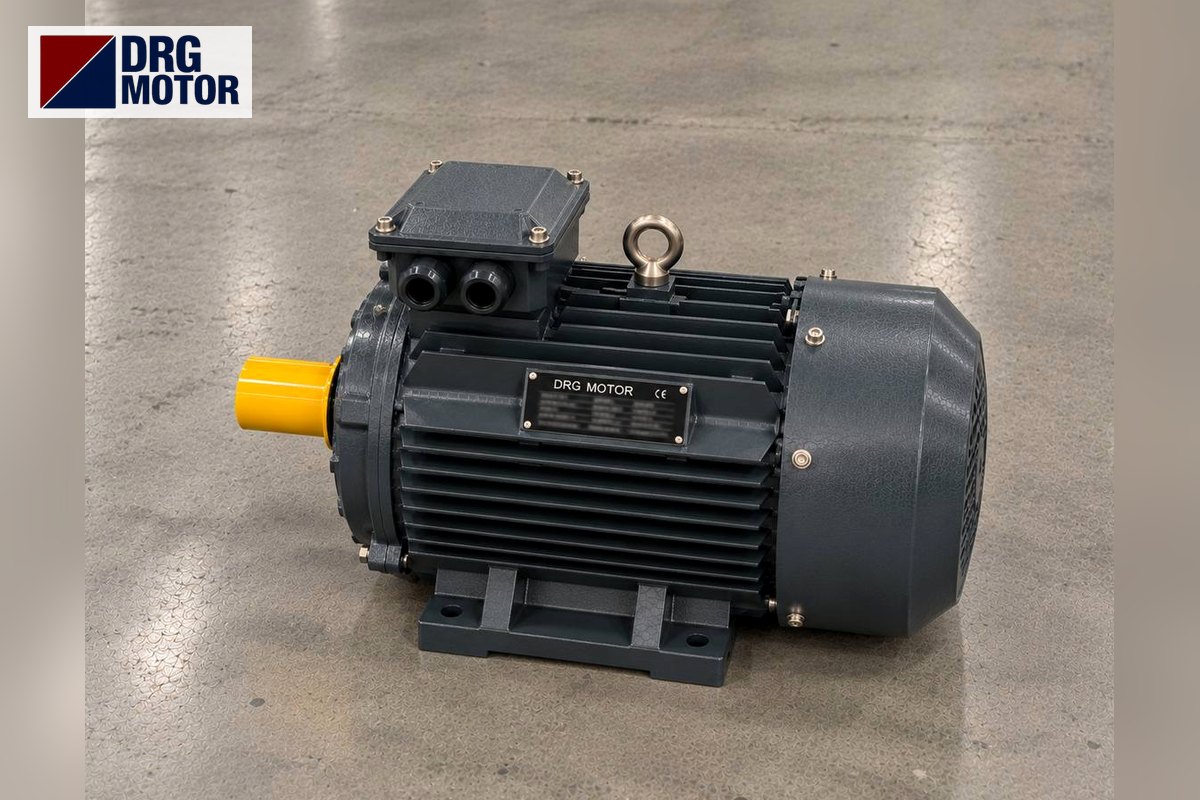

Which electric motor you should buy becomes clear once you answer five questions: how much power (kW) you need, which speed (number of poles) is required, how it will be mounted (B3, B5, B35), which housing material (aluminium or cast iron) suits you, and the voltage of your supply. This guide helps you choose the three-phase asynchronous motor that best fits your need, step by step.
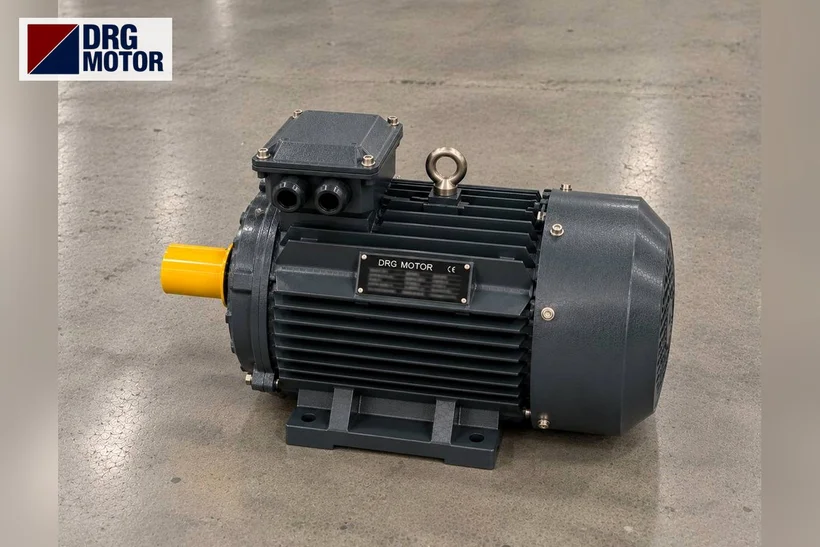
DRG Motor is a manufacturer, supplier and seller of electric motors. Follow the steps below in order to pin down the right model, and compare every option in the online motor shop. The models are also listed together in the three-phase asynchronous electric motors category.
Step 1: Determine the power (kW) you need
Power is the starting point. If the power required by the driven machine is unclear, take it from the machine maker's figure or from the kW value on the nameplate of the motor you are replacing. Rated motor powers are not arbitrary; they follow internationally agreed steps: 0.55 – 0.75 – 1.1 – 1.5 – 2.2 – 3 – 4 – 5.5 – 7.5 – 11 kW.
If your calculation lands on an intermediate value, choosing the next standard step is the safe route; it leaves a little margin for short load peaks. To review the required power and current, use the electric motor calculator and the motor current chart.
Step 2: Choose the speed and the number of poles
The same power is offered at different speeds, because what the application needs is often not power but speed and torque. Speed is set by the number of poles; more poles mean lower speed and higher torque.
| Poles | Approx. speed | Character and typical use |
|---|---|---|
| 2 poles | 3000 rpm | High speed, low torque; small pumps and fans. |
| 4 poles | 1500 rpm | The most common mid speed; conveyors, mixers, general drives. |
| 6 poles | 1000 rpm | Low speed, high torque; heavy-starting mechanisms. |
If you are replacing a motor, reading the speed on the nameplate and keeping the same number of poles is the safest route. Synchronous speed can be checked with n = 120 · f / p; at 50 Hz, 4 poles give 1500 rpm, and the speed drops slightly under load.
Click to see current electric motor prices and order nowSEE PRICES →
1500 rpm three-phase models: selection by power
For the most common class, the 4-pole (1500 rpm) aluminium models, selection by power is as follows. Model codes link straight to the product page; each row shows rated torque and the rated current at 400 V.
| Power (kW / HP) | Model | Torque | Rated current (400 V) |
|---|---|---|---|
| 1.5 kW / 2 HP | DRG-90L-4 | 9.91 Nm | 3.3 A |
| 3 kW / 4 HP | DRG-100L2-4 | 19.8 Nm | 6.02 A |
| 5.5 kW / 7.5 HP | DRG-132S-4 | 36 Nm | 10.7 A |
| 11 kW / 15 HP | DRG-160M-4 | 71.7 Nm | 20.4 A |
Where installation space is tight, the same powers also come in a compact housing: DRG-112M-4K for 5.5 kW and DRG-132M-4K for 11 kW give the same electrical values in a smaller IEC frame. Their 2- and 6-pole counterparts and the cast iron versions are listed in the shop at the same power steps.
Step 3: Choose the mounting (B3, B5, B35)
How the motor attaches to the machine sets the mounting type. The wrong mounting will keep even a correctly rated motor from fitting.
| Mounting | Attachment | Typical use |
|---|---|---|
| B3 | Foot-mounted | Bolted to floor/frame; belt-and-pulley drive. |
| B5 | Large flange | Flange directly to the machine; pump, gearbox input. |
| B35 | Foot + flange | Where both foot support and flange are needed. |
When replacing a motor, compare not only power but also the shaft diameter, foot/flange dimensions and attachment type; since the coupling or pulley is chosen to match the shaft diameter, this measurement is critical. If you are unsure about flange and shaft sizes, sending a photo of the nameplate and dimensions for confirmation is the most practical route.
Step 4: Choose the housing material — aluminium or cast iron?
Most powers come in both aluminium and cast iron housings, and the electrical values (power, speed, torque, current) are identical in both. The difference is mechanical:
- Aluminium housing: lighter, easier to carry and mount; practical for light machines and setups that move often. You can see the aluminium options together on the three-phase asynchronous category page.
- Cast iron housing: heavier and more rugged; preferred in environments with high vibration and mechanical stress.
The choice is about finding what best fits your need; both housings deliver the same rated performance. In the DRG range aluminium covers 0.25–11 kW and cast iron 0.55–355 kW.
Step 5: Confirm the voltage and connection
Your supply voltage is the final step. Models up to 3 kW are usually wound 230/400 V (Δ/Y), while models of 4 kW and above are 400/690 V (Δ/Y). On a 400 V three-phase supply the motor is connected in star (Y); on a 230 V three-phase supply in delta (Δ). The nameplate states which connection matches which voltage.
Before any electrical work, switch off the supply, verify it is de-energised, and have only qualified electrical personnel make the connection. Set values such as the thermal protection current from the rated current on the motor nameplate, not from memory. For cable cross-section, the motor cable size calculator is a useful guide.
Quick selection summary
To narrow down the right model quickly, follow this order:
- Round the required power to a standard step (e.g. 2.2 kW, 5.5 kW, 11 kW).
- Choose the number of poles by the application's speed (2 / 4 / 6 poles).
- Set the mounting by how it attaches to the machine (B3 / B5 / B35).
- Pick the housing by the harshness of the environment (aluminium / cast iron).
- Confirm the connection (Δ/Y) against the nameplate for your supply voltage.
Send a photo of your current motor nameplate and we will find the suitable DRG model together.Send on WhatsApp
If you want to be sure of your choice, you can compare all power and speed options and current prices in the shop.
Compare every power and speed option of the three-phase asynchronous motor that best fits your need, with current prices in the shopSEE PRICES
Frequently asked questions
Which motor should I buy if I don't know the exact power?
If you are replacing a motor, use the kW value on its nameplate. Otherwise start from the power the machine needs and choose the next standard step; at intermediate values the higher step leaves a little margin.
Which matters more, speed or power?
They are considered together. Power sets the capacity, while the speed set by the number of poles determines speed and torque. Choose the power first, then the number of poles by the application's speed.
Should I buy B3 or B5?
If you bolt the motor by its feet to the floor/frame, B3; if you attach it to the machine by a flange, B5; if both are needed, B35. If unsure, look at how the existing setup is attached.
Is aluminium or cast iron more suitable?
If lightness and easy mounting are your priority, aluminium; in harsh settings with high vibration and mechanical stress, cast iron fits the need better. The electrical values are the same in both housings.
Electric Motors Related to This Topic — Models and Current Prices
Suitability is not decided by power alone: compare the speed, voltage, mounting, shaft and fixing dimensions of your machine with the product data; if unsure, send us the nameplate of your current motor.
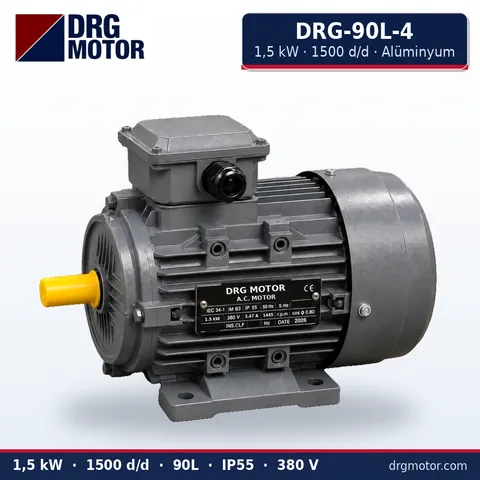
1.5 kW Three-Phase Motor 1500 rpm – DRG-90L-4 Aluminium
- 1.5 kW · 1500 rpm (4 poles)
- Aluminium frame · IEC 90L
- Shaft: 24 × 50 mm
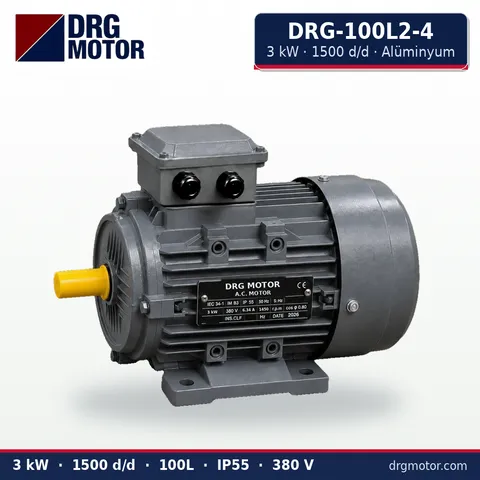
3 kW Three-Phase Motor 1500 rpm – DRG-100L2-4 Aluminium
- 3 kW · 1500 rpm (4 poles)
- Aluminium frame · IEC 100L
- Shaft: 28 × 60 mm
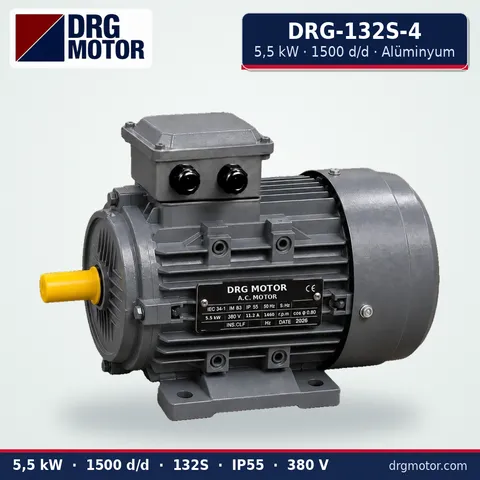
5.5 kW Three-Phase Motor 1500 rpm – DRG-132S-4 Aluminium
- 5.5 kW · 1500 rpm (4 poles)
- Aluminium frame · IEC 132S
- Shaft: 38 × 80 mm
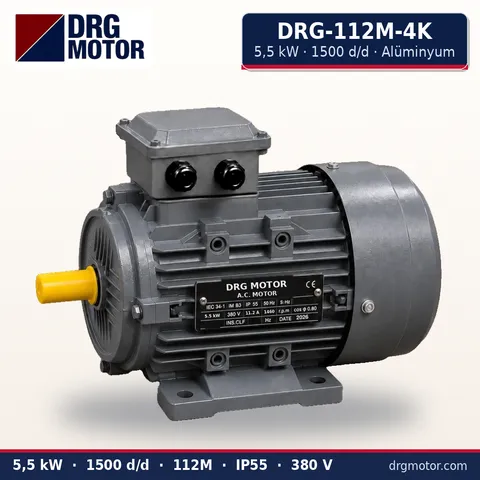
5.5 kW Compact Three-Phase Motor 1500 rpm – DRG-112M-4K Aluminium
- 5.5 kW · 1500 rpm (4 poles)
- Aluminium frame · IEC 112M
- Shaft: 28 × 60 mm
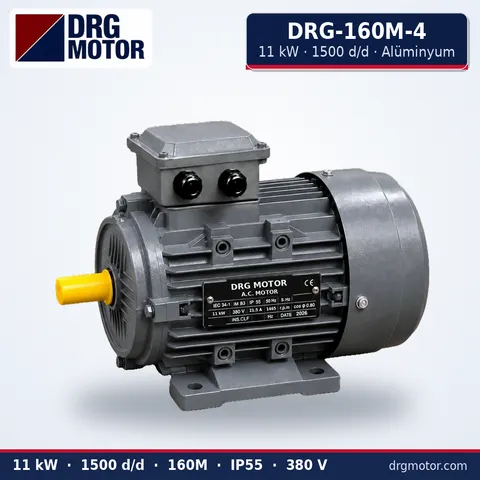
11 kW Three-Phase Motor 1500 rpm – DRG-160M-4 Aluminium
- 11 kW · 1500 rpm (4 poles)
- Aluminium frame · IEC 160M
- Shaft: 42 × 110 mm
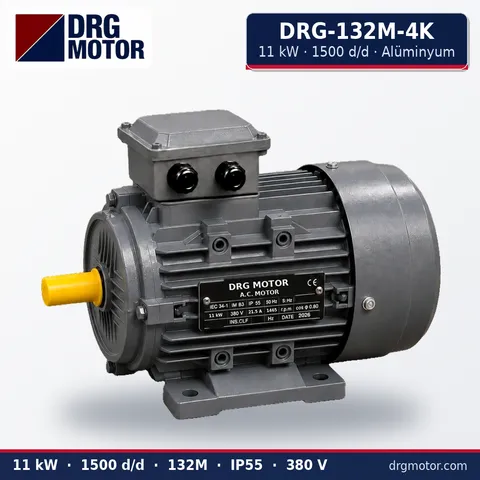
11 kW Compact Three-Phase Motor 1500 rpm – DRG-132M-4K Aluminium
- 11 kW · 1500 rpm (4 poles)
- Aluminium frame · IEC 132M
- Shaft: 38 × 80 mm