English
 Le français
 Türkçe




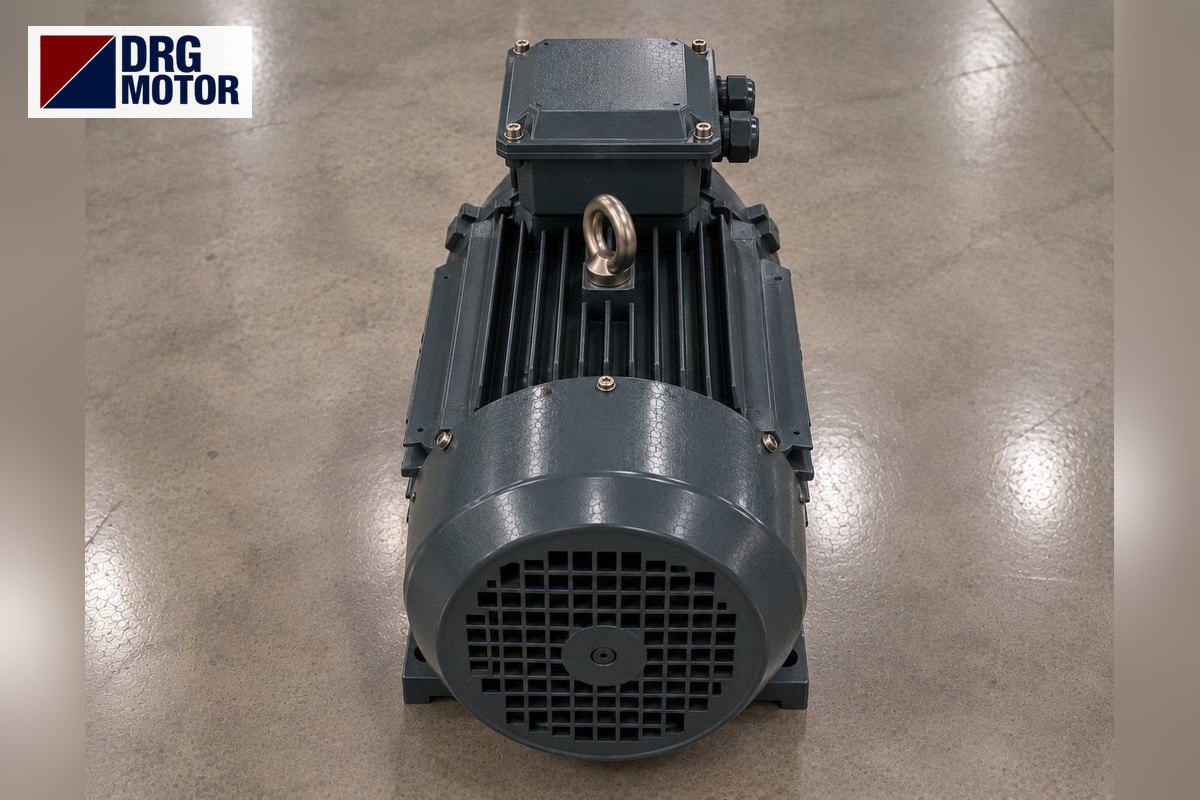

In a salt grinding machine, the motor turns the roller pair or hammer rotor that breaks rock or sea salt; power is set by machine type and capacity, but how long the motor lasts is often set by the environment. Salt dust combined with moisture turns into a conductive, corrosive layer that attacks the motor frame, terminal box, cable entry and bearings. This article covers power and speed first, then ways to protect the motor in a salty environment.
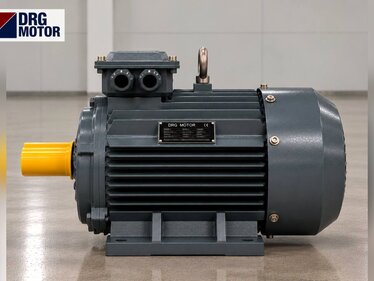
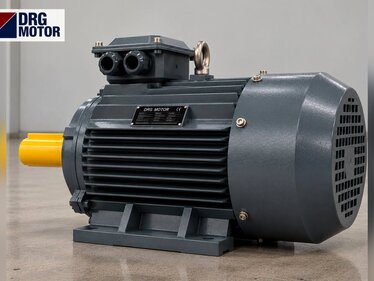
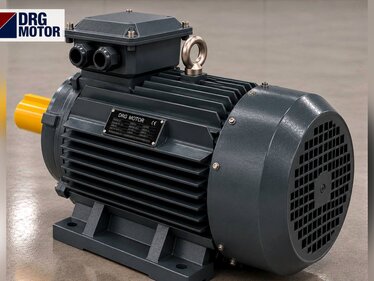
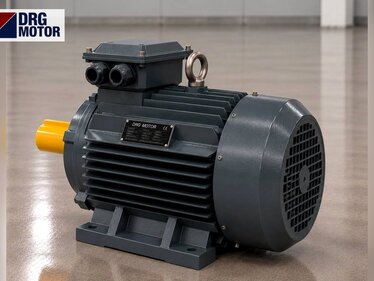
DRG Motor is a manufacturer, supplier and seller of electric motors; it does not build salt mills but supplies the three-phase asynchronous IEC motor that drives roller and hammer salt crushers. All cast iron and aluminium frame models are listed on the buy electric motors online page.
Motor selection for the hammer machines used at the first stage of a rock salt crushing line follows rules similar to those for soft rock; see also the hammer crusher motor page.
Which Machine Grinds Salt, and Under What Load?
Roller crusher: Coarse rock salt or dried sea salt passes between two rollers with an adjustable gap. The rollers usually run at 300–700 rpm, driven by the motor through belts and pulleys. The load is fairly steady, but torque peaks briefly if the feed piles up suddenly or a hard foreign stone enters the gap.
Hammer or pin mill: Used to reach table salt fineness. The rotor runs fast; the motor is coupled directly or by belt and is usually 2- or 4-pole. Impact load repeats continuously, and rotor inertia makes the run-up long.
Damp salt: Salt is hygroscopic. Salt that leaves the dryer insufficiently dry, or picks up moisture in storage, sticks to the rollers and blinds the hammer mill screen. Motor current then rises and the overload trips; the problem is the product's moisture content, not motor power.
Roller Speed and Pulley Ratio Calculation
Motor power is set by the machine builder according to roller length, feed size and the required output fineness. Crushers in small packing plants may use a few kW, rock salt lines tens of kW. Take the definitive value from the machine nameplate or catalogue; estimating motor power from tonnes per hour is misleading.
Example (assumption): on a roller crusher the motor pulley is 125 mm and the roller pulley 250 mm. With the 6-pole 11 kW DRG-160L-6 (970 rpm) the roller turns at n2 = n1·d1/d2 = 970 × 125 / 250 ≈ 485 rpm. Ignoring belt losses, roller shaft torque is twice the motor's rated torque of 108.3 Nm, about 216.6 Nm.
Fit the 4-pole 15 kW DRG-160L-4 (1465 rpm) with the same pulleys and the roller turns at about 732.5 rpm with roughly 195.6 Nm on the shaft. Power has gone up, yet roller torque has gone down; the extra power has gone into speed. A faster roller turns more salt into dust and wears faster. If the pole count is changed, recalculate the pulley ratio; you can use the pulley and belt calculator for this.
Because the load is steady, choosing a larger motor than needed gives no protection; the motor runs at partial load and cos φ drops. We cover this separately in the article on the oversized motor trap.
Click to see current electric motor prices and order nowSEE PRICES →
Where Does Salt Dust Attack the Motor?
Dry salt dust looks harmless on its own. But when the temperature drops at night or the plant is washed, it absorbs moisture from the air and forms a salty film. This film corrodes metal, lifts paint from underneath and conducts electricity. The motor's weak points and the measures that help are:
| Area | Effect of salt | Measure |
|---|---|---|
| Frame and cooling fins | Paint lifts, pitting | Paint touch-up, regular dry cleaning |
| Fan and fan cover | Crust forms, airflow stops | Remove the cover and clean |
| Terminal box | Moisture enters, leads oxidise | Gasket and cover screws complete |
| Cable entry | Leakage around the gland | Correct gland size, spare entry plugged |
| Shaft end and seal | Crystals wear the seal | Guard the shaft end |
| Bearing | Salt gets into the grease | Monitor noise and temperature |
| Nameplate and fixing screws | Rust, becomes unreadable | Photograph and keep the nameplate |
DRG motors are IP55; this limits dust ingress and protects against water jets from any direction. In a salty environment that protection holds only if the terminal box gasket is in place, the cover screws are all fitted and the cable entries are closed with the right glands. A single cable entry left open during installation is enough to let salty moisture in.
Cast Iron or Aluminium: Choosing the Frame
In the DRG range the aluminium frame covers 0.25–11 kW and the cast iron frame 0.55–355 kW. Both are painted and neither is stainless. If a stainless or special marine-coated frame is required, a standard IEC motor cannot meet that duty and a special motor is needed; DRG does not offer such frames.
The cast iron frame has thick walls and withstands crusher vibration and the impact of falling salt lumps well. Where its paint is damaged the surface rusts, but this rust spreads slowly and can be stopped by touch-up. The aluminium frame has thin fins; in salty moisture a white oxide layer and pitting can form, and paint on fin edges lifts more easily. Next to the crushing line, where dust is dense, a cast iron frame is the more suitable starting point; aluminium frames can be used for small motors in the cleaner packing section.
Whichever frame you choose, the main factor in motor life is placement. Put the motor beside or above the crusher discharge and screen outlet, not below them. An open shelter that keeps rain and dust off without cutting ventilation is suitable; enclosing the motor in a closed box spoils cooling.
Condensation, Downtime and the Electrical Side
Salt plants often work seasonally or in campaigns, and machines can stand idle for weeks. A motor that warms up while running cools when stopped and draws in moist air, which condenses on the windings and in the terminal box. After a long stop, have the winding insulation resistance measured before the first start and dry the motor if it is low.
Ambient temperature must stay within −15…+40 °C and altitude up to 1000 m. A motor placed next to a salt drying kiln can exceed the upper limit. The panel, contactor and overload relay are also affected by salt; a panel in a room separate from the dust extends contact life. DRG motors from 4 kW are rated 400/690 V and connected in delta on a 400 V supply, so star-delta starting can be applied directly on large roller crushers.
Before replacement or ordering, check:
- kW, rpm and voltage on the old nameplate; a readable photo if it is rusted
- Machine type: roller, hammer or pin; belt-driven or coupled
- Pulley diameters and belt type; hub bore if coupled
- Mounting type: foot (B3) or flange (B5, B35); foot holes and shaft height H
- Motor location: distance from the discharge, the screen and the wash hose
- Number and size of cable entries, terminal box orientation
- Plant operating pattern: uninterrupted or seasonal; any long stops
DRG Motors Suited to Salt Grinding Machines
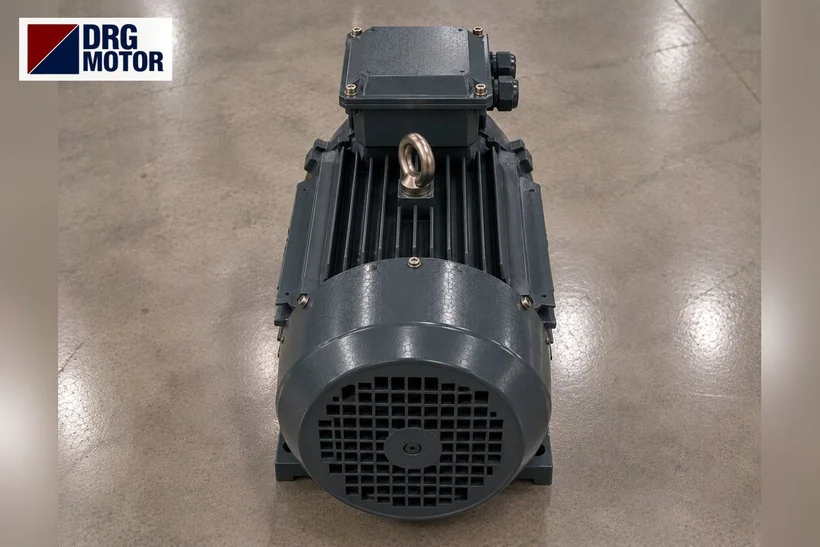
All four have cast iron frames; the 6-pole models suit belt-driven roller crushers, the 4-pole models faster roller and hammer mill drives. The two frame-132 models have a 38 × 80 mm shaft, the two frame-160 models a 42 × 110 mm shaft.
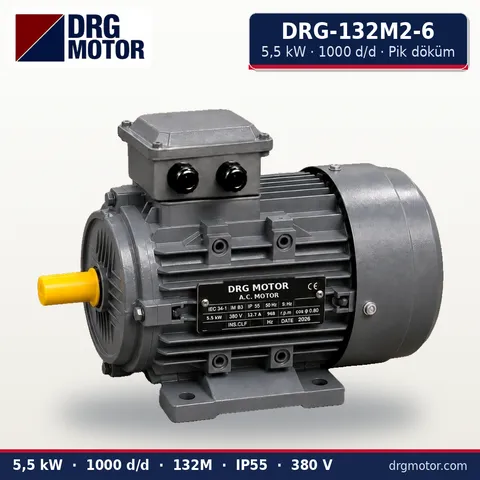
5.5 kW Three-Phase Motor 1000 rpm – DRG-132M2-6 Cast Iron
- 5.5 kW · 1000 rpm (6 poles)
- Cast iron frame · IEC 132M
- Mounting: B3 · B5 · B14 · B35
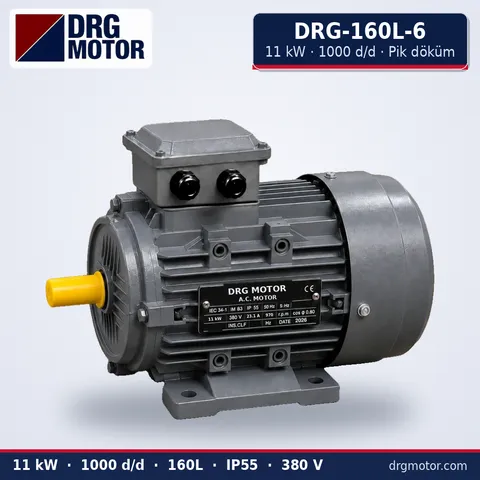
11 kW Three-Phase Motor 1000 rpm – DRG-160L-6 Cast Iron
- 11 kW · 1000 rpm (6 poles)
- Cast iron frame · IEC 160L
- Mounting: B3 · B5 · B14 · B35
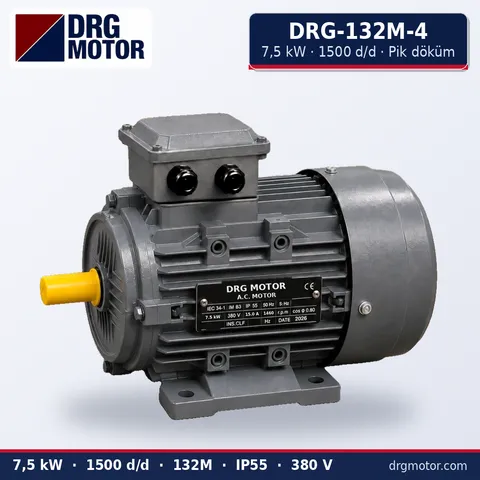
7.5 kW Three-Phase Motor 1500 rpm – DRG-132M-4 Cast Iron
- 7.5 kW · 1500 rpm (4 poles)
- Cast iron frame · IEC 132M
- Mounting: B3 · B5 · B14 · B35
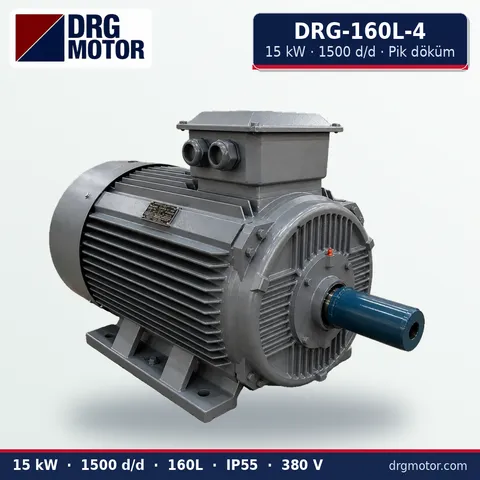
15 kW Three-Phase Motor 1500 rpm – DRG-160L-4 Cast Iron
- 15 kW · 1500 rpm (4 poles)
- Cast iron frame · IEC 160L
- Mounting: B3 · B5 · B14 · B35
Click to see current prices and order these motors nowSEE PRICES →
Salt Mill Motor: Frequently Asked Questions
Why does the motor on a salt grinding machine fail so quickly?
The most common causes are salty moisture entering the terminal box and cable entry, salt crusting on the fan cover, and salt crystals wearing the seal and reaching the bearing. Moving the motor, sealing the entries with the right glands and regular dry cleaning are often more effective than adding power.
Does a salt mill need a stainless motor?
If the motor is washed directly with brine or constantly exposed to salt water, a stainless or specially coated motor is considered; that is a special motor and not in the DRG range. In dry grinding plants where the motor stands away from the product flow, a painted cast iron IP55 motor can be used.
What speed should a rock salt crusher motor be?
Roller crushers usually use a 4- or 6-pole motor with roller speed set by the pulleys. Hammer mills commonly use 2- or 4-pole motors. When replacing, keep the old motor's pole count and pulley diameters.
Can the motor of a salt machine that has stood idle for a long time be started straight away?
First turn the motor by hand to make sure the bearing is not seized and check that there is no water or salt crust in the terminal box. Have the insulation resistance measured; if it is low, do not run the motor before drying it.
For a quote, the old motor's nameplate photo (frame dimensions if rust has made it unreadable), power, speed, foot or flange mounting, shaft size and whether the machine is a roller or hammer type are enough. Share these via WhatsApp or add the models to the quote list; phone +90 (542) 666 11 11, e-mail info@drgmotor.com, plus the contact page. Current prices are in the online shop.