English
 Le français
 Türkçe




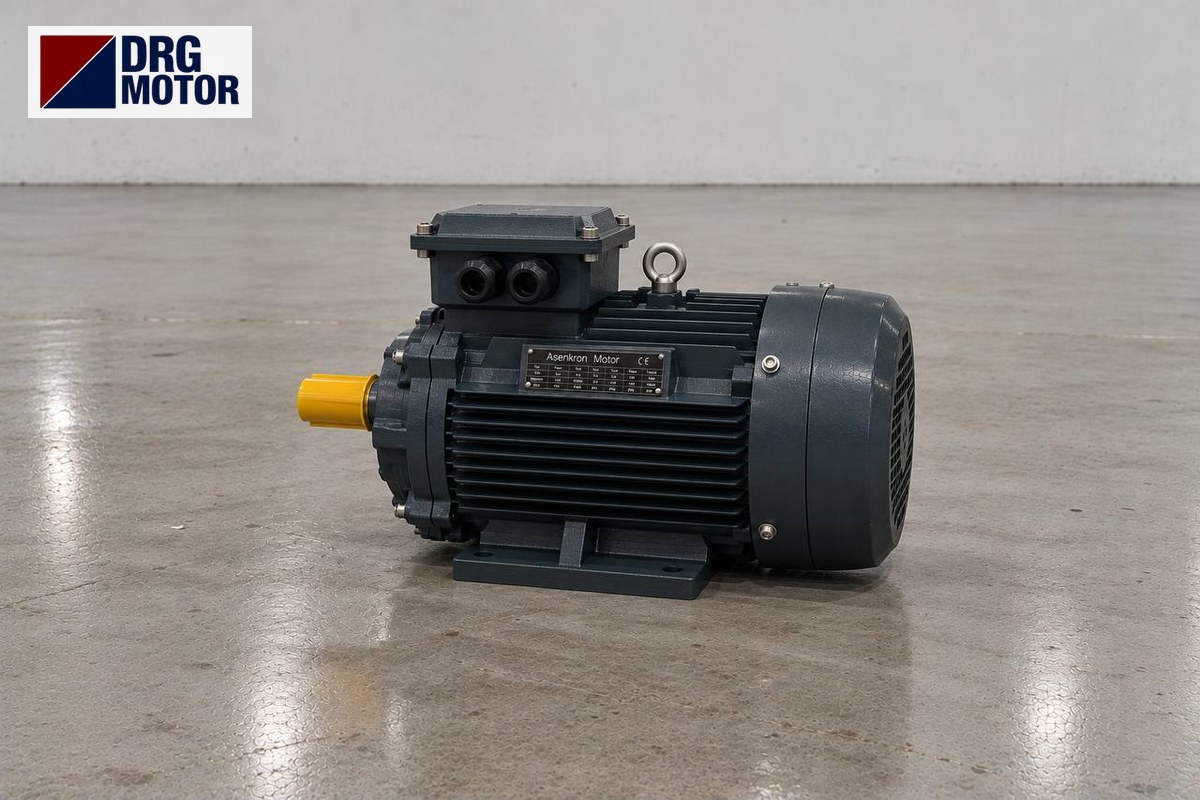

In a food mixing kettle, motor power is set by the product's consistency: free-flowing syrup or brine mixes with a small, fast propeller, while thick products such as jam, halva, Turkish delight, cream or sauces are mixed with an anchor agitator that scrapes the kettle wall, at a few dozen revolutions per minute and with high torque. That is why a kettle motor is almost always a 4-pole (1500 rpm) three-phase motor plus a gearbox, mounted vertically on top of the lid (V1, flange down). For example, the 1.5 kW DRG-90L-4 runs at 1445 rpm, draws 3.3 A at 400 V and delivers 9.91 N·m rated torque; with a gearbox of about 48:1 the agitator turns at roughly 30 rpm.
Kettle motor size depends less on volume than on how the product changes while cooking: sugary and starchy products thicken as they heat and water evaporates, so the heaviest load usually comes at the end of the batch. Kettles generally use motors from below 1 kW up to a few kW; the exact value is on the kettle's nameplate or in the manufacturer's data. You can review suitable motors with dimensions and current values on the Buy Electric Motors Online page. Motor wiring and drive installation must be carried out by a qualified electrician.
Product consistency sets the agitator type, and the agitator sets the motor
Motor selection should start with the agitator, not the motor catalogue. In the same 500-litre kettle, three agitators need three different motors:
- Propeller / pitched-blade turbine: free-flowing products (syrup, brine, milk-based mixes). High speed, low torque. The motor often runs without a gearbox or with a low ratio.
- Anchor with scrapers: thick and sticky products (jam, cream, sauce, halva). It scrapes the wall so product does not burn on. Low speed, high torque; a high-ratio gearbox is essential.
- Helical ribbon / dual-motion agitator: very thick, paste-like products. This type has the highest torque; on some kettles the central agitator and the scraper run on separate motors in opposite directions.
For agitators in free-flowing products, power grows roughly as P ~ n³ · D⁵ (n speed, D agitator diameter). In practice, doubling speed raises power about 8 times, and a 1.1 times larger agitator diameter raises it about 1.6 times. With thick products the load depends mainly on the product's resistance, that is torque; the calculation uses P = T · n / 9550.
Low speed and torque: sizing a geared motor
For a thick-product kettle, follow the calculation below. The values are assumptions; on your kettle take agitator speed and torque from the manufacturer or from the load current of the existing motor.
- Assumption: anchor agitator at 30 rpm, 400 N·m on the agitator shaft at the end of cooking.
- Power at the agitator shaft: 400 × 30 / 9550 = 1.26 kW.
- Assuming η = 0.9 for gearbox losses, motor power: 1.26 / 0.9 = 1.40 kW → standard 1.5 kW.
- Gearbox ratio: 1445 / 30 ≈ 48. With the DRG-90L-4 the rated torque at the agitator shaft is ≈ 9.91 × 48.2 × 0.9 ≈ 430 N·m; with Ts/Tn = 2.3 it can briefly reach ≈ 988 N·m at start-up.
- If the product is thicker (assumed 600 N·m): 600 × 30 / 9550 / 0.9 = 2.09 kW → 2.2 kW DRG-100L1-4; ≈ 631 N·m at the shaft with the same ratio.
Starting a full, cooled kettle is a special case: if product left from the previous batch has set, starting torque rises above the rated value. That is why the starting torque ratio (Ts/Tn) is also considered. You can check gearbox output speed and torque with the gearbox output speed and torque calculator.
Speed control with a drive: speed by recipe
On kettles a drive does two jobs: it sets speed to suit the product and gives a soft start. In the example, running the agitator at 20 instead of 30 rpm means the motor turns at about 50 × 20 / 30 ≈ 33 Hz. Since the load is constant-torque, torque stays the same and power falls with speed: 400 × 20 / 9550 ≈ 0.84 kW (at the shaft).
- At low frequency the motor's own fan slows down; on kettles running for long periods at very low speed, monitor motor temperature and, if needed, discuss a forced-ventilation solution with the manufacturer.
- Starting a thick product with a 5–10 second ramp protects scraper blades and gearbox teeth from shock (the ramp time is a setting suggestion and varies by machine).
- On some kettles the agitator runs in reverse during discharge; set reverse and speed limits together in the drive.
You can try the frequency, speed and torque relation in the VFD frequency-torque-power calculator.
Steam-jacketed kettles: a hot, humid environment
On steam- or oil-jacketed cooking kettles, the motor sits just above the lid. When the lid opens, rising steam and hot air gather around the motor frame. The motor is chosen and placed with this in mind:
- Our catalogue models are IP55 protected with class F insulation. IP55 protects against splashing water and dust; do not expose the motor directly to steam jets or pressure washing.
- A gearbox and a lantern (coupling housing) sit between motor and lid; this distance keeps the motor away from the hot lid. Avoid design changes that shorten the lantern.
- In vertical mounting the fan cover faces up; the manufacturer should add a drip shield against condensate falling from above.
- Turn the terminal box away from the steam outlet, connect the cable gland from below and check the cover gasket at every service.
- Food-contact surfaces are the agitator, shaft and kettle; their material and hygienic design are the machine manufacturer's responsibility. The motor does not touch the product.
Here we focus only on kettle-specific points; for general agitator supply see our article on motor supply for mixers and agitators.
Motor on top, vertical: V1 flange mounting
The most common mounting for a kettle motor is V1: a B5 large-flange motor in vertical position, shaft down, flange bolted to the gearbox input flange. Foot-mounted motors are not used. On replacement, the flange dimensions must match the gearbox exactly. B5 flange dimensions from the DRG catalogue:
| Frame | Flange P / N | Bolt circle M / S | Shaft D × E |
|---|---|---|---|
| IEC 80 | 200 / 130 mm | 165 / 12 mm | 19 × 40 mm |
| IEC 90L | 200 / 130 mm | 165 / 12 mm | 24 × 50 mm |
| IEC 100L | 250 / 180 mm | 215 / 14.5 mm | 28 × 60 mm |
| IEC 112M | 250 / 180 mm | 215 / 14.5 mm | 28 × 60 mm |
| IEC 132S | 300 / 230 mm | 265 / 14.5 mm | 38 × 80 mm |
P is the flange outer diameter, N the spigot (pilot) diameter, M the bolt circle diameter and S the hole diameter. The 100L and 112M frames share the same flange and shaft, so moving from 2.2 kW to 4 kW often leaves the gearbox input flange unchanged. For dimensioned drawings, see the motor technical drawings page.
In vertical mounting, the agitator's weight and the axial force from the product must be carried by the gearbox output bearing; the motor bearing is not selected for this load. When ordering, note B5 flange and vertical (V1) use.
Kettle motor replacement checklist
- Write down power, speed, voltage and current from the nameplate; note vertical mounting and flange type (B5).
- Measure flange P, N, M and shaft D × E with a rule; check the key width.
- Clean the key and shaft bore in the gearbox input hub and use assembly paste; if the key slips on a vertical shaft, the gearbox input wears.
- Check direction with an empty kettle; a scraper agitator turning the wrong way lifts its blades off the wall.
- If a drive is used, enter motor parameters (current, speed, cos φ) from the new nameplate.
- On the first batch, measure current at the end of cooking and compare it with the nameplate current.
Which DRG motor for which kettle?
The table lists the 4-pole powers most often used on geared kettle agitators. Choose the next standard size above the power you calculated.
| Model | Power / speed | Frame | Current 400 V |
|---|---|---|---|
| DRG-802-4 | 0.75 kW · 1420 rpm | Aluminium · IEC 80 | 1.75 A |
| DRG-90S-4 | 1.1 kW · 1445 rpm | Aluminium · IEC 90S | 2.48 A |
| DRG-90L-4 | 1.5 kW · 1445 rpm | Aluminium · IEC 90L | 3.3 A |
| DRG-100L1-4 | 2.2 kW · 1450 rpm | Aluminium · IEC 100L | 4.52 A |
| DRG-100L2-4 | 3 kW · 1450 rpm | Aluminium · IEC 100L | 6.02 A |
| DRG-112M-4 | 4 kW · 1450 rpm | Aluminium · IEC 112M | 7.95 A |
Catalogue data of the 1.5 kW model used in the example:
- Power: 1.5 kW
- Rated speed: 1445 rpm
- IEC frame: 90L
- Voltage: 230/400 V (Δ/Y)
- Current 380 V / 400 V: 3.47 A / 3.3 A
- cos φ: 0.77
- Rated torque: 9.91 N·m
- Starting torque Ts/Tn: 2.3
- Breakdown torque Tmax/Tn: 2.3
- Starting current Is/In: 7
- Shaft D × E: 24 × 50 mm
- Bearing: 6205-ZZ-C3
- Cable entry: 1 × M25×1.5
Motors in this power range
- DRG-90S-4 – 1.1 kW – 1445 rpm – Aluminium IEC 90S
- DRG-90L-4 – 1.5 kW – 1445 rpm – Aluminium IEC 90L
- DRG-90L-4 – 1.5 kW – 1445 rpm – Cast iron IEC 90L
- DRG-100L1-4 – 2.2 kW – 1450 rpm – Aluminium IEC 100L
- DRG-112M-4 – 4 kW – 1450 rpm – Aluminium IEC 112M
Click to see current prices and order these motors nowSEE PRICES →
Frequently Asked Questions
What speed should a mixing kettle motor be?
The motor is usually a 4-pole 1500 rpm unit (rated speed about 1445–1450 rpm); agitator speed is reduced with a gearbox. With thick products an anchor agitator mostly runs at a few dozen rpm.
How many amps does a 1.5 kW motor draw?
The 4-pole 1.5 kW DRG-90L-4 draws a rated current of 3.47 A at 380 V and 3.3 A at 400 V; during starting the current briefly reaches 7 times this value.
Can an agitator motor be mounted vertically?
Yes. A B5 flange motor is connected to the gearbox in vertical, shaft-down (V1) position. State vertical use when ordering; the agitator weight must be carried by the gearbox output bearing.
Why is the kettle motor struggling?
Usually because the product thickens at the end of cooking or because the kettle is started with cooled product. Compare the current with the nameplate value; if it stays high, a larger motor or a higher gearbox ratio is needed.
Write to us with your kettle's nameplate, gearbox ratio and flange dimensions and we will determine the right motor together: +90 (542) 666 11 11 · [email protected] · Contact. Technical data for all models are listed among the 120 models in our online store.