English
 Le français
 Türkçe




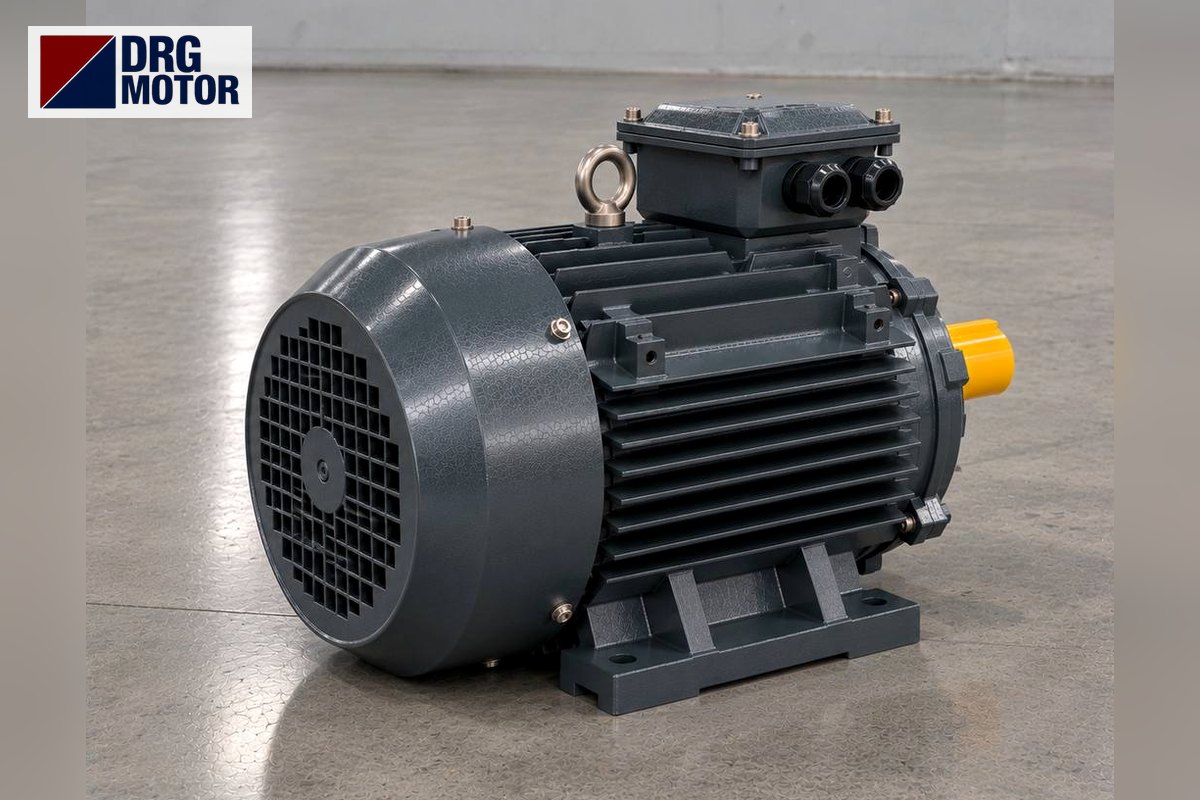

The right questions to ask a seller when buying an electric motor stop the wrong unit from ever arriving. The key ones are: does the power and speed match your need, what mounting type (foot or flange), the housing material, your supply voltage, the protection rating, the shaft diameter, warranty, delivery and technical support. This article also explains why each question matters.
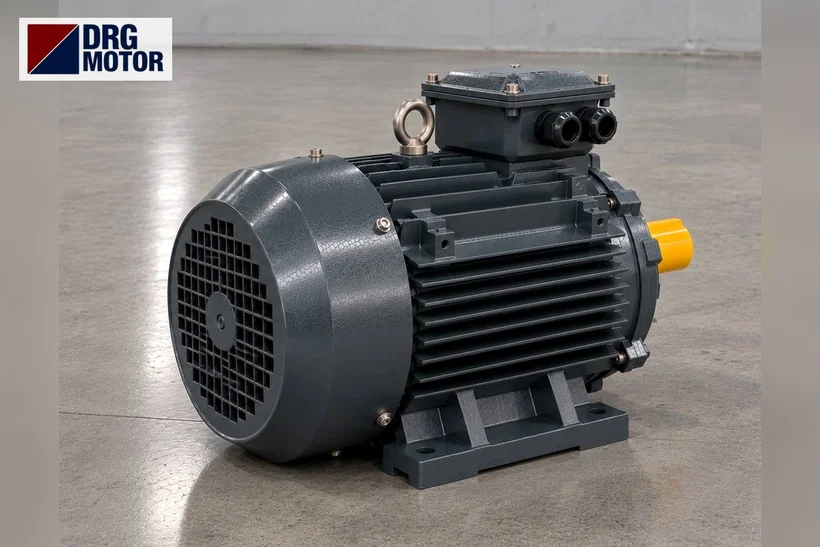
DRG Motor is a manufacturer, supplier and seller of electric motors. Keep these questions ready and the choice becomes easy; browse the models by power and speed in the online electric motor shop, or see them together in the three-phase asynchronous electric motors category.
1. Which power and speed suit me?
This is the first and most important question. Describe your machine, the load it drives and, if any, the values of the old unit. The same power exists at different speeds: 2 poles about 3000 rpm, 4 poles about 1500 rpm, 6 poles about 1000 rpm. If the speed is wrong, the job simply won't work. If unsure, we assess your application together and pick the right class; our electric motor calculator also helps.
Values like "1 kW, 2 kW, 10 kW" are non-standard; the nearest standard steps are 1.1 / 2.2 / 11 kW. Tell the seller your need and ask for the closest standard model.
2. Foot or flange mounting?
The same power comes with a foot (B3), flange (B5) or foot-and-flange (B35) housing. Ask for the one your machine uses. On a flange, always ask the flange diameter and bolt pattern; a wrong flange won't seat even if the power is right. Telling the seller what type you currently have is the quickest path.
3. Aluminium or cast-iron housing?
An aluminium housing is light and easy to handle and install, and is enough for most general use. A cast-iron housing is heavier and tougher, preferred where impacts and harsh conditions occur. Describe your environment so the seller can decide which housing fits you.
4. Does my supply voltage match the unit?
Make sure you have a three-phase supply and know the connection type. Lower powers show 230/400 V, higher powers 400/690 V. Tell the seller your site voltage and whether you will use a drive (inverter), so the correct winding connection is clear.
Click to see current electric motor prices and order nowSEE PRICES →
5. Is the protection rating (IP) enough for the site?
The IP value states protection against dust and water. If the unit will run in a dusty, wet or outdoor place, say so from the start. DRG's standard three-phase units come with IP55 protection and F insulation class; if your site is special (for example an explosive area or submersible use), mention it, as such special solutions are outside the standard range.
6. What is the shaft diameter and length?
Because a pulley, coupling or gear sits on the shaft, the shaft diameter (D) and length (E) matter a lot. Ask the seller for this dimension clearly. Below are the shaft sizes of popular 1500 rpm aluminium models:
| Model | Power | Shaft (D×E) | Current (400 V) |
|---|---|---|---|
| DRG-112M-4 | 4 kW | 28x60 mm | 7.95 A |
| DRG-132S-4 | 5.5 kW | 38x80 mm | 10.7 A |
| DRG-132M-4 | 7.5 kW | 38x80 mm | 14.3 A |
| DRG-160M-4 | 11 kW | 42x110 mm | 20.4 A |
If you are unsure of the shaft size, share your pulley/coupling details and we will confirm the right shaft together.
7. May I see the nameplate and documents?
A serious seller is happy to share the nameplate data and technical documents. Power, speed, voltage, current, protection and insulation class are all on the plate. If you are replacing an old unit, send a photo of the old nameplate; we compare the values and settle on the model that best fits your need.
8. What about warranty, delivery and support?
After-sales matters as much as the unit. Ask about the warranty period, the delivery method and who to reach if something goes wrong. At DRG Motor you get technical support from selection to installation and can clear up any doubts before ordering. To compare models, browse the electric motor shop.
Once your questions are answered, pick the electric motor that best fits your need; click to see current prices and place your orderSEE PRICES
A quick reminder before buying
Power, speed, mounting type, housing, voltage, IP, shaft size, warranty and support: note these nine points on paper and ask the seller one by one. With this information in hand, the chance of the wrong unit arriving drops to almost zero.
Send a photo of your current motor nameplate and we will find the suitable DRG model together.Send on WhatsApp
Frequently asked questions
I have no technical background; can I still ask the right question?
Of course. The easiest way is to describe your machine and what work it will do. If you have one, share a photo of the old unit's nameplate and its mounting, and we settle the rest together.
What if the seller keeps saying "this is the best"?
The right approach is not "the best" but "the most suitable" unit. Ask the seller to explain why it fits your power, speed and mounting; a solid answer means you are on the right track.
How do I measure the shaft diameter and flange?
Measure the shaft diameter at the shaft end with a ruler or caliper; for the flange, stating the outer diameter and hole spacing is enough. If unsure, send a photo and we confirm it together.
Two models came up at the same power; which do I choose?
The difference is usually housing (aluminium/cast iron), shaft diameter or speed. Tell us your environment and connection type, and we pick the one that best fits your need.
Electric Motors Related to This Topic — Models and Current Prices
Suitability is not decided by power alone: compare the speed, voltage, mounting, shaft and fixing dimensions of your machine with the product data; if unsure, send us the nameplate of your current motor.
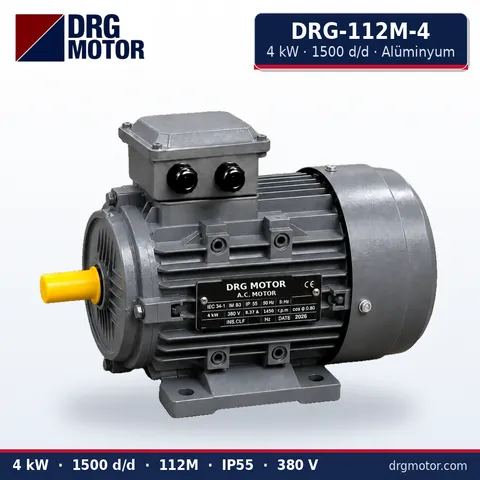
4 kW Three-Phase Motor 1500 rpm – DRG-112M-4 Aluminium
- 4 kW · 1500 rpm (4 poles)
- Aluminium frame · IEC 112M
- Shaft: 28 × 60 mm
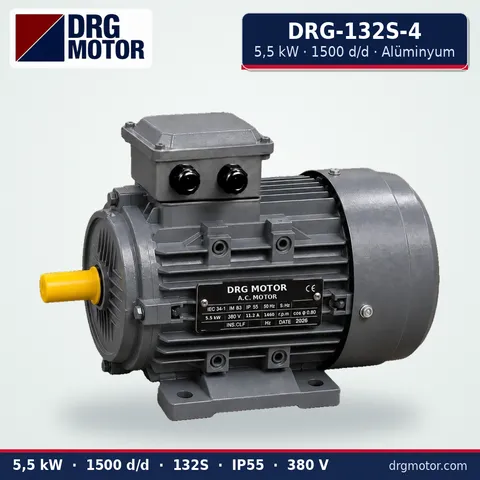
5.5 kW Three-Phase Motor 1500 rpm – DRG-132S-4 Aluminium
- 5.5 kW · 1500 rpm (4 poles)
- Aluminium frame · IEC 132S
- Shaft: 38 × 80 mm
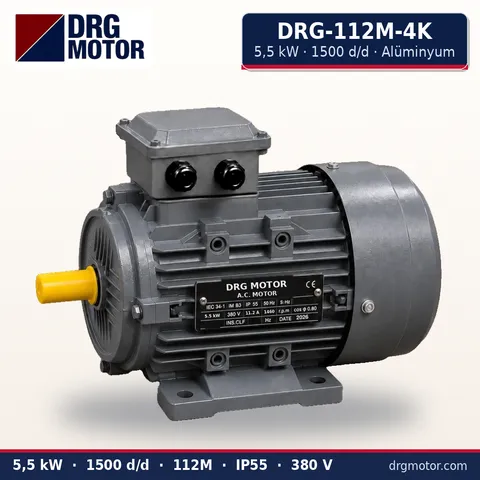
5.5 kW Compact Three-Phase Motor 1500 rpm – DRG-112M-4K Aluminium
- 5.5 kW · 1500 rpm (4 poles)
- Aluminium frame · IEC 112M
- Shaft: 28 × 60 mm
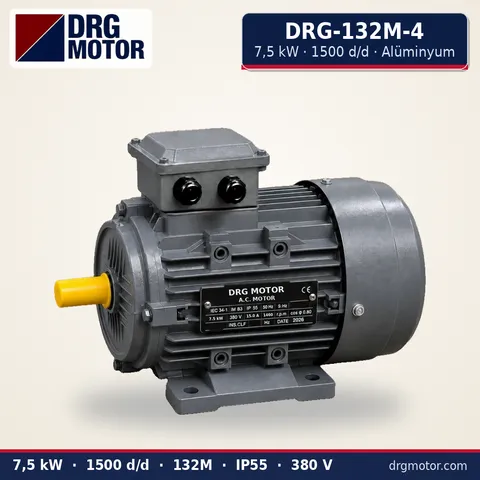
7.5 kW Three-Phase Motor 1500 rpm – DRG-132M-4 Aluminium
- 7.5 kW · 1500 rpm (4 poles)
- Aluminium frame · IEC 132M
- Shaft: 38 × 80 mm
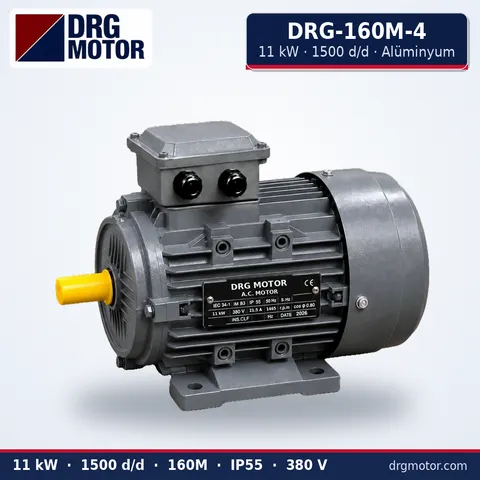
11 kW Three-Phase Motor 1500 rpm – DRG-160M-4 Aluminium
- 11 kW · 1500 rpm (4 poles)
- Aluminium frame · IEC 160M
- Shaft: 42 × 110 mm
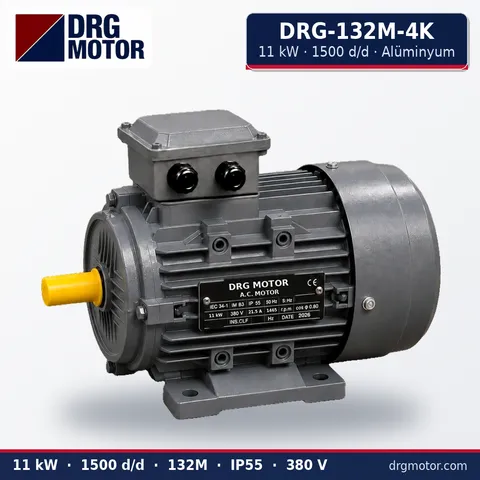
11 kW Compact Three-Phase Motor 1500 rpm – DRG-132M-4K Aluminium
- 11 kW · 1500 rpm (4 poles)
- Aluminium frame · IEC 132M
- Shaft: 38 × 80 mm