English
 Le français
 Türkçe

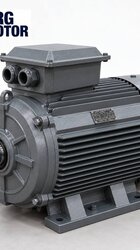
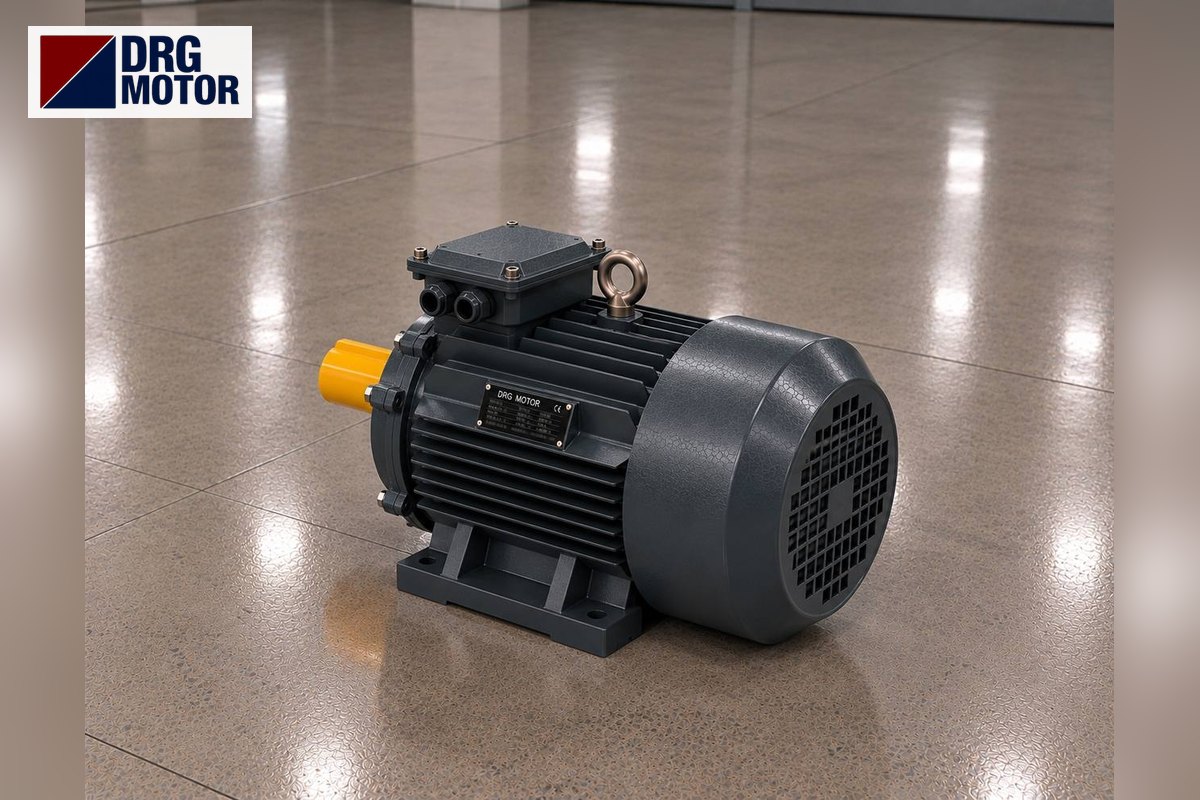

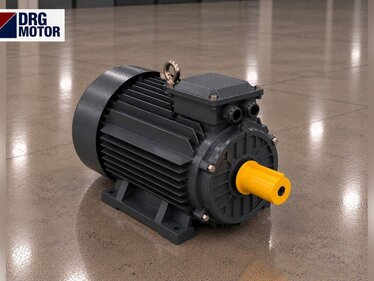
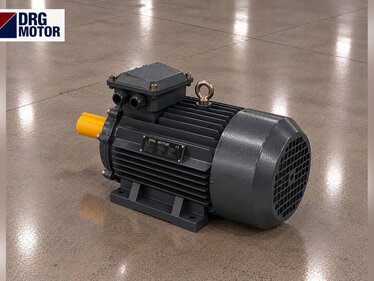
The motor of an electrically driven diaphragm dosing pump is small; on most industrial types it is a 4-pole three-phase motor of 0.25–0.75 kW, flange-mounted to the pump gearbox. When replacing it, the connection matters more than the power: flange type (B5 or B14), shaft diameter and length, keyway position. On some pumps the motor shaft is specially machined as part of the gearbox; in that case a standard IEC motor is not a direct replacement.
DRG Motor is an electric motor manufacturer, supplier and seller; it does not sell dosing pumps or gearboxes, but supplies the standard three-phase motor flange-mounted to the pump housing. Small aluminium-frame models are listed in the DRG online motor shop.
How Motor Rotation Becomes a Diaphragm Stroke
The motor turns a worm and wheel in the pump housing; through an eccentric or crank, the wheel drives a push rod back and forth. The diaphragm at the end of the rod performs a suction and a discharge stroke in the dosing head that holds the chemical; check valves at inlet and outlet keep flow in one direction. On hydraulic diaphragm types the rod pushes oil behind the diaphragm rather than the diaphragm itself, and the diaphragm moves under oil pressure.
In this design motor speed is fixed and flow is adjusted in two ways: stroke length is changed with a mechanical knob or a motorised actuator, and stroke rate is either fixed by the gear ratio or adjusted by changing motor speed with an inverter. Reducing stroke length lowers motor torque somewhat, but not to zero; mechanism friction and the return spring are always carried by the motor.
Stroke Rate, Flow and the Real Power Requirement
Example (assumption): the DRG-711-4 runs at a rated 1340 rpm and the gear ratio inside the pump is 15. Stroke rate is 1340/15 ≈ 89 strokes/min. A head delivering 20 ml per stroke gives about 1.79 l/min at full stroke length, i.e. about 107 l/h. The hydraulic power to deliver this at 10 bar, assuming a pump efficiency of 0.5, is P = Q·p/(600·η) = 1.79·10/(600·0.5) ≈ 0.06 kW.
This small result explains why the motor is 0.25 kW or more rather than 0.06 kW: motor power is set not by average hydraulic power but by the peak push force at the top of the discharge stroke, gear and crank losses and the return spring. Torque fluctuates widely within one revolution, and the motor must pass the peak without stalling. So keep the motor power on the pump plate; do not fit a smaller motor because "the flow is small". The exact value is in the pump maker's catalogue.
Starting Torque and a Pressurised Line
A dosing pump usually waits on a pressurised line behind a check valve. If the crank stopped mid-discharge, the motor starts against full pressure. Per the catalogue, Ts/Tn is 2.1 for the DRG-711-4 and DRG-712-4 and 2.3 for the DRG-802-4; their rated torques are 1.78, 2.64 and 5.04 Nm respectively. If the old motor often stalled at start, check the injection valve and line pressure first.
Click to see current electric motor prices and order nowSEE PRICES →
Chlorine, Acid and Vapour: What IP55 Does and Does Not Cover
IP55 is a degree of protection that limits harmful dust ingress and water jets from any direction. It does not mean material resistance to chemical vapour or splashes. The aluminium frame, paint, screw heads and cable glands can be affected over time by chlorine and acid vapour; this is independent of the protection class.
In practice, the layout of the dosing room determines motor life more than the IP class. The table below summarises points to watch with common chemicals; it is not a resistance statement, only general precautions.
| Dosing environment | Risk to the motor | Measure |
|---|---|---|
| Sodium hypochlorite (chlorine) | Chlorine vapour, paint/screw corrosion | Keep the motor above no vapour source |
| Acid (sulphuric, hydrochloric) | Terminal and cable gland attack | Ventilation, check gland seals |
| Caustic, lime milk | Crusting on the frame after leaks | Drip tray, regular cleaning |
| Polymer, flocculant | Slippery floor, splashes | IP55 adequate; avoid wash jets |
| Flammable solvent | Explosive atmosphere | Ex-protected special motor needed |
DRG does not offer stainless or washdown (hygienic) frame motors or Ex-protected motors. Where aggressive vapour is heavy, extra protection for the motor (cover, ventilation, separate room) should be planned by the plant. Other motor options for chemical pump duties are on the process and chemical pump motor page.
Connection to the Pump Housing: Flange and Shaft
On diaphragm dosing pumps the motor usually sits on top of or beside the gearbox on a flange. Small pumps use B14 (small flange, tapped holes) and larger ones B5 (large flange, clearance holes). According to the DRG catalogue, B5 flange values are:
- Frame 71: flange outside diameter 160 mm, bolt circle 130 mm, spigot 110 mm, hole diameter 10 mm, shaft 14×30 mm
- Frame 80: flange outside diameter 200 mm, bolt circle 165 mm, spigot 130 mm, hole diameter 12 mm, shaft 19×40 mm
B14 small flange dimensions are confirmed at order; measure the old motor's flange and report it. On pumps where the worm sits directly on the motor shaft or the shaft is hollow, the shaft is special; DRG does not supply special shafts, and the pump maker's motor-gear unit is needed.
Electrical Side: Voltage, Current and Control
DRG motors up to 3 kW are wound 230/400 V and connected in star on a 400 V supply. The DRG-712-4 draws 0.92 A and the DRG-802-4 1.75 A rated current at 400 V; with such small currents, make sure the overload relay setting range covers the motor current. You can compare small motor currents in the motor current chart.
In water treatment, dosing can be made proportional via an inverter using a flowmeter signal. When the inverter lowers the stroke rate, the motor fan slows too; at small ratings and moderate frequencies this is usually not a problem. If long running at very low frequency is needed, combining it with stroke length adjustment is better. If a single-phase supply is required, this duty is outside the DRG range; DRG supplies three-phase motors only.
Pre-Replacement Checklist
- Motor power, speed and voltage on the pump plate; 50/60 Hz
- Flange type: B5 or B14? Flange outside diameter, bolt circle and spigot diameter
- Shaft diameter, length, key width; is the shaft standard or specially machined?
- Mounting orientation (vertical, horizontal) and terminal box position
- Chemicals and vapour in the dosing room, ventilation
- Is stroke adjustment manual or by actuator; is there an inverter?
What Happens with the Wrong Choice
A motor smaller than the plate value slows at the peak of the discharge stroke; dosed quantity falls with pressure and the motor heats up. Fitting a 2-pole motor roughly doubles the stroke rate; the check valves cannot keep up, dosing becomes irregular and the diaphragm fatigues early. A motor whose flange spigot does not match shifts the worm-to-wheel axis; the gearbox runs hot and wears quickly.
DRG Motors Suited to Diaphragm Dosing Pumps
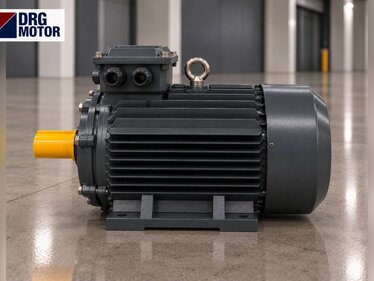
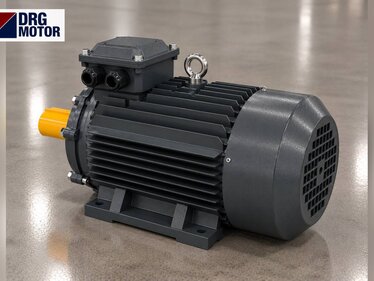
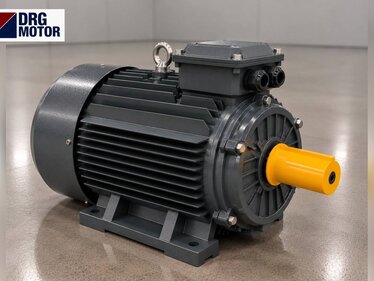
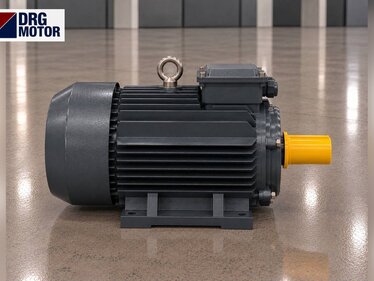
4- and 6-pole aluminium-frame models in the small power range found on industrial dosing pumps, available for flange mounting.
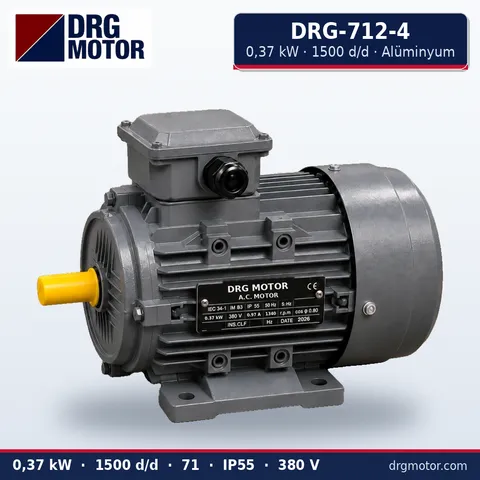
0.37 kW Three-Phase Motor 1500 rpm – DRG-712-4 Aluminium
- 0.37 kW · 1500 rpm (4 poles)
- Aluminium frame · IEC 71
- Mounting: B3 · B5 · B14 · B35
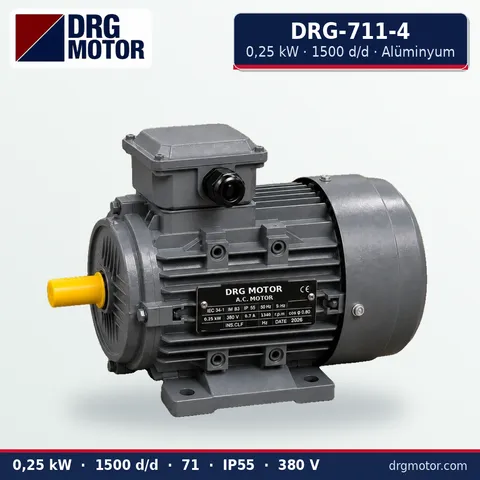
0.25 kW Three-Phase Motor 1500 rpm – DRG-711-4 Aluminium
- 0.25 kW · 1500 rpm (4 poles)
- Aluminium frame · IEC 71
- Mounting: B3 · B5 · B14 · B35
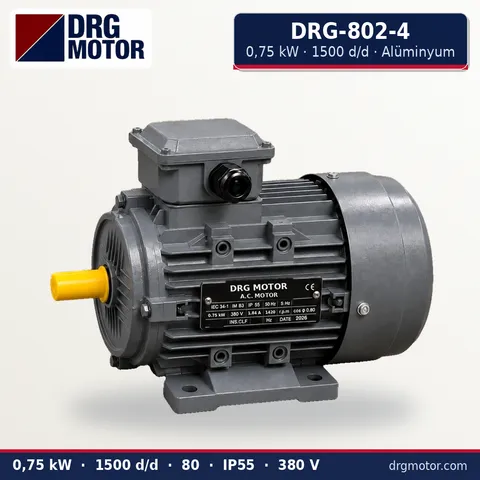
0.75 kW Three-Phase Motor 1500 rpm – DRG-802-4 Aluminium
- 0.75 kW · 1500 rpm (4 poles)
- Aluminium frame · IEC 80
- Mounting: B3 · B5 · B14 · B35
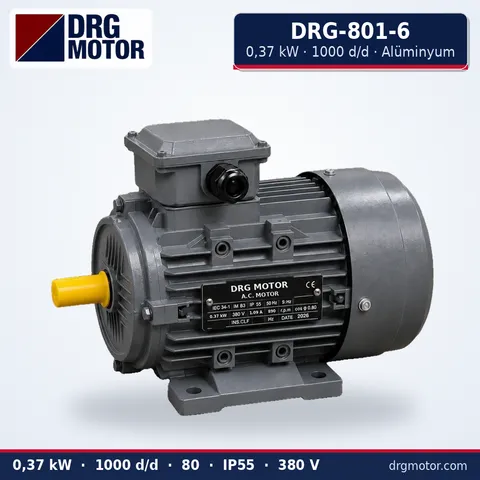
0.37 kW Three-Phase Motor 1000 rpm – DRG-801-6 Aluminium
- 0.37 kW · 1000 rpm (6 poles)
- Aluminium frame · IEC 80
- Mounting: B3 · B5 · B14 · B35
Click to see current prices and order these motors nowSEE PRICES →
Dosing Pump Motor: Frequently Asked Questions
How many kW is a dosing pump motor?
Industrial diaphragm pumps mostly use 0.25–0.75 kW, while large multi-head pumps use more. Even if flow is small, power is set by stroke force and mechanism losses; keep the plate value.
Can a 2-pole motor replace a dosing pump motor?
It should not. Stroke rate roughly doubles, valves and diaphragm are not designed for that speed and dosing accuracy suffers.
Is an IP55 motor enough for a chlorine dosing pump?
IP55 protects against dust and water jets but does not provide material resistance to chemical vapour. Keep the motor away from the vapour source, ventilate the room and check gland seals.
Is dosing pump flow changed by inverter or stroke adjustment?
Both are used. Stroke length adjustment does not change motor speed; an inverter changes stroke rate. For automatic proportional dosing, an inverter or actuator-driven stroke adjustment is usually preferred.
For a quotation, send photos of the pump and motor nameplates, the flange type (B5/B14) and flange dimensions, shaft diameter and the chemical being dosed via WhatsApp, or add the models to the quote list. Phone: +90 (542) 666 11 11 · E-mail: info@drgmotor.com · Contact page. All models are listed in the online shop.