English
 Le français
 Türkçe




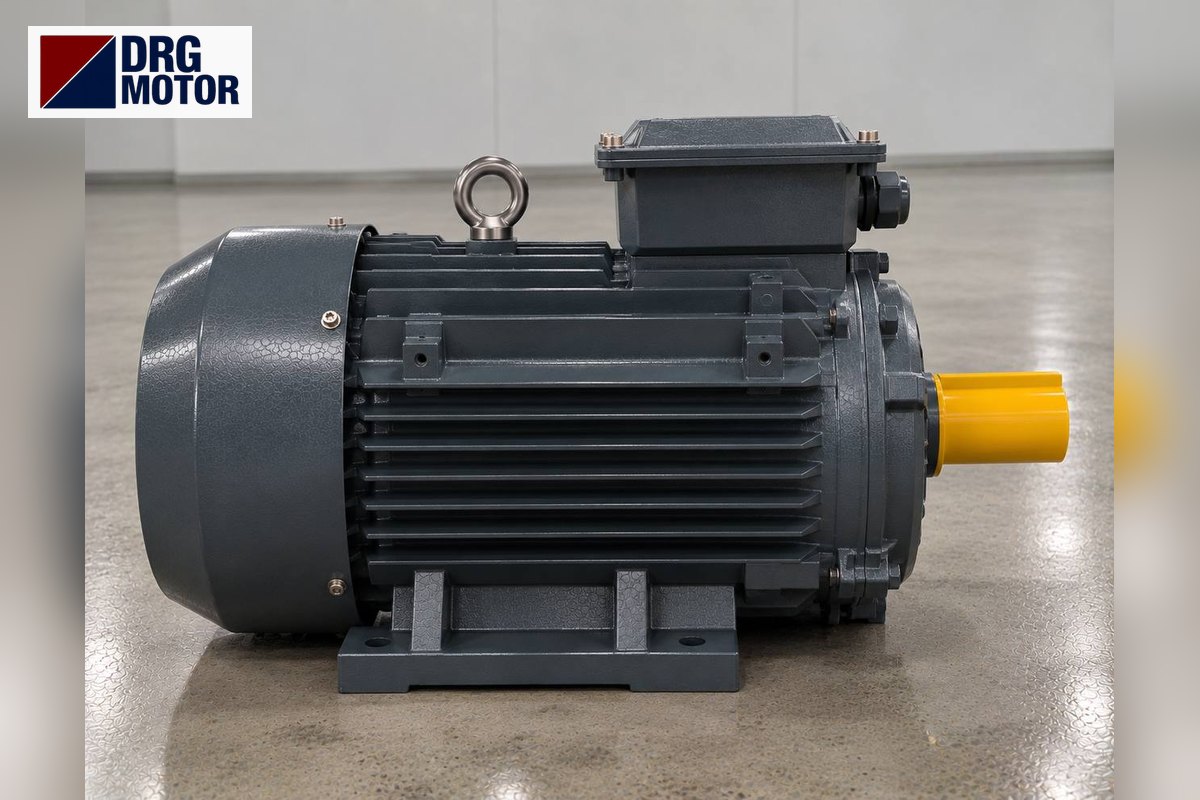

In an icing sugar grinding machine, the motor spins the pinned disc or hammer rotor that turns crystal sugar into powder within seconds. That is why the motor on these machines is usually 2-pole (3000 rpm class), and three conditions govern its selection: the rotor speed required, the starting load the motor and supply must carry while bringing a heavy rotor up to speed, and the zone the motor sits in, given the explosion risk created by sugar dust.
DRG Motor is a manufacturer, supplier and seller of electric motors; it does not build sugar mills but supplies the standard three-phase asynchronous IEC motor that turns the mill rotor. All 2-pole aluminium and cast iron frame models are on the buy electric motors online page.
For the motors of conveyors, sifters and filling machines on the sugar line, see the food machine motors page.
Pinned Disc and Hammer Rotor: What Breaks the Sugar?
In a pin mill, two discs face each other, one fixed and one rotating; the rings of pins on their faces interlock. Crystal sugar fed at the centre is thrown outward by centrifugal force and shatters against the pins of each ring. Fineness is set mainly by rotor speed: as speed drops, impact energy falls and the powder gets coarser.
In the hammer type, swinging hammers are hinged to the rotor; the sugar is reduced by striking both the hammers and the impact plate in the housing, and leaves the chamber as soon as it can pass the screen below. Some machines have a classifier wheel above the rotor, driven by its own motor, that sends particles not yet fine enough back to the grinding chamber. That motor is small, usually speed-controlled, and selected separately from the main motor.
What both types share is that the work is done by impact. The rotor is heavy and very fast; most of the motor's power goes not into grinding but into keeping the rotor and air at speed and accelerating the incoming sugar. Even with the feed stopped, the motor keeps drawing a significant no-load current.
Rotor Speed: Direct Coupling or Belt Overdrive?
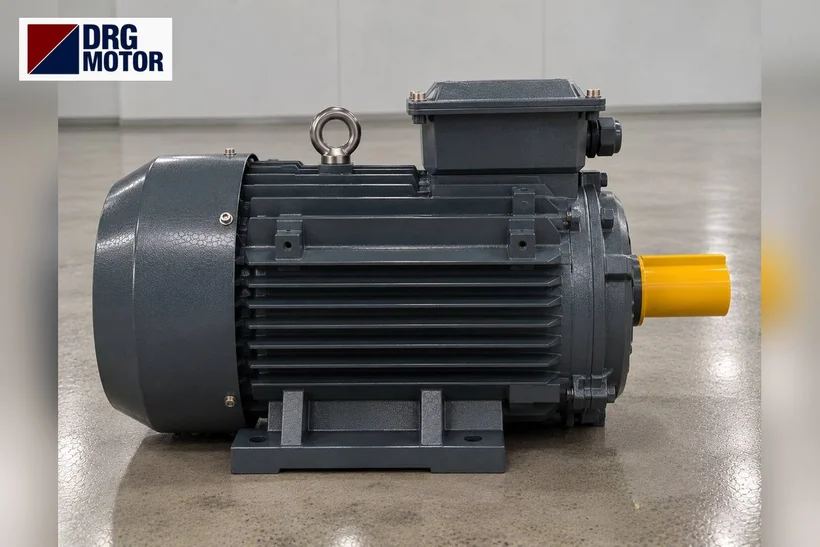
On small and medium icing sugar mills the rotor is usually coupled directly to the motor shaft, so rotor speed equals the motor's rated speed. For the 11 kW DRG-160M1-2 that means 2945 rpm. Example (assumption): on a 400 mm pin ring the peripheral speed from v = π·D·n/60 is about 61.7 m/s.
For finer powder some builders raise the speed above motor speed with belts and pulleys. Example: if the motor pulley is 1.5 times the rotor pulley, the rotor runs at 2945 × 1.5 ≈ 4418 rpm and the same ring reaches about 92.5 m/s. The torque at the rotor shaft then falls to about two thirds of the motor shaft torque, but the rotor's kinetic energy grows with the square of speed, and run-up time grows with it.
Two rules apply when replacing. First, keep the pole count: a 4-pole motor in place of a 2-pole one runs the rotor at half speed, and the machine will crack crystals but not produce icing sugar. Second, leave the pulley diameters as they are: the rotor's balance and bearings were designed for the builder's chosen speed, and raising it can mean exceeding the safety limit.
Click to see current electric motor prices and order nowSEE PRICES →
Bringing a Heavy Rotor Up to Speed: Starting Current and Starting Method
The icing sugar mill motor works hardest at start. The load sits between a fan and a flywheel: air resistance rises as the rotor accelerates, but what really takes time is rotor inertia. The motor draws several times its rated current meanwhile, and the run-up can last more than a few seconds; if the overload relay and fuses are not chosen for that time, the machine trips before reaching speed.
The difference between current drawn in direct-on-line and in star-delta starting is calculated below from the catalogue values of two DRG models. In star connection both current and torque are about one third of direct-on-line values:
| Value | DRG-160M1-2 (11 kW) | DRG-160M2-2 (15 kW) |
|---|---|---|
| Rated current (400 V) | 19.6 A | 26.5 A |
| Starting current Is/In | 8.1 | 8.1 |
| Direct-on-line current | ≈ 158.8 A | ≈ 214.7 A |
| Starting current in star | ≈ 52.9 A | ≈ 71.6 A |
| Rated torque | 35.7 Nm | 48.6 Nm |
| Starting torque in star | ≈ 23.8 Nm | ≈ 32.4 Nm |
If the mill starts empty (feed closed), the lower star torque is usually enough to accelerate the rotor. If the grinding chamber is still full or the feed screw starts together with the motor, the rotor cannot gain enough speed in star and a large current surge occurs at the switch to delta. The feed must be closed during start-up. You can review starting methods and the wiring diagram on the star-delta starting page.
DRG motors from 4 kW are rated 400/690 V; they run in delta on a 400 V supply and are therefore suitable for star-delta starting. Motors up to 3 kW, rated 230/400 V, run in star at 400 V and cannot be started this way; small mills use direct-on-line starting or a soft starter.
Sugar Dust Can Explode: Where a Standard Motor Must Not Be Used
Fine sugar dust can ignite once it reaches a certain concentration in air and cause a dust explosion. The icing sugar mill, product cyclone, filter and sifter are where this dust is densest. The plant operator therefore divides the site into zones through a risk assessment; the zone the motor sits in determines which motor may be used.
If the motor is in a zone where an explosive dust atmosphere can form, an Ex-protected special motor is required. This duty cannot be met by a standard IEC motor, and the DRG range does not include Ex motors. A main motor in an unclassified area, for example a machine room separated from the mill by a wall or an open section where dust does not settle, can be a standard IP55 motor. That distinction is made by the plant's zone classification document, not by the motor seller. You will find the general framework in the article on explosion-proof motors for hazardous areas.
Even in an unclassified area, sugar dust is a problem for the motor. Sugar is hygroscopic; dust that collects on the fan cover and fins absorbs moisture, hardens into a crust and blocks cooling. A layer that caramelises on a warm frame becomes harder to remove over time. Clean the frame dry at regular intervals and do not place the motor below the product flow or the filter discharge.
Bearings, Vibration and Nameplate Current
In the 3000 rpm class, bearing life is shorter than at 1500 rpm, and any small loss of rotor balance passes straight into the motor bearing. Misalignment between motor and rotor shaft on a direct-coupled mill, or excessive belt tension on a belt-driven one, wears the motor's drive-end bearing. DRG motors use 6309-C3 bearings in frame 160, 6208-ZZ-C3 in frame 132 and 6206-ZZ-C3 in frame 112.
Motor power is set by the machine builder according to mill capacity, required fineness and rotor diameter; small bakery units may use a few kW, industrial lines tens of kW. The definitive value is the machine nameplate or catalogue. If the plate is unreadable, compare the current measured while grinding at normal feed rate with the new motor's 400 V rated current. If current is above rated, the feed is too high, the screen is blocked or the motor is too small.
Gather this information before ordering:
- kW, rpm, voltage and connection (star or delta) on the old nameplate
- Whether the rotor is coupled directly to the motor shaft or belt-driven; if belt-driven, both pulley diameters
- Mounting type: foot (B3), flange (B5) or foot+flange (B35)
- Shaft diameter and length, bore of the coupling hub
- Starting method: direct-on-line, star-delta or soft starter
- Zone classification of the motor location (explosive dust atmosphere or not)
- Direction of rotation: hammer rotors usually run both ways, pinned discs one way only
DRG Motors Suited to Icing Sugar Mills
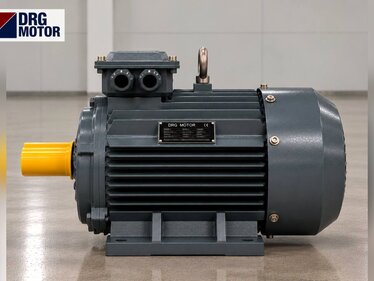
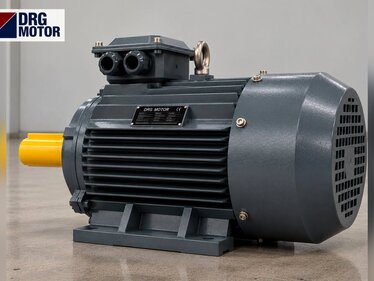
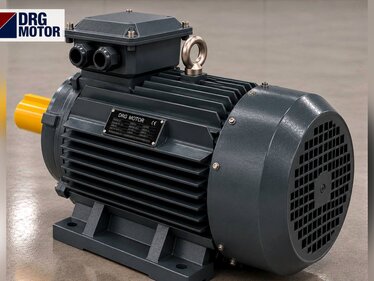
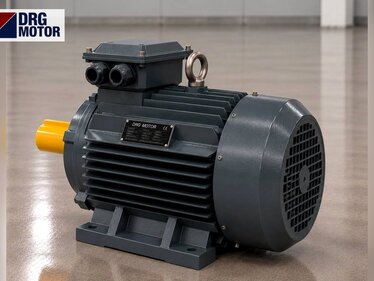
All four are 2-pole and intended for mill drives in unclassified areas; the 4 and 7.5 kW units have aluminium frames, the 11 and 15 kW units cast iron frames. The two frame-160 models share the same 42 × 110 mm shaft and B5 flange.
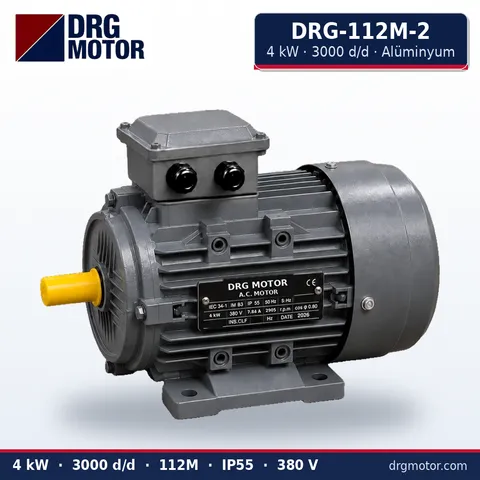
4 kW Three-Phase Motor 3000 rpm – DRG-112M-2 Aluminium
- 4 kW · 3000 rpm (2 poles)
- Aluminium frame · IEC 112M
- Mounting: B3 · B5 · B14 · B35
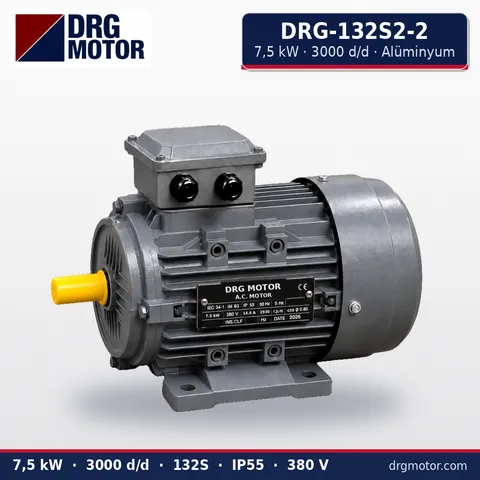
7.5 kW Three-Phase Motor 3000 rpm – DRG-132S2-2 Aluminium
- 7.5 kW · 3000 rpm (2 poles)
- Aluminium frame · IEC 132S
- Mounting: B3 · B5 · B14 · B35
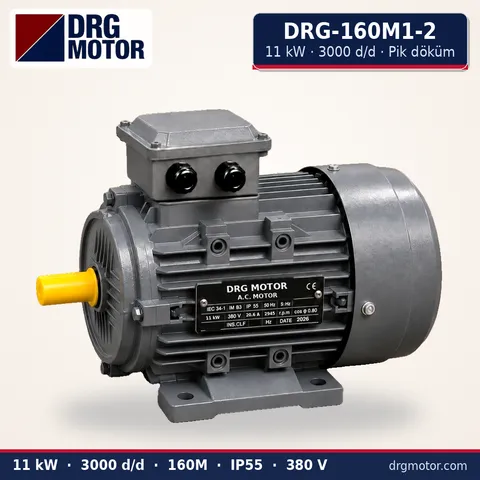
11 kW Three-Phase Motor 3000 rpm – DRG-160M1-2 Cast Iron
- 11 kW · 3000 rpm (2 poles)
- Cast iron frame · IEC 160M
- Mounting: B3 · B5 · B14 · B35
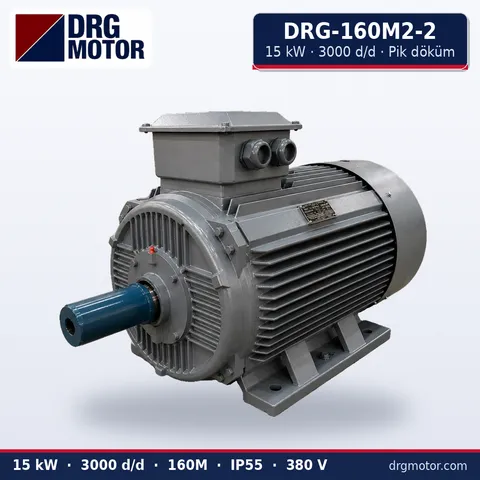
15 kW Three-Phase Motor 3000 rpm – DRG-160M2-2 Cast Iron
- 15 kW · 3000 rpm (2 poles)
- Cast iron frame · IEC 160M
- Mounting: B3 · B5 · B14 · B35
Click to see current prices and order these motors nowSEE PRICES →
Icing Sugar Mill Motor: Frequently Asked Questions
What speed should an icing sugar machine motor be?
Most pin and hammer mills use a 2-pole motor turning at around 2900 rpm rated. If the rotor is overdriven by belt, the motor is still in the 3000 rpm class and rotor speed rises with the pulley ratio. Keep the pole count of the old motor when replacing it.
Is an explosion-proof motor mandatory on a sugar mill?
Yes, if the motor sits in a zone classified as an explosive dust atmosphere in the plant's risk assessment; an Ex-protected special motor is then needed. DRG does not supply such motors. A standard IP55 motor is sufficient for a motor located in an unclassified area.
Why does the icing sugar mill trip while running?
If it trips at start, the overload setting or starting method may not suit the rotor's long run-up. If it trips while running, the feed is too high, the screen is blocked or damp sugar has lumped and filled the chamber. Measure current under load first.
Can speed be adjusted with a motor drive on a sugar mill?
The main rotor speed is normally fixed; fineness is adjusted with the classifier wheel speed, and that wheel's small motor runs on a drive. Running the main rotor above 50 Hz should only be done with the machine builder's approval because of the rotor's mechanical limits.
When asking for a quote for the mill motor, include the nameplate photo, power and speed, foot or flange mounting, shaft size and whether the rotor is direct- or belt-driven. You can send the details via WhatsApp or add the motors you choose to the quote list. Phone +90 (542) 666 11 11, e-mail info@drgmotor.com, other channels on the contact page. For current prices, visit the online shop.