English
 Le français
 Türkçe




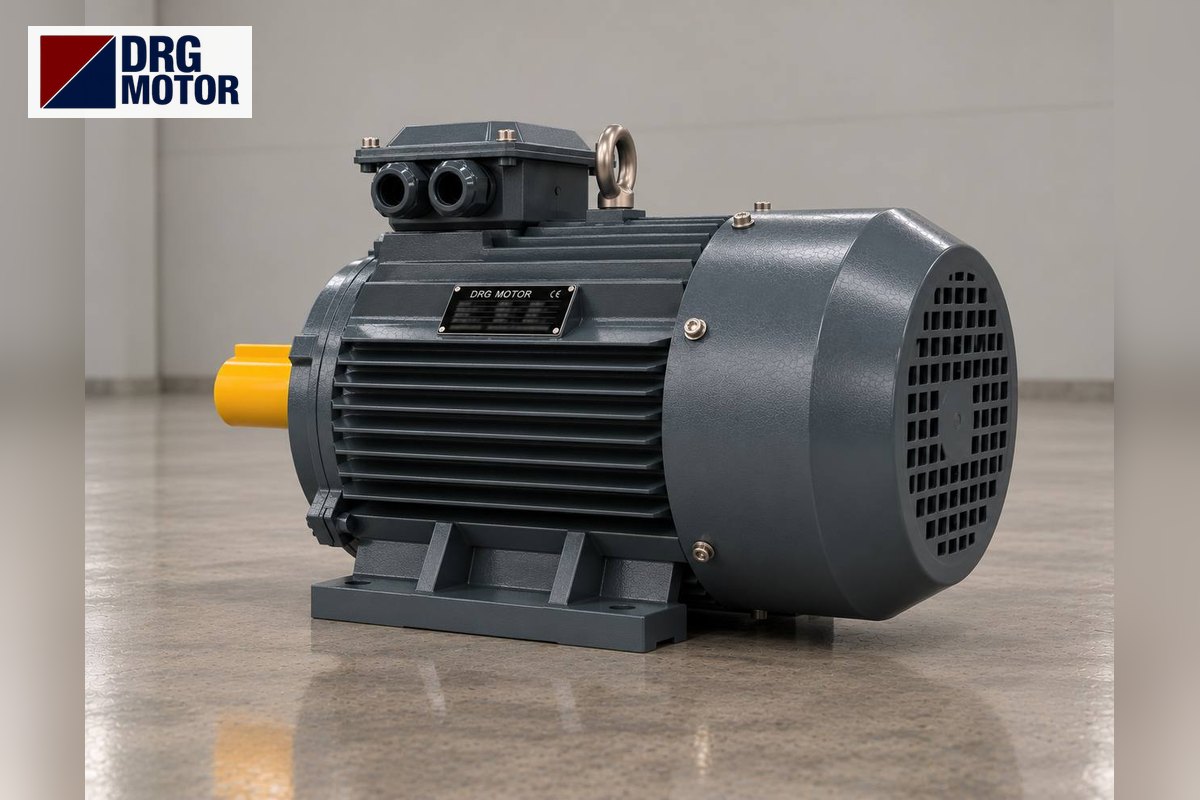

In a halva kneading machine, the motor provides the drive that kneads thickened sugar syrup with tahini using heavy arms and builds halva's fibrous structure. This mass creates one of the heaviest loads found on food machines: it is sticky, it cools and hardens as kneading goes on, and the arms press it against the trough wall on every turn. The deciding factors are therefore the peak torque at the arm shaft and starting with a full trough; the motor is usually connected to the arms through a belt and pulleys and a gearbox.
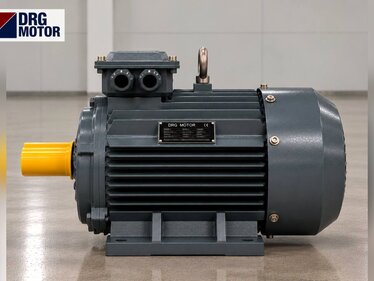
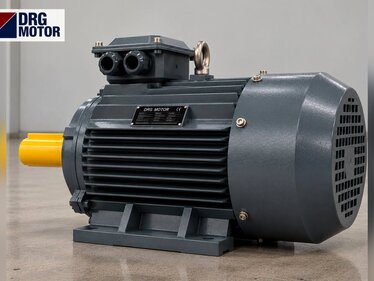
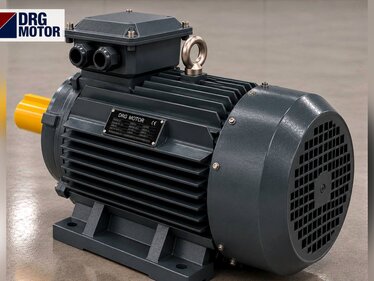
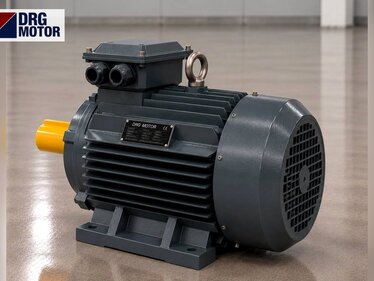
DRG Motor is a manufacturer, supplier and seller of electric motors; rather than gearboxes, it supplies the three-phase asynchronous motor that turns the kneader's gearbox or pulley. Cast iron motors suitable for heavy kneading are listed in the online shop. For similar kneading drives, see also the planetary mixer and dough mixer motors page.
What Happens at the Arms When Syrup Meets Tahini?
For tahini halva, sugar syrup is boiled at high temperature and thickened, and is often whipped white with soapwort root extract. It then goes into the kneading trough with the tahini. The arms pull and fold the syrup through the tahini again and again; as the syrup spreads into fine threads, the fibrous texture typical of halva forms.
During this process the mass loses heat while its resistance grows as the fibres develop. Towards the end of kneading, the arms are trying to cut and fold a hard, sticky mass that holds its own weight. The halva maker usually ends kneading by eye; for the motor, this means the heaviest moment of the batch falls right at the finish.
The load is not smooth either. As the arms approach the trough wall they compress the mass, and release it as they move away. The ammeter shows a ripple that repeats on every arm turn; the motor should be sized for these peaks, not for the average load.
Belt, Gearbox and Arm Speed: an Example Chain
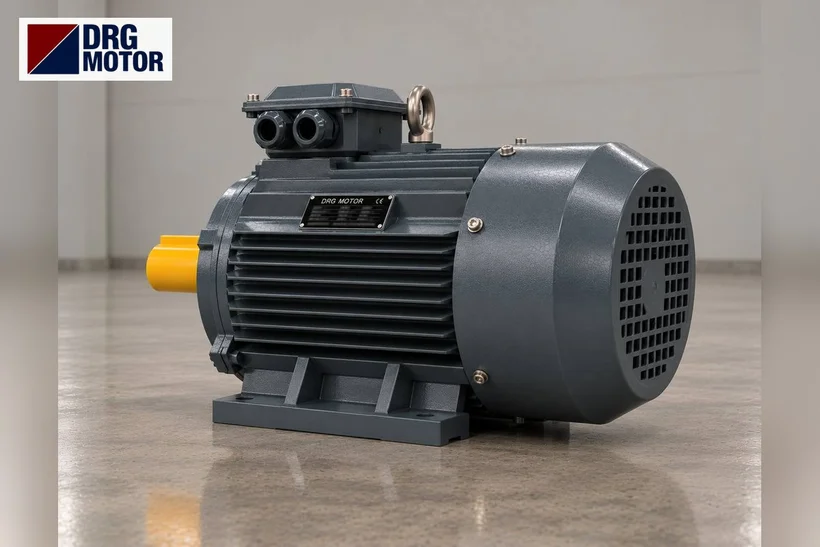
Example (assumption): a 160 mm motor pulley, a 400 mm machine pulley, then a gearbox with i = 25; belt efficiency 0.95 and gearbox efficiency 0.94. Arm shaft speed is n = n1 · d1 / d2 / i, and arm shaft torque T = Tn · (d2 / d1) · i · efficiencies.
- DRG-160M-4 (11 kW, 1465 rpm): pulley output 586 rpm, arm shaft 23.4 rpm, rated arm torque about 4002 Nm.
- Belt speed v = π · D · n / 60 = π · 0.16 · 1465 / 60 ≈ 12.27 m/s; a normal value for V-belts.
- If peak torque at the arm shaft is assumed to be 3500 Nm, the power required is P = T · n / 9550 ≈ 8.59 kW, and about 9.62 kW at the motor once belt and gearbox losses are added.
With this assumption the 11 kW motor meets the peak load below its rated torque. In the same chain, the DRG-132M-4 (7.5 kW) gives about 2740 Nm and stays below the peak load; at the end of kneading it nears its breakdown torque and heats up. For larger troughs, the DRG-160L-4 (15 kW) gives about 5458 Nm with the same ratio. To test pulley diameters for your own machine, use the pulley and belt calculator.
Click to see current electric motor prices and order nowSEE PRICES →
A Shorter Chain with a Six-Pole Motor
Some machines use a six-pole motor, reaching the same arm speed with a lower gearbox ratio. In the example, the DRG-160M-6 (7.5 kW, 970 rpm) with the same pulleys and an i = 16 gearbox turns the arms at 24.2 rpm and gives about 2636 Nm. As you can see, a motor that stays at 7.5 kW does not carry a 3500 Nm peak at the arm shaft even with a different pole count; power is what decides here.
Changing the pole count means changing the gearbox and pulleys as well. If the motor has burnt out on an existing machine, stay with the same pole count to keep the belt and gearbox as they are.
Starting a Full Trough and the Starting Method
A halva machine is strained most when it restarts with a full trough after a power cut or emergency stop. The mass keeps cooling meanwhile and grips the arms. On DRG cast iron four-pole motors the starting torque is 2.2 times rated (DRG-160M-4), which leaves an adequate margin on direct-on-line starting.
At 11 kW and above, most panels use star-delta starting. In star connection motor torque falls to about one third; with a full trough the motor may stall in star, and the change to delta brings a high current surge. In that case, start the trough empty or part-filled; if that is not possible, review the starting method. You can find the differences between methods on the motor starting methods and star-delta page.
The belt protects the motor and gearbox by slipping during a short jam, so overtightening the belt is not right. If the belt slips all the time, the problem is not tension but a load that is too high for the motor.
Halva Machine Checks by Fault
| Symptom | Likely cause | What to do |
|---|---|---|
| Motor will not start a full trough | Residue cooled and hardened | Clean the trough while warm |
| Stalls in star | Star torque below the load | Start empty or part-filled |
| Belt squeals and slips | Low tension or worn belt | Check tension and grooves |
| Current peaks on each arm pass | Arm presses mass against wall | Normal; watch the peak value |
| Trips at end of kneading | Power short or batch too big | Cut batch, review motor size |
The mill motor used in tahini preparation is a separate subject; we covered the link between stone gap and current in the tahini mill motor article. For other food drives, see the food machine motors page.
Before replacing the motor, note the following:
- Old motor nameplate: power, speed, voltage, connection (delta at 400/690 V)
- Mounting: foot (B3) or foot+flange (B35); foot hole spacing and shaft height (H)
- Shaft diameter and length, key, pulley hub
- Pulley diameters and belt type; gearbox ratio
- Panel starting type: direct-on-line, star-delta or soft starter
- Amount of tahini and syrup per batch, current at the end of kneading
The DRG-160M-4 and DRG-160L-4 are cast iron frame 160: shaft 42 × 110 mm, shaft height 160 mm. The DRG-132M-4 is frame 132: shaft 38 × 80 mm. If the frame changes, the slide rails and pulley hub change too.
DRG Motors Suited to Halva Kneading Machines
All have cast iron housings, chosen for frame rigidity and a bearing arrangement that carries belt pull under heavy, pulsating kneading loads. The power order follows the trough sizes in the worked example.
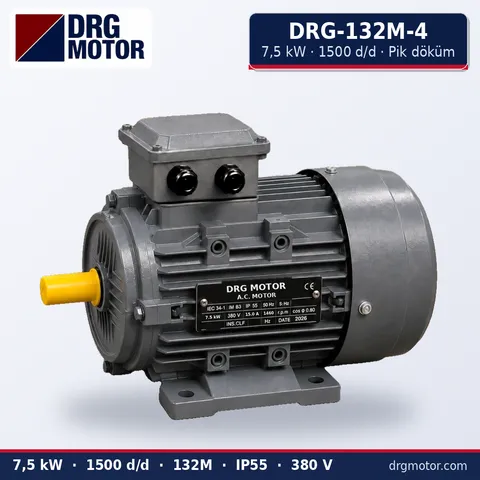
7.5 kW Three-Phase Motor 1500 rpm – DRG-132M-4 Cast Iron
- 7.5 kW · 1500 rpm (4 poles)
- Cast iron frame · IEC 132M
- Mounting: B3 · B5 · B14 · B35
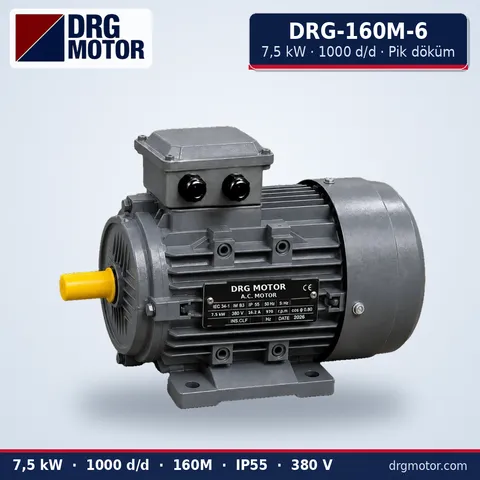
7.5 kW Three-Phase Motor 1000 rpm – DRG-160M-6 Cast Iron
- 7.5 kW · 1000 rpm (6 poles)
- Cast iron frame · IEC 160M
- Mounting: B3 · B5 · B14 · B35
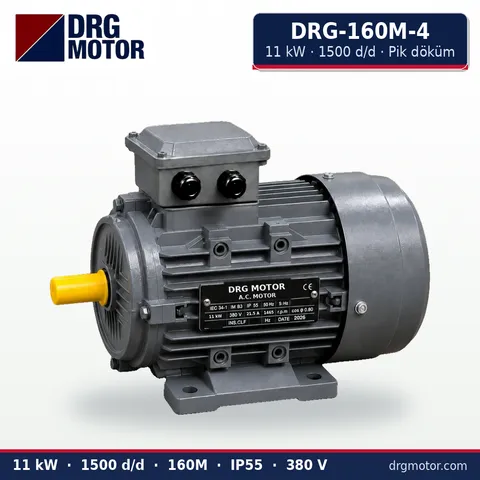
11 kW Three-Phase Motor 1500 rpm – DRG-160M-4 Cast Iron
- 11 kW · 1500 rpm (4 poles)
- Cast iron frame · IEC 160M
- Mounting: B3 · B5 · B14 · B35
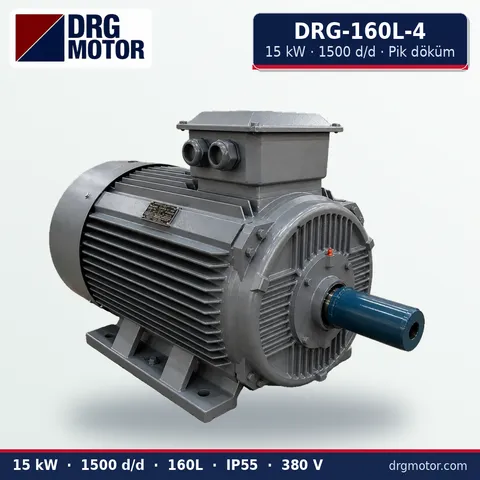
15 kW Three-Phase Motor 1500 rpm – DRG-160L-4 Cast Iron
- 15 kW · 1500 rpm (4 poles)
- Cast iron frame · IEC 160L
- Mounting: B3 · B5 · B14 · B35
Click to see current prices and order these motors nowSEE PRICES →
Halva Kneading Motor: Frequently Asked Questions
What kW motor does a halva kneading machine use?
Small workshop machines may use a few kW, large troughs more than 10 kW. Check the machine's own plate for the exact figure. The 11 kW in the example is based on an assumed 3500 Nm peak torque.
Why does the halva machine struggle at the end of kneading?
Resistance rises as the fibre structure develops and the mass cools; the heaviest moment of the batch is the end of kneading. If the batch size is above the machine design, the motor heats up at this point every batch.
Will a halva machine start on star-delta?
It will with an empty or part-filled trough. With a full, cooled trough the low torque of the star connection may not be enough; in that case empty and clean it while warm, or change the starting method.
Can an aluminium-housed motor be used?
Aluminium options exist up to 11 kW. On kneading machines where belt tension and a pulsating load act all the time, a cast iron housing is the more robust choice.
If you need a new motor for your halva machine, photograph the old motor's plate and share it on WhatsApp together with the mounting (foot or flange), shaft size, both pulley diameters and the way your panel starts the motor; we will pick the matching model with you. You can also add models to your quote list and ask for an offer. Phone +90 (542) 666 11 11, e-mail info@drgmotor.com, or our contact page. All cast iron and aluminium models are in the DRG motor shop.