English
 Le français
 Türkçe




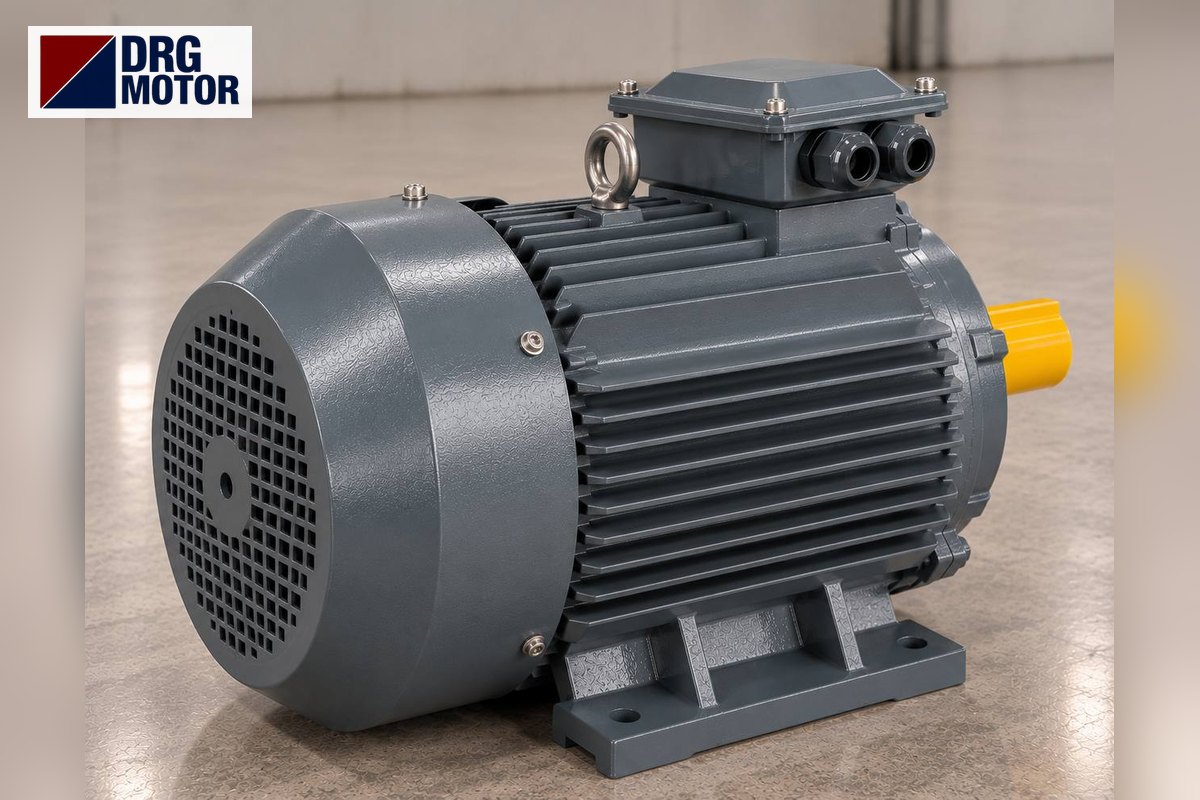

On a water-based glue (PVAc dispersion, white glue) mixing machine, the motor is decided less by rated power than by the moment of starting. Thick glue gels as it stands in the vessel; getting the agitator moving again in a full vessel needs noticeably more torque than keeping it turning. So the gearbox ratio and output shaft torque are calculated first, then you check whether the motor’s starting torque and starting method can deliver that torque.
In these vessels the agitator shaft turns through a gearbox; the motor is a 4- or 6-pole three-phase motor connected to the gearbox input by flange or coupling. All models, cast iron options included, are on the buy electric motors online page.
DRG Motor is a manufacturer, supplier and seller of electric motors. DRG does not sell gearboxes; it supplies the standard IEC motor to be fitted to the existing gearbox or the one chosen by the machine maker.
Which Agitators Work in a Glue Vessel?
In plants making commercial glue from ready PVAc dispersion, the vessel is charged with dispersion, water, plasticiser, filler (e.g. calcite) and additives. The mix needs two different motions: high-speed shear so the powder disperses without lumps, and slow circulation of the thick mass through the whole vessel.
A dissolver spins a toothed disc at the end of its shaft at high speed and disperses the filler into the liquid. A dual-shaft mixer adds a slow anchor or scraper frame following the vessel wall to this fast dissolver shaft. In thick glue the dissolver alone is not enough; it opens a cavity around the disc and the outer zone of the vessel stands still. The slow shaft eliminates this dead zone.
The calculation in this article is for the slow shaft, which is hardest on motor selection. The dissolver motor is usually belt-driven and starts more easily because the disc is free at start.
Why Does Gelled Glue Load the Start?
PVAc dispersion is thixotropic: it thins as it is stirred and thickens as it stands. Filled glue left in the vessel overnight can become a semi-solid mass by morning. The agitator arms cannot start turning without breaking this mass; the torque needed in the first seconds is higher than after the product starts to flow.
The difference grows with higher filler content and lower temperature. A vessel standing in an unheated store in winter starts harder than the same recipe in summer. After starting, torque falls, but rises again while filler is added.
The ratio of starting load to running load depends on recipe, filler and standing time; the reliable way to measure it is to log starting and running currents on the existing machine. In the example below this ratio is assumed to be 1.8.
Click to see current electric motor prices and order nowSEE PRICES →
Worked Example: Gearbox Ratio, Shaft Torque and Motor Power
Example (assumption): the slow shaft is expected to turn at 30 rpm and need 3500 N·m at the shaft while running. Shaft power P = T·n/9550 = 3500·30/9550 ≈ 11.0 kW.
With the DRG-160L-4 (1465 rpm), the gearbox ratio is i = 1465/30 ≈ 48.8. With a factor of 0.9 for gearbox losses, the motor shaft needs 3500/(48.8·0.9) ≈ 79.6 N·m. With a starting factor of 1.8, about 143.3 N·m is needed at the motor shaft in a full vessel.
| Case | Required (motor shaft) | Motor delivers | Result |
|---|---|---|---|
| Running, 11 kW motor | 79.6 N·m | Tn 71.7 N·m | Overload, relay trips |
| Running, 15 kW motor | 79.6 N·m | Tn 97.8 N·m | Below rated torque |
| Full vessel, direct-on-line start | 143.3 N·m | Ts ≈ 215.2 N·m | Starts |
| Full vessel, star start | 143.3 N·m | Ts/3 ≈ 71.7 N·m | Cannot start in star |
The first row shows a common mistake: since shaft power comes out at 11.0 kW, an 11 kW motor is chosen, and with gearbox losses it runs above its rated torque. Add gearbox losses to the measured or calculated shaft power and choose the next motor size up. You can check ratio and output torque with the gearbox output speed and torque calculator.
Star-Delta or Direct-On-Line Starting?
At powers such as 15 kW, star-delta starting is common to limit current. DRG motors from 4 kW upwards are wound for 400/690 V and suit star-delta. But in star, the motor’s starting torque also drops to roughly one third. For the DRG-160L-4, with Ts/Tn = 2.2 and Tn = 97.8 N·m, about 71.7 N·m remains in star; not even half of the 143.3 N·m needed for a gelled vessel.
As a result the motor cannot turn in star or stays at very low speed; when the timer switches to delta, it draws almost as much current as a direct start and the changeover gains nothing. In current terms, with Is/In = 7.8, about 213 A is expected for direct-on-line starting and about 71 A in star.
The options then are: direct-on-line starting if the supply capacity allows; a frequency inverter set for constant torque (DRG does not sell inverters); or briefly stirring the vessel before each stop to reduce gelling. For a comparison of starting methods, see the motor starting methods and star-delta page.
4-Pole or 6-Pole: Two Routes to the Same Shaft Torque
The same 30 rpm output can also be reached with the DRG-180L-6 (978 rpm) and a gearbox ratio of about 32.6. The motor shaft then needs about 119.3 N·m, and about 214.7 N·m at start; the motor’s rated torque is 146.5 N·m and its starting torque about 293 N·m.
The 6-pole motor needs a smaller gearbox ratio, but at the same kW it is heavier with a larger frame (180L, 48 mm shaft). Choose according to the frame the existing gearbox input flange and shaft bore were made for; changing pole number also changes the ratio. The motors for bevel helical gearboxes page gives details on motors for bevel helical gearboxes.
Information to Collect from the Vessel Before Ordering
- Which shaft’s motor: slow anchor/frame or fast dissolver
- Old motor nameplate: kW, speed, voltage (400/690 V?) and connection
- Gearbox nameplate: ratio, input flange and input shaft bore
- How the motor connects to the gearbox: flange (B5), foot and flange (B35) or foot-mounted with coupling (B3)
- Starting method in use, and whether the overload relay or fuse trips on a full-vessel start
- Vessel volume, filler content and how long the vessel stands full
- Environment: dusty filler discharge area, humidity and temperature range
When powder fillers such as calcite are discharged, the motor’s fan cowl can become coated with dust. DRG motors are IP55 with a shaft-mounted fan (IC411); cleaning the fan grille regularly prevents overheating. Solvent-based adhesives can create an explosive atmosphere; such plants need an Ex-protected special motor, which DRG does not offer.
DRG Motors for Glue Mixers
These cast iron 4- and 6-pole models cover the power range for heavy-starting slow agitator shafts on a gearbox input; the final choice is made from shaft torque and gearbox ratio.
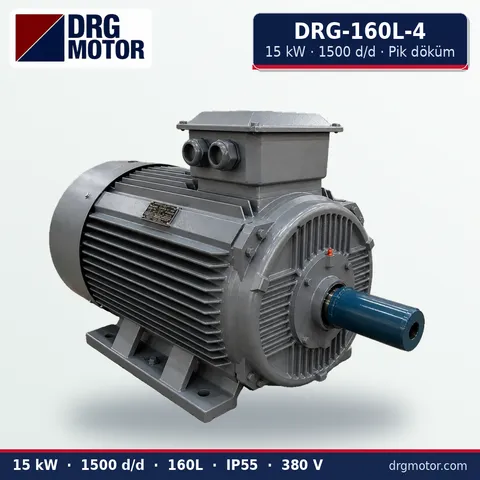
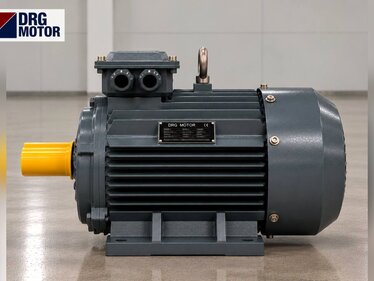
15 kW Three-Phase Motor 1500 rpm – DRG-160L-4 Cast Iron
- 15 kW · 1500 rpm (4 poles)
- Cast iron frame · IEC 160L
- Mounting: B3 · B5 · B14 · B35
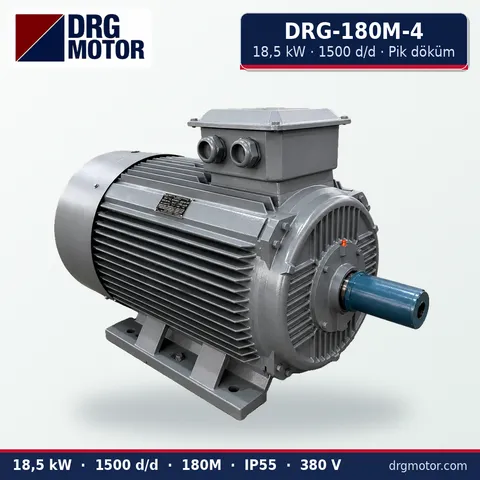
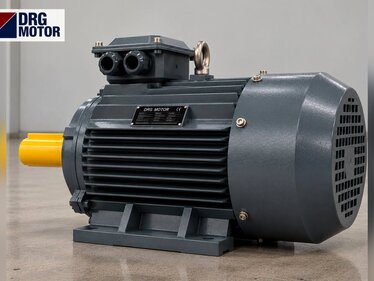
18.5 kW Three-Phase Motor 1500 rpm – DRG-180M-4 Cast Iron
- 18.5 kW · 1500 rpm (4 poles)
- Cast iron frame · IEC 180M
- Mounting: B3 · B5 · B14 · B35
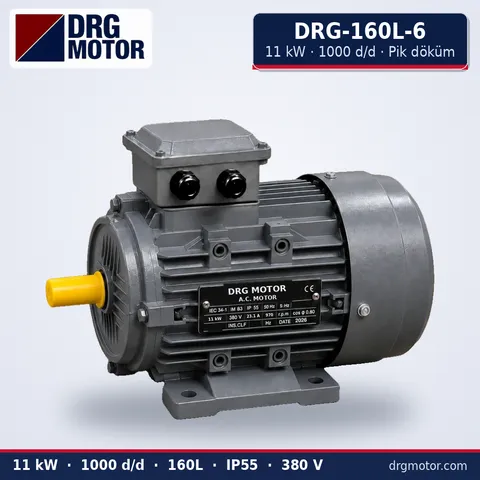
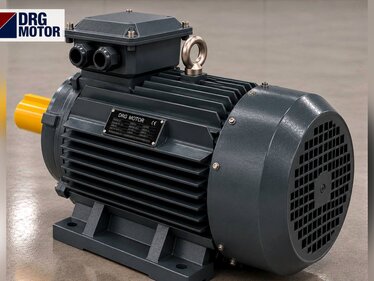
11 kW Three-Phase Motor 1000 rpm – DRG-160L-6 Cast Iron
- 11 kW · 1000 rpm (6 poles)
- Cast iron frame · IEC 160L
- Mounting: B3 · B5 · B14 · B35
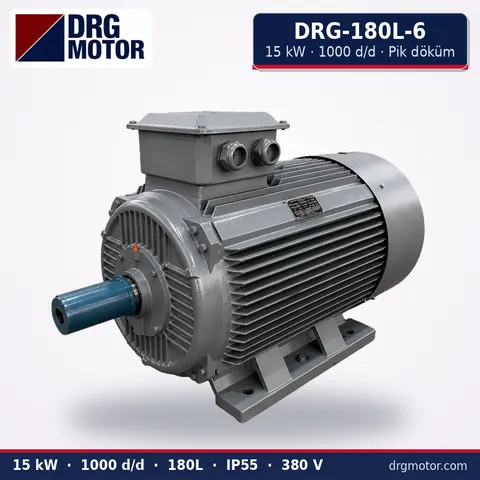
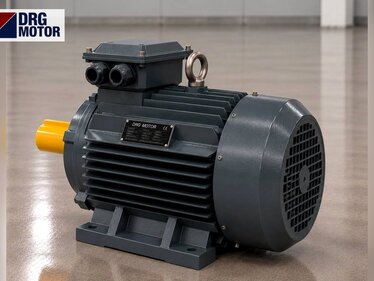
15 kW Three-Phase Motor 1000 rpm – DRG-180L-6 Cast Iron
- 15 kW · 1000 rpm (6 poles)
- Cast iron frame · IEC 180L
- Mounting: B3 · B5 · B14 · B35
Click to see current prices and order these motors nowSEE PRICES →
Glue Mixer Motor FAQ
The glue mixer trips the overload on morning start. Is the motor too small?
Not always. If the motor runs below nameplate current while running, the problem is most likely the start: gelled product and star-delta starting together leave too little starting torque. Check the starting method and overload setting first; enlarge the motor only if the running current is also high.
How is the gearbox ratio calculated for a glue mixer?
The ratio is the motor’s rated speed divided by the desired agitator speed: i = n1/n2. For a 1465 rpm motor and a 30 rpm agitator, it is about 48.8. The gearbox multiplies the motor shaft torque by this ratio and by the gearbox’s mechanical loss factor (0.9 in the example).
Can the dissolver motor and the slow-shaft motor be the same?
Usually not. The dissolver runs at high speed with a belt ratio and is relatively light at start; the slow shaft needs high torque through a gearbox. The two motors are chosen separately, each for its own speed and torque needs.
Is an inverter needed on a glue vessel?
Not mandatory, but often chosen to adjust speed to the recipe and to give a soft yet strong start in a full vessel. The inverter must be set to constant torque; for long runs at low speed, motor heating must be assessed separately because the motor fan also slows down.
To pin down the right motor together, share photos of the motor and gearbox nameplates, the agitator speed, the mounting (B5, B35 or B3), the shaft size and your starting method via WhatsApp, or build a quote list. Call: +90 (542) 666 11 11 · write: info@drgmotor.com · contact form. All cast iron 4- and 6-pole models are in our online store.