English
 Le français
 Türkçe




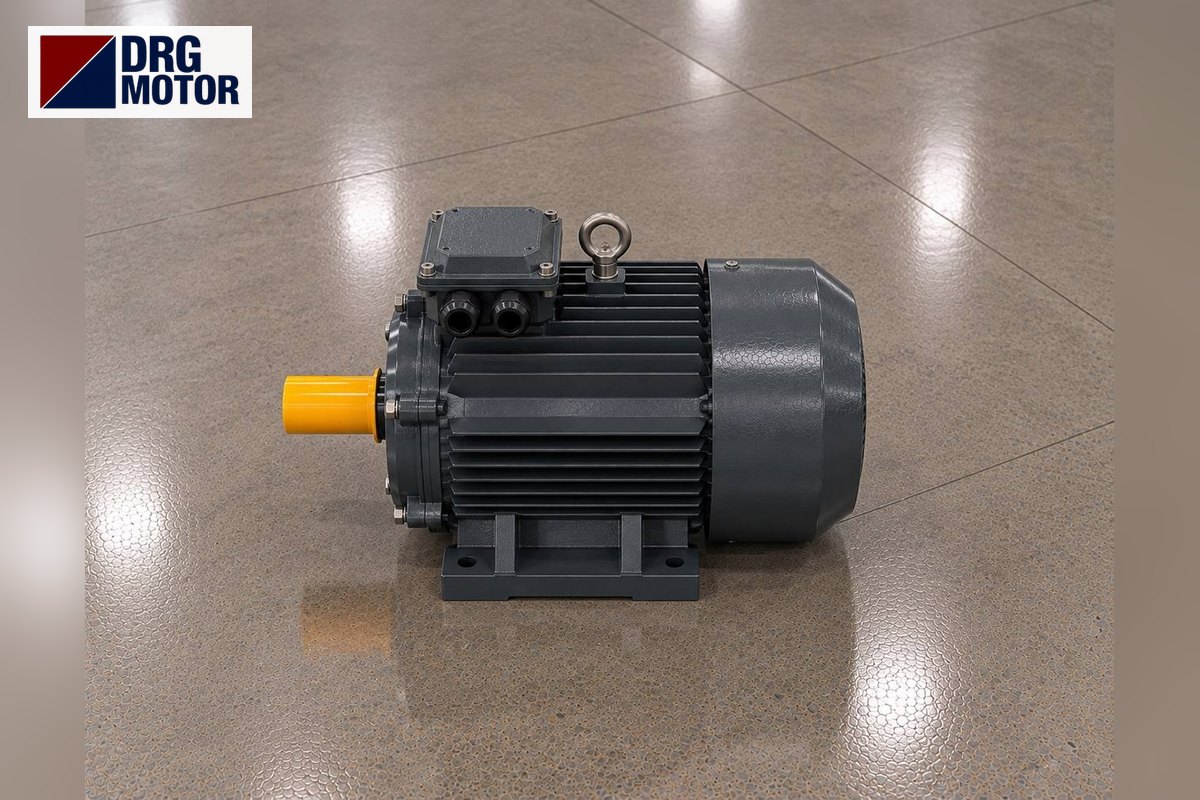

On a fabric winding machine, the motor's real job is to take up the fabric onto the roll at constant tension and constant speed. As the roll grows, the force needed to pull the fabric stays the same but its lever arm (the roll radius) grows; on a centre-driven winder the shaft torque therefore rises with diameter while the speed falls in the same ratio. What sizes the motor is not power but the torque it must deliver on a full roll at the lowest speed.
If you are replacing a motor with a readable nameplate, you can find a replacement with the same power, speed and flange on our buy electric motors online page. If you are building a new winder or upsizing the motor of an A-frame unit, the example calculation below shows what needs to be measured.
Centre Winding versus Surface Winding
Two winding layouts are used in textiles. In centre winding the roll shaft is connected straight to the motor through a gearbox; to keep fabric speed constant, motor speed is reduced as the roll grows. This is done with an inverter; tension is read from the position of a dancer arm or from a load cell, and the inverter's speed reference is corrected accordingly.
In surface winding the roll rests on a drive drum of fixed diameter and turns by friction. Because the drum diameter does not change, the motor runs at constant speed and constant torque; roll growth does not concern the motor. This layout is common on batching units and on winders that build fabric into large rolls. For delicate, pile or crush-sensitive fabrics, centre winding is preferred.
Torque and Speed by Roll Diameter: an Example Calculation
The values below are an assumption; on your own machine tension and speed differ according to fabric type and the maker's settings.
Example: fabric width 180 cm, winding tension 1.5 N/cm, fabric speed 80 m/min. Total pulling force is 1.5 × 180 = 270 N. Power delivered to the fabric is F·v = 270 × 80/60 ≈ 360 W and does not depend on roll diameter. Let the empty mandrel be 140 mm and the full roll 1000 mm; the diameter ratio is about 7.1.
| Roll diameter | Roll speed | Shaft torque | Inverter frequency |
|---|---|---|---|
| 140 mm | 181.9 rpm | 18.9 N·m | 50.0 Hz |
| 300 mm | 84.9 rpm | 40.5 N·m | 23.3 Hz |
| 600 mm | 42.4 rpm | 81.0 N·m | 11.7 Hz |
| 1000 mm | 25.5 rpm | 135.0 N·m | 7.0 Hz |
The last column is the frequency the inverter must supply when the gearbox ratio is chosen so that the motor runs at 50 Hz on the empty mandrel (i ≈ 7.97). On a full roll the motor must run at about 7 Hz while applying 135 N·m to the shaft. With an assumed gearbox efficiency of 0.9, motor shaft torque is 135 / 7.97 / 0.9 ≈ 18.8 N·m.
Compare that figure with the nameplate: DRG-112M-4 (4 kW) has a rated torque of 26.3 N·m, DRG-132S-4 (5.5 kW) 36.0 N·m. This is why the motor is several kW while the power going into the fabric is under half a kilowatt: torque is needed at low speed.
Click to see current electric motor prices and order nowSEE PRICES →
Heating at Low Speed and the Shaft-Mounted Fan
DRG motors are IC411 cooled; cooling air comes from the fan on the shaft. At 7 Hz the fan turns at one seventh of rated speed and the air it moves over the housing drops sharply. If the motor is loaded close to rated torque at this speed for a long time, the winding heats up.
In practice there are three routes. The first is to choose one frame size larger to lower the load ratio: in the example 18.8 N·m is about 71 percent of rated torque for the 112M-4 and about 52 percent for the 132S-4. The second is a separately powered cooling fan; this is not in the standard range and needs a special motor. The third is to narrow the diameter range: a smaller full roll or a larger mandrel directly shortens the frequency range.
Which one fits depends on how many minutes the machine takes to fill a roll. With short rolls the full-roll phase is brief; with long rolls the motor stays at low frequency for hours. The inverter's torque and current limit at low frequency must also be confirmed with the inverter maker's data.
Stopping, Starting and the Inertia of a Full Roll
A full fabric roll is heavy and its inertia grows with the square of its diameter. When the line stops, the inverter has to brake this mass through the motor; the braking energy flows back to the DC bus. That is why centre-driven winders have a braking resistor on the inverter, and the stop ramp is set short enough not to lose tension and long enough to avoid an overvoltage trip.
At start-up, the dancer arm should not drop and the fabric should not go slack. The inverter starts with a torque feed-forward calculated from roll diameter. For the motor, what matters is covering the starting torque and short overloads; the motors in the example have a starting torque ratio Ts/Tn of 2.2 and 2.0.
Gearbox and Mounting Dimensions
On centre-driven winders the motor is usually attached to a helical or worm gearbox with a large B5 flange. DRG does not sell gearboxes; it supplies the motor that fits the gearbox. When replacing, the gearbox input flange and shaft bore must match the motor's flange and shaft exactly.
- Frame 112M B5 flange: M = 215 mm, N = 180 mm, P = 250 mm, S = 14.5 mm
- Frame 112M shaft (D × E): 28 × 60 mm, key 8 mm
- Frame 132S B5 flange: M = 265 mm, N = 230 mm, P = 300 mm, S = 14.5 mm
- Frame 132S shaft (D × E): 38 × 80 mm, key 10 mm
Moving from 112M to 132S changes flange and shaft, so the gearbox input adapter also changes. To check ratio and output speed use our gearbox output speed and torque calculator; the general rules for matching motor and gearbox are on our electric motors for gearboxes page.
Before Ordering the Winder Motor
- Winding layout: centre or surface?
- Fabric width, maximum tension (N/cm) and maximum speed (m/min).
- Empty mandrel and full roll diameter; time to fill one roll.
- Gearbox ratio, input flange (M, N, P) and shaft bore diameter.
- Old motor nameplate: kW, rpm, voltage, mounting (B3 / B5 / B35).
- Inverter frequency range and whether a braking resistor is fitted.
For surface winding the calculation is much shorter. In the example, with a 250 mm drive drum the drum needs 270 × 0.125 ≈ 33.8 N·m at about 102 rpm; a 0.75–1.5 kW 4-pole motor with a suitable gearbox is enough. In this layout the motor runs at a fixed frequency, so low-speed heating does not occur.
DRG Motors Suited to Fabric Winders
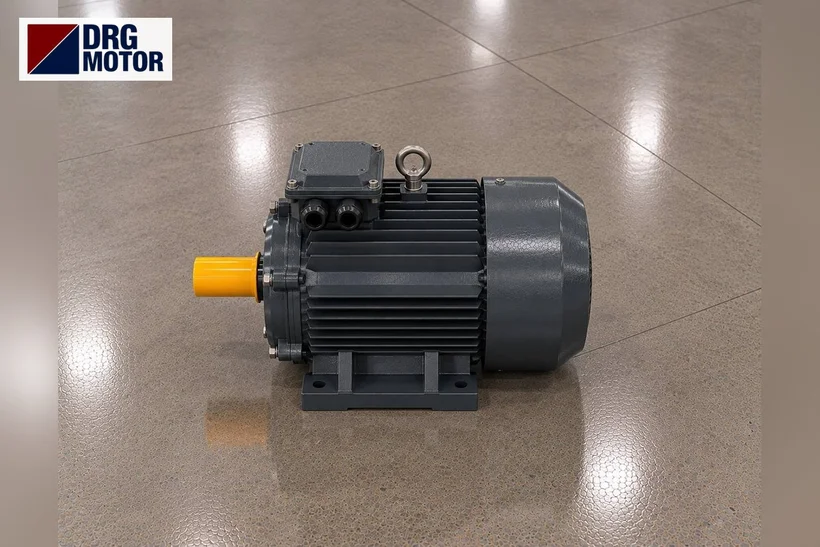
Frames 112M and 132S carry the full-roll torque in centre winding, while the smaller 4-pole models suit surface winding; all have aluminium housings and can be fitted to a gearbox with a B5 flange.
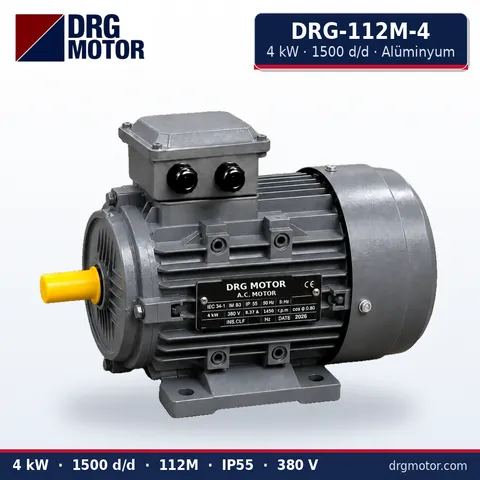
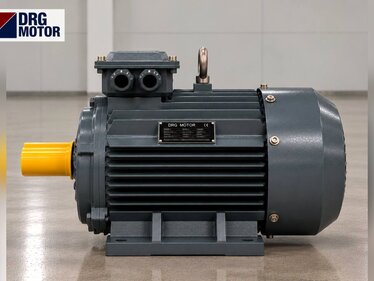
4 kW Three-Phase Motor 1500 rpm – DRG-112M-4 Aluminium
- 4 kW · 1500 rpm (4 poles)
- Aluminium frame · IEC 112M
- Mounting: B3 · B5 · B14 · B35
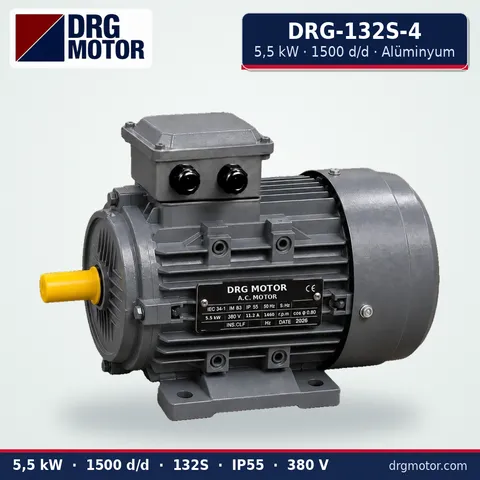
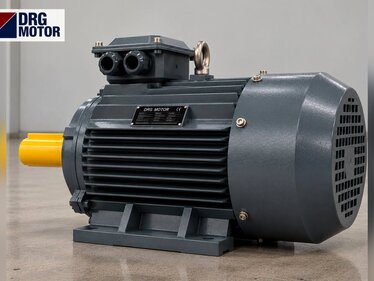
5.5 kW Three-Phase Motor 1500 rpm – DRG-132S-4 Aluminium
- 5.5 kW · 1500 rpm (4 poles)
- Aluminium frame · IEC 132S
- Mounting: B3 · B5 · B14 · B35
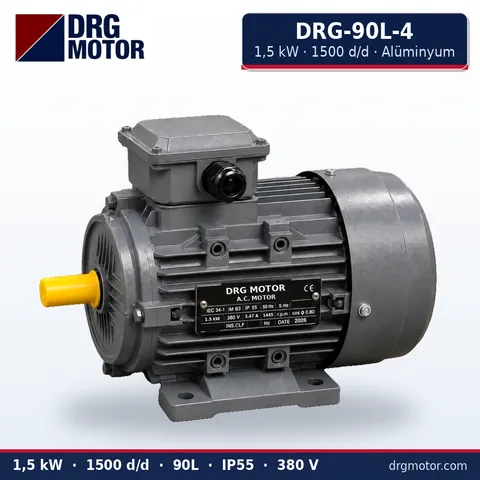
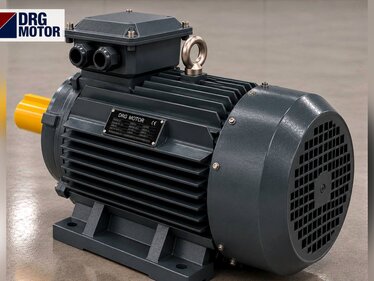
1.5 kW Three-Phase Motor 1500 rpm – DRG-90L-4 Aluminium
- 1.5 kW · 1500 rpm (4 poles)
- Aluminium frame · IEC 90L
- Mounting: B3 · B5 · B14 · B35
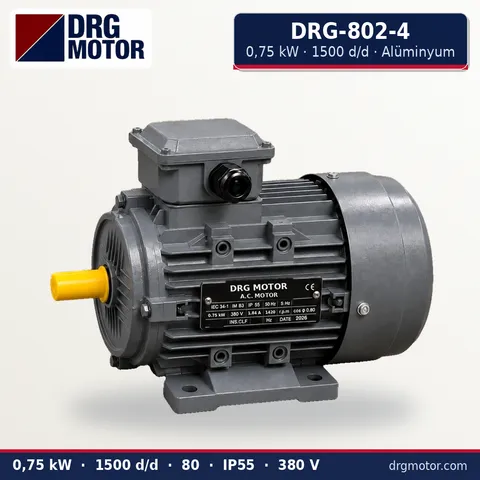
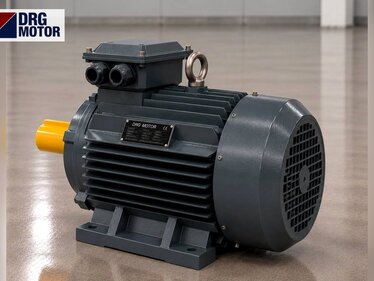
0.75 kW Three-Phase Motor 1500 rpm – DRG-802-4 Aluminium
- 0.75 kW · 1500 rpm (4 poles)
- Aluminium frame · IEC 80
- Mounting: B3 · B5 · B14 · B35
Click to see current prices and order these motors nowSEE PRICES →
Fabric Winding Motor: Frequently Asked Questions
Why does the fabric go slack or tear as the roll grows?
In centre winding, if motor speed is not reduced as the diameter grows, fabric speed rises and tension increases; if it is reduced too much, the fabric goes slack. The dancer or load cell makes this correction. If the problem persists, check whether the motor torque is enough on a full roll and whether the inverter is hitting its current limit.
What motor kW does a fabric winding machine need?
The power going into the fabric is small; the motor is sized by the torque on a full roll. Workshop winders use roughly 1 kW, wide large-diameter A-frame units several kW. The exact value is the machine maker's nameplate; with the calculation above you can check your own tension and diameter values.
Is a 6-pole motor better for a winder?
A 6-pole motor gives more torque for the same power and works with a smaller gearbox ratio, but the speed range problem remains: if the diameter ratio is 7, the frequency range is still 7 to 1. The choice follows the gearbox ratio and flange.
Can I convert an existing AC motor to inverter-driven winding?
A standard three-phase induction motor can be driven by an inverter. First calculate the full-roll torque and the frequency at that point as shown above; if the motor is at its limit, choose one frame size larger.
For selection, send a photo of the old motor's nameplate, its power, speed, mounting (foot/flange), shaft size, gearbox ratio and roll diameters via WhatsApp, or request a quotation through the quote list. Phone +90 (542) 666 11 11, e-mail info@drgmotor.com, contact page. DRG Motor is a manufacturer, supplier and seller of electric motors; all ready models are listed in our online store.