English
 Le français
 Türkçe




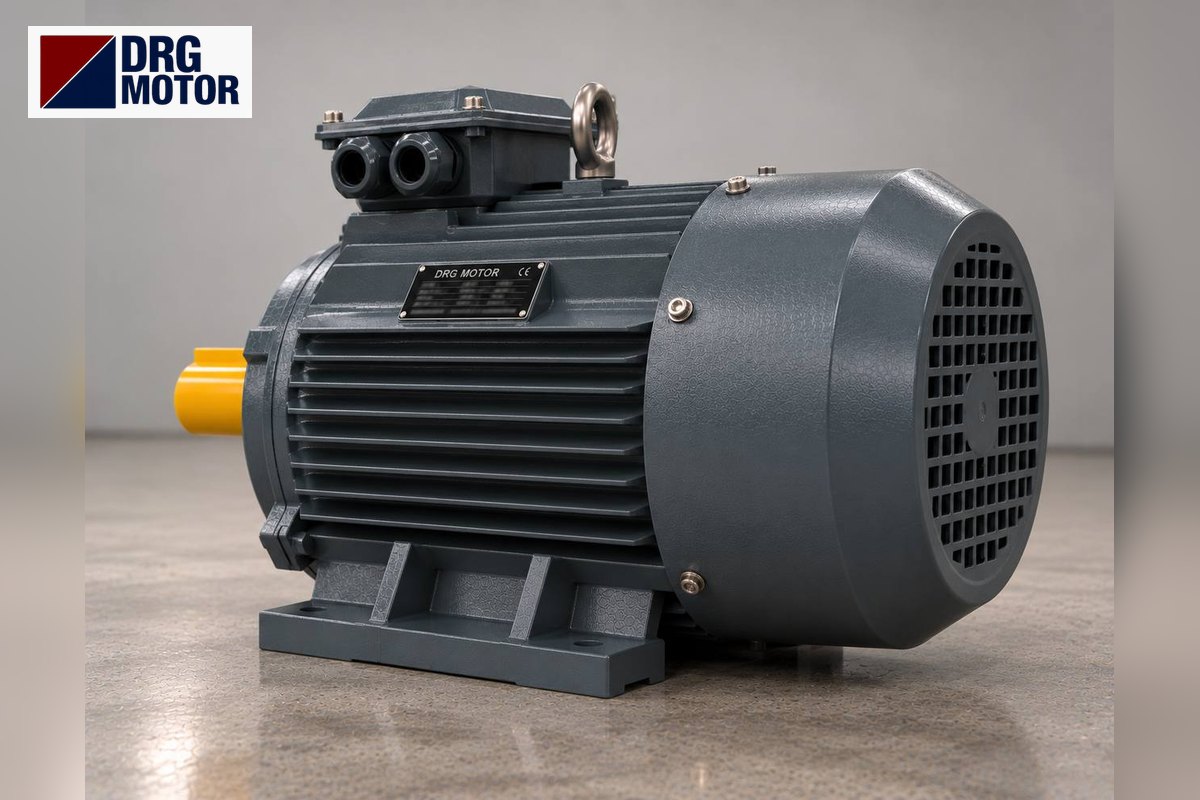

On a chocolate tempering machine, the agitator motor moves the melted chocolate slowly while it cools and rewarms; what decides the selection is the torque needed in the crystallisation stage, when the chocolate is coldest and thickest. Motor power on these machines is low, often below 1 kW; the challenge is not power but delivering enough torque at low speed and keeping motor heat away from the product. The motor stands outside the hygiene zone; only stainless agitator and pump parts touch the product.
DRG Motor is a manufacturer, supplier and seller of electric motors. If you are looking for a small three-phase motor for a tempering kettle gearbox or a chocolate pump, browse the DRG online motor shop, where models are sorted by kW and pole number. DRG does not sell gearboxes, pumps or stainless frame motors; it supplies the standard IEC motor that fits the existing transmission on the machine.
Which Motor Does What on a Tempering Machine?
Tempering means taking chocolate through a set temperature curve so that cocoa butter forms a stable crystal structure. Depending on the machine type, the work is split among several motors:
- Kettle agitator: turns the chocolate in a jacketed kettle while scraping the wall; runs at low speed through a worm or helical gearbox.
- Chocolate pump: pushes product from the kettle to the tempering column or enrobing curtain; a positive displacement gear or lobe pump.
- Column scraper rotor: on continuous tempering columns, turns the discs or scrapers in the cooling and heating zones.
- Vibrating table: removes air from the moulds; this task needs a vibration motor and is not met by a standard IEC motor.
This article focuses on the kettle agitator and pump motor, which are the motors most often replaced on industrial machines.
The Temperature Curve and the Load on the Motor
Chocolate flows less easily as temperature drops, and thickens markedly once crystallisation starts. The same agitator speed is a light load during melting and a heavy load during crystallisation. The temperatures below are common values for dark chocolate; they vary with the recipe and cocoa butter content.
| Stage | Typical temperature, dark | Load on agitator motor |
|---|---|---|
| Melting | 45–50 °C | Low: product is fluid |
| Cooling / crystallisation | 27–28 °C | Highest: product thickens |
| Rewarming | 31–32 °C | Medium: excess crystals melt |
| Holding at working temperature | Around 31–32 °C | Medium, steady |
The practical conclusion: the motor must keep running at the machine's coldest point. If cooling water is opened too far or a sensor fails, chocolate starts to set on the wall and the agitator can lock. The motor's overload protection must therefore be set correctly, to the motor's nameplate current.
Click to see current electric motor prices and order nowSEE PRICES →
Speed and Torque on the Kettle Agitator: A Worm Gear Example
Kettle agitators turn at a few tens of revolutions per minute. This speed usually comes from a worm gearbox, which gives a high ratio but lower efficiency than helical gearing. For motors on this type of gear unit, see also electric motors for worm gearboxes.
Worked example (assumption)
With a 0.37 kW 6-pole DRG-801-6 (890 rpm, rated torque 3.97 Nm), an i = 30 worm gearbox and an assumed gearbox efficiency of 0.7: output speed 890 / 30 ≈ 29.7 rpm, output torque about 9550 · 0.37 / 29.7 · 0.7 ≈ 83 Nm. A 4-pole DRG-712-4 of the same power (1340 rpm) with i = 40 gives 33.5 rpm and about 74 Nm.
These two examples show why the pole number should be kept when replacing a motor: fitting a 4-pole motor in place of a 6-pole one on the same gearbox makes the agitator about 50% faster, draws more air into the product and raises friction heat. Larger kettles may go up to the 1.1 kW class; the exact value is on the machine builder's nameplate.
Chocolate Pump Motor: Flow, Pressure and Power
The flow of a positive displacement chocolate pump is proportional to its speed; pressure is set by line length, pipe diameter and chocolate consistency. As the product cools, the same flow needs higher pressure and the motor is loaded more.
Example (assumption): with 15 l/min flow, 6 bar pressure and pump efficiency 0.5, P = Q · p / (600 · η) = 15 · 6 / (600 · 0.5) = 0.3 kW shaft power. Allowing for thickening and cold starts, 0.37 kW is the lower limit for this example; with a long line or a filled cream product, consider one size larger. You can test your own values with the pump and fan motor power calculator.
The pump is usually driven through a coupling or a gearbox. On close-coupled types where the pump sits directly on the motor shaft, a special shaft is needed and a standard motor cannot be fitted directly.
Keep Motor Heat Away from the Product: Layout and Cleaning
DRG motors are self-cooled by a shaft-mounted fan (IC411); the fan blows frame heat from the rear towards the front. On a tempering machine this warm air stream must not point at the kettle, the column or an open enrobing curtain. The motor usually sits under the machine body in a closed compartment; keep the compartment's ventilation grilles open and the motor ambient below +40 °C.
Food production machines are cleaned often. An IP55 motor is protected against splashing water, but it is not designed for pressure washing or caustic solution jets. Keep the compartment cover closed during cleaning so water does not reach the motor. For other motor applications in food machinery, see food processing machine motors.
Table-Top Machines, and Before Replacing the Motor
Most table-top tempering machines used in patisseries and small-batch production run from a single-phase socket with a small single-phase or DC motor. DRG does not offer single-phase or DC motors; replacing such a motor with a three-phase standard motor also means changing the supply and controls. The selection in this article applies to three-phase industrial kettle and pump motors.
Checklist before replacement:
- Nameplate: kW, speed, voltage (230/400 V) and connection (Δ/Y)
- Mounting: B3 foot, or connected to the gearbox by a B5 or B14 flange
- Shaft diameter × length and key size
- Gearbox type and ratio, or pump and coupling type
- Space in the compartment: frame length and fan cover clearance
- Direction of fan air and temperature in the compartment
- Whether the controls include an inverter or reversing
According to DRG catalogue B5 dimensions, frame 71 has flange outer diameter P 160 mm, bolt circle M 130 mm, spigot N 110 mm and shaft 14×30 mm. Frames 80 and 90 have P 200 mm, M 165 mm and N 130 mm; the shaft is 19×40 mm on frame 80 and 24×50 mm on frame 90. B14 flange dimensions are confirmed at order.
DRG Motors Suited to Tempering Machines
The list consists of small 4- and 6-pole aluminium frame motors for tempering kettle agitators and chocolate pumps; the pole number is chosen to match the input speed of the existing gearbox.
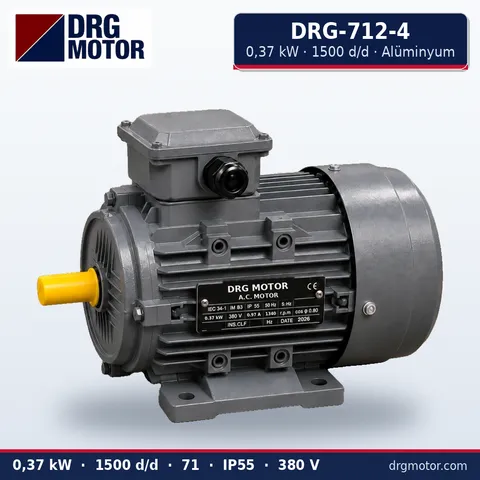
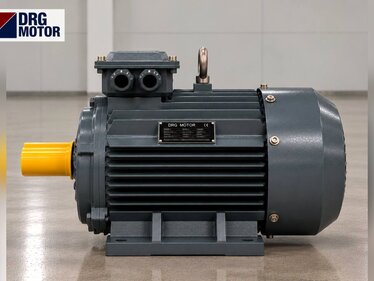
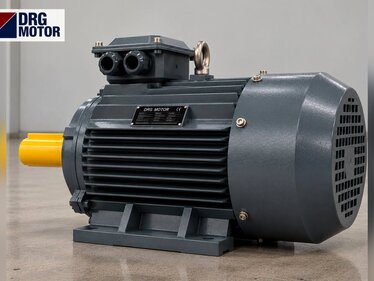
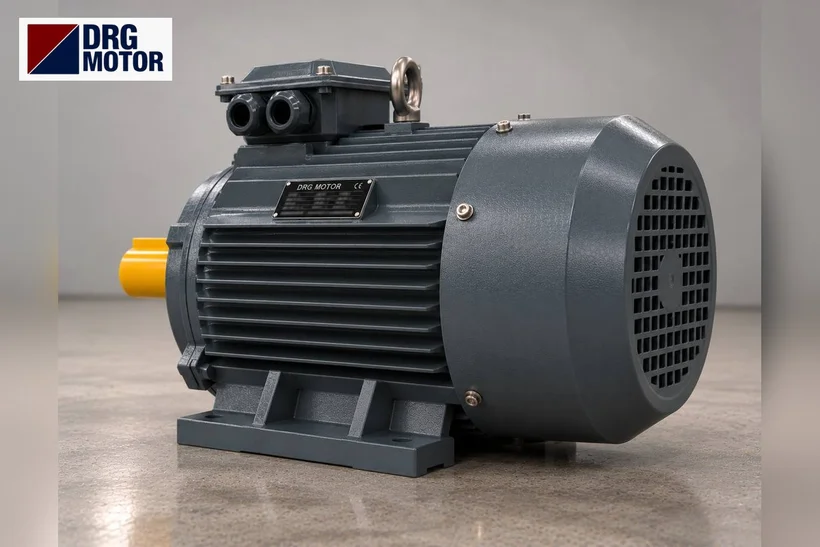
0.37 kW Three-Phase Motor 1500 rpm – DRG-712-4 Aluminium
- 0.37 kW · 1500 rpm (4 poles)
- Aluminium frame · IEC 71
- Mounting: B3 · B5 · B14 · B35
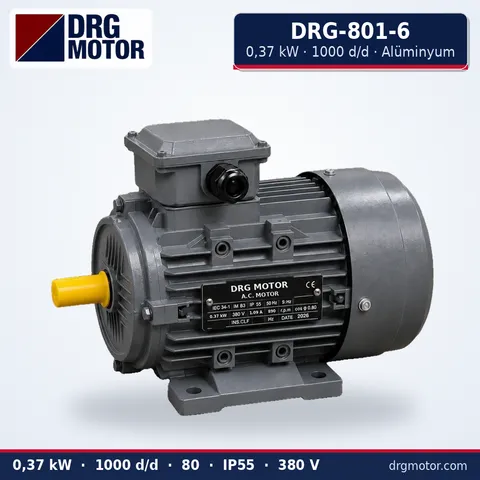
0.37 kW Three-Phase Motor 1000 rpm – DRG-801-6 Aluminium
- 0.37 kW · 1000 rpm (6 poles)
- Aluminium frame · IEC 80
- Mounting: B3 · B5 · B14 · B35
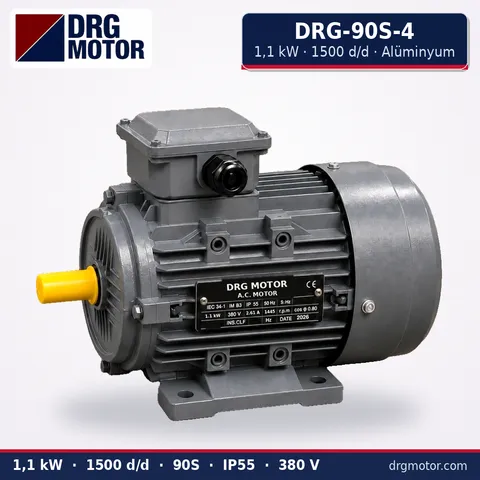
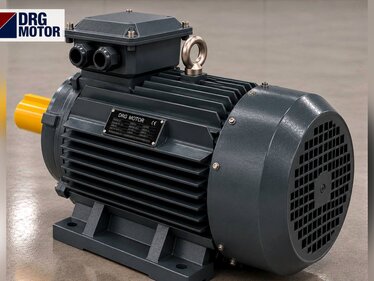
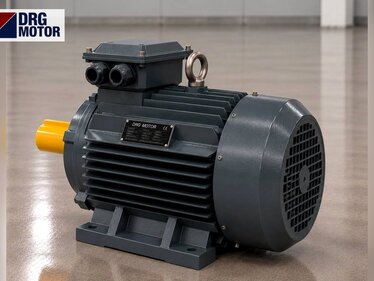
1.1 kW Three-Phase Motor 1500 rpm – DRG-90S-4 Aluminium
- 1.1 kW · 1500 rpm (4 poles)
- Aluminium frame · IEC 90S
- Mounting: B3 · B5 · B14 · B35
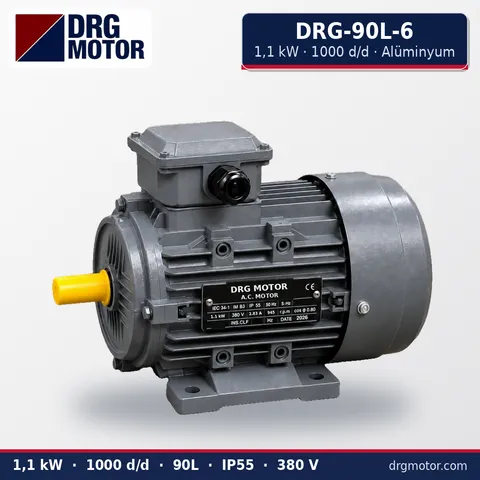
1.1 kW Three-Phase Motor 1000 rpm – DRG-90L-6 Aluminium
- 1.1 kW · 1000 rpm (6 poles)
- Aluminium frame · IEC 90L
- Mounting: B3 · B5 · B14 · B35
Click to see current prices and order these motors nowSEE PRICES →
Tempering Machine Motor FAQ
How many kW is a chocolate tempering machine motor?
On industrial kettle agitators and chocolate pumps, motor power is mostly below 1 kW or in the range of a few kW. Read the exact value from the machine's nameplate; kettle volume and line length change the power.
Why does the tempering machine agitator stop?
The most common cause is chocolate cooling too far and setting on the wall; agitator torque rises and the overload protection trips the motor. Check the cooling water setting and the temperature sensor.
Can a faster motor be fitted to a tempering machine?
Not recommended. Higher speed draws air into the product and friction heat can upset the crystal structure. If a speed change is needed, it is made through the gearbox ratio or an inverter; DRG does not sell inverters.
Does a food machine need a stainless motor?
If the motor is outside the product zone in a closed compartment, a standard IP55 motor is used. Parts touching the product are stainless. Stainless or washdown-frame motors are outside the DRG range.
Send a photo of the motor nameplate, its power and speed, whether it is foot or flange mounted, the shaft size, and whether it drives the kettle agitator or the pump via WhatsApp, or request a quote through the quote list. Phone: +90 (542) 666 11 11 · e-mail: info@drgmotor.com · contact. All power and speed options are listed in the online store.