English
 Le français
 Türkçe




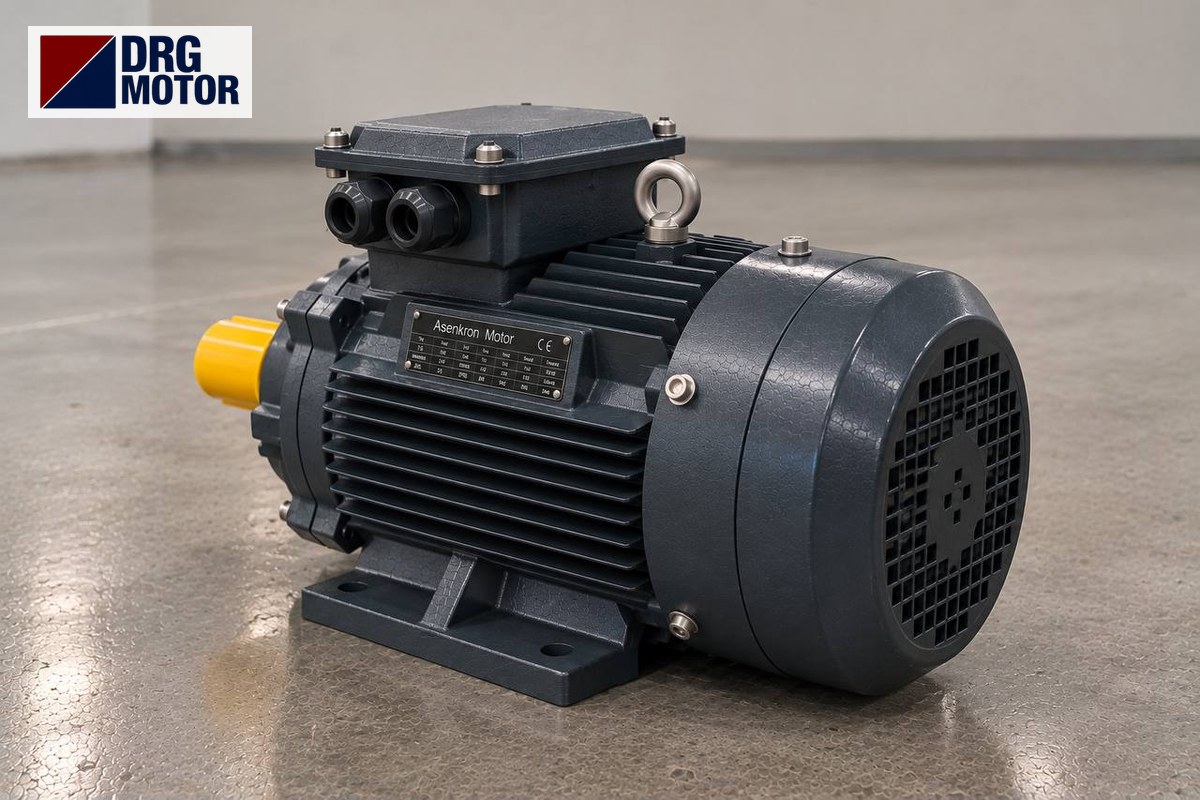

A roller conveyor motor is chosen from the total weight of the load, the rolling resistance of the rollers and the line speed: P = m·g·μ·v / η. For example, on a chain-driven line carrying 4 tonnes of cartons in total at 12 m/min, with an assumed μ = 0.05, the steady-speed power is about 0.49 kW and 0.59 kW with a 2-second start; a 0.75 kW 4-pole DRG-802-4 (1420 rpm, 1.75 A at 400 V) with a gearbox of about 33:1 is enough. These figures are a guide; the exact power is the conveyor manufacturer's data and the old motor's nameplate.
On a roller line the deciding factor is not speed but mass and start time: on heavy pallet lines the motor power often comes from the acceleration share, and a ramp lengthened by an inverter can allow a smaller motor. Speed is set by roller diameter and gearbox ratio and fine-tuned with the inverter. Motor and inverter wiring must be done by a qualified electrician; never run the line with the chain guard open.
Once you know the power, compare frame and speed options among the 120 models on the Buy Electric Motors Online page.
Driven roller conveyor: how is power calculated on a chain-driven system?
On a driven roller conveyor the load rolls over turning rollers rather than sliding, so resistance does not come from belt-on-bed friction as on a belt conveyor, but from the roller bearings and the rolling resistance of the load on the rollers. The calculation has three parts:
- Rolling force: F = m·g·μ. m is the load standing on the line at the same time plus the rotating roller/chain mass; μ depends on the load base and the roller (carton, wooden pallet, plastic crate). We used an assumed μ = 0.05.
- Acceleration force: Fa = m·a, with a = v / tstart. The shorter the start, the larger this term.
- Drive chain loss: in roller-to-roller chain systems every chain loop adds a small loss; together with the gearbox loss we assumed an overall transmission factor η = 0.8.
Motor power: P = (F + Fa) · v / η. The table compares two lines at the same speed (12 m/min = 0.2 m/s):
| Case (assumed) | Force | Motor power | Selection |
|---|---|---|---|
| 4 t cartons, steady | 1962 N | 0.49 kW | DRG-802-4 |
| 4 t cartons, 2 s ramp | 2362 N | 0.59 kW | DRG-802-4 |
| 10 t pallets, 1 s ramp | 6905 N | 1.73 kW | exceeds 1.5 kW |
| 10 t pallets, 4 s ramp | 5405 N | 1.35 kW | DRG-90L-4 |
Rows three and four stand out: on the 10-tonne pallet line a 1 s ramp takes the power to 1.73 kW, above the rating of a 1.5 kW motor; stretching the ramp to 4 s brings it down to 1.35 kW and DRG-90L-4 is enough. The inverter sets the ramp, so power and speed control must be planned together.
Line speed, roller diameter and gearbox ratio
Conveyor speed is the roller's peripheral speed: v = π·D·n. Knowing roller diameter and the required m/min, roller speed is n = v / (π·D) and the gearbox ratio is motor speed / roller speed. The table below is for a Ø89 mm roller (assumption), 1:1 chain sprockets and a 1420 rpm motor:
| Line speed | Roller speed (Ø89 mm) | Ratio (1420 rpm) | Note |
|---|---|---|---|
| 6 m/min | 21.5 rpm | ≈ 66.2 | Slow accumulation |
| 9 m/min | 32.2 rpm | ≈ 44.1 | Heavy pallets |
| 12 m/min | 42.9 rpm | ≈ 33.1 | Carton line example |
| 18 m/min | 64.4 rpm | ≈ 22.1 | Light cartons |
| 24 m/min | 85.8 rpm | ≈ 16.5 | Fast transfer |
If the sprockets differ (for example a small one on the gearbox output and a larger one on the roller), the sprocket ratio enters the overall ratio: overall ratio = gearbox ratio × (roller sprocket teeth / gearbox sprocket teeth). Check the figures with the gearbox output speed and torque calculator.
Torque check: can the gearbox output carry the load?
Power may be enough while gearbox output torque is not. In example 1 the drive roller needs (F + Fa) × D/2 = 2362 × 0.0445 ≈ 105 Nm. DRG-802-4 has a rated torque of 5.04 Nm; with a 33.1 ratio and η = 0.8 it delivers ≈ 133 Nm at the output, so the load is covered. On the 10-tonne line the 1.5 kW motor (9.91 Nm) gives ≈ 267 Nm at the output against 241 Nm required. At first movement the pallet base has settled on the rollers and resistance briefly rises; since the motor's starting torque is 2.3 times rated, this breakaway moment is covered.
4-pole or 6-pole?
On slow lines a 6-pole motor reduces the gearbox ratio: for 12 m/min the ≈ 33.1 ratio needed with 4 poles drops to ≈ 21.8 with DRG-90S-6 (935 rpm). On the other hand the 6-pole motor uses a larger frame for the same power (90S instead of 80) and has a lower cos φ (0.71 instead of 0.75). With standard gearboxes 4 poles is usually the more flexible choice.
Soft start and speed control with an inverter
An inverter does three jobs on a roller conveyor: soft start, speed adjustment and soft stop. On carton or crate lines a sudden start tips the load; on pallet lines it shocks chains and sprockets. The longer the ramp, the smaller the acceleration a = v / t; in the pallet example, going from a 1 s to a 4 s ramp cut the acceleration force to a quarter.
Speed is proportional to frequency: a line running 12 m/min at 50 Hz runs 6 m/min at 25 Hz. A roller conveyor is a constant-torque load; the motor needs the same torque at low frequency, but its shaft-mounted fan slows down and cooling drops. If the line will run at low speed for long periods, either choose the ratio so the motor stays close to 50 Hz or consider forced cooling. See the frequency–torque–power relation in the VFD frequency, torque and power calculator.
- On accumulation lines, zones are stopped by separate motors or clutches; on a single-motor line the whole line stops together.
- On reversing transfer lines change direction with the inverter; abrupt reversing with contactors shocks the chain.
- If the line stops on sensors at the start and end, the stop ramp must be long enough to keep the load from sliding on the rollers.
Gearbox connection: flange, shaft and key
On a roller conveyor the motor is usually flange-mounted to a gearbox, and the gearbox drives the drive roller through a sprocket. The point to watch is that the same flange can come with different shaft diameters. In our catalogue frames 80 and 90 share the same B5 flange but have different shafts:
- Frame 80 (DRG-802-4): shaft 19 × 40 mm, B5 flange P 200 / N 130 / M 165 mm
- Frame 90L (DRG-90L-4): shaft 24 × 50 mm, B5 flange P 200 / N 130 / M 165 mm
So if you want to fit a 1.5 kW motor instead of 0.75 kW, the flange fits, but a 24 mm shaft will not enter a 19 mm gearbox bore; an input bush or adapter is needed. B14 (small, tapped flange) dimensions, common on small frames, are not in our catalogue table; in the store the mounting option (B5 / B35 / B14) is stated in the order note, and dimensions should be taken from the gearbox input flange. All flange and shaft dimensions are on the DRG motor technical drawings page.
Our conveyor belt motor selection article covers pulley diameter, belt tension and ratio sizing for belt conveyors and helps where belt and roller lines work side by side in the same plant.
Roller conveyor motor selection checklist
- Has the heaviest load case on the line at one time (number of pallets/cartons, total kg) been defined?
- Has the rolling resistance for the load base and roller type been obtained from the manufacturer?
- Has the overall ratio been calculated from required speed (m/min), roller diameter and sprocket teeth?
- Has the start time (ramp) been set and the acceleration share added to the power?
- Is gearbox output torque above the torque at the drive roller?
- Do motor shaft and gearbox bore match in diameter; does the flange type (B5 / B14) match?
- With inverter operation, are the minimum speed and the time spent at it acceptable for cooling?
- Were chain tension, sprocket alignment and guard checked after installation?
DRG models for roller conveyors
The models in the table have aluminium frames; currents are at 400 V. Light carton lines often use 0.55–0.75 kW and heavy pallet lines 1.1–2.2 kW; the exact power must come from the calculation above and the manufacturer's data.
| Model | Power / speed | Frame | Current 400 V |
|---|---|---|---|
| DRG-801-4 | 0.55 kW / 1400 rpm | 80 aluminium | 1.31 A |
| DRG-802-4 | 0.75 kW / 1420 rpm | 80 aluminium | 1.75 A |
| DRG-90S-4 | 1.1 kW / 1445 rpm | 90S aluminium | 2.48 A |
| DRG-90L-4 | 1.5 kW / 1445 rpm | 90L aluminium | 3.3 A |
| DRG-100L1-4 | 2.2 kW / 1450 rpm | 100L aluminium | 4.52 A |
| DRG-90S-6 | 0.75 kW / 935 rpm | 90S aluminium | 1.93 A |
Motors in this power range
- DRG-801-4 – 0.55 kW – 1400 rpm – 80 aluminium
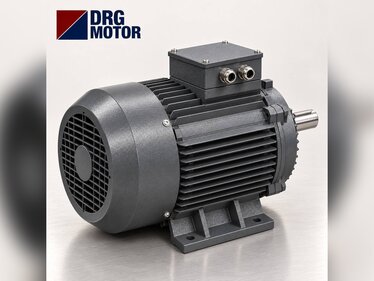
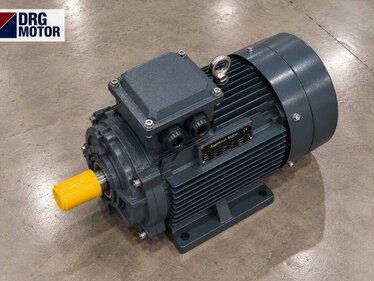
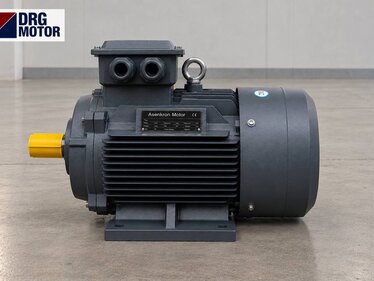
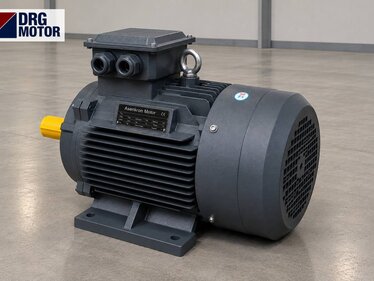
- DRG-802-4 – 0.75 kW – 1420 rpm – 80 aluminium
- DRG-90S-4 – 1.1 kW – 1445 rpm – 90S aluminium
- DRG-90L-4 – 1.5 kW – 1445 rpm – 90L aluminium
- DRG-100L1-4 – 2.2 kW – 1450 rpm – 100L aluminium
- DRG-90S-6 – 0.75 kW – 935 rpm – 90S aluminium
Click to see current prices and order these motors nowSEE PRICES →
Frequently Asked Questions
What size motor does a roller conveyor need?
Use P = (m·g·μ + m·a)·v / η. With 4 t of cartons, 12 m/min and a 2 s ramp it comes to ≈ 0.59 kW and a 0.75 kW motor is enough; heavy pallet lines can need 1.5 kW or more.
How do you calculate conveyor speed?
v = π × roller diameter × roller speed. A Ø89 mm roller turning at 42.9 rpm moves the line at 12 m/min; with a 1420 rpm motor that needs a ratio of ≈ 33.1.
Is an inverter necessary on a roller conveyor?
Not strictly, but it is recommended for soft start and speed adjustment. A longer ramp reduces the acceleration force; in our pallet example a 4 s ramp made a 1.5 kW motor sufficient.
Will the gearbox fit when I replace the motor?
Yes if flange type and shaft diameter are the same. Frames 80 and 90 carry the same B5 flange but have 19 mm and 24 mm shafts; check the gearbox bore when moving up in power.
Send us your conveyor's load, speed and roller diameter and we will work out the right motor and ratio together. All models are on the Buy Electric Motors Online page. DRG Motor is a manufacturer, supplier and seller of electric motors. Phone: +90 (542) 666 11 11 · E-mail: [email protected] · Contact