English
 Le français
 Türkçe




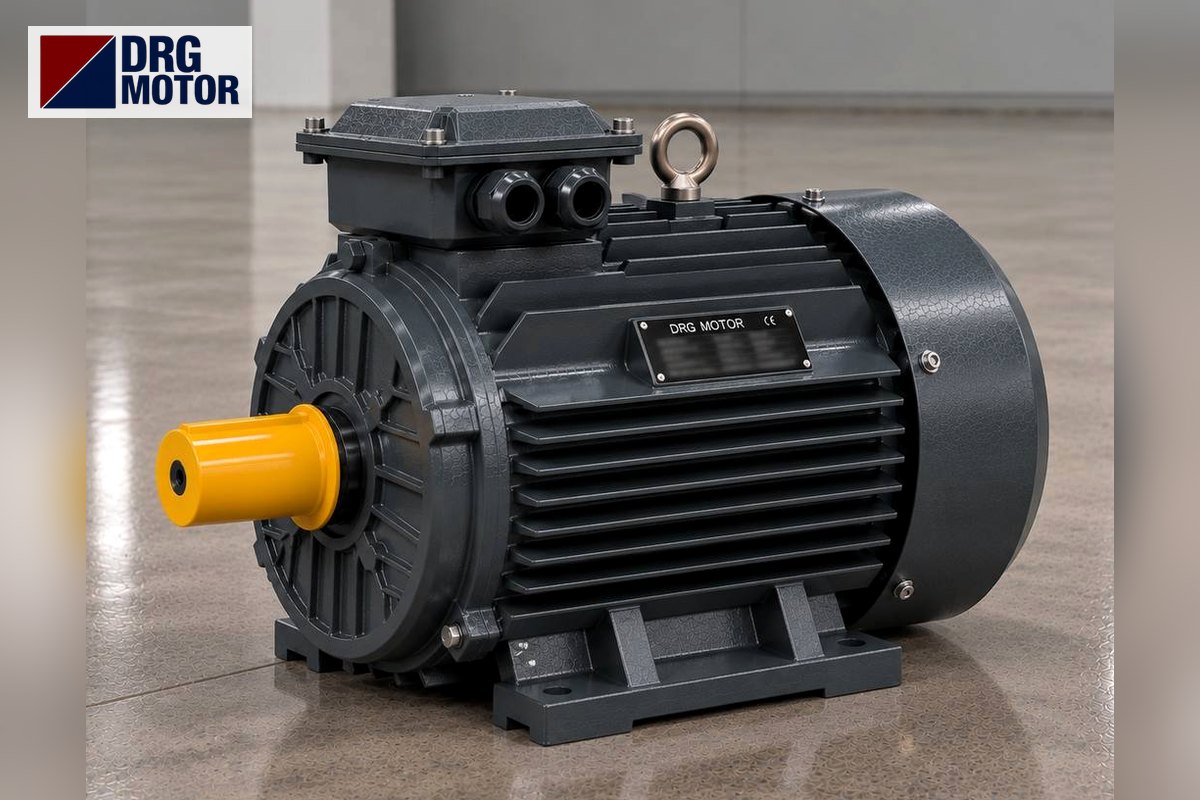

There are three practical ways to reduce the speed of an electric motor: choosing a motor with the right number of poles, slowing the driven shaft with a pulley-belt ratio, and adjusting the speed electronically with a frequency inverter (drive). Which one is right depends on whether you need a fixed low speed or an adjustable one.
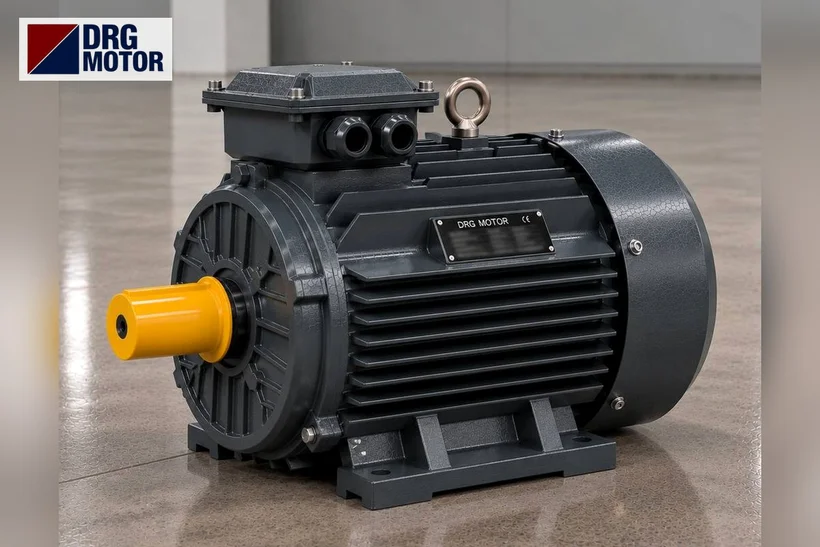
DRG Motor is a manufacturer, supplier and seller of electric motors. You can review three-phase models by speed class in the online motor shop and see every option together in the three-phase asynchronous electric motors category.
What determines motor speed?
In a three-phase asynchronous motor, speed is set by the mains frequency and the number of poles in the windings. Synchronous speed follows n = 120·f / p, where f is frequency (Hz) and p the pole count. At 50 Hz, 2 poles give 3000, 4 poles 1500 and 6 poles 1000 rpm synchronous speed. Actual load speed is slightly lower because of slip (for 4 poles, the nameplate value is roughly 1450–1465 rpm). So "reducing speed" means either choosing a slower motor from the start or lowering the output speed by a mechanical or electronic method.
1) Choosing the right number of poles
The cleanest solution is to pick the pole class closest to the speed your application needs. The same power is offered in 2, 4 or 6 poles; more poles means lower speed but higher torque at the same power. The table below shows the three speed classes of 4 kW and the matching DRG models.
| Poles | Synchronous speed | Load speed (≈) | Example DRG model (4 kW) |
|---|---|---|---|
| 2 | 3000 rpm | 2905 rpm | DRG-112M-2 |
| 4 | 1500 rpm | 1450 rpm | DRG-112M-4 |
| 6 | 1000 rpm | 968 rpm | DRG-132M1-6 |
Logic: If the speed stays fixed at a set value, the right pole count is an efficient, maintenance-free choice that needs no extra equipment. Limit: Pole counts are stepped (only rungs like 3000/1500/1000 rpm); for an in-between speed, pole choice alone is not enough. You also cannot turn one motor into a lower-pole one later — a different speed means a different motor.
Click to see current electric motor prices and order nowSEE PRICES →
2) Reducing speed with a pulley-belt ratio
The most common mechanical way to lower speed is a pulley-belt system. A small pulley on the motor shaft drives a large pulley on the driven shaft; output speed falls with the diameter ratio. The basic relation is n₂ = n₁ · (d₁ / d₂). So with the motor at 1450 rpm, a 100 mm drive pulley and a 200 mm driven pulley give about 725 rpm at the driven shaft.
| Motor speed | Pulley ratio (d₁:d₂) | Driven shaft speed (≈) |
|---|---|---|
| 1450 rpm | 1:2 | 725 rpm |
| 1450 rpm | 1:3 | 483 rpm |
| 2930 rpm | 1:4 | 733 rpm |
Logic: Because the ratio can be chosen freely, intermediate speeds are easy to reach; as speed drops, torque at the driven shaft rises. Once the diameter ratio is set, the speed stays fixed. You can use the motor calculator to set the ratio correctly. Limit: The speed is still fixed (it changes only if you change the pulley), the belt-pulley layout needs space, and belt tension and wear require periodic maintenance. For very large ratios, pulley diameters become impractical; at that point a separate mechanical transmission solution (such as a gearbox) sits between motor and load — a separate product group outside DRG's standard range.
3) Adjustable speed with a frequency inverter (drive)
If you want to change speed electronically and while running, the method is a frequency inverter. The inverter changes the frequency applied to the motor; from n = 120·f / p, lower frequency means lower speed. For example, a 4-pole motor runs at ~1450 rpm at 50 Hz and at about half speed at 25 Hz. This gives a wide speed range from a single motor.
Logic: One solution delivers adjustable speed, soft start and process control; it is the most flexible method where line speed must change on the fly. Limit: At very low frequencies the motor's own fan may not cool enough and torque behaviour changes, so for jobs needing high torque at low speed the motor and drive must be sized together. An inverter is used with a three-phase motor — the solution is a suitable three-phase motor plus a separate drive unit. To verify power during selection, use the electric motor calculator.
Fixed speed or adjustable speed?
The choice comes down to one question: will the speed always stay the same, or does it need to change?
| Method | Speed type | Short note |
|---|---|---|
| Pole choice | Fixed, stepped | No extra equipment; 3000/1500/1000 steps |
| Pulley-belt | Fixed, free ratio | Easy intermediate speed; needs space and upkeep |
| Frequency inverter | Adjustable | Variable while running; mind cooling/torque |
In many applications these methods are combined: you start with the right pole count, fine-tune speed with a pulley ratio if needed, and add a drive when variable speed is required throughout the process. In all three cases, what you basically need is a three-phase asynchronous motor with the right power and poles. For common 1500 rpm powers you can look at DRG-132S-4 (5.5 kW), DRG-132M-4 (7.5 kW) and DRG-160M-4 (11 kW).
See current prices for 4, 5.5, 7.5 and 11 kW three-phase motors and order the right speed classSEE PRICES
Send a photo of your current motor nameplate and we will find the suitable DRG model together.Send on WhatsApp
Frequently asked questions
Can I permanently halve a three-phase motor's speed?
For a permanent, fixed low speed there are two practical ways: choose a motor with more poles (for example 1000 rpm instead of 1500) or set a 1:2 pulley-belt ratio. Both give a fixed speed; changing a motor's pole count later by rewinding is not advised in the field.
Does power drop when speed is reduced by a pulley?
Apart from losses, power is preserved; what changes is the balance between speed and torque. When speed halves, torque at the driven shaft roughly doubles (P = torque × speed). So the pulley ratio must be chosen for the torque that will move the load.
Can a frequency inverter be fitted to any motor?
An inverter is used with three-phase asynchronous motors. Because cooling and torque behaviour change at very low speeds, the motor must be selected accordingly if continuous low-speed load is expected. Use the motor calculator to verify the right power and set the device per its documentation.
Which method is the most economical?
There is no single "best"; it depends on the need. If speed never changes, the right pole count is the simplest solution. For an intermediate fixed speed, the pulley-belt stands out; for continuously variable speed, the frequency inverter does.
Electric Motors Related to This Topic — Models and Current Prices
Suitability is not decided by power alone: compare the speed, voltage, mounting, shaft and fixing dimensions of your machine with the product data; if unsure, send us the nameplate of your current motor.

4 kW Three-Phase Motor 1500 rpm – DRG-112M-4 Aluminium
- 4 kW · 1500 rpm (4 poles)
- Aluminium frame · IEC 112M
- Shaft: 28 × 60 mm
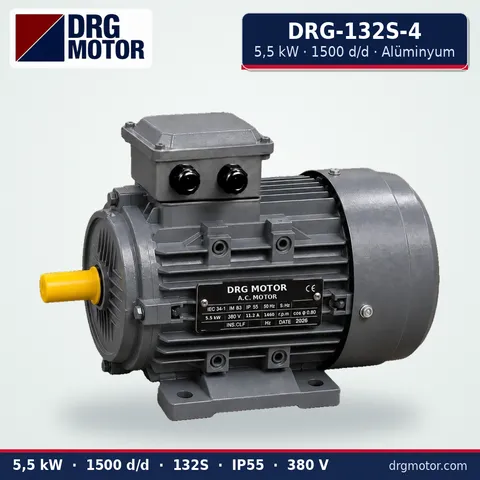
5.5 kW Three-Phase Motor 1500 rpm – DRG-132S-4 Aluminium
- 5.5 kW · 1500 rpm (4 poles)
- Aluminium frame · IEC 132S
- Shaft: 38 × 80 mm
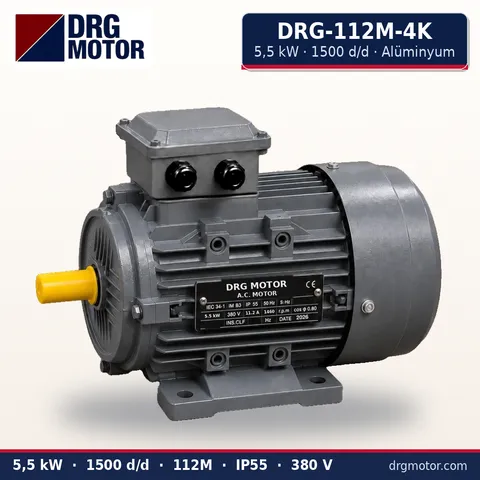
5.5 kW Compact Three-Phase Motor 1500 rpm – DRG-112M-4K Aluminium
- 5.5 kW · 1500 rpm (4 poles)
- Aluminium frame · IEC 112M
- Shaft: 28 × 60 mm
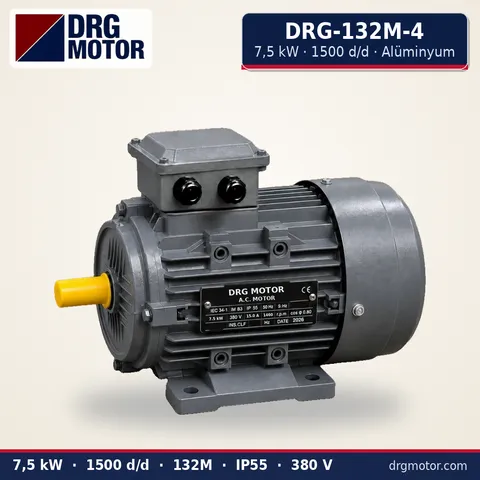
7.5 kW Three-Phase Motor 1500 rpm – DRG-132M-4 Aluminium
- 7.5 kW · 1500 rpm (4 poles)
- Aluminium frame · IEC 132M
- Shaft: 38 × 80 mm
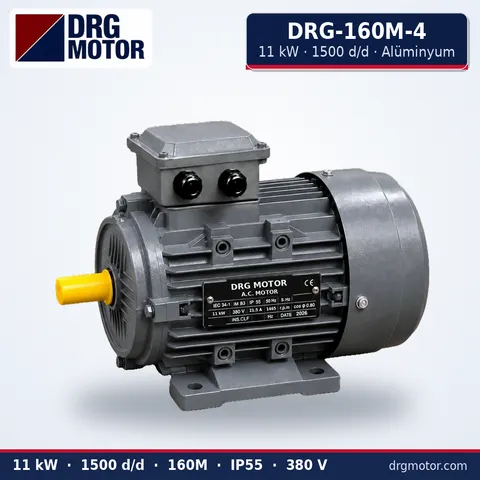
11 kW Three-Phase Motor 1500 rpm – DRG-160M-4 Aluminium
- 11 kW · 1500 rpm (4 poles)
- Aluminium frame · IEC 160M
- Shaft: 42 × 110 mm
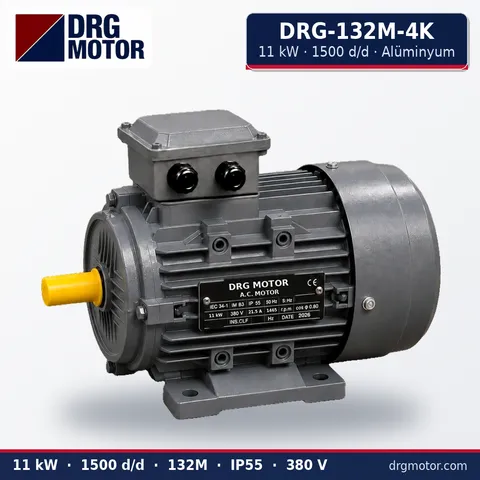
11 kW Compact Three-Phase Motor 1500 rpm – DRG-132M-4K Aluminium
- 11 kW · 1500 rpm (4 poles)
- Aluminium frame · IEC 132M
- Shaft: 38 × 80 mm