English
 Le français
 Türkçe




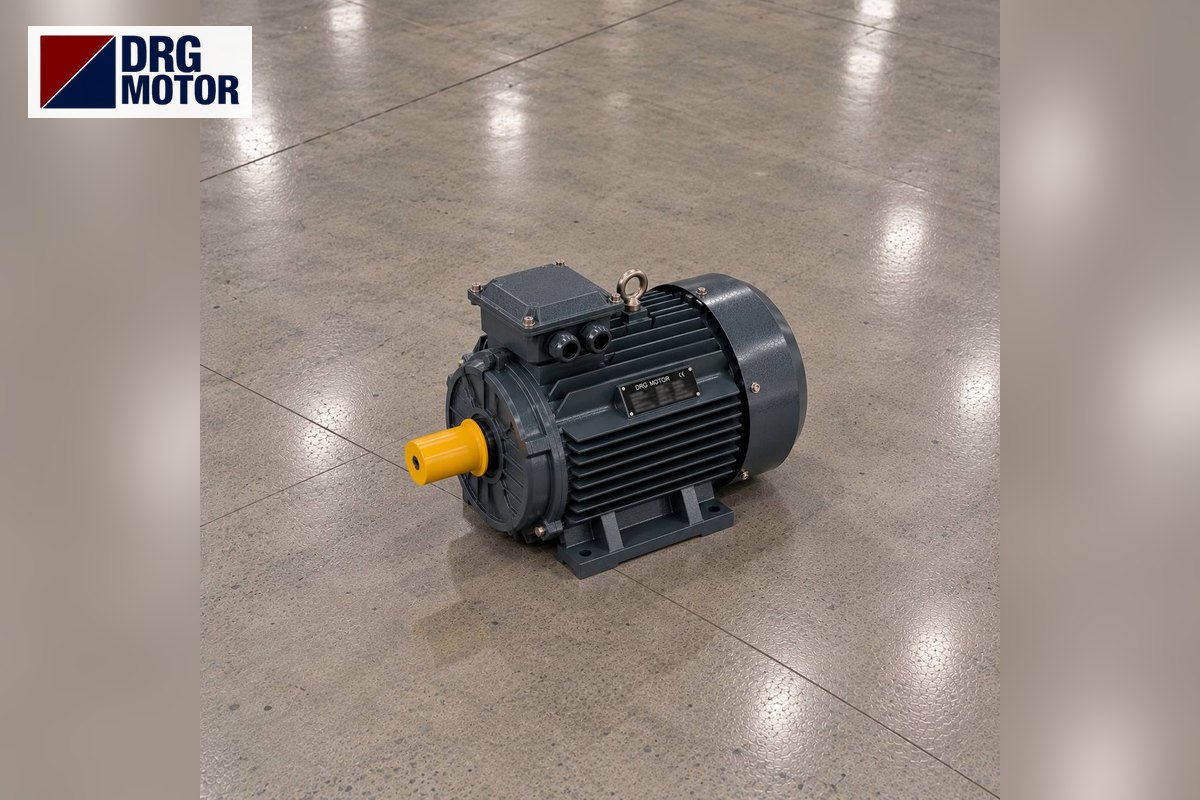

A seed treating machine does not have a single motor: a fast-spinning disc that breaks the treatment liquid into droplets, a mixer that brings seed and chemical together (drum, bowl or auger) and often a small dosing pump are each driven separately. For the mixer motor, the deciding factor is that the speed at the gearbox output mixes the seed without cracking or peeling it; on the atomiser disc, speed directly sets droplet fineness.
That is why the mixer usually has a 4-pole motor with a gearbox, while the disc has a small 2-pole motor coupled directly. Aluminium-frame three-phase motors in this power range can be viewed in the DRG online electric motor shop. Of these three drives, the motors are DRG's part: DRG Motor is a manufacturer, supplier and seller of electric motors, while the gearbox and dosing pump come from the machine builder.
Where Do the Motors Sit on Batch and Continuous Machines?
On a batch machine, a weighed lot of seed is emptied into a bowl or a horizontal drum. The chemical is poured onto a disc spinning in the middle of the drum; centrifugal action throws it outwards as a fine mist, which the tumbling seed bed catches. After a few minutes of mixing, the door opens and the batch is discharged. On a continuous machine, seed passes a metering roller, falls into the disc chamber, is treated and is carried to the outlet by a mixing auger or an inclined drum below.
In both types the motors have different jobs. The table below shows the general layout; exact power and speed are in the machine builder's catalogue.
| Drive point | Load character | Common layout | Mounting |
|---|---|---|---|
| Atomiser disc | Light, high speed | 2-pole, direct | Often vertical, flanged |
| Mixing drum | Constant torque, inertia | 4-pole + gearbox | B5 at gearbox input |
| Mixing auger | Constant torque, loaded start | 4-pole + gearbox/belt | B5 or B3 |
| Metering roller, pump | Very low power | Small motor + gearbox | B14 or B5 |
Seed cleaning and screening machines are the step before this line; their motors are covered on the grain and seed cleaning machine electric motors page.
The Atomiser Disc: Why Is Speed the Droplet Size?
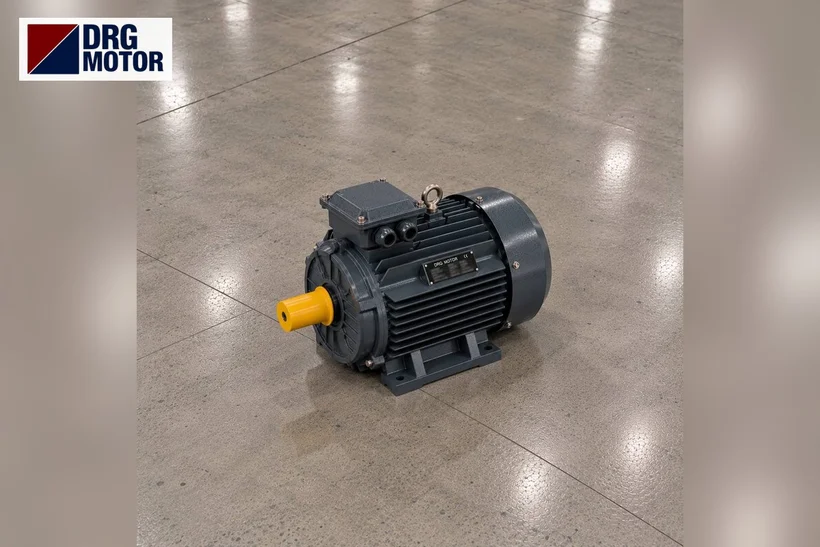
The liquid film leaving the disc rim gets thinner and breaks into smaller droplets as peripheral speed rises. Example: a 150 mm disc driven directly by the 2-pole DRG-801-2 (0.75 kW, 2880 rpm) has a peripheral speed v = π·0.15·2880/60 ≈ 22.6 m/s; the same disc on a 4-pole motor turns at about half the speed and the droplets get coarser. A 200 mm disc at 2880 rpm reaches ≈ 30.2 m/s.
The disc load is light; motor power is often set by frame size and shaft dimensions rather than liquid flow. So when replacing a disc motor, the main point is the speed class: swap the 2-pole motor for a 4-pole unit and the chemical does not spread evenly over the seed and builds up on the drum wall and under the disc. On machines that adjust disc speed with an inverter, the motor's rated speed should still be in the 2-pole class.
Click to see current electric motor prices and order nowSEE PRICES →
Mixer Speed: Coating Seed Without Cracking It
In the drum, the seed bed should tumble as it turns, not stick to the wall and fly off. The drum's critical speed is roughly 42.3/√D (D in metres); at that speed seed clings to the wall by centrifugal force and mixing stops. Mixing drums run well below this value. Everything in this list is illustrative and built on assumptions.
- Drum: 600 mm inside diameter → critical speed ≈ 54.6 rpm; aiming for roughly one third of that, the drum should turn at about 18.2 rpm.
- Motor and gearbox: DRG-802-4 (0.75 kW, 1420 rpm, 5.04 Nm) with a ratio-75 gearbox → n2 = 1420/75 ≈ 18.9 rpm.
- Gearbox output torque: 5.04 × 75 × 0.95 (assumed factor for gearbox losses) ≈ 359 Nm; at start-up with Ts/Tn = 2.3, ≈ 826 Nm.
- Continuous auger type: DRG-90L-4 (1.5 kW, 1445 rpm) with a ratio-10 gearbox → auger ≈ 144.5 rpm, output torque ≈ 94.1 Nm.
With large or delicate-coated seeds such as maize, sunflower and beans, cracking and peeling increase with speed; wheat and barley tolerate a little more. So when the seed changes, the gear ratio or inverter setting is changed, not the motor.
Mounting: B3, B5, B35 and Vertical Operation
Mixer drives mostly carry the motor on a B5 flange at the gearbox input. Older belt-driven drums use a foot-mounted motor (B3); frames that use both feet and flange need B35. The atomiser disc usually enters the drum vertically from above or below; for vertical mounting, state at order whether the shaft points up or down, because whether rain and dripping chemical reach the terminal box or the shaft seal depends on that direction.
Small frames hide a trap: the B5 flange of frame 80 and of frames 90S/90L is identical in the catalogue (P 200, M 165, N 130 mm), so both will bolt onto the gearbox, yet the shafts differ. Frame 80 has a Ø19×40 mm shaft, frame 90 a Ø24×50 mm one, and a shaft that does not fit the gearbox hub can only be adapted with a sleeve. On 100L the values rise to P 250, M 215, N 180 mm with a Ø28×60 mm shaft. For the small B14 flange common on dosing drives, we verify the dimensions together at order.
Chemical Dust, Liquid Treatment and Washing
In the treatment room, the motor's worst enemy is chemical mist and dried chemical dust. Once the cowl and cooling fins are coated, the self-ventilated (IC411) motor loses its cooling air path. Motors should stand outside the treatment room, behind the dust extraction, and the fan cowl should be cleaned between batches. IP55 protects against dust and splashing water; when washing the machine, do not aim a water jet directly at the terminal box and cable gland.
With a solvent-based product that releases flammable vapour, the treatment room may fall within an explosive zone; a motor working there cannot be a standard IEC motor and an Ex-protected special motor must be chosen. On machines using water-based treatments a standard motor is suitable, but aggressive chemicals can degrade paint and seals over time, so check the frame and seals at the start of each season.
Checks Before Replacement and Ordering
- Which motor is being replaced: disc, drum, auger or dosing?
- kW, rpm and pole class on the plate (2 or 4); motors of these sizes are wound 230/400 V.
- Mounting type and direction: B3, B5, B35 or vertical (shaft up/down).
- Flange outer diameter, bolt circle, spigot and shaft diameter and length.
- Gear ratio or pulley diameters; drum or auger speed.
- Type of treatment (water- or solvent-based) and the motor's distance from the treatment room.
- Overload setting and contactor choice; for small motors, our overload relay, fuse and contactor guide gives the values.
For the rest of the seed store (elevators, augers, cleaners), visit agricultural machine electric motors.
Picking a DRG Motor for a Seed Treater
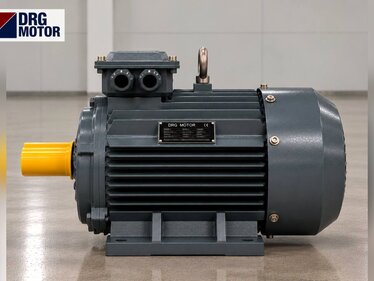
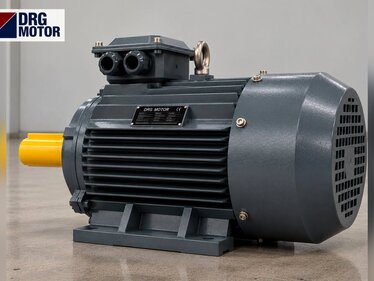
A 2-pole model for the atomiser disc and light 4-pole aluminium-frame models for the mixing drum and auger; all can be flange-mounted on a gearbox input or foot-mounted.
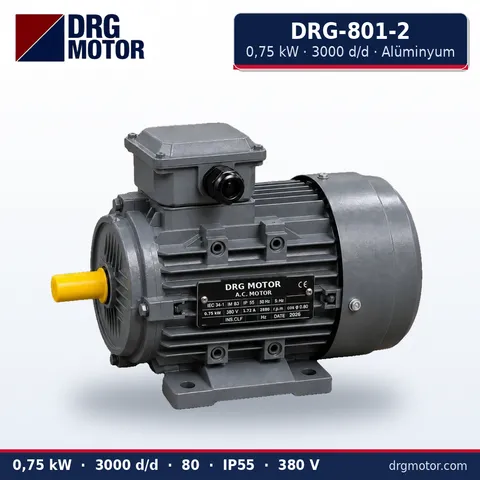
0.75 kW Three-Phase Motor 3000 rpm – DRG-801-2 Aluminium
- 0.75 kW · 3000 rpm (2 poles)
- Aluminium frame · IEC 80
- Mounting: B3 · B5 · B14 · B35
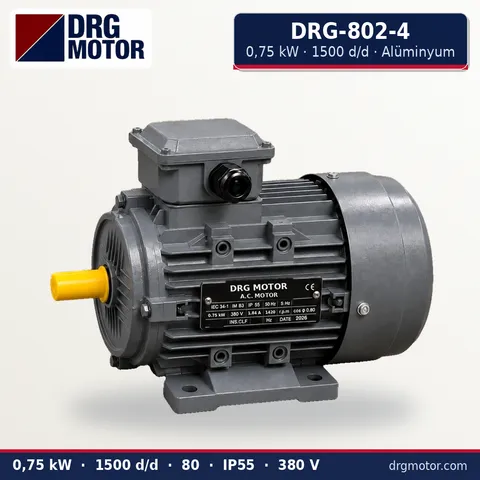
0.75 kW Three-Phase Motor 1500 rpm – DRG-802-4 Aluminium
- 0.75 kW · 1500 rpm (4 poles)
- Aluminium frame · IEC 80
- Mounting: B3 · B5 · B14 · B35
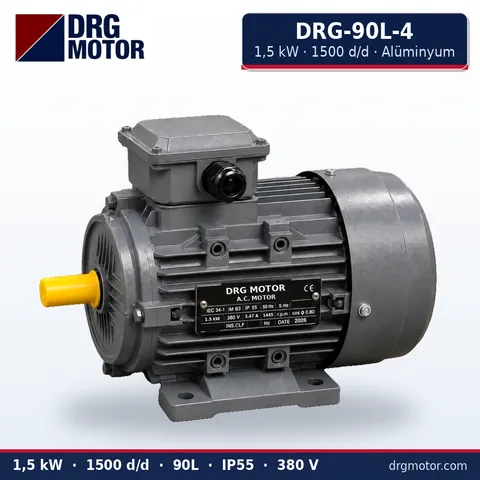
1.5 kW Three-Phase Motor 1500 rpm – DRG-90L-4 Aluminium
- 1.5 kW · 1500 rpm (4 poles)
- Aluminium frame · IEC 90L
- Mounting: B3 · B5 · B14 · B35
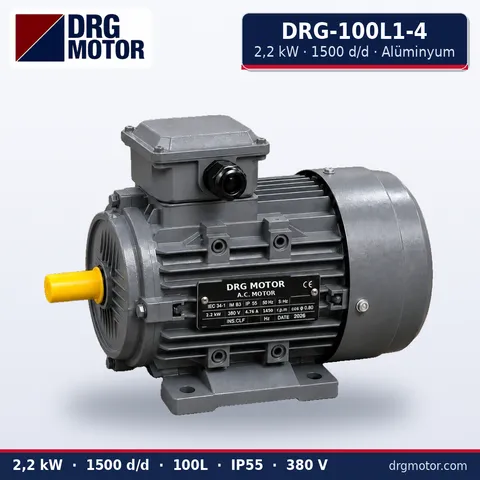
2.2 kW Three-Phase Motor 1500 rpm – DRG-100L1-4 Aluminium
- 2.2 kW · 1500 rpm (4 poles)
- Aluminium frame · IEC 100L
- Mounting: B3 · B5 · B14 · B35
Click to see current prices and order these motors nowSEE PRICES →
Seed Treating Machine Motor: Frequently Asked Questions
What speed should the disc motor of a seed treater have?
The disc is usually driven directly by a 2-pole motor (about 2880 rpm); droplet fineness depends on peripheral speed. Disc diameter and the builder's recommended speed apply; fitting a 4-pole motor spoils the distribution.
The treating drum is cracking seed: should I change the motor?
Usually not; the problem is that drum speed is too high. The solution is a larger gear ratio, different pulleys or lowering speed with an inverter. Lower speed means higher torque demand, so check that the motor can deliver it.
Why won't the mixer start when the drum is full?
A bigger batch, or wet seed stuck to the drum, raises the torque needed at start. A star-delta starter would leave only a third of the motor's starting torque, so small motors are normally started direct-on-line. Gearbox oil thickening in winter cold also makes starting harder.
Can a standard motor be used on a seed treating machine?
A standard IP55 motor is suitable for machines using water-based treatments with the motor outside the treatment room. Where solvent-based products give off flammable vapour, the location calls for an Ex-protected special motor instead.
Tell us which motor is being changed (disc, drum, auger or dosing), attach a plate photo and note whether it is foot- or flange-mounted, which way it faces and its flange and shaft sizes; a WhatsApp message is enough, or add the models to your quote list. You can also reach us on +90 (542) 666 11 11, at info@drgmotor.com or via the contact page. All the small 2- and 4-pole motors used on treaters are in the DRG online shop.