English
 Le français
 Türkçe




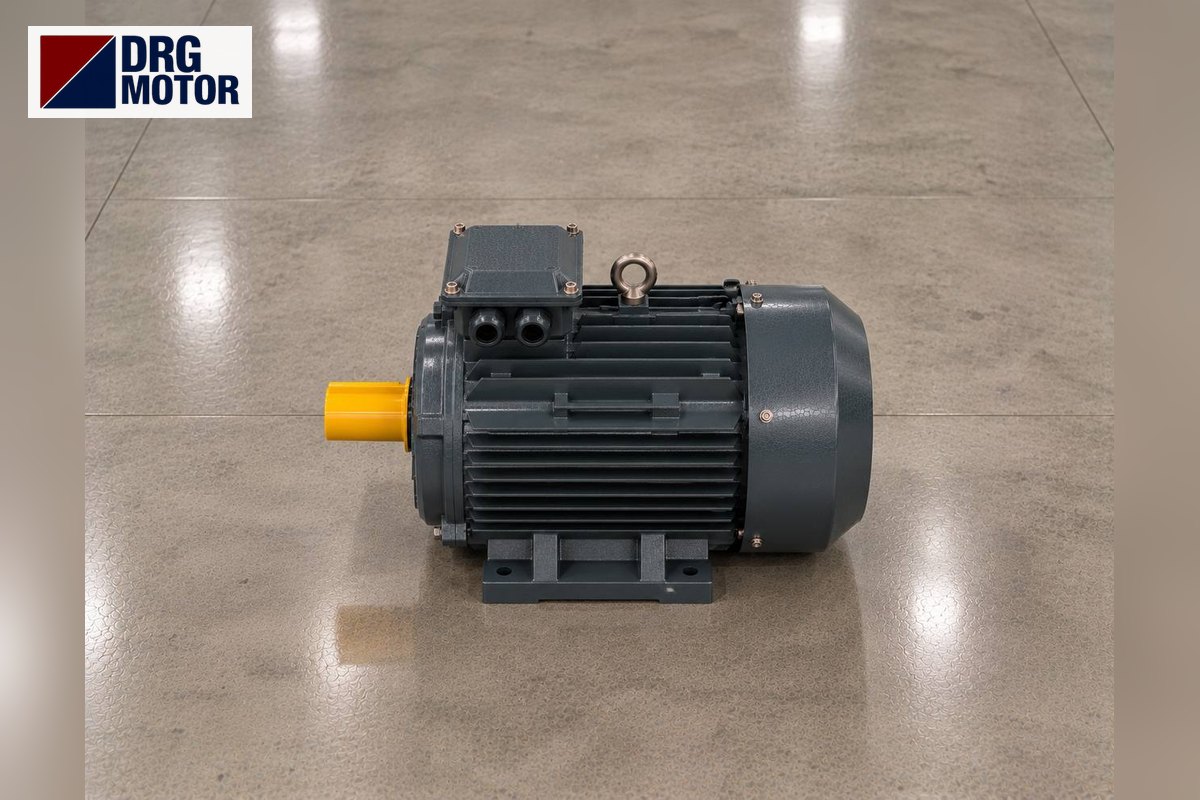

In a pasta press the main motor turns the auger that compresses the dough and forces it through the die, via a gearbox at low speed. Two things decide the choice: the high torque demanded by an auger turning at a few tens of rpm, and the start made while the barrel and die are still full of dough. Small workshop presses use a motor of a few kW, while industrial short-cut and long-cut pasta lines can need tens of kW; the exact rating is on the machine builder's nameplate and catalogue.
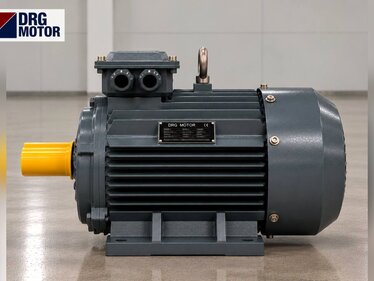
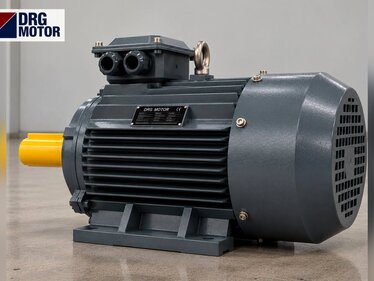
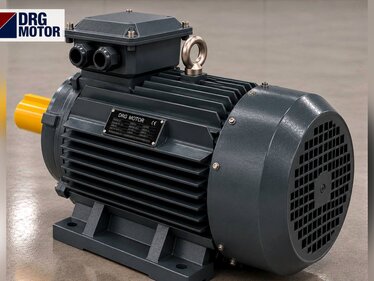
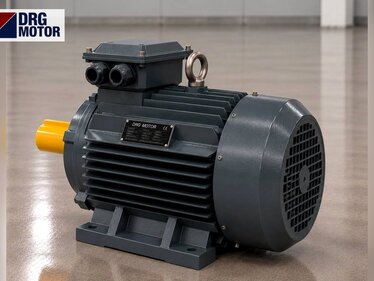
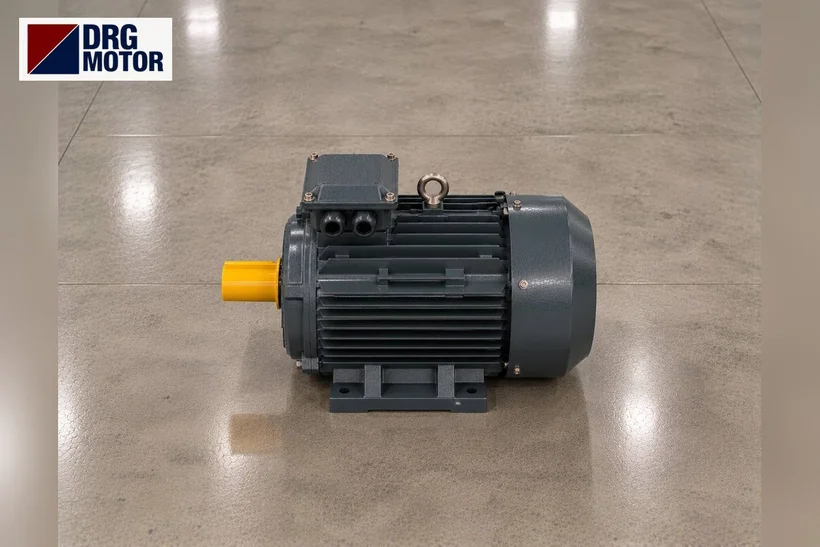
DRG Motor is a manufacturer, supplier and seller of electric motors; it supplies not the press itself but the three-phase asynchronous IEC motor that drives the auger gearbox. All power and speed options are listed in the DRG online motor shop. Motors for the other machines of a dough line are grouped on the food machine motors page.
Auger, Barrel and Die: What Sets the Torque?
In the mixing trough above the press, flour and water turn into a moist, crumbly mass. This crumb falls into the auger chamber; the screw pushes it forward, compresses it and forces it through the holes of the die at the end of the barrel. A knife rotating in front of the die cuts the strands or tubes to length.
Most of the resistance seen by the auger comes from the die. The number and section of the holes, wear of the die inserts, and the moisture and temperature of the dough all change the pressure in front of the die. Dry or cold dough demands higher pressure and torque at the same speed. On presses with a pressure gauge the operator sees the change there first; on the motor side it shows up as rising current.
Compression creates friction heat, so the barrel is double-walled and cooling water flows through it to keep the dough from spoiling. If cooling fails, the dough warms up and becomes sticky; that returns as a product defect rather than as motor load.
Starting with a Full Auger: the Hardest Moment of the Press
When the press stops at the end of a shift or after a fault, the barrel and die stay full of dough. The longer it waits, the harder it gets; on restart the auger has to break this packed mass loose from the die. This moment, which exceeds the torque of normal production, is the real yardstick for motor selection.
That is why the starting torque ratio (Ts/Tn) matters. For example, the DRG-132S-4 5.5 kW motor has a rated torque of 36.0 Nm and a Ts/Tn ratio of 2.0; on direct-on-line starting it delivers about 72.0 Nm at the shaft.
Star-delta starting cuts torque to one third
Motors of this size are wound for 400/690 V and run in delta on a 400 V supply; with star-delta starting, the start is made in star. Torque in star drops to about one third, so the same motor gives only around 24.0 Nm at start. With an auger full of dough this is often not enough: the motor hums in star, a current surge occurs at the changeover to delta, or the overload trips. Starting methods are compared on the star-delta and motor starting methods page.
On presses with frequent loaded starts a frequency inverter is used because it can deliver high, controlled torque at low frequency; it also lets the auger speed be set to suit the die. A soft starter limits current by lowering voltage, which also lowers torque, so it can cause the same problem with a full auger. The inverter is sourced separately; DRG does not sell inverters.
Click to see current electric motor prices and order nowSEE PRICES →
Gearbox Ratio, Auger Speed, and 4 or 6 Poles?
Auger speed depends on the press design and comes from the gearbox ratio and motor speed: n2 = n1 / i. The table below is an example for a press that should turn its auger at about 30 rpm. A gearbox efficiency of 0.9 is assumed; the actual ratio and efficiency are read from the gearbox nameplate.
| Model | Example ratio (i) | Auger speed | Auger torque (rated) |
|---|---|---|---|
| DRG-132S-4 (5.5 kW) | 50 | 29.2 rpm | ≈ 1620 Nm |
| DRG-132M2-6 (5.5 kW) | 32 | 30.2 rpm | ≈ 1564 Nm |
| DRG-160M-4 (11 kW) | 50 | 29.3 rpm | ≈ 3226 Nm |
| DRG-160L-6 (11 kW) | 32 | 30.3 rpm | ≈ 3119 Nm |
As the table shows, a 4-pole and a 6-pole motor of the same power give the auger almost the same torque; the ratio makes up the difference. With a 6-pole motor a lower-ratio gearbox is enough, but the motor frame is larger. If the existing gearbox is kept, the pole number must be kept too; otherwise auger speed and die output change.
DRG does not sell gearboxes; it supplies the motor that fits the gearbox input flange. A separate page covers electric motors for gearboxes. B5 flange dimensions from the catalogue: on frame 132, bolt circle M 265 mm, spigot N 230 mm, flange outside diameter P 300 mm, shaft 38×80 mm; on frame 160, M 300, N 250, P 350 mm and shaft 42×110 mm.
The Other Motors Around the Press
The auger motor is not the only motor on a pasta press. A separate motor and gearbox turn the paddle shaft in the mixing trough; a pump that creates vacuum under the trough, so the dough comes out without air bubbles, runs on its own motor. The cutter motor in front of the die is small and is often driven by an inverter to set the cut length.
These motors differ in power and mounting; each nameplate must be read separately at replacement. Looking only at the auger motor after a failure can hide strain in the mixer or the vacuum pump.
Moisture, Flour Dust and Cleaning
Flour dust, dough crumbs and moisture from the barrel cooling water are all present around a press. DRG motors have IP55 protection: they are protected against dust and water splashing from any direction, but they are not designed for high-pressure jet washing. If the line is washed with pressurised water, shield the motor; if a stainless, hygienic housing is required, the task cannot be met with a standard IEC motor.
Flour dust builds up on the fan cover and reduces cooling. The cover grille and the housing fins must be cleaned regularly; otherwise an auger motor under heavy load runs hotter than it should.
Before Replacing the Motor
- Old nameplate: power, speed, voltage (230/400 V or 400/690 V) and rated current
- Mounting: flanged to the gearbox (B5), or foot-mounted (B3) with a coupling
- Flange dimensions M, N, P, shaft diameter × length and key width
- Gearbox ratio and auger speed; will the pole number stay the same?
- Starting: direct-on-line, star-delta or inverter
- Does the press struggle at start; is the barrel emptied at the end of a shift?
- Separate nameplates of the mixer, vacuum pump and cutter motors
Common mistakes: fitting a larger motor on a press that struggles at start (the cause is often the star start); replacing a 6-pole motor with a 4-pole one and raising auger speed; reversed wiring that makes the auger push the dough backwards. Check the direction of rotation on first start, before the die is fitted.
DRG Motors Suited to Pasta Presses
4- and 6-pole 5.5 and 11 kW models for the auger gearbox, with a starting torque ratio of 2.0–2.2; all are wound for 400/690 V and run in delta on a 400 V supply.
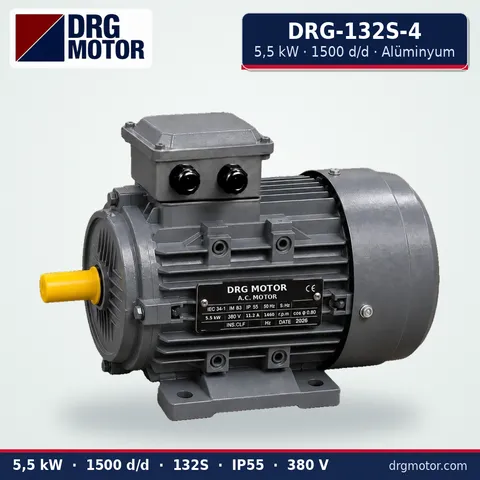
5.5 kW Three-Phase Motor 1500 rpm – DRG-132S-4 Aluminium
- 5.5 kW · 1500 rpm (4 poles)
- Aluminium frame · IEC 132S
- Mounting: B3 · B5 · B14 · B35
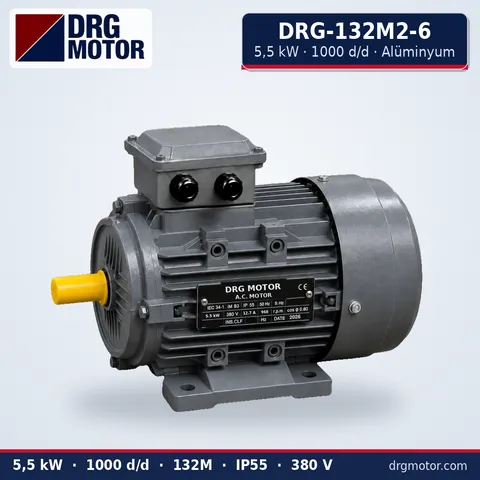
5.5 kW Three-Phase Motor 1000 rpm – DRG-132M2-6 Aluminium
- 5.5 kW · 1000 rpm (6 poles)
- Aluminium frame · IEC 132M
- Mounting: B3 · B5 · B14 · B35
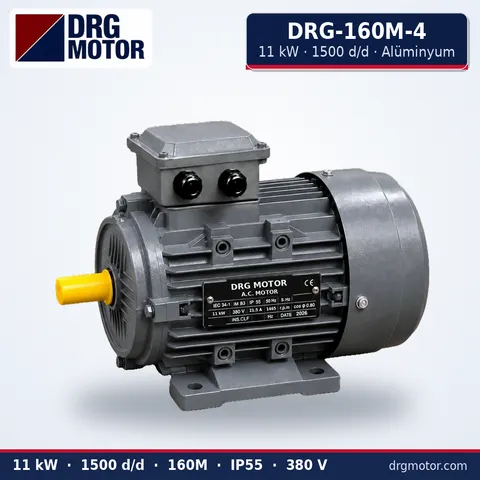
11 kW Three-Phase Motor 1500 rpm – DRG-160M-4 Aluminium
- 11 kW · 1500 rpm (4 poles)
- Aluminium frame · IEC 160M
- Mounting: B3 · B5 · B14 · B35
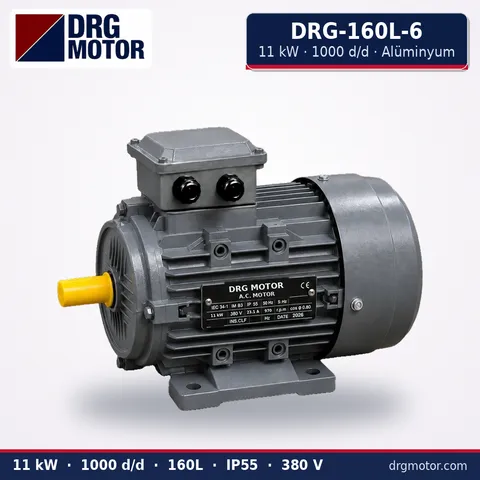
11 kW Three-Phase Motor 1000 rpm – DRG-160L-6 Aluminium
- 11 kW · 1000 rpm (6 poles)
- Aluminium frame · IEC 160L
- Mounting: B3 · B5 · B14 · B35
Click to see current prices and order these motors nowSEE PRICES →
Pasta Press Motor: Frequently Asked Questions
What kW should a pasta press motor be?
The machine builder sets the power by die size, hourly output and auger diameter; at replacement, keep the nameplate power of the old motor. If the press struggles at start, check the starting method before increasing power.
The pasta machine will not start in the morning and the motor hums; why?
The dough left in the barrel and die has hardened, and the motor is most likely trying to start in star with low torque. Emptying the barrel at the end of the shift or starting via an inverter reduces the problem.
Does lowering auger speed with an inverter harm the motor?
An auger is a constant-torque load; the motor works close to rated torque at low frequency too, but its own fan slows down and cools less. If it will run at very low frequency for long periods, revisiting the gearbox ratio is the better answer.
Should the gearbox be replaced together with the motor?
If the gearbox is sound, only the motor is changed; the new motor's flange and shaft must fit the gearbox input. If the gearbox is replaced, ratio and input flange are chosen for the new situation; DRG does not supply gearboxes.
For a quote, send a photo of the auger motor nameplate with power, speed, flanged or foot mounting, shaft size, gearbox ratio and the press starting method via WhatsApp, or add the chosen models to the quote list. Phone +90 (542) 666 11 11, e-mail info@drgmotor.com; further details on the contact page. All power and speed options are in the online shop.