English
 Le français
 Türkçe




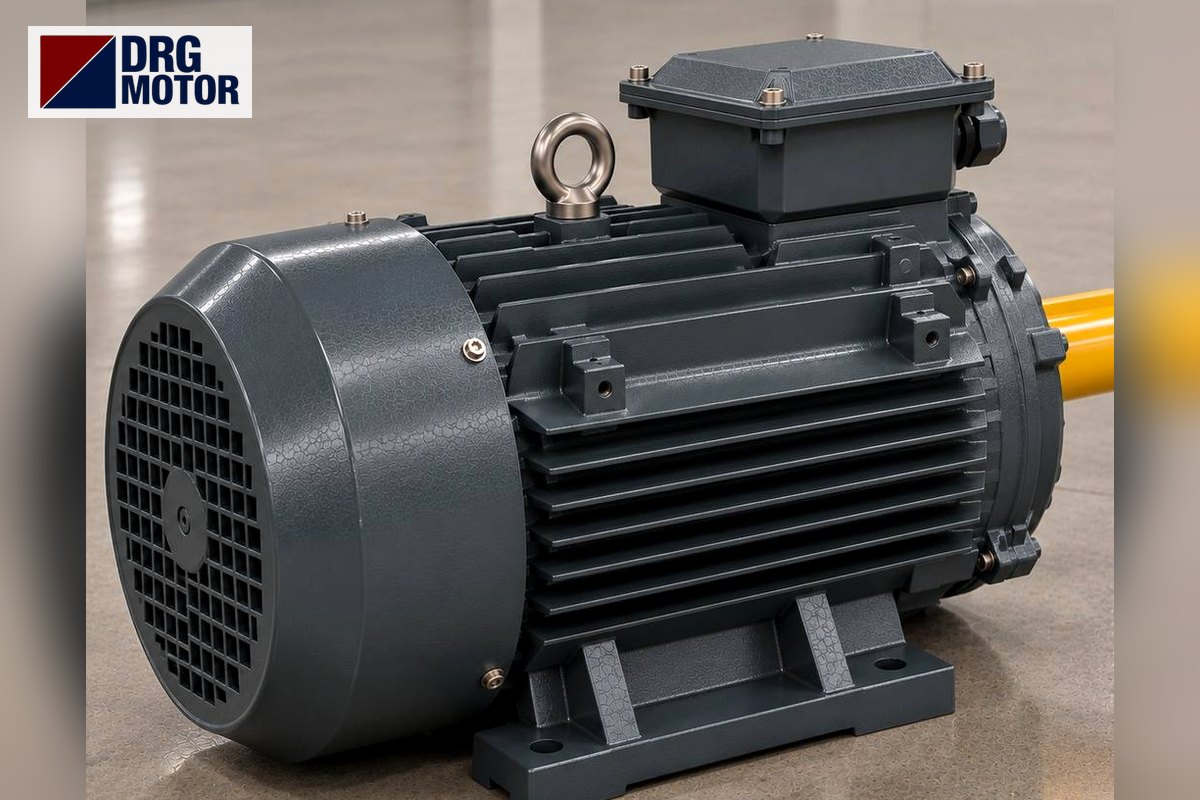

On the exhaust, supply and circulation fans of a paint booth and powder-coating oven, the fans sitting on the clean/exhaust side of the air stream run on an IP55, class-F three-phase asynchronous motor. The right choice follows the fan's power and speed, the ambient temperature and any solvent-vapour risk.
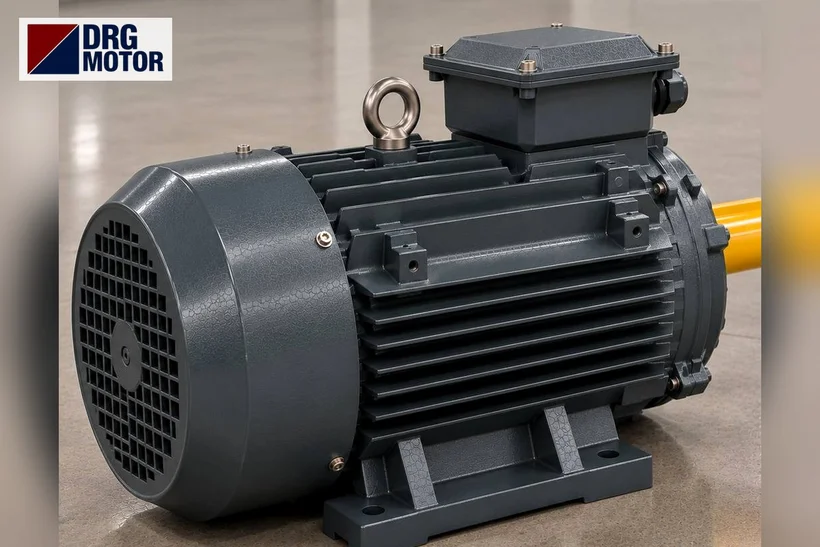
DRG Motor is a manufacturer, supplier and seller of electric motors. You can compare the mid-power three-phase models commonly used on paint-line fans in the online motor shop, and see the same motors together in the three-phase asynchronous electric motors category.
Where does the motor work in a booth and oven?
A paint booth and its powder-coating oven have several fans. The main ones are the exhaust fan that removes the dirty air, the supply fan that pushes clean air in, and the circulation fan that moves hot air inside the oven. A three-phase asynchronous motor drives each fan; its power and speed are set by the fan's airflow and pressure.
Two questions must be clear: in what environment does the motor sit (clean air, or solvent vapour), and how hot is the air the fan handles. These two points directly decide whether a given motor is suitable.
Important warning in solvent-vapour zones
In liquid (solvent-based) paint applications, explosive solvent vapour can exist inside the booth and in part of the exhaust duct. In such explosive-atmosphere (Ex) zones a standard three-phase motor is not suitable; explosion-protected (Ex) motors are required there. The DRG standard range does not include Ex-protected motors, so we cannot recommend a standard DRG motor for those zones; define the hazardous-area classification (zone) and motor type with your project's qualified engineer.
In practice the fan motor is usually placed outside the air stream, on the clean side with no solvent vapour. Where the motor stays outside the explosive zone in clean air, a standard three-phase asynchronous motor can be used. What matters is the on-site zone classification, not the catalogue.
Where is a standard motor used?
On powder (electrostatic) lines the solvent-vapour risk is far lower than with liquid paint; the exhaust and circulation fans usually run on standard three-phase motors. In liquid-paint booths, layouts that keep the motor on the clean/exhaust side away from solvent vapour suit a standard motor. The key features sought in these motors are:
- IP55 protection: an enclosed housing against dust and splashing water, suitable for dusty paint-shop air.
- Class-F insulation: high thermal strength of the winding insulation.
- Three-phase supply: fans are driven by a three-phase asynchronous motor for balanced torque and vibration-free running.
Click to see current electric motor prices and order nowSEE PRICES →
Oven side and temperature
The oven's circulation fan carries hot air, yet the motor itself stays outside the oven, in air at ambient temperature. Standard IEC motors are designed for the ambient-temperature range stated on their nameplate. It matters that the motor body is not exposed to high heat, that the cooling fan inlet is clear, and that it is insulated from hot surfaces. Shaft/impeller layouts that enter the hot stream directly inside the oven need a temperature-rated special solution, which is for the project engineer to assess.
DRG three-phase models by power
Paint-line fans most often use 4-pole (1500 rpm class) motors. The table below lists the aluminium-housing DRG models in this class with power/speed, rated torque and rated current at 400 V; the codes link straight to the product page.
| Model | Power / Speed | Torque | Current (400 V) |
|---|---|---|---|
| DRG-90L-4 | 1.5 kW / 1445 rpm | 9.91 Nm | 3.3 A |
| DRG-100L1-4 | 2.2 kW / 1450 rpm | 14.5 Nm | 4.52 A |
| DRG-100L2-4 | 3 kW / 1450 rpm | 19.8 Nm | 6.02 A |
| DRG-112M-4 | 4 kW / 1450 rpm | 26.3 Nm | 7.95 A |
| DRG-132S-4 | 5.5 kW / 1460 rpm | 36.0 Nm | 10.7 A |
| DRG-112M-4K | 5.5 kW / 1460 rpm | 36.0 Nm | 10.7 A |
Models up to 1.5 kW are wound 230/400 V (Δ/Y), and those of 4 kW and above 400/690 V (Δ/Y). When choosing the best fit for your fan's power and speed, base it on the values on the nameplate of the motor you are replacing. Thanks to their light build these models are also listed among the aluminium-housing motors.
Speed, connection and calculation
A fan motor's speed directly affects the required airflow, so when replacing an old motor the safest path is to keep the pole number (2/4/6) and nameplate speed the same. On a 400 V three-phase supply the motor is connected in star (Y), on a 230 V three-phase supply in delta (Δ). For rated current and cable size you can use the motor current chart, the motor cable size calculator and the electric motor calculator.
Before any electrical work, switch off the power, verify the absence of voltage, and let only authorised electrical personnel make the connection. Set values such as thermal protection current according to the rated current on the motor nameplate.
Mounting and shaft selection
Fan motors are mounted as B3 foot, B5 or B14 flange depending on the application. Since the fan hub is chosen by shaft diameter, when replacing a motor compare the shaft diameter, foot/flange dimensions and mounting type as well as the power. For the differences between mounting types, see the motor mounting types B3, B5, B14 and B35 article.
Send a photo of your current motor nameplate and we will find the suitable DRG model together.Send on WhatsApp
If you share your fan's airflow, pressure and the current motor nameplate, we can determine the DRG model with the right power and speed together.
See the models and current prices of three-phase asynchronous motors suitable for paint booth and oven fans in the shopSEE PRICES
Frequently asked questions
Which motor is used on a paint booth exhaust?
On exhaust fans that sit on the clean/exhaust side of the air, outside the solvent-vapour zone, an IP55 three-phase asynchronous motor is used. In explosive zones with solvent vapour a standard motor is not suitable.
Is a standard DRG motor suitable for a solvent-based paint booth?
It is not suitable for the zone with explosive solvent vapour; an Ex-protected special motor is required there and that type is not in the DRG standard range. Where the motor stays in clean air, outside the explosive zone, a standard three-phase motor can be used.
Does oven heat affect the motor?
As long as the motor stays outside the oven, in air at ambient temperature, a standard motor runs fine. The key points are that the motor body is not exposed to high heat and its cooling is not blocked.
Which speed class should I choose?
If you are replacing a fan motor, keep the pole/speed value from its nameplate. In a new application the speed is set by the required airflow; make that assessment with the fan manufacturer's data.
Electric Motors Related to This Topic — Models and Current Prices
Suitability is not decided by power alone: compare the speed, voltage, mounting, shaft and fixing dimensions of your machine with the product data; if unsure, send us the nameplate of your current motor.
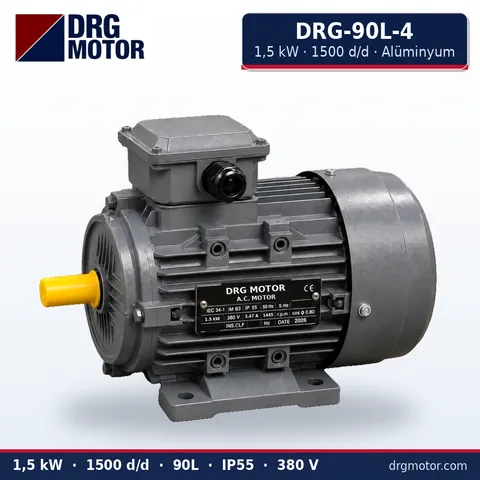
1.5 kW Three-Phase Motor 1500 rpm – DRG-90L-4 Aluminium
- 1.5 kW · 1500 rpm (4 poles)
- Aluminium frame · IEC 90L
- Shaft: 24 × 50 mm
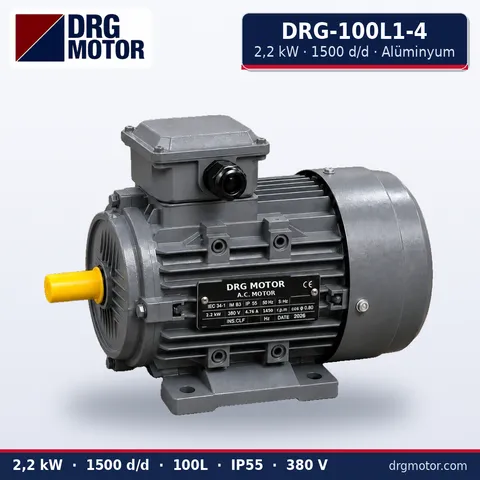
2.2 kW Three-Phase Motor 1500 rpm – DRG-100L1-4 Aluminium
- 2.2 kW · 1500 rpm (4 poles)
- Aluminium frame · IEC 100L
- Shaft: 28 × 60 mm
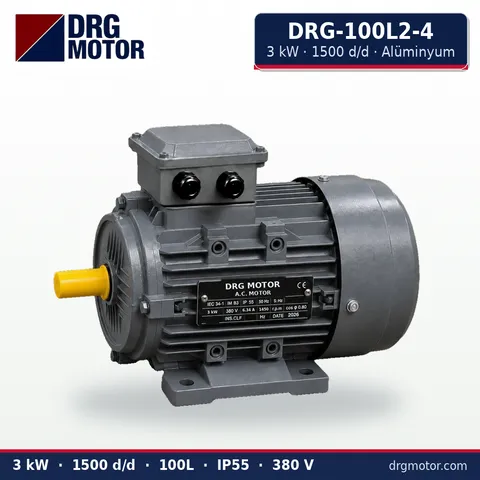
3 kW Three-Phase Motor 1500 rpm – DRG-100L2-4 Aluminium
- 3 kW · 1500 rpm (4 poles)
- Aluminium frame · IEC 100L
- Shaft: 28 × 60 mm

4 kW Three-Phase Motor 1500 rpm – DRG-112M-4 Aluminium
- 4 kW · 1500 rpm (4 poles)
- Aluminium frame · IEC 112M
- Shaft: 28 × 60 mm
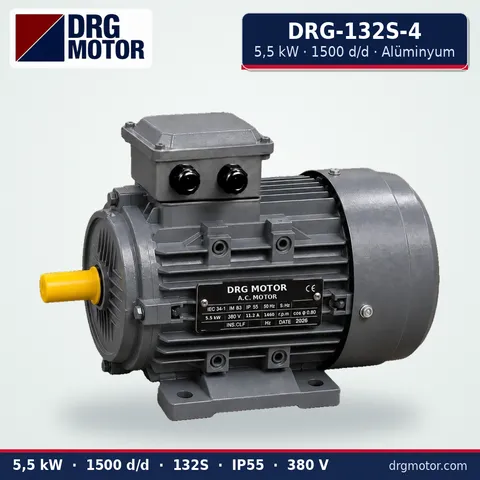
5.5 kW Three-Phase Motor 1500 rpm – DRG-132S-4 Aluminium
- 5.5 kW · 1500 rpm (4 poles)
- Aluminium frame · IEC 132S
- Shaft: 38 × 80 mm
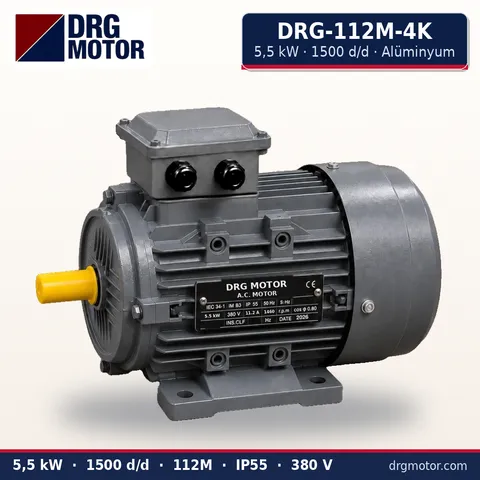
5.5 kW Compact Three-Phase Motor 1500 rpm – DRG-112M-4K Aluminium
- 5.5 kW · 1500 rpm (4 poles)
- Aluminium frame · IEC 112M
- Shaft: 28 × 60 mm