English
 Le français
 Türkçe




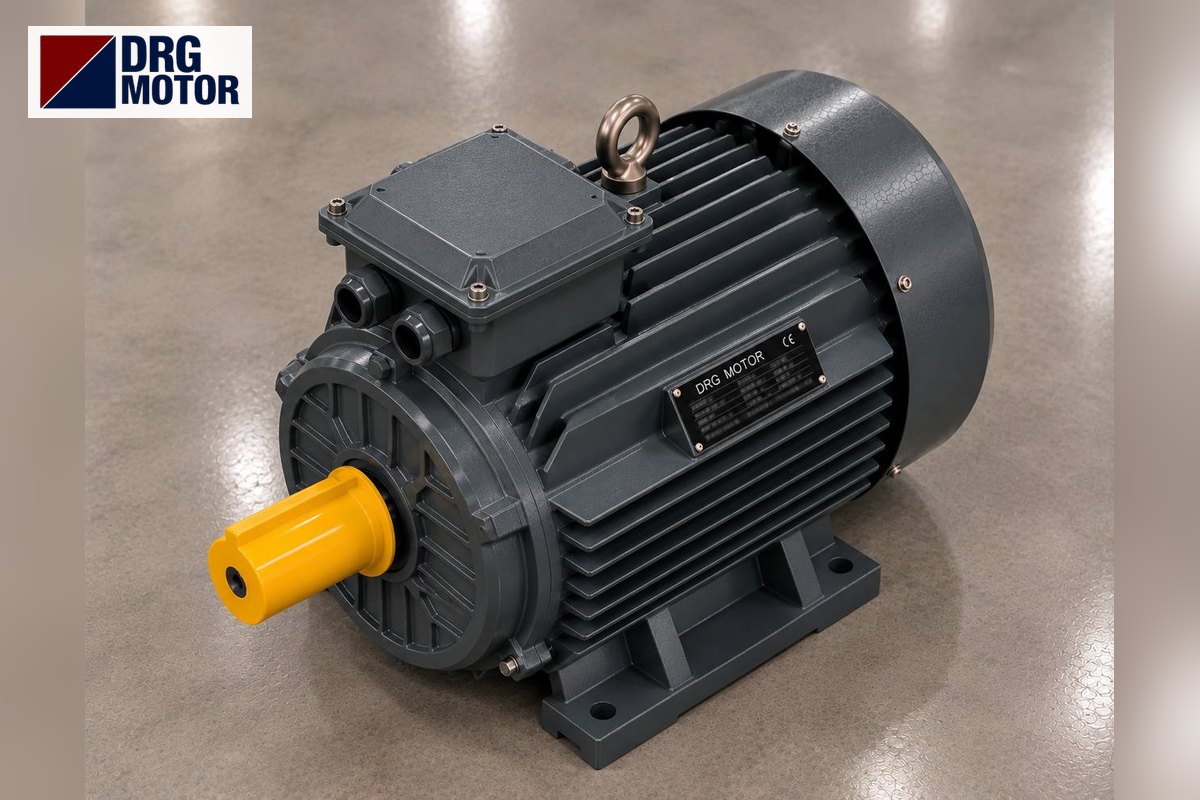

The motor of a nut salting drum provides the motion that tumbles roasted hazelnuts, peanuts, chickpeas or seeds inside a slowly turning pan so that brine, oil or powdered salt spreads evenly over the kernels. Because the drum turns at only a few tens of revolutions per minute, the motor never works alone: a gearbox that lowers speed and multiplies torque is needed, sometimes followed by a chain stage. What decides the choice is the required drum speed, the torque needed at that speed and the size of the gearbox input. Motor power follows from these three.
DRG Motor is a manufacturer, supplier and seller of electric motors. The salting pan's gearbox is outside the DRG range; what DRG provides is the three-phase asynchronous motor that bolts onto that gearbox's input. Models in suitable power ratings are listed in the online shop. The motors of the roaster the product passes through before salting are covered on the nut roasting machine motors page; this article deals only with the coating and salting drum.
How Does a Salting Drum Coat the Product?
Salting drums come in two forms. The first is an inclined, open-mouthed pan: it sits at roughly 30–45 degrees, is filled through the mouth and tipped to discharge. The second is a horizontal cylinder with internal flights; on line machines the product enters at one end and leaves at the other. In both, the motor lifts the product, the product slides down under its own weight and the kernels constantly change place.
Coating is usually done in stages. A nozzle or dosing pump first sprays brine or oil, then fine salt is sprinkled on and sticks to the wet surface. Some machines have a fan blowing warm air to dry off the water. The drum load therefore changes with the coating stage: wet, sticky product clings to the pan wall, rises higher and demands more torque.
The real source of load is the centre of gravity of the product mass, which piles to one side as the drum turns and sits off the axis. The product does not just rotate; it is continuously carried upwards. This load does not grow with speed; it is a constant-torque load.
At What Speed and With How Much Torque? A Worked Example
For an even coating the product must roll and slide in the drum; a drum turning too fast throws the product, increasing broken kernels and spilled salt. In a drum turning too slowly the salt collects at the bottom. Machine builders set drum speed according to pan diameter and product type; the machine's data sheet states the right speed.
Example (assumption): 80 kg of product in the drum, with the centre of gravity of the product heap 0.12 m off the axis. The torque created by the product is T = m · g · e = 80 × 9.81 × 0.12 ≈ 94.2 Nm. Allowing a factor of 1.5 for the wet, sticky stage and bearing friction gives a design torque of about 141 Nm. The shaft power needed at 20 rpm is P = T · n / 9550 ≈ 0.30 kW.
That is not the power to be written on the motor nameplate; the gearbox loss lies in between. A worm gearbox has low efficiency at high ratios; taking an efficiency of 0.6, the power required from the motor rises to about 0.49 kW. The table shows the drum speed reached with different motor and gearbox layouts and the output torque found from motor rated torque × ratio × gearbox efficiency (assumed 0.6 for worm, 0.95 for helical):
| Motor | Gearbox (example) | Drum speed | Output torque |
|---|---|---|---|
| DRG-712-4 0.37 kW | worm, i = 70 | 19.1 rpm | ≈ 110.9 Nm – too low |
| DRG-802-4 0.75 kW | worm, i = 70 | 20.3 rpm | ≈ 211.7 Nm |
| DRG-90S-6 0.75 kW | helical, i = 47 | 19.9 rpm | ≈ 342 Nm |
| DRG-90L-6 1.1 kW | helical, i = 47 | 20.1 rpm | ≈ 495.6 Nm |
The table shows two things. Whatever the ratio, the 0.37 kW motor cannot supply the 141 Nm this drum needs. The two 0.75 kW motors reach the same speed, but the six-pole motor with a helical gearbox delivers far more torque from the same power because the loss is small. If you want to change the ratio and efficiency to match your own gearbox, the gearbox calculator page does this.
Click to see current electric motor prices and order nowSEE PRICES →
Worm or Helical: What Changes for the Motor
Worm gearboxes are common on salting pans: they give a high ratio in a single stage, the motor axis sits at right angles to the drum axis and the unit fits under an inclined pan. The price is efficiency. A high-ratio worm turns a large part of the motor power into heat, so the same drum needs a larger motor.
A helical or bevel-helical gearbox is more efficient but longer and heavier for the same ratio. On the motor side, the difference shows in the flange and shaft size at the gearbox input. The B5 flange is P 160 / M 130 / N 110 mm on frame 71, P 200 / M 165 / N 130 mm on frames 80 and 90, and P 250 / M 215 / N 180 mm on frame 100L; shaft diameters are 14, 19, 24 and 28 mm respectively. Small-flange B14 input dimensions are confirmed at order.
A worm gearbox has one more property: at high ratios it becomes hard to back-drive. When the power fails, an inclined pan tries to turn back under the weight of the product; whether it stays put depends on the gearbox, not the motor. DRG does not supply brake motors; if holding is needed, it is solved on the gearbox and machine side. Motor selection for gearbox inputs is covered separately on the electric motors for gearboxes page.
If there is a chain stage
On some drums the gearbox has a smaller ratio and the final stage is a chain. Example: a DRG-802-4 (1420 rpm) with an i = 25 gearbox gives 56.8 rpm; a 15-tooth pinion and a 45-tooth drum sprocket bring this down to 18.9 rpm. If a sprocket has been changed, the old motor speed no longer gives the same drum speed; include the tooth counts when you replace the motor.
Salt, Moisture and Oil: Protecting the Motor From Corrosion
The salting section is one of the harshest places on a food line for a motor. Fine salt dust in the air combines with moisture and sticks to the housing; salt attracts moisture and forms a thin electrolyte film on metal. Screw heads with chipped paint, the edges of the fan cover and the foot faces are the first places to rust.
DRG motors are IP55: protected against dust and water splashed from any direction. Even so, brine should not reach the motor directly and the motor should not sit below the spray nozzle. Where the outside of the drum is washed with pressurised water, cover the motor beforehand; if a stainless motor built for heavy wash-down is required, a standard IEC motor cannot fulfil the task and a special motor is needed.
- Drum speed from the data sheet and ratio (i) on the gearbox nameplate
- Gearbox type: worm, helical or bevel-helical
- Gearbox input flange (B5/B14) and input bore diameter
- Power, pole count and voltage of the old motor
- Pinion and sprocket tooth counts if there is a chain stage
- Motor position on an inclined pan: are the terminal box and cable entry facing down?
- Rust on the housing, flange face and shaft end
On inclined pans the motor sits at an angle together with the gearbox. The orientation of the terminal box and cable gland must be reconsidered in this position: if the gland faces up, condensation running down the cable fills the box. When fitting the new motor, position the terminal box so the cable entry faces downwards.
Starting, Discharge and Speed Adjustment
On a batch salting drum the hardest moment is restarting a full pan. The product has settled at the bottom and is stuck together with damp salt; the motor has to break this mass loose and lift it. The catalogue starting torque ratio Ts/Tn is 2.3 for the DRG-802-4 and 2.0 for the DRG-90S-6. A motor chosen with little margin, as in the table, copes in normal running but struggles on a full start.
Some builders set drum speed with an inverter, turning slowly in the wet stage and faster for dry salting. Drives are not part of the DRG range; the standard motor can be fed from an inverter bought elsewhere. With a constant-torque load, the motor's own fan slows as frequency drops; in the example layout the drum turns at 16.2 rpm at 40 Hz and 12.2 rpm at 30 Hz while the torque demand stays the same. If long running at low frequency is planned, the next power size should be considered.
On line machines the salt dosing screw, brine pump and drying fan are separate motors. Each of these small motors is replaced according to its own nameplate; unlike the drum motor, they may not need a gearbox and torque calculation.
DRG Motors Suited to Salting Drums
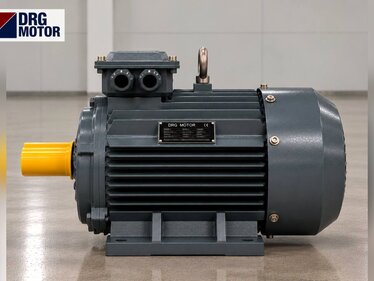
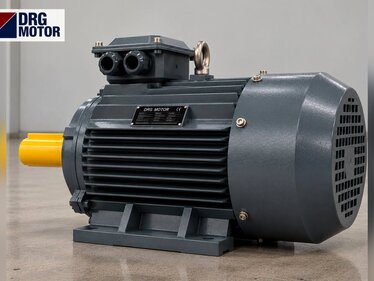
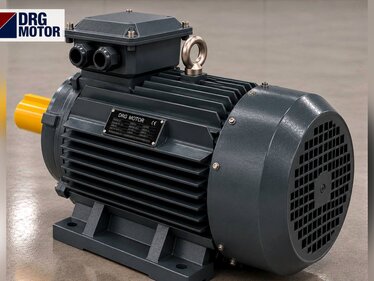
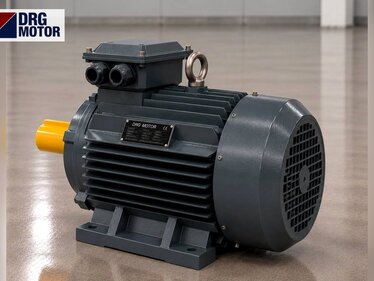
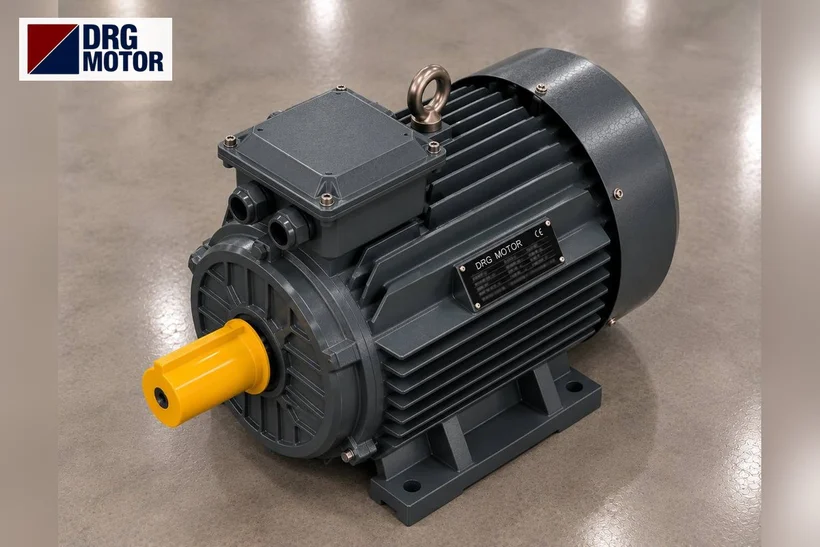
The four models named in the calculation above, each able to sit on a gearbox input with a B5 or B14 flange: 0.37 kW for a small pan, 0.75 kW and 1.1 kW for a mid-size drum.
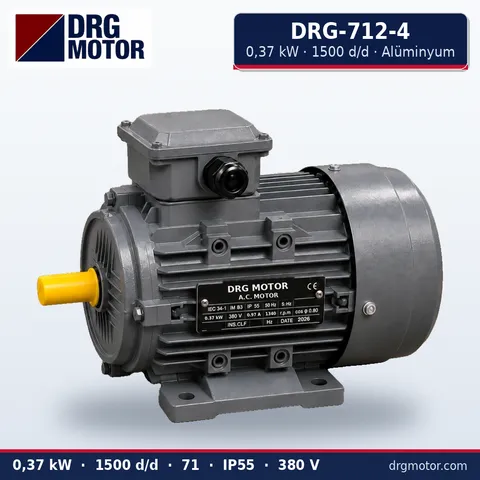
0.37 kW Three-Phase Motor 1500 rpm – DRG-712-4 Aluminium
- 0.37 kW · 1500 rpm (4 poles)
- Aluminium frame · IEC 71
- Mounting: B3 · B5 · B14 · B35
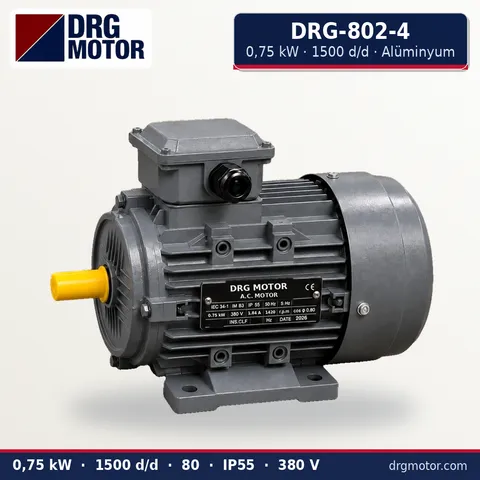
0.75 kW Three-Phase Motor 1500 rpm – DRG-802-4 Aluminium
- 0.75 kW · 1500 rpm (4 poles)
- Aluminium frame · IEC 80
- Mounting: B3 · B5 · B14 · B35
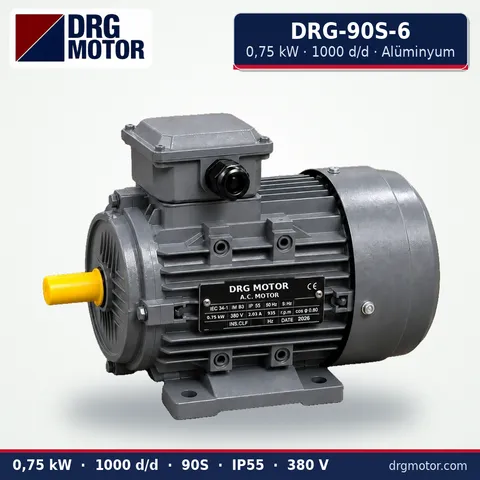
0.75 kW Three-Phase Motor 1000 rpm – DRG-90S-6 Aluminium
- 0.75 kW · 1000 rpm (6 poles)
- Aluminium frame · IEC 90S
- Mounting: B3 · B5 · B14 · B35
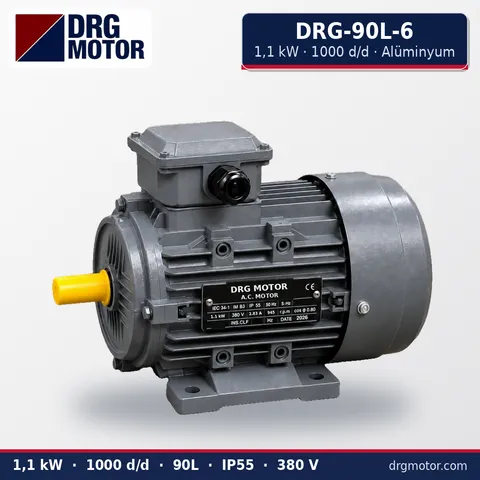
1.1 kW Three-Phase Motor 1000 rpm – DRG-90L-6 Aluminium
- 1.1 kW · 1000 rpm (6 poles)
- Aluminium frame · IEC 90L
- Mounting: B3 · B5 · B14 · B35
Click to see current prices and order these motors nowSEE PRICES →
Salting Drum Motor: Frequently Asked Questions
What power should a nut salting pan motor have?
It depends on the amount of product in the pan, the drum speed and the gearbox type. Small batch pans usually have a motor below 1 kW, large line drums may need several kW. The exact value is on the machine nameplate and the builder's data sheet; replace a burnt-out motor with the same power and pole count.
Why does the salting drum motor rust?
Salt dust and moisture stick to the housing and rust starts where the paint is damaged. Keep the motor away from below the nozzle, clean the housing with a dry cloth, point the cable entry downwards and cover the motor during pressure washing.
Can the motor pole count change without changing the gearbox?
If it changes, the drum speed changes too. A six-pole motor turns the drum roughly 1/3 slower than a four-pole one; at equal power the torque on the motor shaft goes up. If you want the same coating result, keep the old pole count.
The motor will not start with a full drum — what should I do?
First check that the gearbox and drum bearings turn freely, then attempt a restart after emptying part of the product. If voltage drops on starting, check the cable size. If the problem recurs often, the motor power, gearbox ratio or efficiency may be insufficient for the drum.
To get a quotation for your salting drum, photograph the old motor's nameplate and the gearbox plate and send them to our WhatsApp line together with power, speed, flange or foot fixing, shaft diameter and the drum's speed per minute. If you have already picked models, you can also pass them on through the quote list. You can reach us on +90 (542) 666 11 11 or at info@drgmotor.com, or fill in the contact form. The full model list is in the DRG online shop.