English
 Le français
 Türkçe




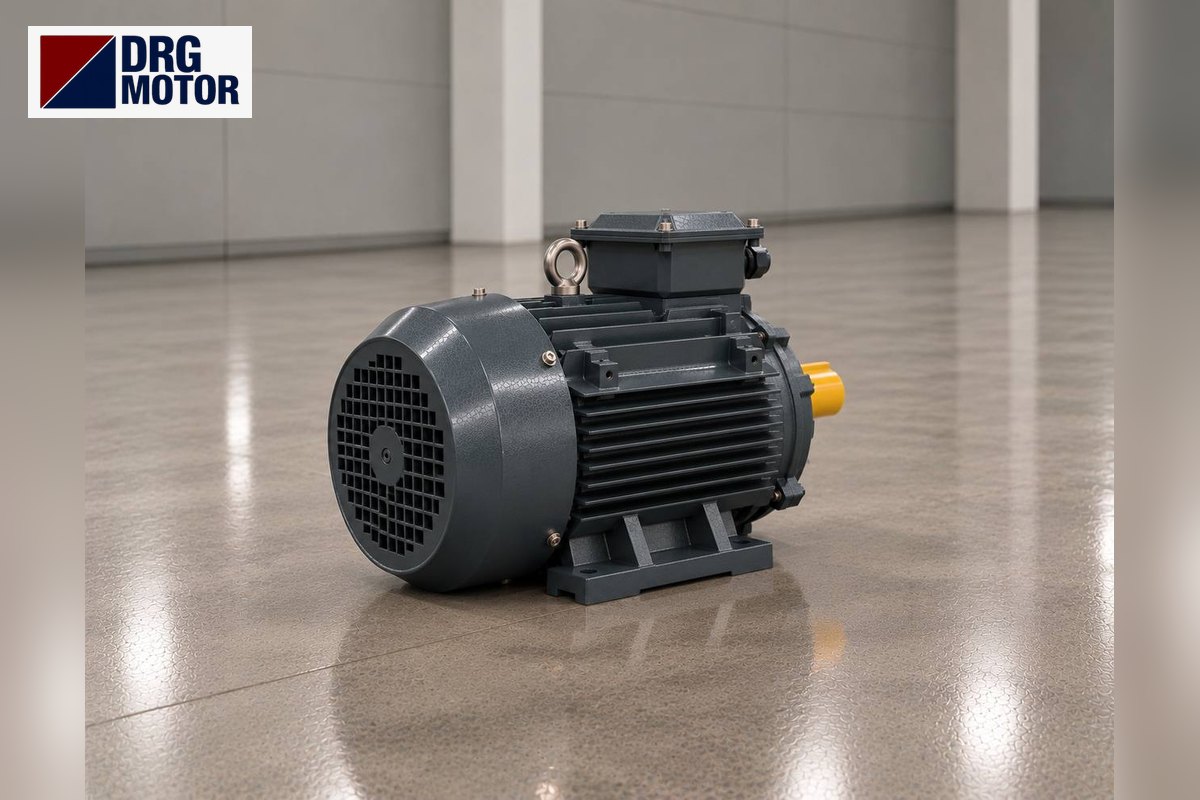

In a noodle cutting machine the motor turns, via a chain, belt or small gearbox, the rollers that thin the dough sheet and the grooved cutting rollers that split it into strips; if the machine has a guillotine knife that cuts to length, it usually takes its motion from the same drive. The power needed is low: workshop and village-type machines usually run on a motor in the 0.37–1.5 kW range. The exact value is on the machine nameplate; at replacement, the real point of care is not power but a speed and connection match that keeps the cutting speed unchanged.
All three-phase motors in this small power class are on the DRG buy electric motors online page. There is also a separate page for dough sheeter electric motors, covering the machines that roll out the dough sheet.
From Dough Sheet to Strip: the Motion Inside the Machine
Kneaded, stiff noodle dough first passes between two smooth rollers whose gap can be closed. The gap is reduced a little at each pass until the sheet reaches the required thickness. The thinned sheet then enters between two cutting rollers with evenly spaced grooves; the grooves interlock and separate the sheet into strips. Groove pitch sets the noodle width; the cutting roller set is changed for wide or narrow noodles.
The rollers are geared together and turn in opposite directions. The motor sits under or beside the frame; the sprocket or pulley on its shaft drives the roller shaft through a chain or belt. Some machines have a worm gearbox between motor and roller.
Cutting Speed: Roller Speed and Surface Speed
In a noodle machine, speed means how fast the dough travels on the roller surface: v = π · D · n. This speed decides how many metres of strip come out per hour and whether the dough enters the rollers cleanly. A roller that turns too fast tears soft dough or makes it stick in the grooves; one that turns too slowly cuts output.
The table below is an example based on a Ø80 mm cutting roller and two assumed transmission ratios. The real roller diameter and ratio are measured on the machine or obtained from its builder.
| Motor | Example ratio (i) | Roller speed | Surface speed |
|---|---|---|---|
| DRG-712-4 (1340 rpm) | 40 | 33.5 rpm | ≈ 8.4 m/min |
| DRG-801-4 (1400 rpm) | 40 | 35.0 rpm | ≈ 8.8 m/min |
| DRG-802-4 (1420 rpm) | 25 | 56.8 rpm | ≈ 14.3 m/min |
| DRG-90S-6 (935 rpm) | 25 | 37.4 rpm | ≈ 9.4 m/min |
The last two rows make an important point: with the same ratio of 25, a 4-pole motor turns the roller about one and a half times faster than a 6-pole motor. If the old motor is 6-pole, fitting a 4-pole one raises cutting speed by the same proportion unless the pulley or sprocket is changed.
Length on machines with a guillotine knife
If the knife that cuts strips to length is driven from the same drive as the rollers, length is independent of motor speed; both speed up in the same proportion. If the knife has its own motor, length comes from the ratio of the two speeds. Example: at a strip speed of 8.8 m/min, a knife striking 110 times per minute gives noodles about 8.0 cm long. Changing the roller motor but leaving the knife motor changes length as well.
Click to see current electric motor prices and order nowSEE PRICES →
Dimensions and Connection at Motor Replacement
On noodle machines the motor is mostly foot-mounted (B3), with the chain sprocket or pulley fitted straight onto the motor shaft. The first dimensions to check are therefore shaft diameter and foot fixing. According to the DRG catalogue, frame 71 has a 14×30 mm shaft and 112×90 mm foot hole spacing; frame 80 has a 19×40 mm shaft and 125×100 mm spacing; frame 90S has a 24×50 mm shaft and 140×100 mm spacing. If the shaft does not match, the sprocket or pulley is re-bored or replaced.
If the motor is flanged to a worm gearbox, check the flange type. Large-flange (B5) dimensions are in the catalogue; for small-flange (B14) connections the dimensions are confirmed at order. DRG does not supply the gearbox; it supplies the motor that connects to it.
Single-phase machines
Some small noodle machines are sold with a 230 V single-phase motor. DRG supplies three-phase motors only; models up to 3 kW are wound for 230/400 V. If the workshop has a three-phase supply, the motor is connected in star at 400 V. With only a single-phase supply a standard motor cannot run on its own; a frequency inverter with single-phase input and three-phase output is used and the motor is connected in delta at 230 V. The inverter is sourced separately; DRG does not sell inverters.
Flour Dust, Dough Crumbs and Jamming
The flour dusted onto the rollers forms a fine cloud around the machine and sticks to the motor fan cover. The IP55 protection of DRG motors keeps dust out of the housing; flour building up on the cover grille still blocks the cooling air. Weekly dry brushing is the simplest task that decides how long these small motors last.
What strains the motor most on these machines is a thick or hard lump of dough jamming in the roller gap. The motor locks at once and current rises to its starting value. On small motors the overload relay must catch this; if it is not set to the motor's rated current, the winding overheats. For example, the DRG-801-4 has a rated current of 1.31 A at 400 V. The overload relay, fuse and contactor selection page can be used to choose protection.
Before Ordering a Noodle Machine Motor
- Power, speed and voltage on the old nameplate; single-phase or three-phase?
- Shaft diameter and length; does the sprocket or pulley hub fit this shaft?
- Foot hole spacing and shaft height (frame 71, 80, 90S)
- Flange type if flanged to a gearbox (B5 or B14)
- Pole number: a change alters roller speed and cutting speed
- Speed and nameplate of the knife motor, if separate
- Setting of the overload relay
Common mistakes: trying to connect a three-phase motor directly to a single-phase machine; replacing a 6-pole motor with a 4-pole one and tearing the dough; forcing the old sprocket onto a different shaft with a bushing. Check on first start that the rollers turn in the direction that draws the dough in.
DRG Motors Suited to Noodle Cutting Machines
Small-frame models in the power range of noodle machines, wound for 230/400 V and usable foot- or flange-mounted; the 6-pole option is for machines whose old motor is in the 1000 rpm class.
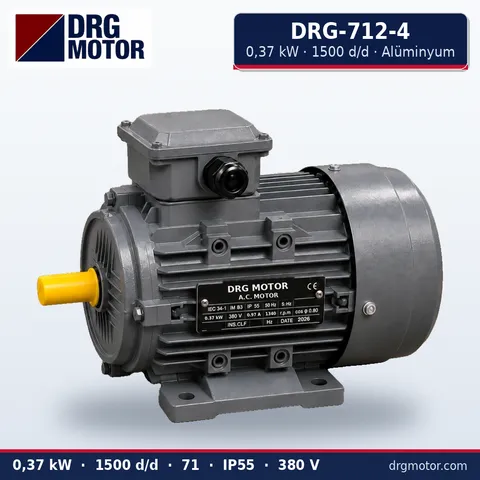
0.37 kW Three-Phase Motor 1500 rpm – DRG-712-4 Aluminium
- 0.37 kW · 1500 rpm (4 poles)
- Aluminium frame · IEC 71
- Mounting: B3 · B5 · B14 · B35
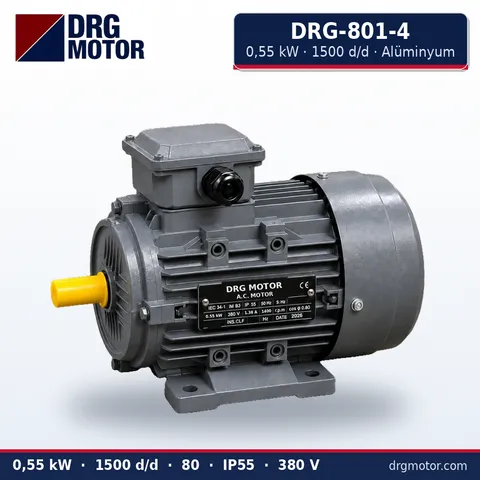
0.55 kW Three-Phase Motor 1500 rpm – DRG-801-4 Aluminium
- 0.55 kW · 1500 rpm (4 poles)
- Aluminium frame · IEC 80
- Mounting: B3 · B5 · B14 · B35
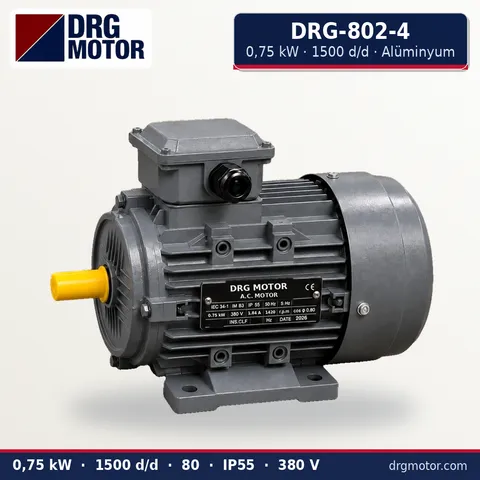
0.75 kW Three-Phase Motor 1500 rpm – DRG-802-4 Aluminium
- 0.75 kW · 1500 rpm (4 poles)
- Aluminium frame · IEC 80
- Mounting: B3 · B5 · B14 · B35
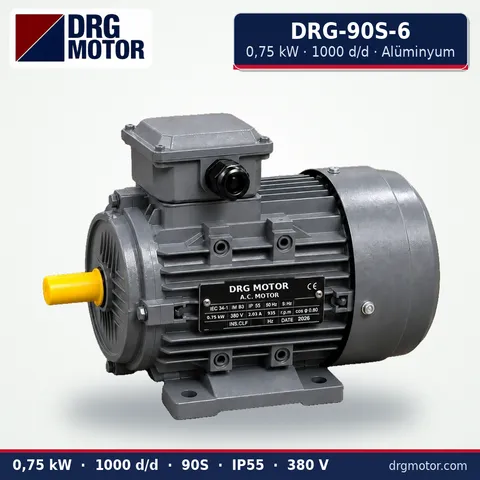
0.75 kW Three-Phase Motor 1000 rpm – DRG-90S-6 Aluminium
- 0.75 kW · 1000 rpm (6 poles)
- Aluminium frame · IEC 90S
- Mounting: B3 · B5 · B14 · B35
Click to see current prices and order these motors nowSEE PRICES →
Noodle Cutting Machine Motor: Frequently Asked Questions
What kW motor does a noodle machine need?
Workshop-type machines usually use a motor in the 0.37–1.5 kW range; wide-roller line machines can need more. At replacement, keep the nameplate power of the old motor.
What speed should a noodle machine motor have?
The same speed as the old motor; most machines have a 4-pole motor in the 1500 rpm class or a 6-pole motor in the 1000 rpm class. If the speed changes without a pulley or sprocket change, cutting speed changes too.
Can a three-phase motor be fitted to a household-type noodle machine?
Not directly if there is no three-phase supply. A small three-phase motor wound for 230/400 V can be run from a single-phase-input, three-phase-output inverter; this also allows roller speed to be adjusted.
The motor stops when dough jams in the rollers; is the motor too weak?
Usually not. Stiff dough or closing the roller gap too much in one pass causes the jam. Close the gap in steps; if the motor also runs hot under normal load, measure the current and compare it with the nameplate value.
For a quote, send a photo of the motor nameplate with power, speed, foot or flange mounting, shaft size and the machine supply (single-phase/three-phase) via WhatsApp, or add the suitable model to the quote list. Phone +90 (542) 666 11 11, e-mail info@drgmotor.com, details on the contact page. For other food line machines see the food machine motors page, and for all models the online shop. DRG Motor is a manufacturer, supplier and seller of electric motors.