English
 Le français
 Türkçe




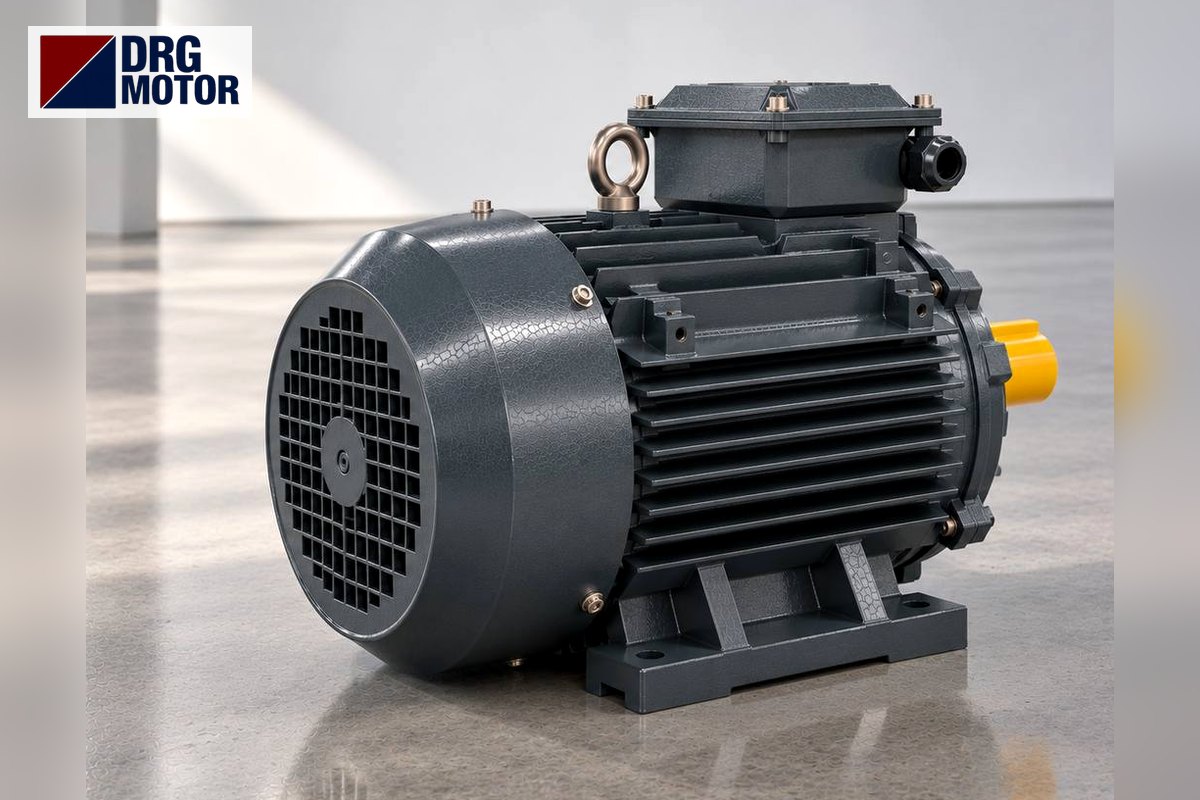

Three-phase asynchronous electric motors deliver their nameplate rated power under standard reference conditions: a 40 °C ambient temperature and up to 1000 m of altitude. When the ambient rises above 40 °C, or the electric motor runs at high altitude or inside a closed, hot space, the power that can be safely drawn from the same frame drops. This reduction is called derating, and its purpose is to keep the winding temperature within the limit allowed by the insulation class.
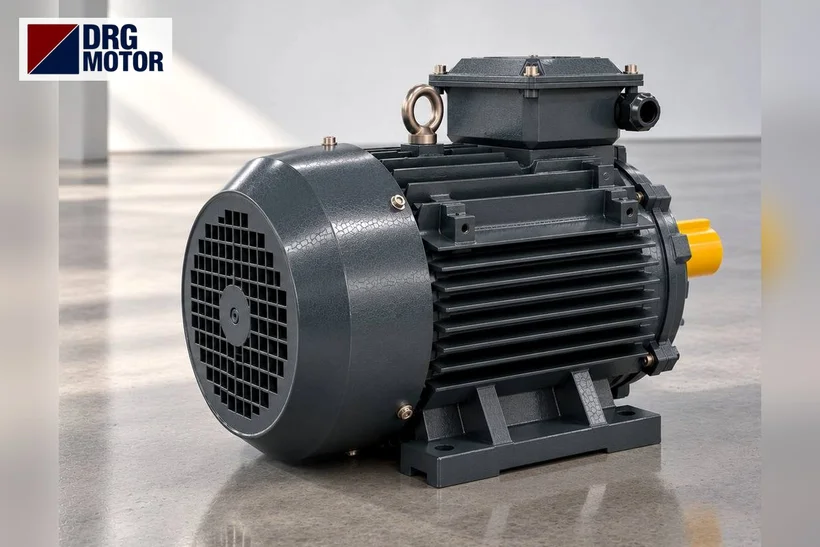
DRG Motor is a manufacturer, supplier and seller of electric motors. For projects with high ambient temperatures you can review suitable three-phase models by power and speed in the online motor shop, and see the same products grouped in the three-phase asynchronous electric motors category.
Why does ambient temperature set an electric motor's power?
The main factor limiting the power an electric motor can deliver is heat. Current flowing through the windings produces heat through copper and iron losses; this heat is released from the frame surface and by the cooling fan. How well it is released depends on the temperature difference between the winding and the ambient. The cooler the ambient, the more the winding may heat up and the more easily the motor delivers its rated power.
When the ambient warms up, that difference shrinks. At the same current the winding reaches a higher absolute temperature. To stay below the limit allowed by the insulation class, either the load (power) or the current drawn must be reduced somewhat. That is the link between ambient temperature and rated power.
What does 40 °C mean? The standard rating condition
The kW value on an electric motor nameplate applies under specific reference conditions: usually 40 °C ambient and 1000 m altitude. So the nameplate power is the rated power under these standard conditions, not "under any condition". If your application stays below them (for example a ventilated room at 25–30 °C), the electric motor delivers its rated power without issue and even keeps a small thermal margin.
If the conditions exceed the standard, meaning the ambient is hotter than 40 °C or the site is above 1000 m, the power available from the same frame drops. You then either reduce the power or move up one frame/power class.
Approximate power reduction above 40 °C
As the ambient rises, the usable power falls roughly as shown below. These figures are approximate guidance margins; the exact factor depends on the electric motor's catalogue and nameplate. Always confirm your selection against the product documentation.
| Ambient temperature | Approx. usable power margin |
|---|---|
| 40 °C (standard) | 100% |
| 45 °C | about 95% |
| 50 °C | about 90% |
| 55 °C | about 85% |
| 60 °C | about 80% |
A practical rule: at 50 °C ambient it is sensible to expect about 10 kW from an 11 kW frame to stay on the safe side. Conversely, if your load is fixed and the ambient is hot, choosing one higher power/frame class restores the margin.
Click to see current electric motor prices and order nowSEE PRICES →
The effect of high altitude
As altitude increases the air thins; thinner air both weakens cooling and slightly lowers the dielectric strength of the insulation. The standard reference is 1000 m. Above 1000 m, similarly to the temperature case, a margin roughly as below should be left. These are again approximate values; check the catalogue for the exact figure.
| Altitude | Approx. usable power margin |
|---|---|
| 1000 m (standard) | 100% |
| 2000 m | about 93% |
| 3000 m | about 85% |
If both high temperature and high altitude occur together, the two effects add up; for such demanding installations the healthiest way is to contact us so we can decide the right frame together.
The margin left by Class F insulation
DRG three-phase asynchronous electric motors are built with Class F insulation winding material. Class F is an insulation level that withstands a higher winding temperature. In above-40 °C ambients this means a partial safety margin: because the winding material tolerates high temperature, moderate temperature rises do not immediately stress the insulation.
It would be wrong, however, to treat this margin as unlimited. Class F improves durability but does not remove the effect of ambient temperature on rated power. If you want long life in a hot ambient, you should still take derating into account.
Practical measures for closed and hot spaces
Derating is not only a selection matter; you can recover margin by improving the environment:
- Do not block the electric motor's cooling fan inlet; leave at least a hand's width of clearance in front of the rear cover.
- In closed spaces (inside a panel, a tight machine cabinet) provide fresh-air circulation; if hot air builds up, the effective ambient can climb well above the nameplate value.
- Do not place the electric motor near another heat source (furnace, boiler, exhaust).
- Monitor the load and the current drawn. Use the motor current chart to check the right power and current, and the motor cable size calculator for cable selection.
Before any electrical work, switch off the supply, verify the absence of voltage, and have only qualified electrical personnel make the connection. Set values such as the thermal overload current not from memory but according to the rated current on the electric motor nameplate.
DRG 4-pole three-phase models for hot ambients
The table below lists 4-pole (1500 rpm) aluminium DRG models often chosen for hot-ambient applications. The power values are the ratings at the 40 °C standard condition; in above-40 °C ambients apply the margins above and consider one higher power class. The model codes link straight to the product page.
| Model | Rated power (40 °C) | Speed class | Rated current (400 V) |
|---|---|---|---|
| DRG-112M-4-AL (aluminium) | 4 kW | 4 poles / 1500 rpm | 7.95 A |
| DRG-132S-4-AL (aluminium) | 5.5 kW | 4 poles / 1500 rpm | 10.7 A |
| DRG-112M-4K-AL (aluminium) | 5.5 kW | 4 poles / 1500 rpm | 10.7 A |
| DRG-132M-4-AL (aluminium) | 7.5 kW | 4 poles / 1500 rpm | 14.3 A |
| DRG-160M-4-AL (aluminium) | 11 kW | 4 poles / 1500 rpm | 20.4 A |
| DRG-132M-4K-AL (aluminium) | 11 kW | 4 poles / 1500 rpm | 20.4 A |
For example, if you target an 11 kW load in a 50 °C ambient, it is sensible to consider the next frame up to stay on the safe side; in a ventilated ambient at 40 °C or below, the 11 kW model in the list can be used directly.
Send a photo of your current motor nameplate and we will find the suitable DRG model together.Send on WhatsApp
Let us determine the right frame and power class together, according to your ambient conditions.
Compare three-phase asynchronous electric motor models with the right power for above-40 °C ambients and high altitude, with current prices in the shopSEE PRICES
Frequently asked questions
What exactly is derating?
Derating is the deliberate reduction of the power that can be safely drawn from an electric motor when you leave the standard conditions (40 °C ambient, 1000 m altitude). The aim is to keep the winding temperature within the insulation class limit.
How much power do I lose above 40 °C?
Roughly a few percentage points of margin per 5 °C rise; at 50 °C about 90% usable power is typical. The exact value depends on the electric motor's catalogue and nameplate.
Does Class F insulation remove derating?
No. Class F withstands a higher winding temperature and provides a safety margin, but it does not fully remove the need to account for derating in a hot ambient.
What should I do about it?
Improving the environment (ventilation, keeping the fan inlet clear) is the first step. If that is not enough, moving up one power/frame class restores the margin; we can decide the suitable model together.
Electric Motors Related to This Topic — Models and Current Prices
Suitability is not decided by power alone: compare the speed, voltage, mounting, shaft and fixing dimensions of your machine with the product data; if unsure, send us the nameplate of your current motor.
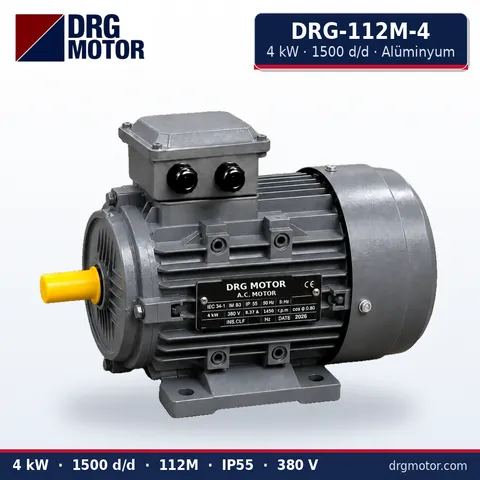
4 kW Three-Phase Motor 1500 rpm – DRG-112M-4 Aluminium
- 4 kW · 1500 rpm (4 poles)
- Aluminium frame · IEC 112M
- Shaft: 28 × 60 mm
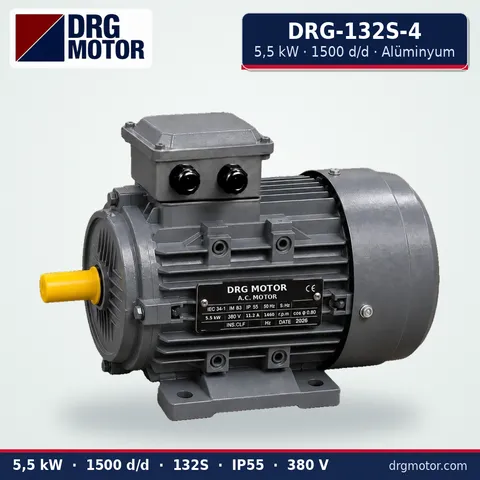
5.5 kW Three-Phase Motor 1500 rpm – DRG-132S-4 Aluminium
- 5.5 kW · 1500 rpm (4 poles)
- Aluminium frame · IEC 132S
- Shaft: 38 × 80 mm
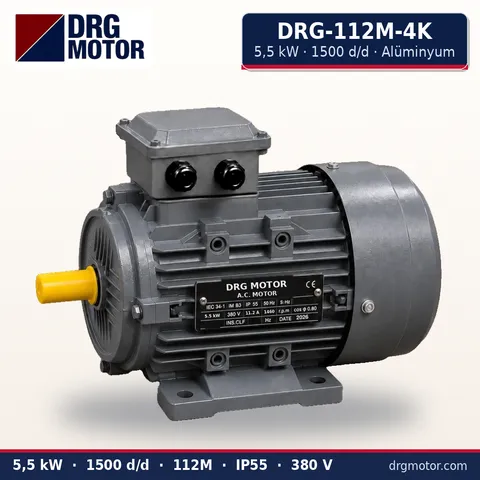
5.5 kW Compact Three-Phase Motor 1500 rpm – DRG-112M-4K Aluminium
- 5.5 kW · 1500 rpm (4 poles)
- Aluminium frame · IEC 112M
- Shaft: 28 × 60 mm
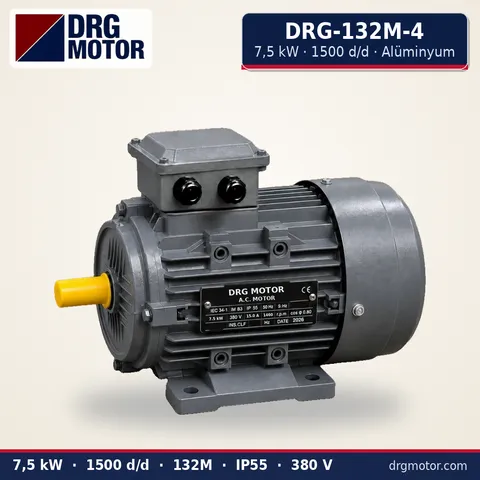
7.5 kW Three-Phase Motor 1500 rpm – DRG-132M-4 Aluminium
- 7.5 kW · 1500 rpm (4 poles)
- Aluminium frame · IEC 132M
- Shaft: 38 × 80 mm
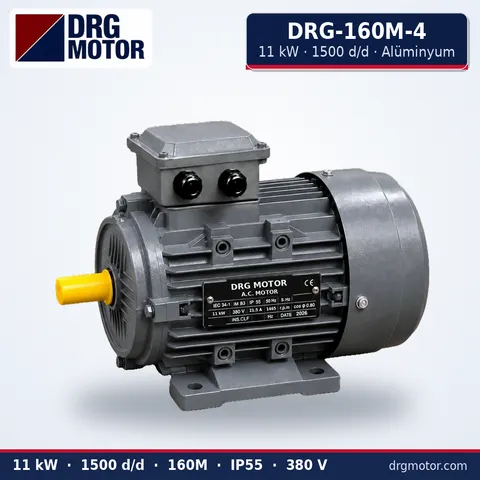
11 kW Three-Phase Motor 1500 rpm – DRG-160M-4 Aluminium
- 11 kW · 1500 rpm (4 poles)
- Aluminium frame · IEC 160M
- Shaft: 42 × 110 mm
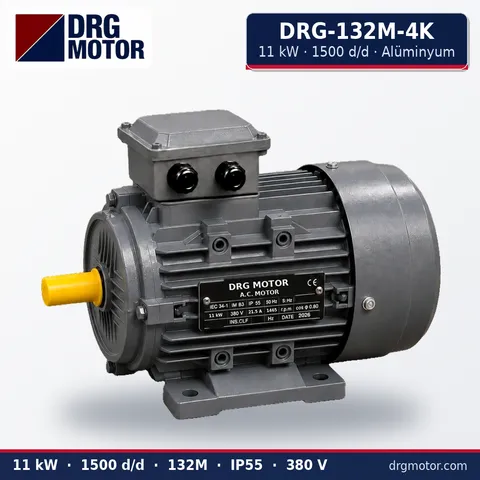
11 kW Compact Three-Phase Motor 1500 rpm – DRG-132M-4K Aluminium
- 11 kW · 1500 rpm (4 poles)
- Aluminium frame · IEC 132M
- Shaft: 38 × 80 mm