English
 Le français
 Türkçe




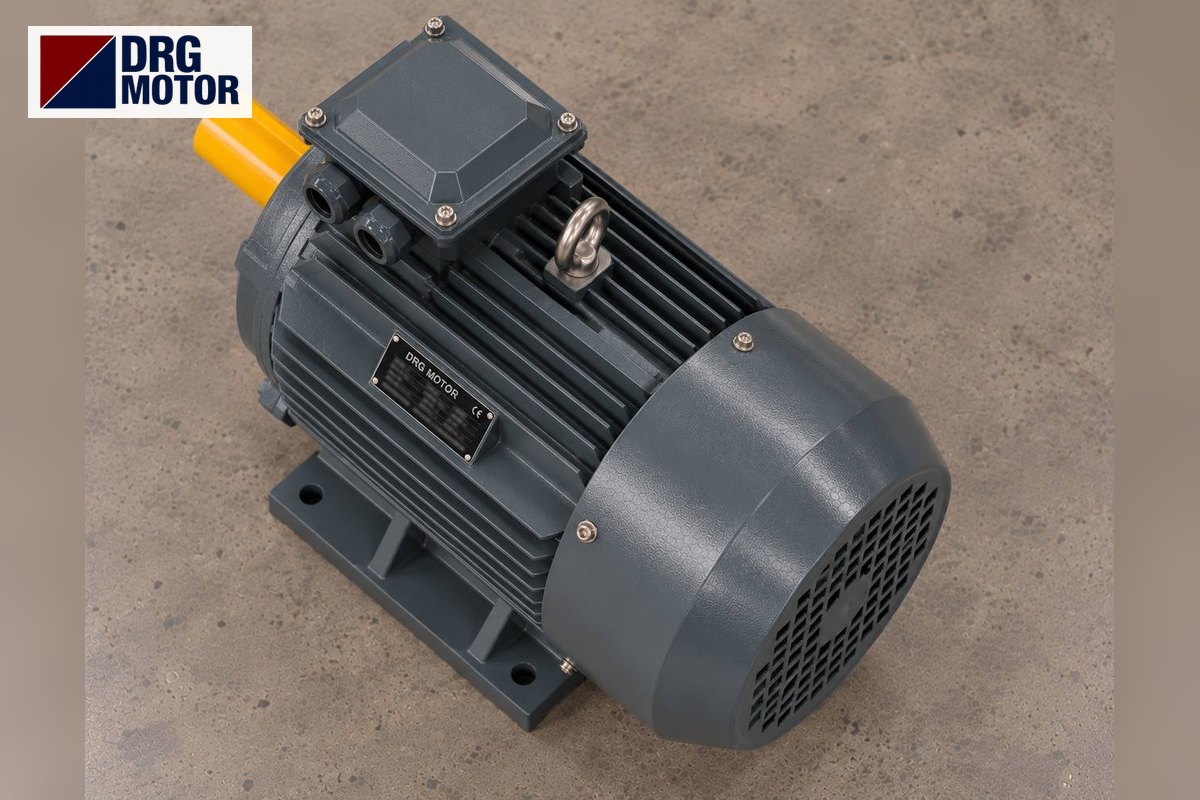

In a milk of lime tank, the agitator motor's real job is to keep calcium hydroxide particles suspended in water, not to shear or knead the product. Because the particles are twice as heavy as water, they start settling the moment the agitator stops. So what decides the motor is not so much concentration as its ability to restart through a settled layer after a long stop. In practice a 6-pole motor drives a low-speed impeller through a gearbox.
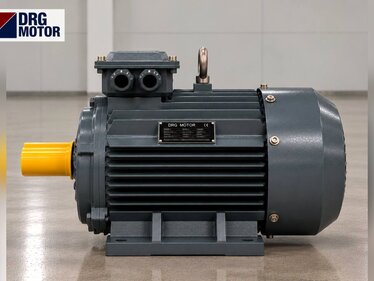
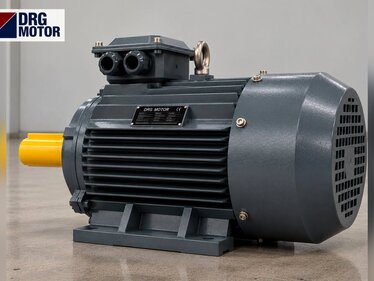
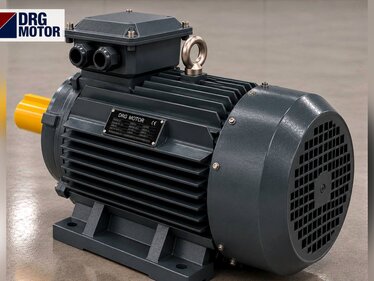
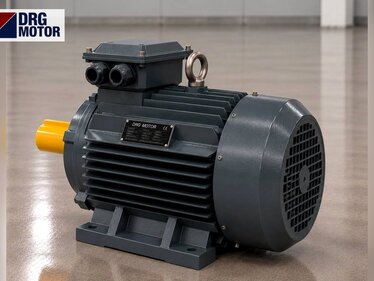
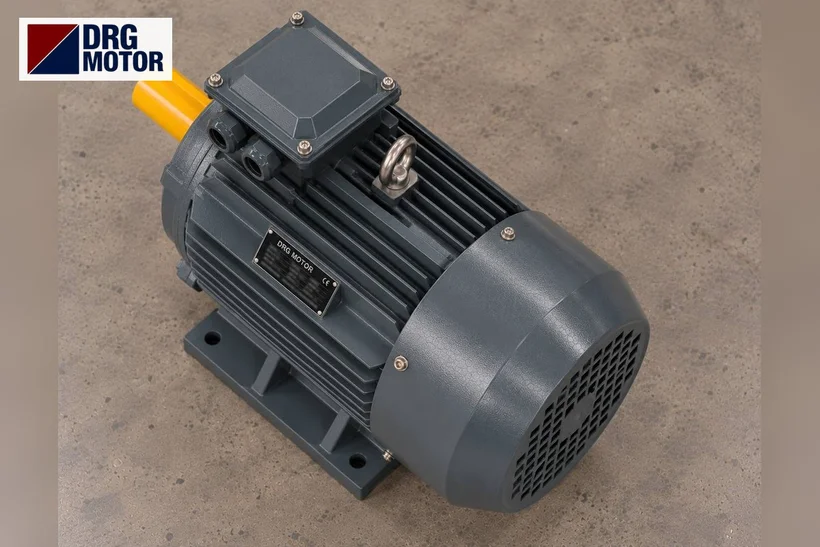
DRG Motor is a manufacturer, supplier and seller of electric motors. The gearbox on the tank stays in place; what DRG provides is the three-phase IEC asynchronous unit bolted to its input. The range of low-power 1000 rpm motors is available on the buy electric motors online page.
Where Is Milk of Lime Prepared and How Does the Tank Work?
Hydrated lime (Ca(OH)₂) is mixed with water to give a white, milk-like suspension. pH correction and softening in drinking water and wastewater treatment, juice purification in sugar plants, neutralisation of acidic water in mining and flue gas treatment are typical uses. The prepared milk is fed to the process by a dosing pump.
The preparation tank is usually cylindrical; the motor and gearbox sit on the bridge on top, and the shaft running down the centre carries one or two pitched-blade impellers. Baffles on the walls stop the liquid from rotating with the impeller and redirect flow up and down. The impeller's task is to create a vertical current that lifts sinking particles back up.
How Much Does Power Change with Concentration?
In turbulent mixing the power drawn by the impeller is P = Np · ρ · n³ · D⁵ (Np power number, ρ density, n revolutions per second, D impeller diameter). In this regime viscosity has almost no effect; power rises only in proportion to density. The density of milk of lime, in turn, rises only modestly with concentration.
The values below are an example. Assumption: 4-blade 45° pitched impeller (Np 1.27), diameter 0.9 m, impeller speed 76.4 rpm, gearbox loss factor 0.95; density calculated with a Ca(OH)₂ particle density of 2.21 g/cm³.
| Concentration (by mass) | Suspension density | Impeller shaft power | Required from motor |
|---|---|---|---|
| 5% | 1028 kg/m³ | 1.59 kW | 1.68 kW |
| 10% | 1058 kg/m³ | 1.64 kW | 1.72 kW |
| 15% | 1089 kg/m³ | 1.69 kW | 1.78 kW |
| 20% | 1123 kg/m³ | 1.74 kW | 1.83 kW |
The result may be surprising: between 5% and 20% the power difference stays small. In this example a 2.2 kW motor is enough in all four cases. The real risk is not normal running but restarting after a stop. The values used here are a calculation example; the actual impeller and speed come from the tank builder.
Click to see current electric motor prices and order nowSEE PRICES →
Restarting from a Settled Layer: the Moment That Loads the Motor
When power fails or the agitator is stopped for maintenance, particles sink and within a few hours can form a dense layer around the lower part of the impeller. Lime also reacts with carbon dioxide in the air and turns into calcium carbonate; in a tank left standing this layer hardens. On restart the impeller has to turn through this wet sludge instead of the fluid it sees in normal running.
Example: 2.2 kW 6-pole motor, i = 12.5
Assumption: DRG-112M-6 (2.2 kW, rated 955 rpm, rated torque 22.0 Nm, Ts/Tn 2.0), gearbox ratio 12.5. Impeller speed is 955 / 12.5 = 76.4 rpm. Rated torque at the gearbox output is 9550 · 2.2 / 76.4 · 0.95 ≈ 261 Nm. With a Ts/Tn of 2.0, the shaft sees 44 Nm in the first instant (2.0 × 22.0); after the 12.5 ratio and losses, roughly 523 Nm reaches the impeller shaft.
If the settled layer demands more than this, the motor cannot start and the overload trips. The fix here comes from operating practice before a bigger motor: avoid leaving the tank full and idle for long, draw off some sludge through the bottom valve before starting, or dilute the tank. Choose the overload relay and contactor using the overload, fuse and contactor selection page; on agitators with long starting times the relay trip class also matters.
Why 6 Poles and a Gearbox? Speed and Impeller Tip Speed
With milk of lime the goal is the lowest speed that keeps particles suspended. Excess speed increases blade wear and draws air in through a surface vortex; air carbonates the lime. A 0.9 m impeller at 76.4 rpm reaches a tip speed of about 3.6 m/s, adequate for a settling suspension.
A 1000 rpm motor reaches the same impeller speed with a smaller gearbox ratio than a 1500 rpm motor; the gearbox is smaller and quieter. That is why 6-pole motors are common on milk of lime tanks. When replacing a burnt motor do not change the pole count: with a 4-pole motor impeller speed rises by about 50%, power demand grows with the cube of speed and the motor is overloaded. For small tanks, the 1.1 kW DRG-90L-6 and the 1.5 kW DRG-100L-6 are 6-pole options.
Lime Dust, Uninterrupted Running and the Motor on the Bridge
Above the tank there is usually a bag tipping station or a screw feeding from a silo; lime dust becomes airborne here and sticks to the motor frame. Combined with moisture, lime dust hardens between the fins and blocks cooling. On IP55 DRG motors dust does not get inside, but the frame needs regular cleaning. Since lime is caustic, milk splashed onto the motor should be wiped off once dry.
In treatment plants the agitator turns for weeks without stopping; running below, not close to, the rated current matters for bearing and winding life. For uninterrupted running the air path of the IC411 shaft-fan cooling must stay clear. For the plant's other pumps and agitators see the water treatment plant electric motors page. Crushing the limestone that hydrated lime comes from is a separate subject; its motor needs are covered on the hammer crusher motor page.
Gearbox Input, Flange and Replacement Checks
On vertical agitators the motor usually sits on top of the gearbox via a B5 large flange with the shaft pointing down. According to DRG catalogue dimensions, the B5 flange of frame 112 is Ø250 mm with a Ø215 mm bolt circle, a Ø180 mm pilot and a 28×60 mm shaft end; on frame 132 (the 3 kW DRG-132S-6) the flange is Ø300 mm and the shaft end 38×80 mm. Frames 90 and 100 also differ: Ø200 mm on 90L, Ø250 mm on 100L. If the gearbox has a small B14 flange, its dimensions are checked at the time of ordering.
Check before ordering:
- What the label says: power, pole count, voltage
- Ratio stamped on the gearbox; measured flange (outer, bolt circle, pilot)
- Shaft end: Ø, usable length, key
- Vertical mounting and terminal box orientation on the bridge
- Tank volume, impeller diameter and concentration of the milk of lime
- Condition at the last stop: was the tank full, how long did it stand
DRG Motors Suitable for Milk of Lime Tanks
All four models are 6-pole, 1000 rpm class motors for mounting on a gearbox input; they cover the power range from small dosing tanks to medium preparation tanks.
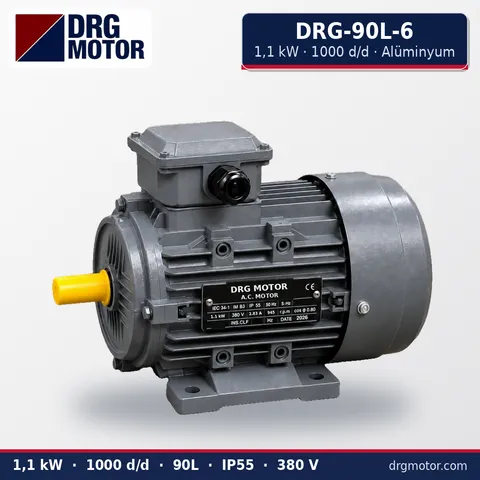
1.1 kW Three-Phase Motor 1000 rpm – DRG-90L-6 Aluminium
- 1.1 kW · 1000 rpm (6 poles)
- Aluminium frame · IEC 90L
- Mounting: B3 · B5 · B14 · B35
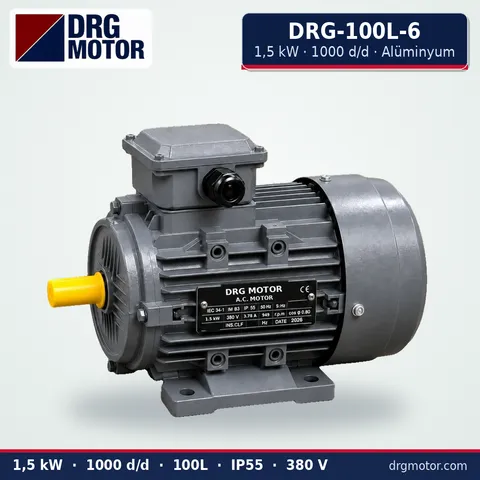
1.5 kW Three-Phase Motor 1000 rpm – DRG-100L-6 Aluminium
- 1.5 kW · 1000 rpm (6 poles)
- Aluminium frame · IEC 100L
- Mounting: B3 · B5 · B14 · B35
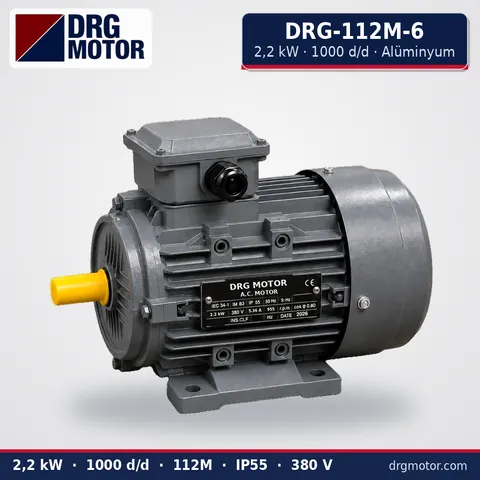
2.2 kW Three-Phase Motor 1000 rpm – DRG-112M-6 Aluminium
- 2.2 kW · 1000 rpm (6 poles)
- Aluminium frame · IEC 112M
- Mounting: B3 · B5 · B14 · B35
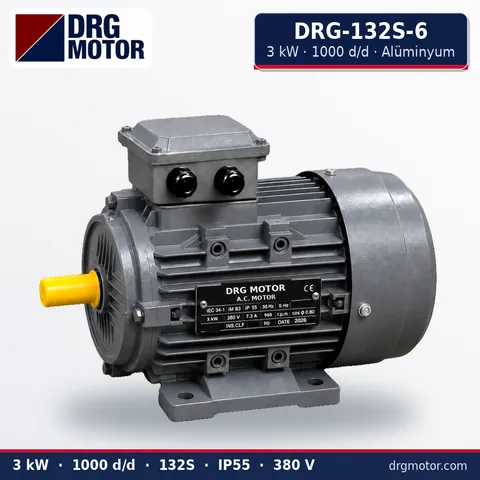
3 kW Three-Phase Motor 1000 rpm – DRG-132S-6 Aluminium
- 3 kW · 1000 rpm (6 poles)
- Aluminium frame · IEC 132S
- Mounting: B3 · B5 · B14 · B35
Click to see current prices and order these motors nowSEE PRICES →
Milk of Lime Agitator: Frequently Asked Questions
How fast should the impeller in a milk of lime tank turn?
It depends on impeller diameter and tank size; the aim is the lowest speed that keeps particles suspended. For example, with a 955 rpm motor and a 12.5 ratio gearbox the impeller turns at 76.4 rpm. The exact value comes from the tank builder.
Why won't the agitator start after a power cut?
When the agitator stops, particles settle and form a dense layer around the impeller. If starting torque exceeds what the motor can deliver, the overload trips; drawing sludge from the bottom valve or diluting the tank makes starting easier.
Does a higher milk of lime concentration need a bigger motor?
In turbulent mixing power is proportional to density, and between 5% and 20% density changes by only a few percent. In normal running the difference is small; settling and restarting are what decide.
Can the agitator motor be replaced with a 4-pole motor?
If the ratio stays the same, the impeller turns about half as fast again and power demand rises much more. The motor is overloaded and wear increases; keep the original pole count.
For a quotation, photograph the label of the motor on the agitator bridge and pass it to our WhatsApp line together with power, speed, how it is fixed (on the gearbox flange or on feet), shaft diameter and gearbox ratio. If you need motors for several tanks, a quote list is more practical. Phone: +90 (542) 666 11 11 · email: info@drgmotor.com · contact. If you also need a motor for the lime dosing pump or feed screw, look in the online shop.