English
 Le français
 Türkçe




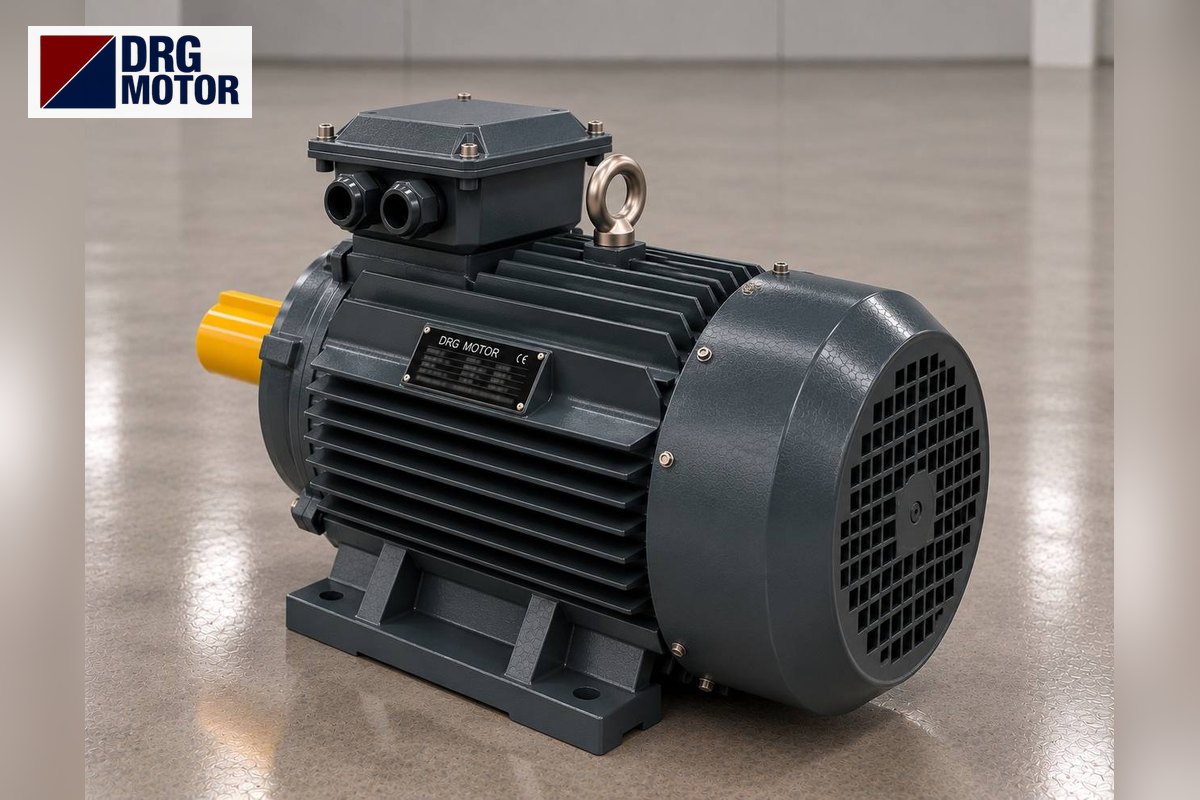

In a hazelnut skin removal machine, the motor turns a friction chamber in which kernels arriving warm from the roaster rub against each other and against a rough surface; on most machines a second motor drives the fan that draws away the loosened skins. Before power, the deciding factor is rotor speed, which is set by the motor's pole count together with the pulley or gearbox ratio. The second critical point is how the motor is fixed to the machine: a foot-mounted motor on a sliding base with a belt, or a flange motor sitting on a gearbox.
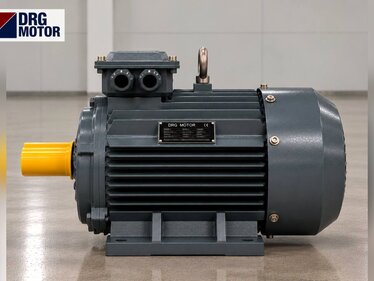
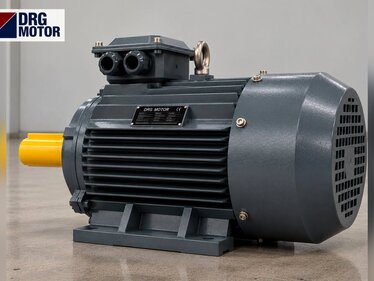
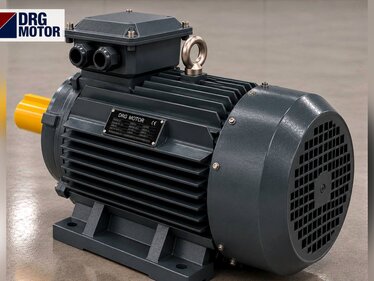
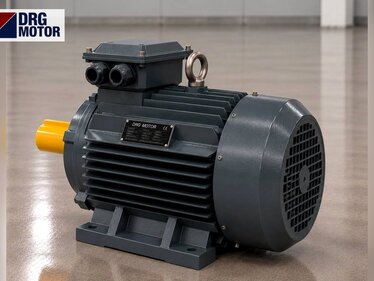
DRG Motor is a manufacturer, supplier and seller of electric motors; the three-phase asynchronous IEC motors for the rotor and fan drives of a skinning machine are listed in the online shop. For other food machines such as crackers, graders and packers see food machine motors, and for the roaster the kernels pass through before skinning see nut roasting machine motors. This article covers only the skin separation stage.
Power figures call for caution: on small workshop machines the rotor motor is often around 1 kW, while line machines handling tonnes of hazelnuts per hour may use several kW. The exact value is on the machine builder's nameplate and catalogue; the calculations below are examples.
How the Skin Comes Off: Friction Chamber and Air Flow
Roasting dries the hazelnut skin and makes it brittle, weakening the bond between skin and kernel. As the nuts cool and pick up moisture, the skin becomes flexible again and is harder to strip. That is why the skinning machine sits directly behind the roaster, often combined with the cooling section.
The friction chamber varies between machines. A common layout is a paddle or brush rotor turning inside a horizontal casing; the rotor stirs the mass of nuts and the skins fall off as the kernels rub together. In another layout a perforated or rubber-lined cylinder rotates and the skins drop through the holes. Some machines pass the nuts between two soft surfaces with an adjustable gap.
The detached skin is very light. The fan draws air from the top of the chamber or the outlet and carries the skins into a duct and cyclone, while the clean kernels leave over a weir or through an outlet gate. The machine therefore carries two different loads: the rotor that moves the mass of nuts and the fan that moves the air.
Rotor Speed: Too Fast Means Splits, Too Slow Means Skins Left On
The goal is to remove the skin without splitting the kernel or scratching its surface. If the rotor or cylinder turns too fast, kernels hit the paddles hard, the share of halves rises and friction heat can bring oil to the surface. If it turns too slowly, the skin stays on and the nuts are fed through a second time.
What stresses the kernel is not rotor speed itself but the peripheral speed of the paddle tip: v = π · D · n / 60. The table shows how motor and pulley choice change this speed on a rotor assumed to be 250 mm in diameter (example values; pulley speed n2 = n1 · d1 / d2):
| Motor | Pulleys (motor/rotor) | Rotor speed | Peripheral speed |
|---|---|---|---|
| DRG-90S-4 (1445 rpm) | 90 / 300 mm | 433.5 rpm | 5.67 m/s |
| DRG-90S-4 (1445 rpm) | 100 / 300 mm | 481.7 rpm | 6.31 m/s |
| DRG-90S-4 (1445 rpm) | 80 / 320 mm | 361.2 rpm | 4.73 m/s |
| DRG-802-2 (2880 rpm) | 90 / 300 mm | 864 rpm | 11.31 m/s |
The last row shows the most common mistake: when a burnt-out 4-pole motor is replaced by a 2-pole motor of the same power, the rotor runs twice as fast even with unchanged pulleys. The rise in split kernels is usually noticed in the first batch. To work with your own pulley diameters, use the pulley and belt calculator.
Torque matters too. For the 1.1 kW and 433.5 rpm in the example, rotor shaft torque is 9550 × 1.1 / 433.5 ≈ 24.2 Nm. If the feed suddenly increases or nuts pile up in the chamber, this torque rises; the starting torque ratio Ts/Tn of the DRG-90S-4 is 2.3, but a lasting overload will trip the overload relay.
Click to see current electric motor prices and order nowSEE PRICES →
The Fan Motor: Air That Carries the Skins
The fan load behaves differently from the rotor: required power changes with the cube of speed. On most machines the impeller is mounted directly on the motor shaft and the motor is 2-pole. A damper or air flap sets the flow; too much air carries small and broken kernels into the cyclone with the skins, too little leaves skins among the nuts.
Example (assumption): for 0.4 m³/s flow, 1500 Pa pressure difference and a fan efficiency of 0.6, shaft power P = Q · Δp / η ≈ 1.0 kW. The 1.1 kW DRG-802-2 (2880 rpm, 2.31 A at 400 V) covers this with a small margin; if the damper will run fully open, the next power size should be considered.
If a 4-pole motor replaces a 2-pole fan motor, fan speed falls to about half (1445 / 2880 ≈ 0.50) and fan power to roughly one eighth; the skins flow to the outlet with the kernels. The reverse, a 2-pole motor on a 4-pole fan, overloads the motor and pushes the impeller above its design speed. Always replace a fan motor with the speed on the old nameplate.
How the Motor Is Fixed: Feet, Sliding Base and Flange
On most rotor-type skinning machines the motor is foot-mounted (B3) and sits on a sliding base used to tension the belt. On replacement, shaft height, foot holes and shaft diameter must match the old motor; otherwise the base has to be redrilled or the pulley bush changed. Dimensions from the DRG catalogue:
| Frame | Foot holes A × B | Shaft height H | Shaft D × E |
|---|---|---|---|
| 80 (DRG-802-4) | 125 × 100 mm | 80 mm | 19 × 40 mm |
| 90S (DRG-90S-4) | 140 × 100 mm | 90 mm | 24 × 50 mm |
| 90L (DRG-90L-4) | 140 × 125 mm | 90 mm | 24 × 50 mm |
One detail to watch: frames 90S and 90L share shaft size and height, but the foot hole distance B grows from 100 mm to 125 mm. Moving from 1.1 kW to 1.5 kW may mean drilling new holes in the base.
On cylinder-type and low-speed machines the motor is flanged to a gearbox input. On frames 80 and 90 the B5 large flange dimensions are P 200 / M 165 / N 130 mm, with hole diameter S 12 mm. Small-flange (B14) dimensions are confirmed at order. DRG does not sell gearboxes; it supplies the motor that fits the existing gearbox input.
- Nameplates of the rotor and fan motors: power, speed, voltage, current
- Pulley diameters and belt type on the rotor drive; gearbox ratio and input flange if fitted
- Shaft diameter and length (D × E), key width
- Foot hole distance A × B and shaft height H
- How the fan impeller is fixed to the shaft: hub, key, clamping bush
- Terminal box orientation and cable slack for the sliding base movement
- Supply: 230/400 V up to 3 kW, 400/690 V from 4 kW
Skin Dust, Roasting Heat and Motor Life
The skin is thin and oily; whatever escapes the fan duct sticks to the motor's fan cover and fins. When the cover grille clogs, a motor with IC411 cooling cannot draw its own air and runs hot. The IP55 housing keeps dust out, but keeping the outside of the cover clean is the user's job. Skin deposits are also combustible, so cleaning the cyclone and ducts matters for machine safety as well.
Hazelnuts reach the skinning machine warm and the chamber is warmer than the room. The motor stays outside this chamber; the air around it should not exceed the −15…+40 °C range for which DRG motors are rated. Do not place the motor above the roaster's hot air outlet.
Why does the motor trip?
Common causes on a skinning machine are overfeeding, nuts piling up in the chamber, a slack belt slipping and a clogged fan cover. Before buying a new motor, measure the current under load: the rated current of the 1.1 kW DRG-90S-4 is 2.48 A at 400 V, and of the 0.75 kW DRG-802-4 1.75 A.
DRG Motors Suited to Hazelnut Skinning Machines
Four-pole 0.75–1.5 kW models for the rotor drive and a two-pole 1.1 kW model for the skin fan, all aluminium-housed and available foot or flange mounted for small and mid-size machines.
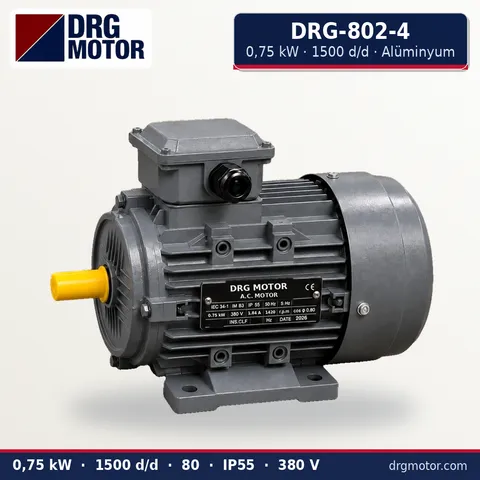
0.75 kW Three-Phase Motor 1500 rpm – DRG-802-4 Aluminium
- 0.75 kW · 1500 rpm (4 poles)
- Aluminium frame · IEC 80
- Mounting: B3 · B5 · B14 · B35
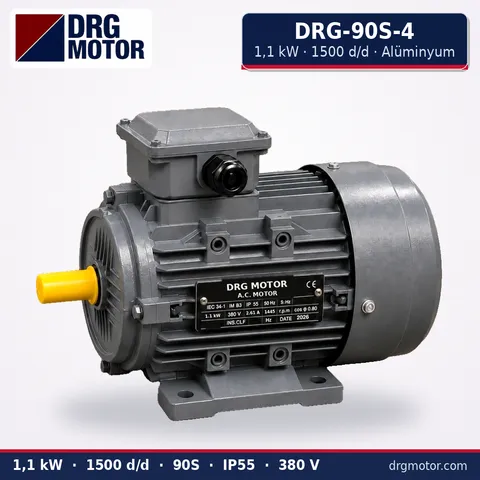
1.1 kW Three-Phase Motor 1500 rpm – DRG-90S-4 Aluminium
- 1.1 kW · 1500 rpm (4 poles)
- Aluminium frame · IEC 90S
- Mounting: B3 · B5 · B14 · B35
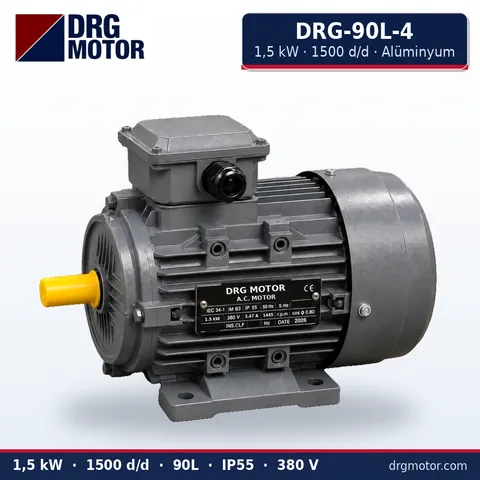
1.5 kW Three-Phase Motor 1500 rpm – DRG-90L-4 Aluminium
- 1.5 kW · 1500 rpm (4 poles)
- Aluminium frame · IEC 90L
- Mounting: B3 · B5 · B14 · B35
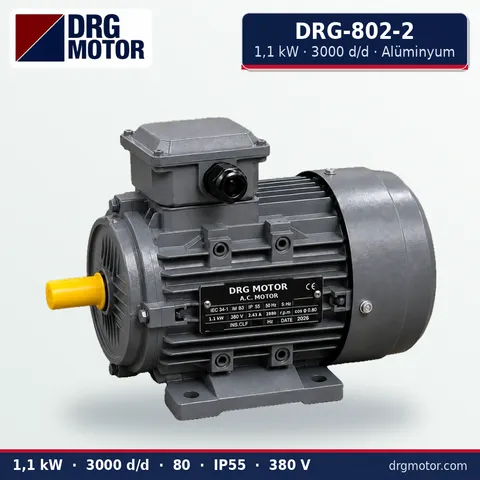
1.1 kW Three-Phase Motor 3000 rpm – DRG-802-2 Aluminium
- 1.1 kW · 3000 rpm (2 poles)
- Aluminium frame · IEC 80
- Mounting: B3 · B5 · B14 · B35
Click to see current prices and order these motors nowSEE PRICES →
Hazelnut Skinning Machine Motor: Frequently Asked Questions
What power should a hazelnut skinning machine motor have?
It depends on the machine's capacity and how many motors it carries. On small machines the rotor motor is usually around 1 kW, on line machines it may be several kW; the fan has its own motor. Replace a burnt-out motor with the power and speed on its nameplate.
Why are hazelnuts splitting in the skinning machine?
The usual causes are a rotor turning too fast (wrong pole count or changed pulleys), nuts that have cooled and hardened, and a reduced gap between paddles and casing. If the motor was changed, first compare its rated speed with the old one.
Should the rotor motor be 2-pole or 4-pole?
The same as the old motor. If the pulleys were sized for a 4-pole motor, a 2-pole motor doubles rotor speed. For a new machine design, a 4-pole motor with a suitable pulley ratio is a common starting point for the rotor.
The skin fan motor burnt out — must the new one have the same speed?
Yes. If fan speed changes, both air flow and motor load change; at low speed the skins are not separated, at high speed the motor is overloaded. Check the shaft diameter and key size for the impeller fixing as well.
For a quotation, send photos of the rotor and fan motor nameplates, their power and speed, mounting type (foot/flange), shaft size and the machine's pulley or gearbox details via WhatsApp, or add the chosen models to the quote list. Phone: +90 (542) 666 11 11 · e-mail: info@drgmotor.com · contact page. All models are in the electric motor online shop.