English
 Le français
 Türkçe




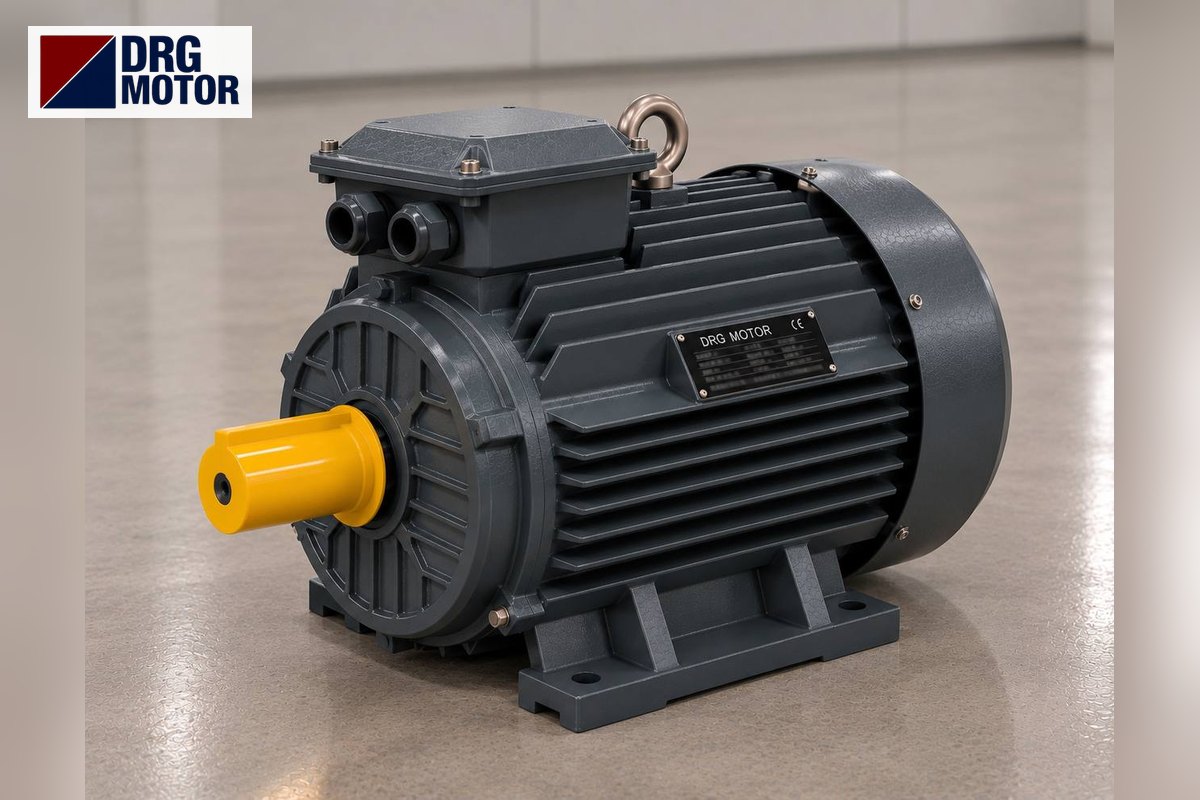

In a fruit puree machine (pulper or finisher) the motor turns a paddle rotor inside a perforated cylindrical screen. The main factor setting the power is the consistency of the product: watery, soft fruit needs a few kW, while fibrous, stony or thick products demand a larger motor for the same screen diameter. Rotor speed, together with the screen hole size, decides puree yield and whether seeds and stones get broken.
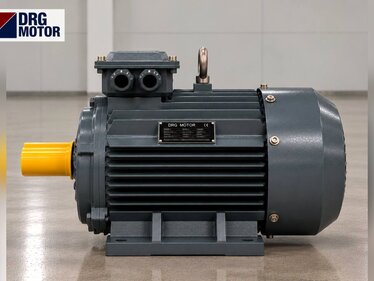
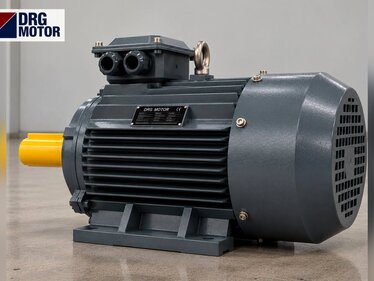
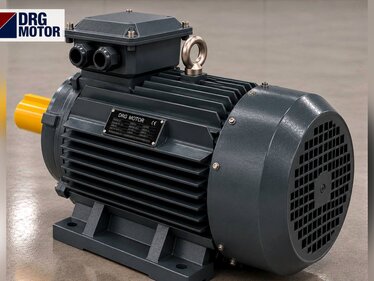
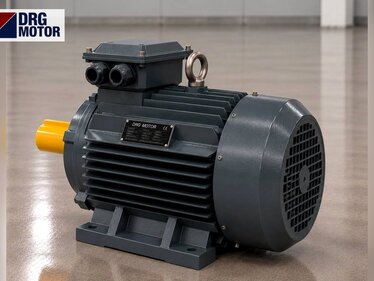
On these machines the drive is in most cases a three-phase, 4-pole unit with an aluminium or cast iron frame, linked to the rotor by belt and pulleys or by a coupling. DRG Motor is a manufacturer, supplier and seller of electric motors; browse the ratings that suit puree machines in the DRG online electric motor store. The binding kW value comes from the plate and documents of whoever built the machine.
What Does the Motor Do Inside a Pulper and Finisher?
Blanched or crushed fruit enters one end of a horizontal screen cylinder. The rotor paddles run a few millimetres from the screen surface at a slight angle; centrifugal action presses the product against the screen and forces puree through the holes. The paddle angle also pushes stones, skins and stalks axially towards the discharge. What passes the screen is puree, what leaves at the end is waste.
Most lines have two stages: a coarse-hole pulper removes stones and seeds, a fine-hole finisher refines the puree. Both machines use the same mechanism, but the finisher sees more friction on its fine screen and often draws more current at the same capacity. A juice press, by contrast, separates liquid from fibre and pomace; its load behaves differently and is covered on the fruit juice press motors page.
Consistency, Screen Holes and Rotor Speed
Motor load comes from friction on the screen and from accelerating the product. Torque rises as the product thickens, the holes get smaller and the paddle-to-screen gap narrows. A higher speed improves separation up to a point; beyond it the product heats up, foams, and broken seeds can turn the puree bitter. That is why machine builders recommend speed and gap by fruit type. The table below shows the general trend only.
| Product | Consistency | Rotor speed trend | Effect on the motor |
|---|---|---|---|
| Strawberry, raspberry, tomato | Watery, small seeds | Medium | Steady current |
| Apricot, peach, plum | Soft flesh, large stone | Low to medium | Sudden load if a stone jams |
| Apple, pear, quince | Fibrous, firm texture | Medium to high | High, constant torque |
| Banana, mango | Thick, sticky | Low | Highest current on fine screen |
In practice the same machine handles several fruits over a season. Size the motor for the heaviest product on the finest screen; a motor chosen only for soft fruit will trip its overload in the apple or banana season.
Click to see current electric motor prices and order nowSEE PRICES →
Setting Rotor Speed with Pulleys: Worked Example
With a belt drive, rotor speed is set by the pulley diameters: n2 = n1·d1/d2. The values below are an example and assumptions; use your own machine's pulley sizes and the builder's recommended speed.
- Motor: DRG-132S-4, 5.5 kW, 1460 rpm, rated torque 36.0 Nm.
- Pulleys: motor 125 mm, rotor 180 mm → n2 = 1460·125/180 ≈ 1014 rpm.
- Paddle tip speed: assuming a 400 mm rotor diameter, v = π·0.4·1014/60 ≈ 21.2 m/s.
- Torque on the rotor shaft: at full motor load about 9550·5.5/1014 ≈ 51.8 Nm (belt losses ignored).
- With a 140 mm motor pulley: n2 ≈ 1136 rpm, paddle tip ≈ 23.8 m/s; at the same feed rate the power demand rises, so measure the current.
Reaching the same rotor speed with the 2-pole DRG-132S1-2 (2930 rpm) needs a ratio of about 1:2.9; the rotor pulley grows and the belt wrap angle shrinks. That is why 4-pole motors are more common on pulpers, while 2-pole motors appear mostly on high-speed finishers with small pulleys. Test other diameter pairs in our pulley and belt calculator.
Hot Product, Washdown and Where the Motor Sits
A puree line is washed with hot water and detergent at the end of each shift; the product often arrives hot and steam forms around the machine. The catalogue motors carry an IP55 rating, which means splashes during cleaning are tolerated; it does not mean a pressure gun may be aimed at the motor. Keeping the motor below the frame, behind the belt guard or under a protective cover is the right approach.
If the hygiene specification calls for a stainless washdown motor, a standard IEC frame does not satisfy it; a special motor has to be sourced, and what DRG can supply is the standard frame only. On a motor cooled by its own fan (IC411), a fan cowl clogged with fibre and pomace overheats the winding, so the cowl must be cleaned during washdown too. Tight spaces next to a steam boiler where ambient temperature exceeds +40 °C are not suitable for the motor.
What to Check Before Replacing the Motor
Pulper motors usually sit foot-mounted (B3) on a belt-tensioning slide; on some machines the motor is flange-mounted (B5) to a bearing housing or the frame. Even at the same kW rating the frame length may differ, so check the dimensions.
- kW, rpm and winding voltage on the plate: models of 3 kW and below are wound 230/400 V, from 4 kW upwards 400/690 V and connected in delta on a 400 V supply.
- Shaft diameter and length: 28×60 mm on frame 112M, 38×80 mm on frames 132S/132M.
- Foot hole spacing and shaft height; whether the motor lines up with the belt on the slide.
- Pulley diameters, belt type and number; if possible, rotor speed measured with a tachometer.
- The heaviest fruit processed and the finest screen used; the current measured with that product.
- Overload setting, direction of rotation (the paddle angle depends on it) and a clean fan cowl.
For the other stations of a puree line (washing, crushing, conveyors), look at food machine motors.
DRG Motors Suited to Fruit Puree Machines
The 4-pole models cover the 4 kW to 7.5 kW range common on pulpers and finishers; a 2-pole option is listed for high-speed finishers with small pulleys.
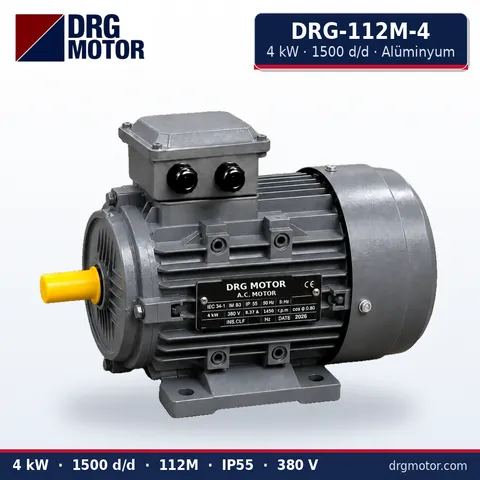
4 kW Three-Phase Motor 1500 rpm – DRG-112M-4 Aluminium
- 4 kW · 1500 rpm (4 poles)
- Aluminium frame · IEC 112M
- Mounting: B3 · B5 · B14 · B35
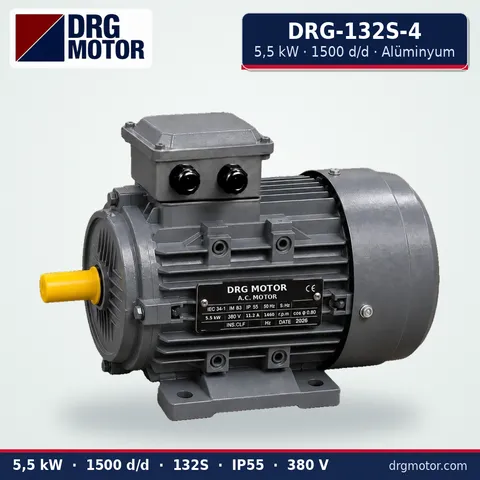
5.5 kW Three-Phase Motor 1500 rpm – DRG-132S-4 Aluminium
- 5.5 kW · 1500 rpm (4 poles)
- Aluminium frame · IEC 132S
- Mounting: B3 · B5 · B14 · B35
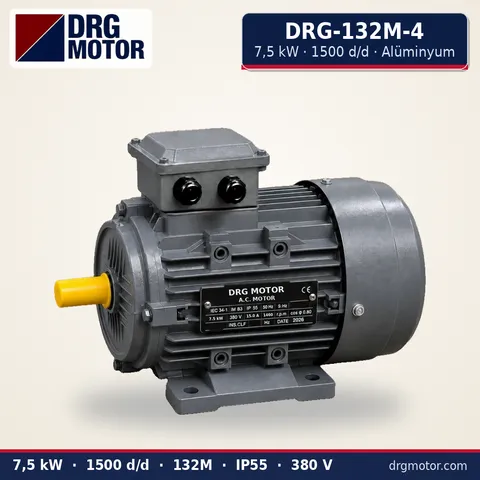
7.5 kW Three-Phase Motor 1500 rpm – DRG-132M-4 Aluminium
- 7.5 kW · 1500 rpm (4 poles)
- Aluminium frame · IEC 132M
- Mounting: B3 · B5 · B14 · B35
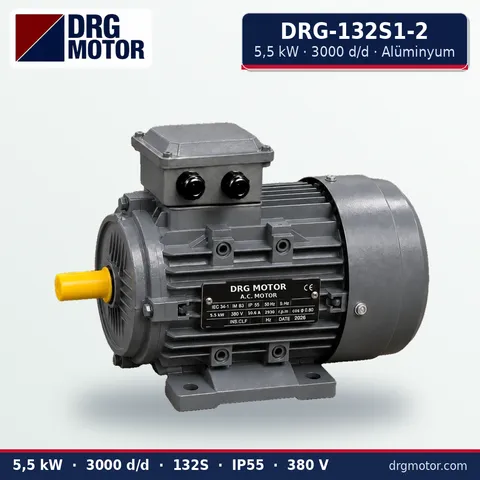
5.5 kW Three-Phase Motor 3000 rpm – DRG-132S1-2 Aluminium
- 5.5 kW · 3000 rpm (2 poles)
- Aluminium frame · IEC 132S
- Mounting: B3 · B5 · B14 · B35
Click to see current prices and order these motors nowSEE PRICES →
Fruit Puree Machine Motor: Common Questions
How fast should the motor of a fruit puree machine run?
The motor itself is usually 4-pole (about 1450 rpm); rotor speed is set by the pulley ratio. The right rotor speed depends on the fruit and the screen hole size, and the machine builder's recommendation applies.
Why does the pulper motor trip when processing apples?
Apple and quince are fibrous, so friction on the screen rises; with a fine screen and a narrow paddle gap the torque goes up. Check the feed rate, the paddle-to-screen gap and the current. If the current stays above the nameplate value, the motor is too small for that product.
Can the same motor be used for the pulper and the finisher?
The mechanism is the same, but the finisher's fine screen imposes more load. The same frame size may be chosen, but confirm the power against each machine's own nameplate.
Can a puree machine motor withstand washdown?
Splashed rinse water is not a problem; pressure jets and foaming chemicals must not be aimed at the motor, which should be shielded by a cover. If a stainless hygienic frame is mandatory, a special motor is needed instead of a standard one.
To pin down the motor for your pulper, photograph its plate and message us on WhatsApp with the kW, speed, whether it is foot- or flange-mounted, the shaft diameter, both pulley diameters and the fruit you run; or add the items to the quote list on the site. You can also call +90 (542) 666 11 11, write to info@drgmotor.com or use the contact form. Every power and speed option is open in the DRG motor store.