English
 Le français
 Türkçe




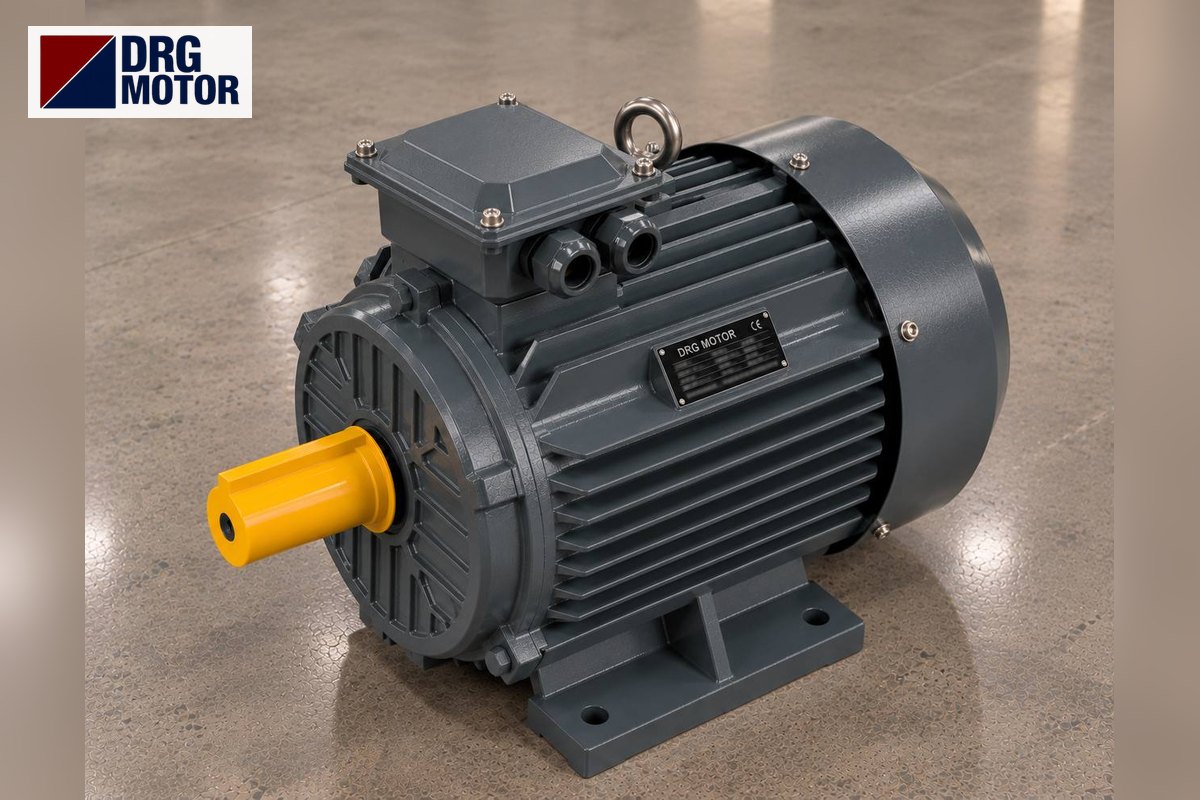

On a fermentation tank, the agitator motor turns the impeller inside the vessel through a gearbox, at the same rhythm for days on end. What decides the motor is not the momentary load but the heaviest operating point, reached when aeration stops or the broth thickens, and the speed range the inverter will cover. In an aerated tank the impeller draws noticeably more power once the gas is shut off. The motor is sized for that case, and the speed is then set by the inverter to the value the process needs.
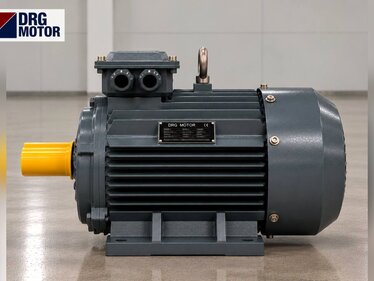
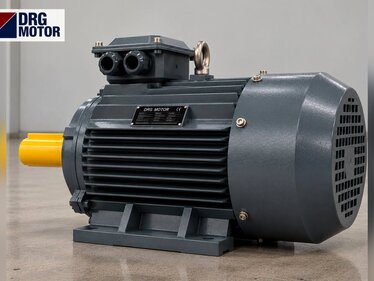
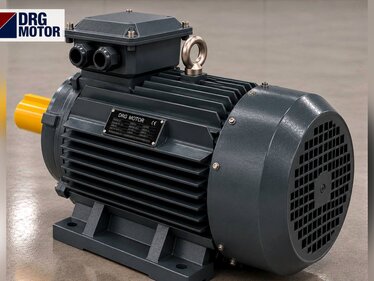
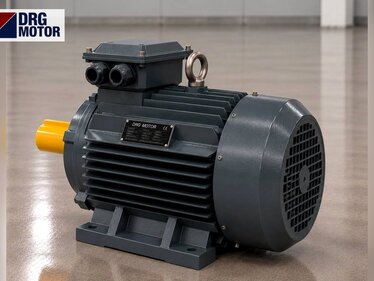
DRG Motor is a manufacturer, supplier and seller of electric motors. Three-phase asynchronous IEC motors for the gearbox input of a fermenter agitator can be selected by power and speed in the online electric motor store. DRG does not sell gearboxes, inverters or stainless hygienic motors; it supplies the standard motor that fits your existing gearbox. For motors on helical and bevel helical gear units, see also electric motors for helical gearboxes.
Three Jobs of a Fermenter Agitator: Oxygen, Heat and Suspension
In industrial fermentation with yeast, bacteria or mould, the agitator does three things at once. It breaks the air fed through the bottom ring (sparger) into small bubbles so that oxygen dissolves in the broth. It carries liquid to the wall so that cooling water in the jacket or coil can remove heat from the whole volume. It keeps cells and solid nutrients from settling.
In top-entry designs the motor and gearbox stand vertically on a bridge over the tank lid; a long shaft goes down and carries one or several impeller stages. The parts in contact with the product are the shaft, the impellers and the mechanical seal; the motor stays outside the product zone. This is why a standard IP55 motor can be used even on sterile tanks: hygiene is handled on the seal and shaft side.
Finding Shaft Power: Power Number and the Gassed–Ungassed Gap
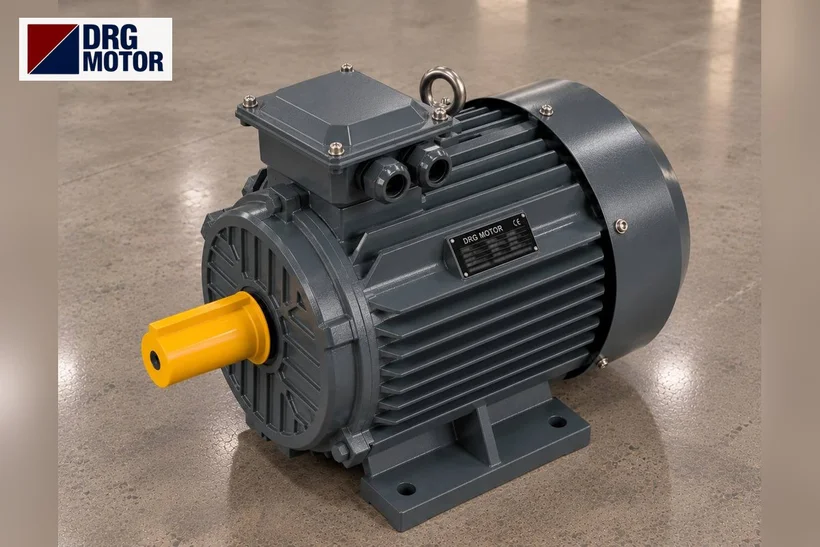
In turbulent flow the power drawn by an agitator is P = Np · ρ · n³ · D⁵, where Np is the impeller power number, ρ the liquid density (kg/m³), n the speed (rev/s) and D the impeller diameter (m). The cube and the fifth power show how fast power changes with a small change in speed or diameter.
Worked example
Assumption: radial disc turbine, Np = 5 (ungassed), ρ = 1020 kg/m³, D = 0.5 m. With a 1450 rpm motor and gearbox ratio i = 10 the impeller turns at 145 rpm and the shaft power is about 2.25 kW. Using a 0.95 factor for gearbox losses, about 2.37 kW is needed at the motor, so a 3 kW 4-pole DRG-100L2-4 (1450 rpm, rated torque 19.8 Nm) is a reasonable choice. The figures are an example; actual impeller and tank data must come from the machine builder.
Why does the motor work harder when the air is cut?
Bubbles form gas cavities behind the impeller blades and reduce the power the blade transfers to the liquid. The current measured with aeration on is therefore misleading. If the air is closed during sterilisation, inoculation or a fault, power rises to the ungassed value. Do not downsize the motor to the current measured during aerated operation; select it for the ungassed value.
Click to see current electric motor prices and order nowSEE PRICES →
Speed Control by Inverter: Power and Torque per Frequency
In fermentation, oxygen demand grows as the cells multiply. Many plants therefore raise and lower agitator speed with an inverter, linked to the dissolved oxygen reading. The table below was calculated in python for the example tank above, with 145 rpm at 50 Hz.
| Frequency | Impeller speed | Shaft power | Load torque (impeller) |
|---|---|---|---|
| 50 Hz | 145 rpm | 2.25 kW | 148 Nm |
| 45 Hz | 130.5 rpm | 1.64 kW | 120 Nm |
| 40 Hz | 116 rpm | 1.15 kW | 95 Nm |
| 30 Hz | 87 rpm | 0.49 kW | 53 Nm |
Because power falls with the cube of speed, the motor has an easier time at low frequency. The other direction is riskier: if the same tank is taken to 60 Hz, the impeller turns at 174 rpm and shaft power rises to about 3.89 kW, overloading a 3 kW motor. If running above 50 Hz is needed, choose the motor one size larger. To repeat the calculation with your own ratio, use the gearbox output calculator.
Fermentations that thicken
In cultures producing polysaccharides such as xanthan, or where mould mycelium grows, the broth thickens as the batch progresses. As flow approaches laminar, power no longer falls with the cube of speed and high torque is needed at low speed too. The fan on the motor's own shaft (IC411 cooling) may then be insufficient at low frequency; the need for separately driven cooling should be discussed before ordering.
Long Batches: Heat, Steam and Bearing Life
A batch can last from a few days to several weeks, and the agitator turns without stopping all that time. In long uninterrupted operation the motor must stay below its nameplate current, and the overload relay must be set to that current. With few starts, starting stress is not the issue; winding temperature and bearing grease life are.
The surroundings also affect the motor. During sterilisation in place (SIP) the tank is heated with steam, and during cleaning in place (CIP) hot solution circulates; the air above the lid becomes hot and humid. DRG motors are meant for air temperatures between −15 and +40 °C, below 1000 m altitude. If the temperature measured on the lid bridge exceeds this limit, ventilation or a protective cover is needed. In areas cleaned with hoses, keep the motor out of the direct jet; IP55 covers rain and splashes, not pressure washing.
Flange, Shaft and Coupling Checks When Replacing the Motor
On top-driven fermenters the motor usually sits on the gearbox input lantern with a B5 large flange and runs vertically with the shaft pointing down. The new motor's flange must match the old one exactly. According to DRG catalogue B5 dimensions, frame 90 has flange outer diameter P 200 mm, bolt circle M 165 mm, spigot N 130 mm and shaft 24×50 mm; frames 100 and 112 have P 250 mm, M 215 mm, N 180 mm and shaft 28×60 mm. B14 small flange dimensions are confirmed at order.
Checklist before replacement:
- Old motor nameplate: kW, speed, voltage and connection (Δ/Y)
- Flange type (B5/B14), flange outer diameter and spigot diameter
- Shaft diameter × length, key width, shaft end thread
- Vertical mounting direction: shaft down or up
- Gearbox ratio and the inverter's maximum frequency setting
- Current measured with aeration off (if available)
- Ambient temperature above the lid and the cleaning method
If the shaft diameter differs, the coupling or hub at the gearbox input changes. Also measure the frame length (L) and check that it fits the space on the bridge.
DRG Motors Suited to Fermentation Tank Agitators
The list covers motors for gearbox inputs, from small pilot tanks to medium production fermenters; the two 6-pole models are for gear units that require a lower input speed.
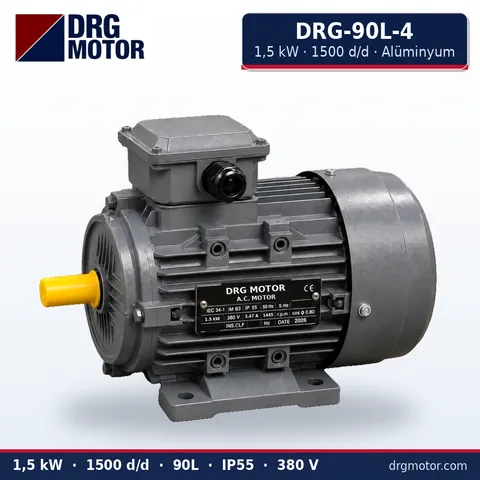
1.5 kW Three-Phase Motor 1500 rpm – DRG-90L-4 Aluminium
- 1.5 kW · 1500 rpm (4 poles)
- Aluminium frame · IEC 90L
- Mounting: B3 · B5 · B14 · B35
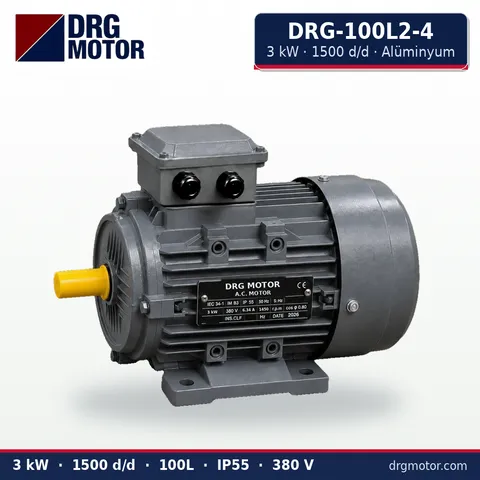
3 kW Three-Phase Motor 1500 rpm – DRG-100L2-4 Aluminium
- 3 kW · 1500 rpm (4 poles)
- Aluminium frame · IEC 100L
- Mounting: B3 · B5 · B14 · B35
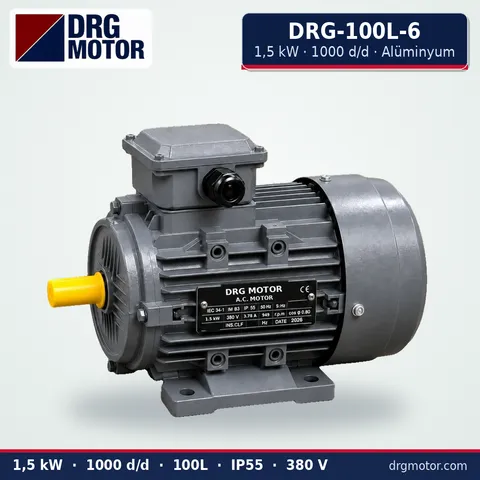
1.5 kW Three-Phase Motor 1000 rpm – DRG-100L-6 Aluminium
- 1.5 kW · 1000 rpm (6 poles)
- Aluminium frame · IEC 100L
- Mounting: B3 · B5 · B14 · B35
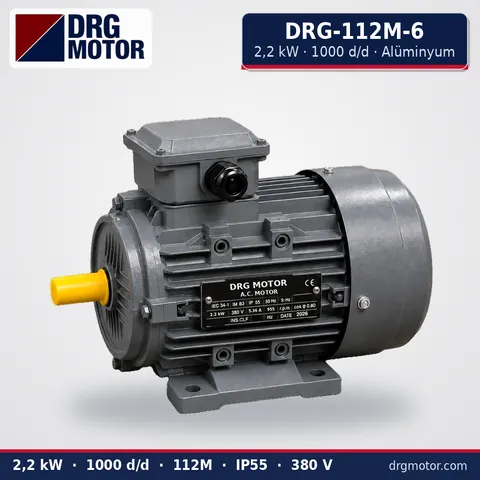
2.2 kW Three-Phase Motor 1000 rpm – DRG-112M-6 Aluminium
- 2.2 kW · 1000 rpm (6 poles)
- Aluminium frame · IEC 112M
- Mounting: B3 · B5 · B14 · B35
Click to see current prices and order these motors nowSEE PRICES →
Fermenter Agitator Motor: Common Questions
How fast should a fermenter agitator rotate?
It depends on tank volume, impeller diameter and the culture's oxygen demand; impeller speed is set by the gearbox ratio and the inverter. In the example above, a 1450 rpm motor with i = 10 turns the impeller at 145 rpm. The exact value is the machine builder's data.
Should a fermenter use a 4-pole or a 6-pole motor?
Keep the pole number that matches the existing gearbox input speed. Switching from 4 to 6 poles or the reverse changes impeller speed; since power changes with the cube of speed, the motor either overloads or oxygen transfer drops.
Is a stainless motor required on a sterile fermenter?
Not when the drive is on top: the motor sits above the lid and the sterile barrier is the mechanical seal around the shaft. A conventional IP55 motor is enough; the DRG range has no stainless or hygienic motors anyway.
Will mixing speed up if I run the inverter at 60 Hz?
The impeller turns faster, but shaft power rises with the cube of speed; in the example tank it reaches about 3.89 kW at 60 Hz. A 3 kW motor is then overloaded and runs hot.
Send a photo of the motor nameplate, its power and speed, whether it is flange or foot mounted, the shaft size and the gearbox ratio together with tank details via WhatsApp, or request a quote through the quote list. Phone: +90 (542) 666 11 11 · e-mail: info@drgmotor.com · contact. All power and speed options are listed in the online store.