English
 Le français
 Türkçe




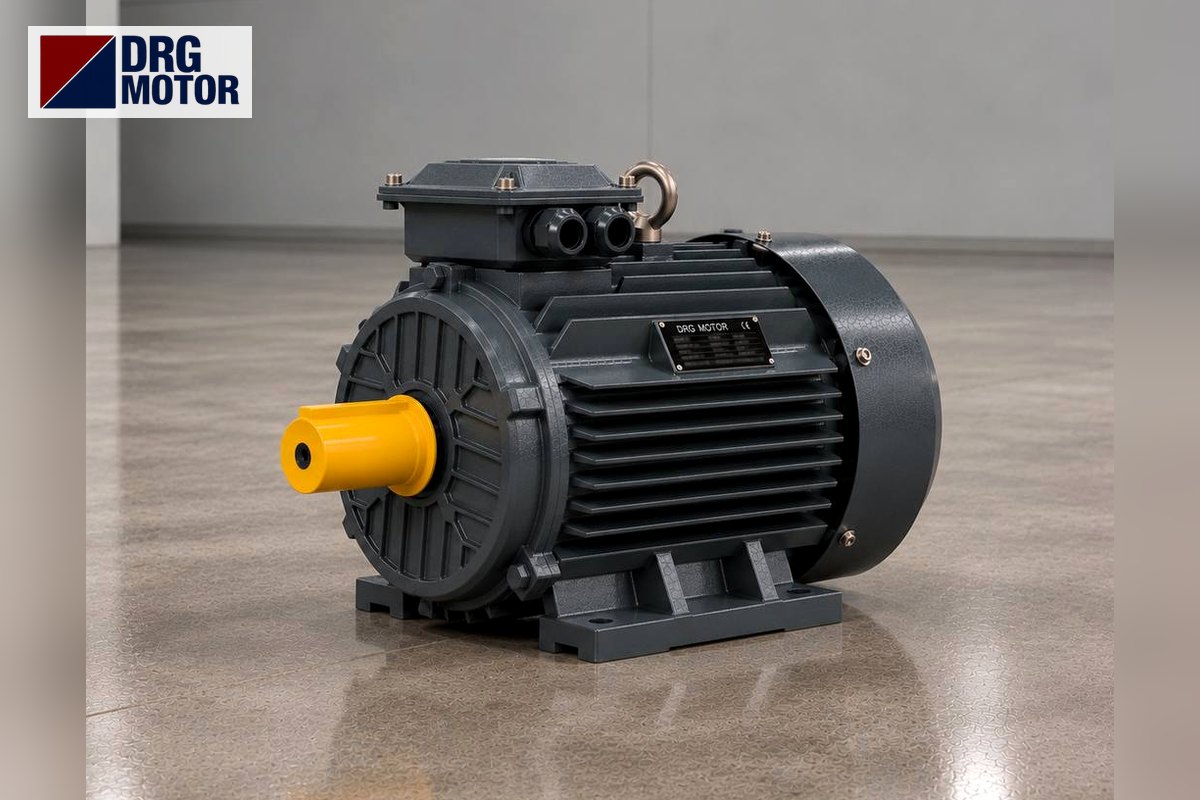

There is no single fixed figure for how many decibels a three-phase electric motor "should" produce; the noise level depends on power, speed and housing type. In practice the running noise of small and medium three-phase asynchronous motors stays around 55–80 dB(A) at 1 metre. The exact value is always defined by the motor nameplate and catalogue data.
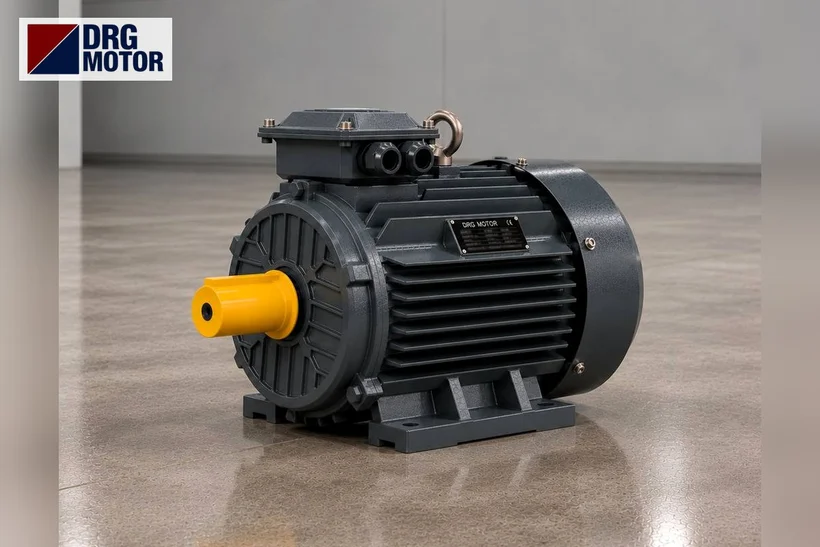
DRG Motor is a manufacturer, supplier and seller of electric motors. You can review every three-phase model across different powers and speeds in the online motor shop, and see the same motors grouped in the three-phase asynchronous electric motors category.
Sound power or sound pressure? What does dB mean?
To read noise correctly, two quantities must be separated. Sound power level (Lw) describes the total acoustic energy the motor radiates as a source and is independent of distance. Sound pressure level (Lp) is the value heard at a given point (usually 1 metre away) and drops as distance grows. Catalogues mostly give sound pressure in dB(A); the (A) means the measurement is weighted to the sensitivity of the human ear.
The decibel is a logarithmic scale: each 3 dB increase roughly doubles the sound energy. So the gap between 68 dB(A) and 71 dB(A), small as a number, is a noticeable rise to the ear. When judging a motor's noise you also need to know at what distance and under what load the measurement was taken.
How does noise change with power and speed?
The general rule is clear: as power grows and speed rises, the noise level increases. Because the cooling fan turns with shaft speed, fan noise climbs markedly on high-speed motors. A 3000 rpm (2-pole) motor therefore usually runs louder than a 1500 rpm (4-pole) or 1000 rpm (6-pole) model of the same power. The table below shows, with approximate values, how noise rises with power in the 1500 rpm class; these are typical ranges that illustrate the order, not fixed figures.
| Power class | Speed class | Approx. sound pressure (1 m) |
|---|---|---|
| 4 kW | 1500 rpm (4-pole) | ~62–68 dB(A) |
| 7.5 kW | 1500 rpm (4-pole) | ~66–72 dB(A) |
| 11 kW | 1500 rpm (4-pole) | ~68–74 dB(A) |
| 4 kW | 3000 rpm (2-pole) | ~68–78 dB(A) |
The values in the table are only meant to show the trend. A motor's exact noise level varies with fan design, housing material (aluminium or cast iron), load condition and mounting surface. So whenever a binding figure is needed for a project, the nameplate and catalogue data of the specific model must be taken as the reference.
Click to see current electric motor prices and order nowSEE PRICES →
Typical behaviour in DRG three-phase models
The three-phase asynchronous motors in the DRG range are IP55 IEC housings cooled by their own fan (IC411). Since the same power is offered in different speed options, choosing a lower-speed pole class makes a clear difference when your application is noise-sensitive. For the same 4 kW power, for example:
| Model | Power / Speed | Rated current (400 V) | Note |
|---|---|---|---|
| DRG-112M-4 | 4 kW / 1500 rpm | 7.95 A | balanced, quieter |
| DRG-112M-2 | 4 kW / 3000 rpm | 7.45 A | faster, louder |
| DRG-132M-4 | 7.5 kW / 1500 rpm | 14.3 A | higher power |
| DRG-160M-4 | 11 kW / 1500 rpm | 20.4 A | larger housing |
As you can see, for noise you should first assess the speed class, then the power and the housing. To pick the motor most suitable for your need, consider power and speed together; instead of hunting for one "quietest" model, the lowest-speed option that still meets the application's speed and torque demand usually gives the best balance.
Abnormal noise is a sign of a fault
A healthy motor has a smooth, steady sound. If the character of that sound changes or a new noise appears, it is usually the herald of a fault. Common cases:
- Bearing noise: a metallic whine, hum or rhythmic ticking usually points to a worn or dry bearing.
- Fan / fan cowl: rubbing or rattling can come from a dirty or damaged fan or a loosened fan cowl.
- Looseness and vibration: loose foot bolts or fasteners resonate with the base and amplify the sound.
- Imbalance / coupling: coupling or pulley misalignment raises both vibration and noise.
When you notice abnormal noise, do not force the motor under load. If inspection or measurement is needed, first switch off the power, confirm it is de-energised, and have the work done by authorised electrical personnel. For bearing, lubrication or setting values, act according to the motor nameplate and the device documentation rather than a fixed number.
Practical tips to reduce motor noise
In most cases noise can be kept to a reasonable level by improving mounting and maintenance conditions:
- Fix the motor on a solid, flat and sufficiently heavy base with anti-vibration mounts to break resonance.
- If your application allows, choose a lower-speed (4- or 6-pole) model to cut fan noise from the start.
- Keep the fan cowl clean; blocked air channels raise both noise and temperature.
- Check coupling/pulley alignment periodically; misalignment is a leading cause of noise.
Send a photo of your current motor nameplate and we will find the suitable DRG model together.Send on WhatsApp
Once you have set the right power and speed class, you can compare all three-phase options and up-to-date information through the shop.
See three-phase asynchronous motor models and current prices by power and speed in the shopSEE PRICES
Frequently asked questions
How many dB should a three-phase motor normally be?
For small and medium three-phase asynchronous motors, roughly 55–80 dB(A) at 1 metre is a typical range. The exact value depends on power, speed and housing; for a binding figure check the nameplate and catalogue data of the specific model.
Why is a 3000 rpm motor louder?
Because the cooling fan turns with the shaft, fan noise rises as speed increases. A 2-pole (3000 rpm) model therefore usually runs louder than a 4- or 6-pole model of the same power.
What should I do if the motor noise suddenly rises?
A new or changed sound is usually a fault signal; the most common causes are bearings, fan and looseness. Do not force the motor; after switching off the power, leave inspection to authorised personnel.
Can I reduce noise with mounting?
Yes. Fixing on a solid base with anti-vibration mounts, a clean fan cowl and correct coupling/pulley alignment visibly lower the sound.
Electric Motors Related to This Topic — Models and Current Prices
Suitability is not decided by power alone: compare the speed, voltage, mounting, shaft and fixing dimensions of your machine with the product data; if unsure, send us the nameplate of your current motor.

4 kW Three-Phase Motor 1500 rpm – DRG-112M-4 Aluminium
- 4 kW · 1500 rpm (4 poles)
- Aluminium frame · IEC 112M
- Shaft: 28 × 60 mm
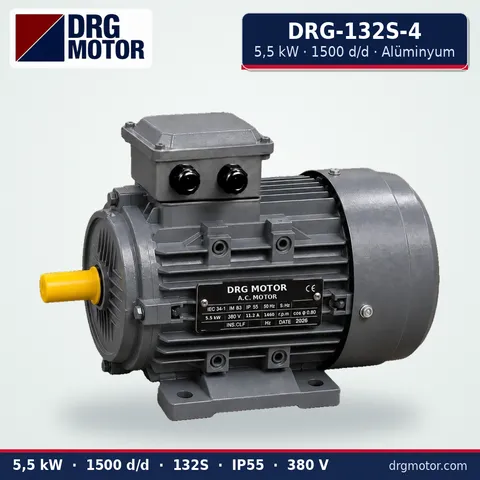
5.5 kW Three-Phase Motor 1500 rpm – DRG-132S-4 Aluminium
- 5.5 kW · 1500 rpm (4 poles)
- Aluminium frame · IEC 132S
- Shaft: 38 × 80 mm
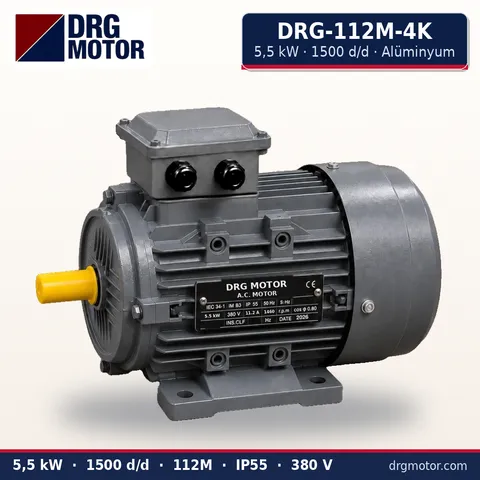
5.5 kW Compact Three-Phase Motor 1500 rpm – DRG-112M-4K Aluminium
- 5.5 kW · 1500 rpm (4 poles)
- Aluminium frame · IEC 112M
- Shaft: 28 × 60 mm
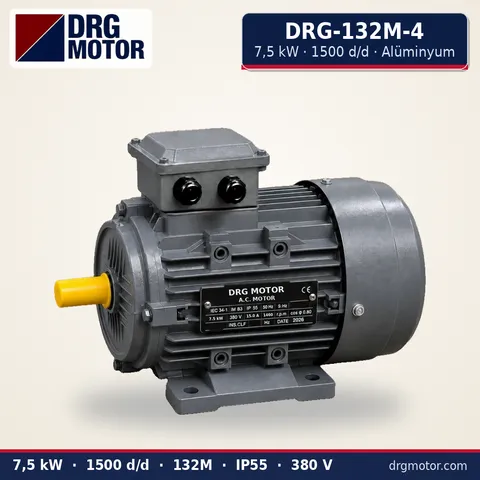
7.5 kW Three-Phase Motor 1500 rpm – DRG-132M-4 Aluminium
- 7.5 kW · 1500 rpm (4 poles)
- Aluminium frame · IEC 132M
- Shaft: 38 × 80 mm
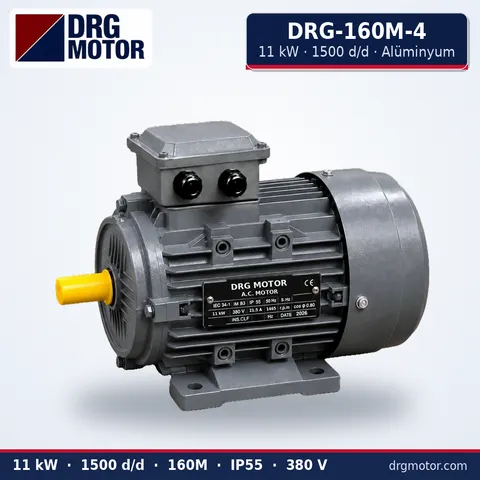
11 kW Three-Phase Motor 1500 rpm – DRG-160M-4 Aluminium
- 11 kW · 1500 rpm (4 poles)
- Aluminium frame · IEC 160M
- Shaft: 42 × 110 mm
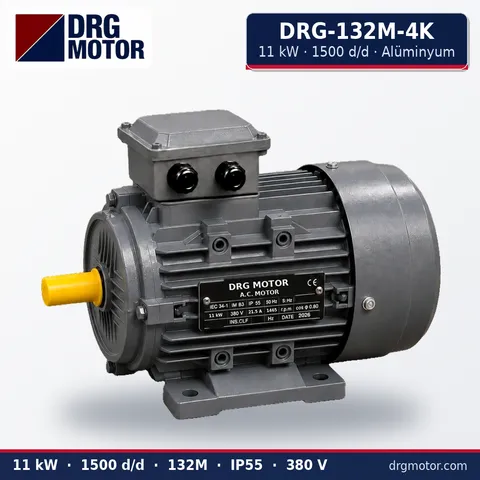
11 kW Compact Three-Phase Motor 1500 rpm – DRG-132M-4K Aluminium
- 11 kW · 1500 rpm (4 poles)
- Aluminium frame · IEC 132M
- Shaft: 38 × 80 mm