English
 Le français
 Türkçe




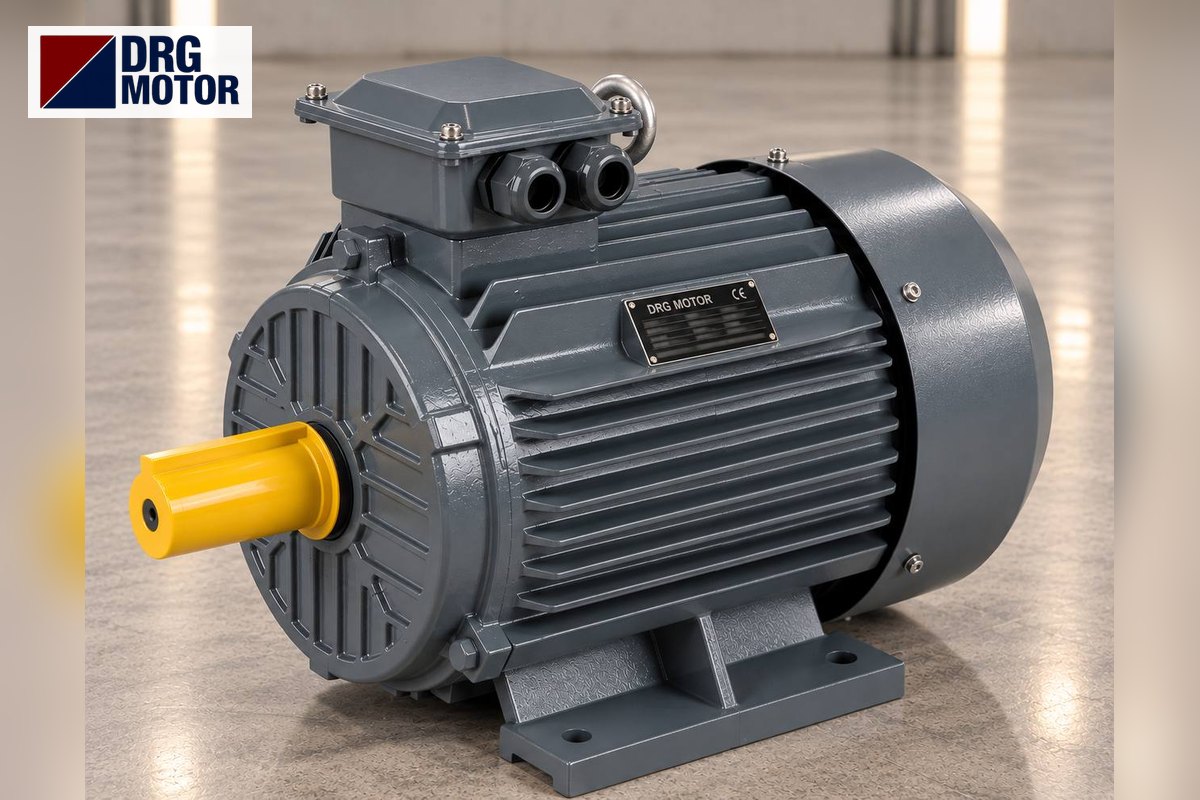

A cosmetic cream processing vessel has not one mixer motor but two very different drives. The homogeniser spins a rotor-stator head at high speed to split the oil and water phases into micron-scale droplets; the frame agitator turns the whole vessel slowly and its scrapers remove cream stuck to the wall. Speed and rotor tip speed decide the first motor; torque, which rises as the cream thickens, decides the second.
The two motors are therefore chosen separately: usually a 2-pole (3000 rpm) flanged motor for the homogeniser, and a 4- or 6-pole motor on a gearbox input for the frame agitator. Suitable three-phase motors for both are listed by power and speed on the buy electric motors online page.
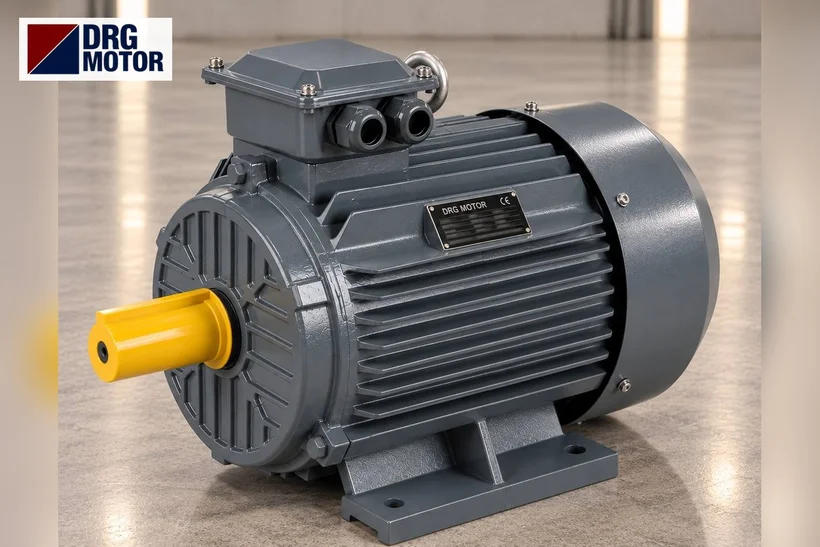
DRG Motor is a manufacturer, supplier and seller of electric motors. It does not supply the vessel, homogeniser head, gearbox or frequency inverter; it supplies the standard IEC induction motor to be fitted to the existing system.
Three Actions in a Vacuum Cream Vessel: Shearing, Scraping, Vacuum
A typical vacuum cream vessel is double-jacketed; hot water or steam in the jacket heats the phase, and cold water cools the emulsion. The oil and water phases are usually prepared in separate pre-mix tanks and drawn into the main vessel by vacuum. The homogeniser sits on top of or at the bottom of the main vessel; the frame agitator hangs from the lid on its own shaft.
The vacuum pump removes air from the vessel so that the cream does not foam or trap bubbles. The vacuum pump motor is also a standard three-phase motor and is assessed separately; see the vacuum pump electric motors page.
The batch runs like this: the heated phases are combined, the homogeniser runs at high speed for a short time to form the emulsion, then the frame agitator keeps turning the cream slowly while the vessel cools. The cream thickens markedly during cooling.
Comparing the Two Drives
Although they work in the same vessel, the loads on the two motors are opposites. The table sets out side by side what to look at:
| Feature | Homogeniser | Frame agitator |
|---|---|---|
| Task | Break up droplets | Turn the mass, scrape the wall |
| Motor speed class | 3000 rpm (2-pole) | 1000 rpm (6-pole) + gearbox |
| Deciding quantity | Rotor tip speed | Shaft torque |
| Load character | Rises with the fluid | Rises with thickness, high at start |
| Typical coupling | Flanged, vertical, direct | Flanged to gearbox input |
| Running time | Limited to minutes | Whole batch |
The homogeniser works in short, intense runs; the motor reaches full load within minutes and is then switched off. The frame agitator runs through the whole batch, including the cooling phase. When choosing a motor, this difference matters as much as power does for heating.
Click to see current electric motor prices and order nowSEE PRICES →
Homogeniser Motor: Rotor Tip Speed and Speed
In a rotor-stator head, the rotor teeth pass the slots of the fixed stator with a very small gap. The cream is subjected to high shear stress in this gap and the droplets break up. The yardstick is rotor tip speed: v = π·D·n/60.
Example (assumption): a 100 mm rotor turned at 2895 rpm by a directly coupled DRG-90L-2 motor reaches a tip speed of about 15.2 m/s. With a 120 mm rotor on the same motor, tip speed rises to 18.2 m/s; but the power drawn by the rotor also rises roughly with the fifth power of diameter, i.e. fast. So whenever a larger head is fitted, motor power must be rechecked.
The required tip speed and the head’s power demand are the homogeniser maker’s data; below 1 kW on small laboratory units, tens of kW on large production vessels. The exact value is on the head’s label or in its catalogue. The homogeniser motor is mostly flange-mounted on the vessel lid, vertically with the shaft pointing down; always state in the order that the flanged (B5) motor will run vertically.
Frame Agitator Motor: Torque in Thickening Cream
The frame agitator is a cage following the inner shape of the vessel, fitted with scraper blades of PTFE or a similar material. Because the scrapers rub against the wall, the motor overcomes this friction as well as the cream. As cooling progresses, the cream thickens and the torque needed at the same speed rises.
Example (assumption): a DRG-100L-6 motor (1.5 kW, 949 rpm) drives a gearbox with a ratio of 25. Output speed n2 = n1/i = 949/25 ≈ 38 rpm. Assuming a factor of 0.9 for gearbox losses, output shaft torque is about 9550·1.5·0.9/38 ≈ 340 N·m. On a 900 mm frame, this speed gives a peripheral speed of about 1.8 m/s.
If 340 N·m is not enough once the cream thickens, the motor is stepped up one size: the DRG-112M-6 (2.2 kW) gives about 495 N·m through the same gearbox. The gearbox’s permitted output torque and input flange must also suit this motor. You can repeat the calculation with the tools on the electric motor calculators page.
Hygiene, Humidity and Washing: The Motor’s Limits
Cosmetic production areas are kept clean and the outside of the vessel is wiped often. DRG motors are IP55; they withstand humidity and splashing, but they are not stainless or hygienic (washdown) housings and are not suited to pressure washing or direct washing with foaming chemicals. Product-contact surfaces are the vessel, shaft and head; the motor must stay outside this zone, above the lid.
Where a hygienic housing is mandatory, a special motor built for that purpose is needed instead of a standard IEC motor. For recipes that may create an explosive atmosphere, such as ethanol vapour, an Ex-protected special motor is needed; DRG does not offer these two motor types.
The motor cools by its shaft-mounted fan (IC411). On a lid close to jacket temperature, the fan inlet must not be covered and ambient temperature must not exceed +40 °C.
Flange and Shaft Checks When Replacing the Motor
On the homogeniser and the gearbox input, the motor is centred by its flange; any mismatch means the motor will not seat or the shaft will run off-axis. B5 large-flange dimensions from the DRG catalogue:
| Frame | Flange P / M / N | Hole S, LA | Shaft D×E |
|---|---|---|---|
| 90L (DRG-90L-2) | 200 / 165 / 130 mm | 4×12 mm, 12 mm | 24×50 mm |
| 100L (DRG-100L-2) | 250 / 215 / 180 mm | 4×14.5 mm, 13 mm | 28×60 mm |
| 112M (DRG-112M-6) | 250 / 215 / 180 mm | 4×14.5 mm, 14 mm | 28×60 mm |
B14 (small flange) dimensions are not in this table; if B14 is needed, dimensions are confirmed with the order.
- Which drive’s motor is being replaced: homogeniser, frame agitator or vacuum pump
- kW, speed and voltage on the nameplate; whether the motor runs on an inverter
- Flange outer diameter P, bolt circle M, spigot diameter N and number of holes
- Shaft diameter and length, key size; on the homogeniser, the coupling or shaft sleeve type
- Mounting position: vertical shaft down, or horizontal
- Gearbox ratio and the maximum input power the gearbox allows
- Hygiene and explosive-atmosphere conditions in the vessel area
For similar dairy and food machines, see also the pasteuriser and homogeniser electric motors page.
DRG Motors for Cream Vessel Drives
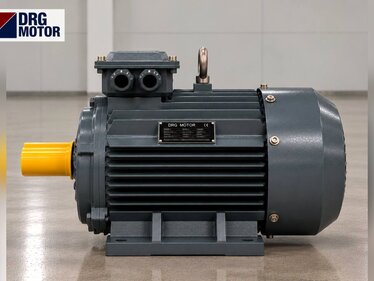
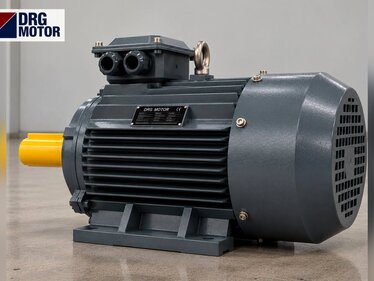
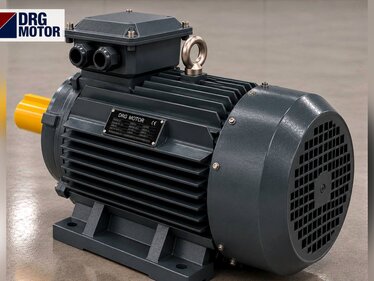
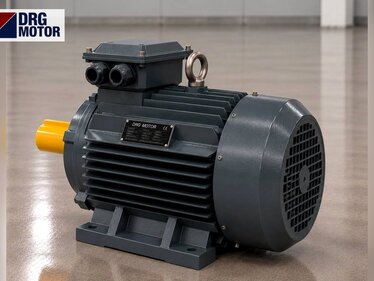
The first two 2-pole models suit the homogeniser head, the last two 6-pole models the frame agitator through a gearbox; all have aluminium housings and can also be ordered with a B5 flange.
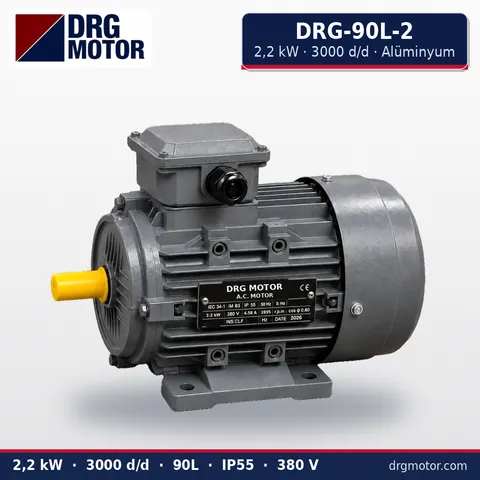
2.2 kW Three-Phase Motor 3000 rpm – DRG-90L-2 Aluminium
- 2.2 kW · 3000 rpm (2 poles)
- Aluminium frame · IEC 90L
- Mounting: B3 · B5 · B14 · B35
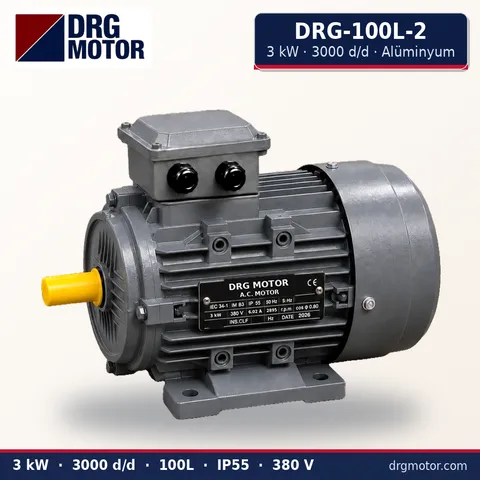
3 kW Three-Phase Motor 3000 rpm – DRG-100L-2 Aluminium
- 3 kW · 3000 rpm (2 poles)
- Aluminium frame · IEC 100L
- Mounting: B3 · B5 · B14 · B35
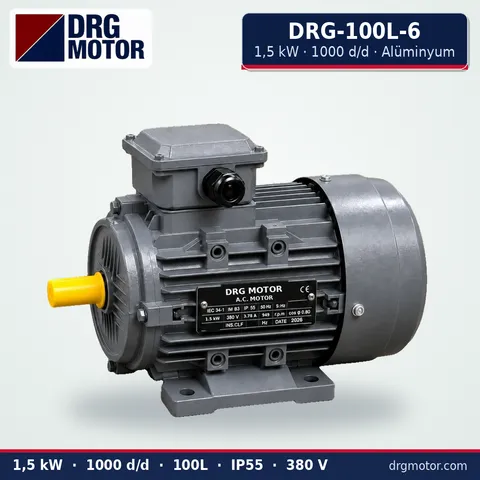
1.5 kW Three-Phase Motor 1000 rpm – DRG-100L-6 Aluminium
- 1.5 kW · 1000 rpm (6 poles)
- Aluminium frame · IEC 100L
- Mounting: B3 · B5 · B14 · B35
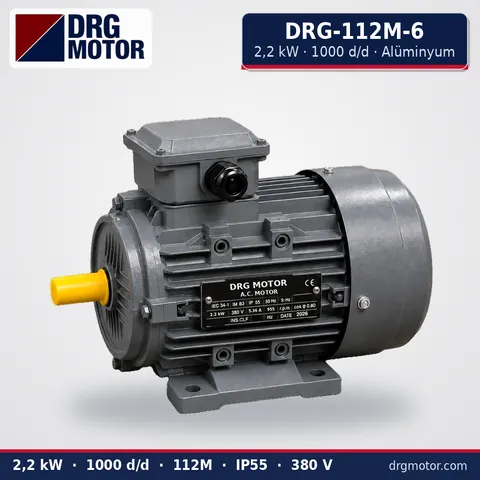
2.2 kW Three-Phase Motor 1000 rpm – DRG-112M-6 Aluminium
- 2.2 kW · 1000 rpm (6 poles)
- Aluminium frame · IEC 112M
- Mounting: B3 · B5 · B14 · B35
Click to see current prices and order these motors nowSEE PRICES →
Cream Mixer Motor FAQ
What speed should a homogeniser motor have?
Directly coupled heads usually use a 2-pole motor turning at about 2900 rpm. The exact speed follows from the head’s required tip speed and the maker’s data; if a higher speed is needed, a belt or inverter solution is planned together with the machine maker.
Why choose a 6-pole rather than a 4-pole motor for the frame agitator?
A scraper frame turns at a few tens of rpm. With a 6-pole motor the same output speed is reached with a smaller gearbox ratio, and at the same kW there is more torque on the motor shaft. If the existing gearbox ratio was chosen for a 4-pole motor, changing the pole number also changes the output speed.
The motor trips when the cream thickens. What should I do?
First measure current during cooling: if it exceeds the nameplate current, power is insufficient or the frame speed is too high for the recipe. Scrapers pressing too hard against the wall also add load. Depending on the result, a one-size-larger motor or a lower output speed is considered.
Do small laboratory cream vessels also use three-phase motors?
Most industrial vessels are three-phase. Very small laboratory units may come with single-phase or DC motors; DRG does not offer these types and supplies motors for systems with a three-phase supply.
Tell us which drive you need a motor for and write with the nameplate photo, kW and speed, flange dimensions (P, M, N), shaft diameter and vessel volume: WhatsApp is the quickest route, and you can also add models to the quote list for a quotation. Phone +90 (542) 666 11 11, e-mail info@drgmotor.com; other channels are on the contact page. All flanged and foot-mounted options are on the store page.