English
 Le français
 Türkçe




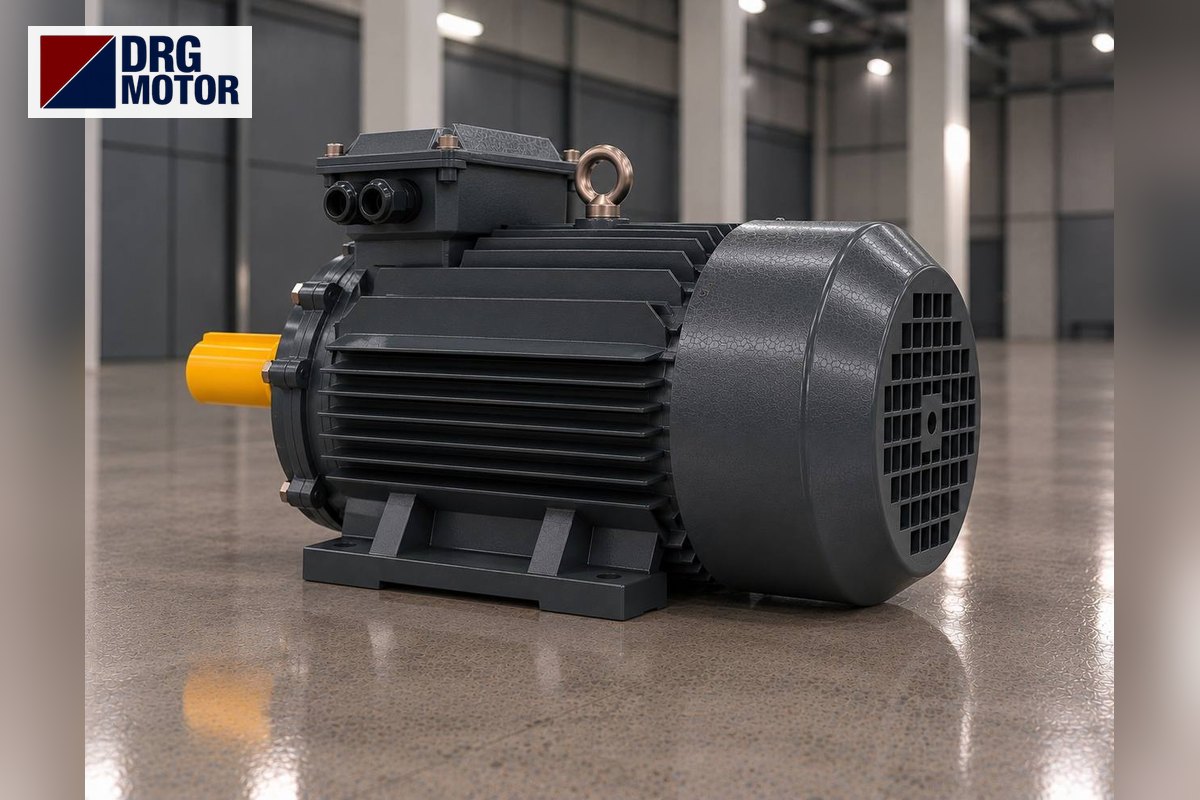

A colloid mill spins a conical rotor at very high speed inside a matching stator and breaks two phases (for example bitumen and soap solution, or oil and water) into droplets a few microns across. The gap between rotor and stator is usually set between a tenth of a millimetre and one millimetre. The motor's main task is therefore to deliver high and stable speed; what decides the selection is a low-vibration 2-pole motor and the power demand that rises as the gap closes.
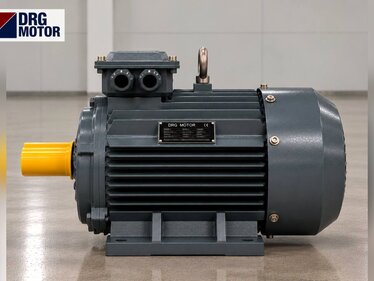
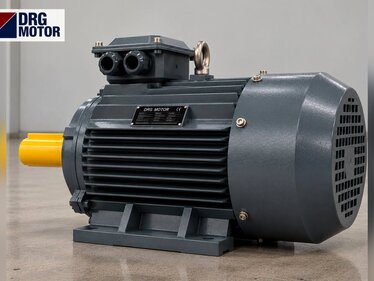
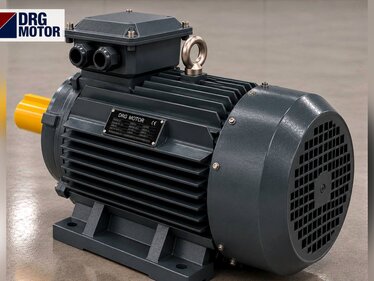
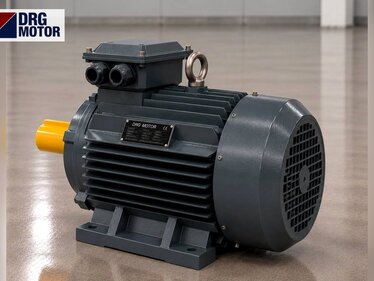
DRG Motor is a manufacturer, supplier and seller of electric motors. It supplies the three-phase IEC asynchronous motor that drives the mill, not the rotor-stator set, mechanical seal or jacket. All 3000 rpm class models are on the buy electric motors online page.
What Happens in the Rotor-Stator Gap?
The premix falls from the mill inlet onto the toothed or grooved surface of the rotor. In the narrow gap between the rotor's peripheral speed and the stationary stator, very high shear develops; droplets are stretched and torn apart. The product passes through the gap under its own weight and the pumping effect of the rotor, then reaches the outlet. Droplet size depends on three things: gap, peripheral speed and residence time in the gap.
In water-based emulsions the second phase is water: cationic bitumen emulsion for road building, paraffin and wax emulsions, silicone and alkyd emulsions and some crop protection formulations are made this way. In bitumen emulsion, bitumen is fed at roughly 120–140 °C and the emulsifier solution at a lower temperature; at the outlet the product is held at a temperature where the water does not boil.
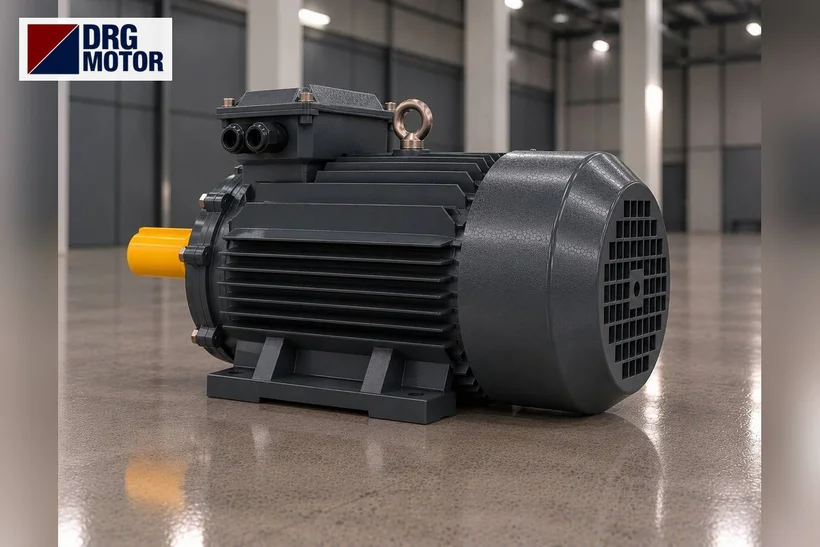
Why 2 Poles? Peripheral Speed Calculation
The value that governs shear is the rotor's peripheral speed: v = π · D · n / 60. In colloid mills this is usually a few tens of metres per second. The table below compares the speeds reached when the same rotor diameters are driven directly by a 2-pole and a 4-pole motor; motor speeds are the nameplate values of DRG-160M1-2 (2945 rpm) and DRG-160M-4 (1465 rpm).
| Rotor diameter | 2-pole, 2945 rpm | 4-pole, 1465 rpm |
|---|---|---|
| 100 mm | 15.4 m/s | 7.7 m/s |
| 150 mm | 23.1 m/s | 11.5 m/s |
| 200 mm | 30.8 m/s | 15.3 m/s |
| 250 mm | 38.5 m/s | 19.2 m/s |
The table shows why fitting a 4-pole motor "that happens to be on the shelf" in place of a burnt 2-pole motor does not work: peripheral speed halves, droplets are not reduced enough and the emulsion separates quickly. In some mills the rotor is belt-driven faster than the motor; you can check the ratio with the pulley and belt calculator.
Click to see current electric motor prices and order nowSEE PRICES →
How Does Power Change as the Gap Closes?
As the operator closes the gap, shear rises, the product stays longer in the gap and the power drawn by the rotor increases. Product viscosity acts the same way: an emulsion with a high bitumen content or a phase fed cold loads the motor more. In many plants the gap is set while watching motor current; closing stops when the ammeter approaches nameplate current.
Example: an 11 kW DRG-160M1-2 has 2945 rpm, 35.7 Nm rated torque and 19.6 A at 400 V on its nameplate. If current rises above this value while setting the gap, either the gap is too narrow or the feed ratio and temperature have drifted from the recipe. Check these two points before upsizing the motor. Mill power can be a few kW on small laboratory types and tens of kW on production lines; the exact value is on the maker's nameplate.
Start empty, then feed
A colloid mill is normally started empty or with only the water phase, and the second phase is fed once the motor reaches full speed. Starting load is therefore low, and star-delta starting causes no trouble on most mills. 2-pole motors have a high starting current ratio (Is/In 8.1 on DRG-160M1-2); star connection cuts this current on the supply side to about one third. If the mill stopped full of product that has cooled and thickened, heat or flush the body before starting.
Motor Connection on Vertical and Horizontal Mills
On vertical types the motor sits on top, flange-mounted to the mill body with the shaft pointing down. In this arrangement the motor's drive-end bearing also carries rotor weight and axial force. State on the order that the motor will run vertically shaft-down (V1); flange size (outer diameter, bolt circle, spigot) and shaft end are taken from the old motor. On horizontal types the motor is usually foot-mounted and connected to the mill through a flexible coupling or belts.
On some compact mills the rotor is fitted directly on the end of the motor shaft, and the shaft is specially extended, threaded or tapered for this purpose. Such a special shaft cannot be covered by a standard IEC motor. Converting the mill to a coupling or intermediate shaft arrangement is then the machine builder's job; DRG supplies the motor with a standard shaft end.
Vibration and seal
Because the rotor-stator gap is so small, shaft runout or coupling misalignment can make the rotor rub the stator directly. When replacing, re-align the coupling with a dial gauge and make sure the motor feet sit flat on the base. The mill's mechanical seal does not tolerate dry running; do not run the motor for long with an empty body.
Surroundings: Hot Product, Steam and Washing
On a bitumen emulsion line the mill body is hot and surrounded by water vapour. DRG motors are rated IP55, class F insulation and −15…+40 °C ambient. If the mill room exceeds this limit, ventilation is needed. On floors washed with a hose, keep water jets off the motor and keep the terminal box and cable glands tight. Food and cosmetic applications requiring a hygienic (washdown) housing are not covered by a standard motor.
Information to Prepare Before Ordering
- Motor nameplate: power, speed (2-pole?), voltage, current
- Mounting position: vertical shaft-down (V1) flange or horizontal foot
- Flange dimensions and shaft end: diameter, length, key; is the rotor fitted on the shaft
- Drive: direct coupling or belt and pulley (pulley diameters)
- Emulsion produced, hourly capacity and current read while running
- Starting method and mill room temperature
DRG Motors for Colloid Mills
Because a colloid mill needs high peripheral speed, we selected 2-pole models. The cast iron housing gives a robust outer surface in the hot, humid surroundings of the mill.
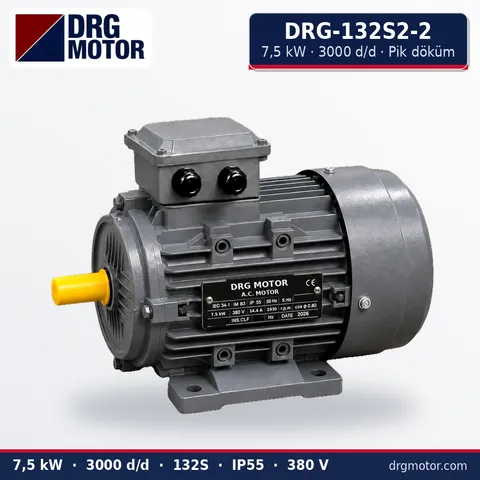
7.5 kW Three-Phase Motor 3000 rpm – DRG-132S2-2 Cast Iron
- 7.5 kW · 3000 rpm (2 poles)
- Cast iron frame · IEC 132S
- Mounting: B3 · B5 · B14 · B35
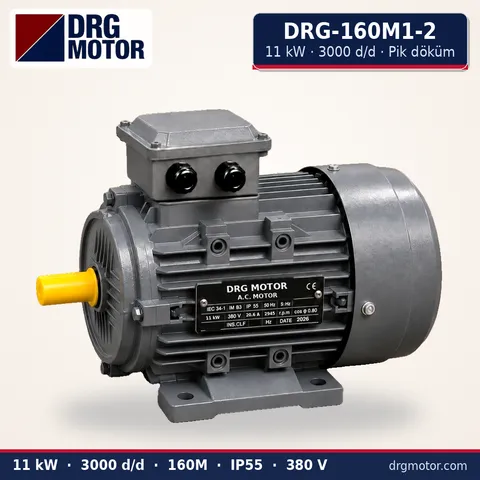
11 kW Three-Phase Motor 3000 rpm – DRG-160M1-2 Cast Iron
- 11 kW · 3000 rpm (2 poles)
- Cast iron frame · IEC 160M
- Mounting: B3 · B5 · B14 · B35
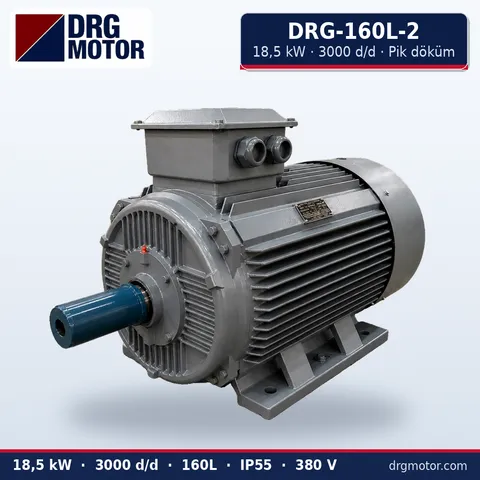
18.5 kW Three-Phase Motor 3000 rpm – DRG-160L-2 Cast Iron
- 18.5 kW · 3000 rpm (2 poles)
- Cast iron frame · IEC 160L
- Mounting: B3 · B5 · B14 · B35
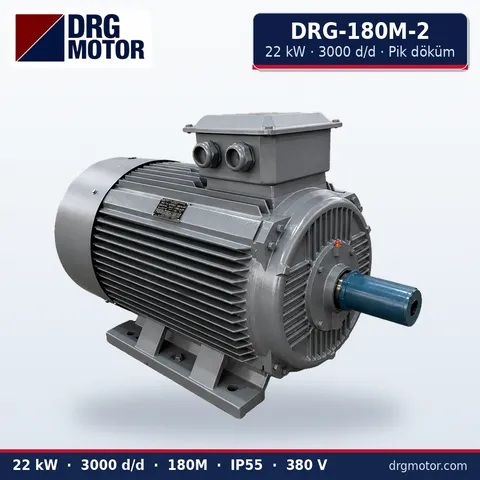
22 kW Three-Phase Motor 3000 rpm – DRG-180M-2 Cast Iron
- 22 kW · 3000 rpm (2 poles)
- Cast iron frame · IEC 180M
- Mounting: B3 · B5 · B14 · B35
Click to see current prices and order these motors nowSEE PRICES →
Colloid Mill Motor: Frequently Asked Questions
What speed should a colloid mill motor have?
Most direct-drive mills run with a 3000 rpm class 2-pole motor. On belt-driven types rotor speed may differ with the pulley ratio; keep the old motor's number of poles when replacing.
Why does the motor trip when the gap is closed?
A narrow gap increases shear and the power drawn by the rotor. When current exceeds the nameplate value, the overload trips. Set the gap by watching current and keep feed temperature within the recipe.
Is an inverter used on a bitumen emulsion mill?
Some lines vary speed with a drive to adjust droplet size. This is the machine builder's choice; DRG does not sell drives, it supplies the standard motor that runs on one.
Will a DRG motor fit a mill with the rotor on the motor shaft?
Yes, if the shaft end is a standard IEC size. If the shaft is specially extended or tapered, a standard motor cannot replace it; the mill must be converted to a coupled arrangement.
If you want to replace the motor or choose one for a new mill, send the nameplate photo with power, speed, mounting (vertical flange or foot), shaft size and mill details via WhatsApp, or build a quote list. Phone +90 (542) 666 11 11, e-mail info@drgmotor.com; other channels are on the contact page. Other options for general applications are on general purpose electric motors, and all models are in the online store.