English
 Le français
 Türkçe




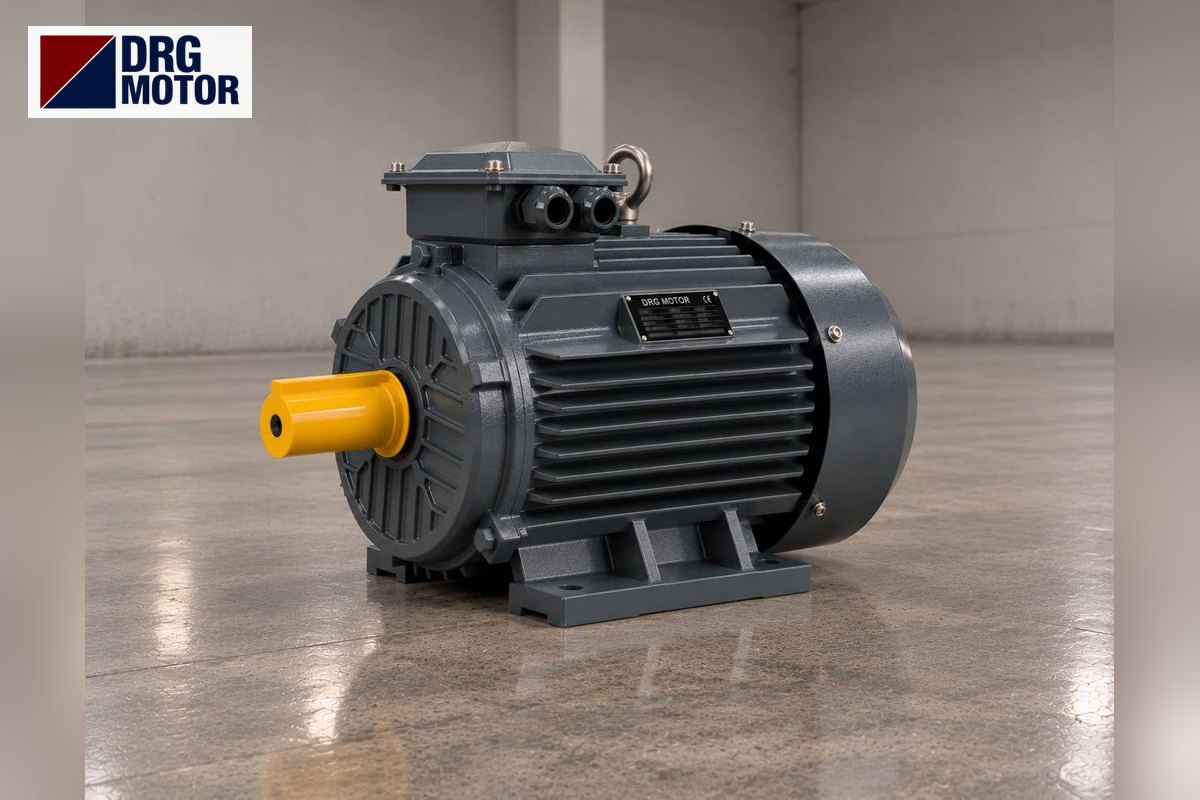

On a biogas plant, a standard three-phase motor may drive an external agitator only if the point where the motor stands lies outside the explosive atmosphere zone (Ex zone). Methane forms in the reactor (digester, fermenter); the gas dome, membrane cover, safety valve and gas line surroundings may be marked as Ex zones in the plant's explosion protection study. Defining these zones is the job of the plant owner and a competent engineer. An agitator in an Ex zone needs an Ex-protected special motor; DRG does not sell Ex/ATEX motors and does not recommend its standard motor at such a point.
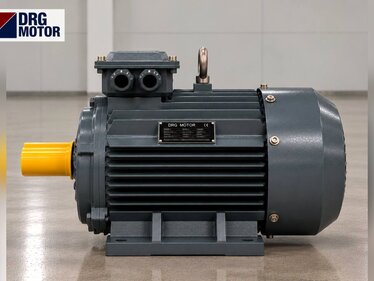
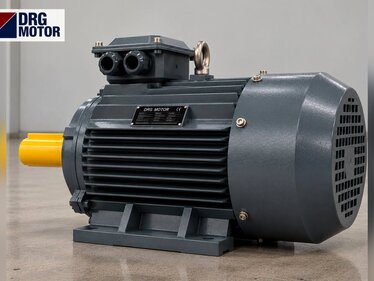
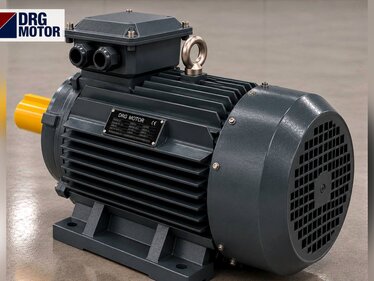
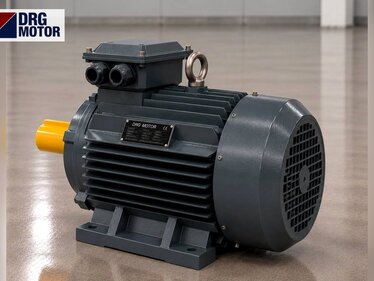
If the motor is outside the zone, for example on a platform outside the tank wall or in a drive room left unclassified, an IP55 cast iron asynchronous motor turning the agitator through a gearbox does the job. DRG Motor is a manufacturer, supplier and seller of electric motors; such motors are listed by power and speed on the buy electric motors online page. DRG does not sell gearboxes; it supplies the motor for the input of your existing gearbox.
Zone First: Where Does the Motor Stand?
Biogas agitators are installed in several layouts and the motor position differs in each. The table below is a first screening; the final decision is the plant's Ex zone plan.
| Agitator / motor location | Ex situation | Standard DRG motor |
|---|---|---|
| Submersible propeller, in tank | Inside liquid and gas | No: submersible + Ex motor |
| On membrane or gas dome | May be an Ex zone | No: Ex-protected special motor |
| Platform outside wall, away from gas | May be outside zones | Yes, if the zone plan allows |
| Enclosed drive room | Depends on ventilation | Per classification |
The third row is what we call external drive: the horizontal shaft of a slow paddle agitator leaves the tank through a seal in the wall, or the motor of a long-shaft inclined agitator is fixed to the outer face of the tank. If the shaft seal leaks gas, the motor's surroundings are affected too; seal maintenance is therefore one of the assumptions of the Ex classification.
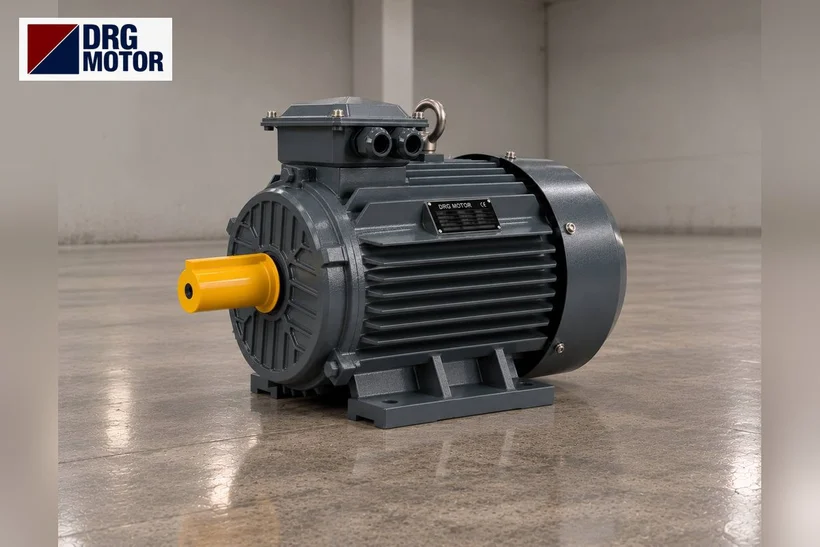
Externally Driven Agitator Types and What the Motor Must Do
Slow paddle agitator
Wide paddles sit on a horizontal shaft that runs across the tank or close to the wall; the shaft turns at only a few to a few tens of revolutions per minute. This low speed comes from a high-ratio gearbox, usually a planetary unit. Here the motor's real task is to turn a fibrous substrate with high dry matter at low speed and high torque. For motors on planetary gear units, see electric motors for planetary gearboxes.
Long-shaft inclined agitator
The motor stands outside or at the edge of the tank and turns a propeller at the end of a shaft entering the tank at an angle. Speed is higher than paddle types, and transmission is by gearbox or belt and pulley. The long lever arm creates radial and axial loads; these must be carried by the machine builder's bearing arrangement, not by the motor bearings.
Click to see current electric motor prices and order nowSEE PRICES →
Torque Calculation: The Motor Behind a Planetary Gearbox
Output torque is approximately T2 = 9550 · P / n2 · η, and output speed is n2 = n1 / i. The figures below are examples and assumptions; the actual ratio and paddle load are the machine builder's data.
Example: 22 kW 4-pole DRG-180L-4 (1470 rpm, rated torque 142.9 Nm), i = 120 planetary gearbox, gearbox loss factor 0.9 assumed. Output speed 1470 / 120 = 12.25 rpm, output torque about 15,436 Nm. With i = 100 on the same motor, speed rises to 14.7 rpm and torque falls to about 12,863 Nm.
A 6-pole motor with a lower ratio reaches the same output speed: an 18.5 kW DRG-200L1-6 (980 rpm) with i = 80 also gives 12.25 rpm, with about 12,980 Nm. When replacing a motor, keep the pole number that suits the existing gearbox; a motor with different poles changes paddle speed.
Intermittent Duty, Starting Current and the Floating Layer
In many biogas reactors the agitator does not run without pause; it runs and stops at set intervals to balance energy use and stratification. For example, 2 starts per hour means 48 starts a day. At each start the motor draws several times its rated current and the winding heats up; the number of starts per hour must be stated in the order.
During standstill a fibrous floating layer (crust) can form at the surface, while sand and heavy particles settle at the bottom. Resistance at breakaway is therefore higher than once the agitator is turning, which makes the starting method important.
Is star-delta starting enough for this agitator?
For the DRG-180L-4 the catalogue gives Is/In = 7.8, so starting current at 400 V is 39.7 A × 7.8 ≈ 310 A; with Ts/Tn = 2.0 the starting torque is about 286 Nm. In star connection both current and torque drop to roughly one third: about 103 A and 95 Nm. In a crusted reactor this torque may not break the paddles free; the motor hangs in star and overheats. A soft starter or inverter-controlled start suits such tanks better. You can check your own motor on the star-delta starting page.
Outdoors, H₂S and Winter: Checking the Environment
External drives are mostly outdoors. The DRG operating window is −15 to +40 °C air temperature at up to 1000 m; in regions that drop below −15 °C in winter, or on metal platforms baking in summer sun, consider a protective canopy and, if needed, a heater. IP55 protects against rain and splashes; keep the motor away from standing water and washing jets.
Biogas contains hydrogen sulphide (H₂S). Even at a point outside the Ex classification, this gas can attack copper connections and paint over time. An intact terminal box gasket, tight cable glands and touched-up paint damage are regular maintenance items on these plants. For other motor applications in treatment and sludge digestion plants, see wastewater treatment plant electric motors.
Information to Prepare for Replacement or a Quote
- Status of the motor location in the plant's Ex zone plan (outside zones?)
- Old motor nameplate: kW, speed, voltage, connection (400/690 V Δ/Y)
- Mounting: B3 foot, B5 flange or B35; shaft horizontal or inclined
- Shaft diameter × length, key size; gearbox input flange
- Gearbox ratio and type (planetary, helical) or pulley diameters
- Starts per hour and starting method
- Minimum winter temperature and whether the motor is outdoors
On cast iron frames 160 and 180 the B5 flange outer diameter P is 350 mm, bolt circle M 300 mm and spigot N 250 mm; the shaft is 42×110 mm on frame 160 and 48×110 mm on frame 180. Frame 200 has P 400 mm, M 350 mm, N 300 mm and a 55×110 mm shaft.
DRG Motors Suited to External Biogas Agitator Drives
The list consists of cast iron frame motors that stand outside the Ex zone and drive the agitator through a gearbox or pulleys; the 6-pole model is for lower-ratio gearboxes.
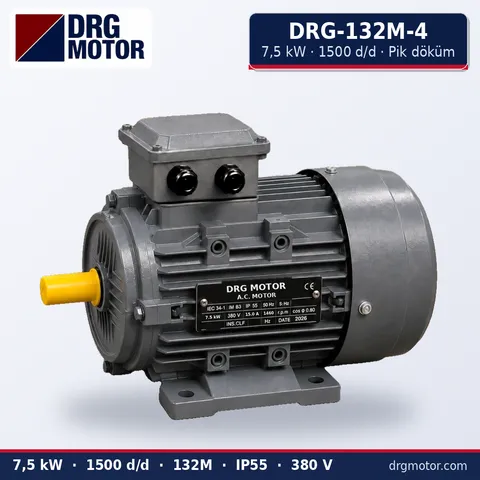
7.5 kW Three-Phase Motor 1500 rpm – DRG-132M-4 Cast Iron
- 7.5 kW · 1500 rpm (4 poles)
- Cast iron frame · IEC 132M
- Mounting: B3 · B5 · B14 · B35
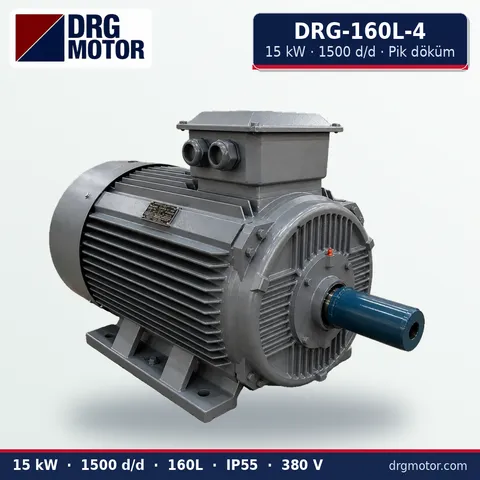
15 kW Three-Phase Motor 1500 rpm – DRG-160L-4 Cast Iron
- 15 kW · 1500 rpm (4 poles)
- Cast iron frame · IEC 160L
- Mounting: B3 · B5 · B14 · B35
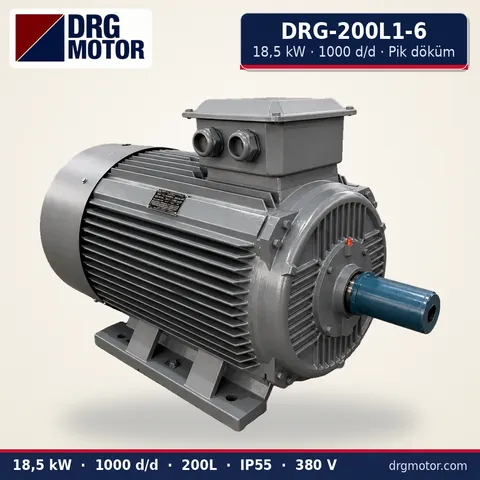
18.5 kW Three-Phase Motor 1000 rpm – DRG-200L1-6 Cast Iron
- 18.5 kW · 1000 rpm (6 poles)
- Cast iron frame · IEC 200L
- Mounting: B3 · B5 · B14 · B35
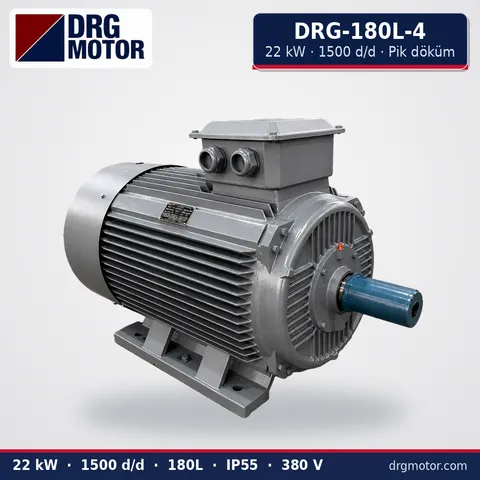
22 kW Three-Phase Motor 1500 rpm – DRG-180L-4 Cast Iron
- 22 kW · 1500 rpm (4 poles)
- Cast iron frame · IEC 180L
- Mounting: B3 · B5 · B14 · B35
Click to see current prices and order these motors nowSEE PRICES →
Biogas Agitator Motor FAQ
Is an ATEX motor mandatory on a biogas agitator?
If the motor location is inside an Ex zone in the plant's zone plan, yes, an Ex-protected special motor is needed. Outside the zone, a standard motor can be used. The plant's explosion protection study makes this decision; DRG does not sell Ex/ATEX motors.
At what speed does a biogas paddle agitator turn?
Slow paddle types turn at a few to a few tens of revolutions per minute. For example, a 1470 rpm motor with an i = 120 gearbox gives 12.25 rpm. The exact value is the builder's data.
Can I replace the motor of a submersible mixer with a standard motor?
No. In a mixer immersed in the tank, the motor runs inside the product and requires a special submersible motor, often Ex-protected as well. DRG does not offer submersible motors.
The agitator runs intermittently; why does the motor overheat?
Frequent starts, laboured starts against a crusted surface, or staying too long in star are the main causes. Check the number of starts per hour and the starting method.
Send a photo of the motor nameplate, its power and speed, whether it is foot or flange mounted, the shaft size and the gearbox ratio, together with information showing the motor is outside the Ex zone, via WhatsApp, or request a quote through the quote list. Phone: +90 (542) 666 11 11 · e-mail: info@drgmotor.com · contact. All power and speed options are listed in the online store.