English
 Le français
 Türkçe




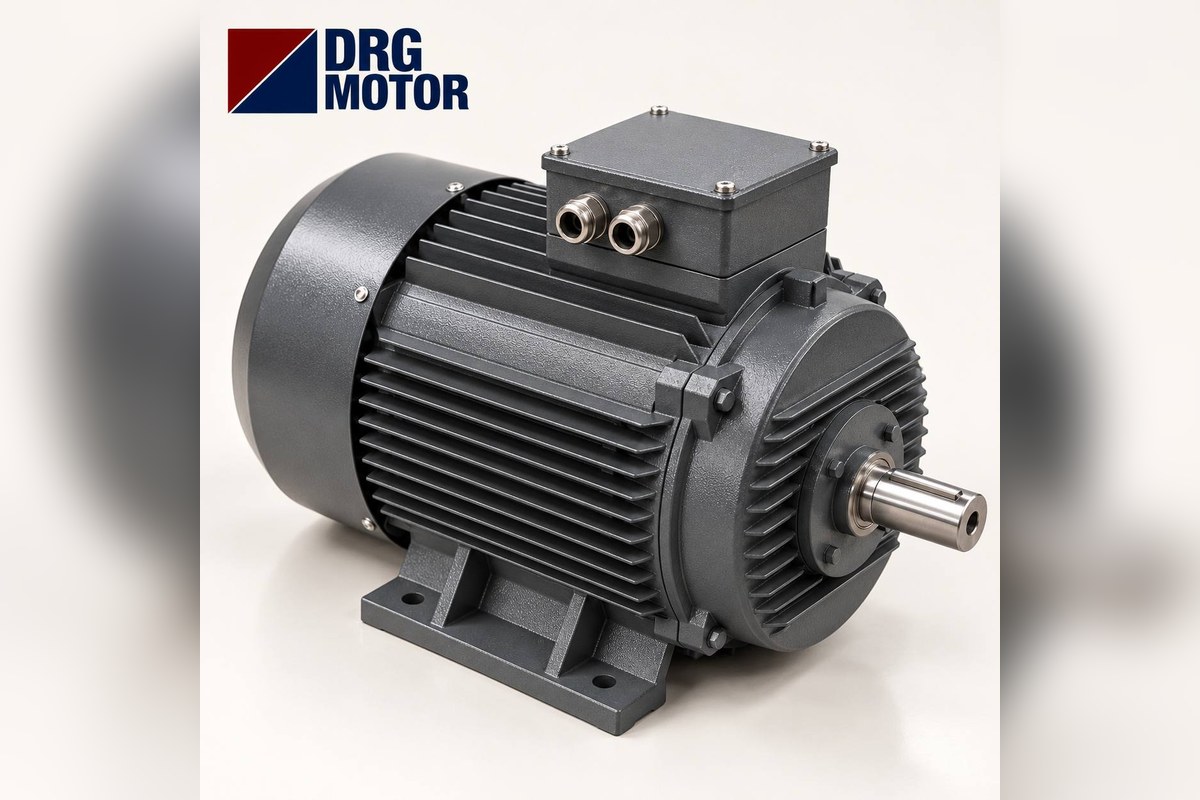

An industrial meat mincer is usually driven by a 4-pole (1450–1460 rpm) three-phase motor in the 1.5–7.5 kW range, depending on the plate size and the daily volume of meat; the motor slows the feed screw through a gearbox or a belt. For example, the 3 kW DRG-100L2-4 draws 6.02 A at 400 V and the 4 kW DRG-112M-4 draws 7.95 A. The exact power is the value on the machine's own nameplate or in its maker's documents; the ranges below are a cross-check for machines whose plate is unreadable.
Three things decide the motor: enough starting torque to start a loaded machine with frozen or sinewy meat, the gearbox ratio that sets the screw speed, and the forward-reverse operation needed to clear a jam. The motor connection, the reversing contactors and the earthing must be done by a qualified electrician; a mincing room means a wet floor and metal worktables. You can see suitable models and current prices among the 120 models in our online store.
The 3 most common mistakes with mincer motors
- Replacing a burnt motor with one size smaller: The screw turns easily when empty, but when a frozen block enters, the motor stalls and the overload trips. Power must not drop below the nameplate value.
- Fitting a 2-pole motor to a 4-pole machine: With the same gearbox the screw runs twice as fast, the meat is crushed and heats up, and the knife-plate pair wears quickly.
- Reversing abruptly: Changing direction while the motor is still running hammers the gears and keys. Wait until the motor has fully stopped between forward and reverse.
How many kW does each plate size need?
Mincers are named by plate number (No 22, No 32, No 42…). The bigger the number, the larger the screw diameter and cutting area, and the higher the torque required. The ranges below are a conservative guide compiled from values commonly seen on machines on the market; even for the same plate number, gearbox ratio, knife type and the share of frozen meat change the power.
| Plate size | Typical use | Conservative range | DRG example |
|---|---|---|---|
| No 22 | Butcher, small shop | 1.1–1.5 kW | DRG-90L-4 |
| No 32 | Butcher, supermarket | 2.2–3 kW | DRG-100L2-4 |
| No 42 | Meat processing, catering | 4–5.5 kW | DRG-112M-4 |
| No 52 and above | Industrial line | 5.5–7.5 kW and above | DRG-132M-4 |
If the plate is unreadable, the second check is the frame size of the old motor: shaft height and foot-hole spacing give the frame, and the frame tells you which powers are possible for that pole number. If the old motor still runs, measuring its current under load with a clamp meter is the most accurate way to see the real load.
Why won't the machine start with frozen meat? Starting torque check
A mincer is often started with a full hopper and meat packed in front of the screw. In that case the motor's torque at start-up matters far more than its running torque. In the DRG catalogue, small 4-pole motors have a starting torque of 2.3 times rated torque (1.5–3 kW), 2.2 times at 4 kW and 2 times at 5.5–7.5 kW.
| Model | Rated torque | Ts/Tn | Starting torque |
|---|---|---|---|
| DRG-100L2-4 | 19.8 Nm | 2.3 | ≈ 45.5 Nm |
| DRG-112M-4 | 26.3 Nm | 2.2 | ≈ 57.9 Nm |
| DRG-132S-4 | 36 Nm | 2 | ≈ 72 Nm |
| DRG-132M-4 | 49.1 Nm | 2 | ≈ 98.2 Nm |
Worked example (assumption): Suppose a No 42 machine with a hopper full of frozen blocks needs 50 Nm at the motor shaft to get the screw moving (this depends on the machine and meat temperature; it is not a measured value). The 4 kW DRG-112M-4 gives 26.3 × 2.2 ≈ 57.9 Nm at start; it is enough, but the margin is only about 16% and starting becomes harder if the voltage drops. The 5.5 kW DRG-132S-4 gives 36 × 2 = 72 Nm. That is why one size up makes sense where frozen meat is common; but first confirm with the machine maker that the gearbox and keys can take that torque.
Click to see current electric motor prices and order nowSEE PRICES →
Screw speed and gearbox: what does motor speed change?
Screw speed equals motor speed divided by the gearbox (or pulley) ratio: nscrew = nmotor / i. Suppose the screw turns at 200 rpm; with a 1450 rpm motor the ratio is i = 1450 / 200 ≈ 7.25. Fit a 6-pole motor (955 rpm) to the same gearbox and the screw drops to about 132 rpm, reducing output; with a 2-pole motor (2905 rpm) it rises to about 401 rpm and the meat heats up and smears. So the pole number must stay the same as the old motor. You can check the ratio and output torque with your own values in the gearbox output speed and torque calculator.
If the gearbox is flange-coupled to the motor, the shaft diameter and length and the flange spigot diameter must match exactly. On belt-driven machines a small speed correction is possible by changing the pulley diameter, but only within the screw speed limit recommended by the machine maker.
Mounting: foot or flange, and which dimensions?
On counter-top machines the motor usually sits on feet (B3) inside the housing and drives the gearbox by belt or coupling. More compact machines bolt the motor directly to the gearbox with a B5 (large) flange. Before ordering, measure these dimensions on the old motor and compare them with the catalogue values below:
| Frame | Shaft D × E | B5 flange P / M / N | Example model |
|---|---|---|---|
| 90L | 24 × 50 mm | 200 / 165 / 130 mm | DRG-90L-4 |
| 100L | 28 × 60 mm | 250 / 215 / 180 mm | DRG-100L2-4 |
| 112M | 28 × 60 mm | 250 / 215 / 180 mm | DRG-112M-4 |
| 132S | 38 × 80 mm | 300 / 265 / 230 mm | DRG-132S-4 |
All foot and flange dimensions are on the technical drawings page. For motors flange-mounted to a gearbox, we explain the B5–B14 difference and spigot centring in detail in our article on choosing a flange motor for a gearbox.
What should the motor and panel look like for forward-reverse?
On a mincer, reverse is used to loosen sinew and bone pieces jammed in front of the screw. On a three-phase motor the direction changes when two phases are swapped; inside the panel this is done by two interlocked contactors (forward and reverse). Nothing special is needed on the motor side: a standard three-phase induction motor delivers the same torque in both directions.
- Forward and reverse contactors must be both electrically and mechanically interlocked; if both close together you get a phase-to-phase short circuit.
- Wire the reverse button as "runs only while pressed" (jog); running in reverse continuously pushes meat back into the hopper.
- A timer relay that waits for the motor to stop before changing direction protects the gearbox.
- On machines that reverse often, an inverter both softens the direction change with a ramp and lowers starting current.
- The emergency stop and the hopper-lid safety switch must cut the motor in both directions.
Starting current also affects the panel: the 4 kW DRG-112M-4 gives a short peak of 7.95 A × 7.8 ≈ 62 A, the 5.5 kW DRG-132S-4 10.7 A × 7.9 ≈ 84.5 A. Check contactor, overload and fuse values with the overload-fuse-contactor selection tool; the overload relay is set to the 400 V current on the motor nameplate.
Cleaning and placing the motor in a food area
The motor never touches the meat, but wash water, fat and meat juice can reach it in a mincing room. DRG three-phase motors are IP55: protected against dust and water spray, not against pressure-washer jets. The finned housing and fan cover hold greasy dirt, which hinders heat dissipation and makes the motor run hot.
- Place the motor inside the closed machine housing, beside the meat path rather than below it.
- Wipe the housing with a damp cloth and a food-safe cleaner, not with a pressure washer.
- Do not block the fan-cover air inlet; the machine cabinet needs a ventilation opening.
- The cable gland should face down, with the terminal-box gasket and cover screws complete.
- A machine brought from a cold room into a warm hall can see condensation; keep the motor dry before the first start after a long stop.
Which DRG motor should you buy?
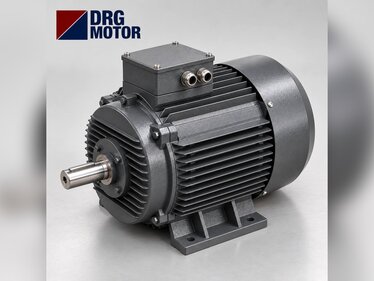
Below are 4-pole cast iron models for the usual mincer range. A cast iron housing is a robust choice under vibration and shock loads; aluminium-housing versions of the same powers are also in the store.
| Model | Power / speed | Frame | Current 400 V |
|---|---|---|---|
| DRG-90L-4 | 1.5 kW / 1445 rpm | 90L · cast iron | 3.3 A |
| DRG-100L1-4 | 2.2 kW / 1450 rpm | 100L · cast iron | 4.52 A |
| DRG-100L2-4 | 3 kW / 1450 rpm | 100L · cast iron | 6.02 A |
| DRG-112M-4 | 4 kW / 1450 rpm | 112M · cast iron | 7.95 A |
| DRG-132S-4 | 5.5 kW / 1460 rpm | 132S · cast iron | 10.7 A |
| DRG-132M-4 | 7.5 kW / 1460 rpm | 132M · cast iron | 14.3 A |
For a No 42 class machine with a high share of frozen meat, a common match is the 5.5 kW 4-pole motor:
- Power: 5.5 kW
- Rated speed: 1460 rpm
- Frame: 132S · cast iron
- Current 400 V: 10.7 A
- cos φ: 0.83
- Rated torque: 36 Nm
- Starting torque: 2 × Tn
- Starting current: 7.9 × In
- Shaft D × E: 38 × 80 mm
- Bearing: 6208-ZZ-C3
- Voltage: 400/690 V (Δ/Y)
DRG Motor is a manufacturer, supplier and seller of electric motors; DRG MOTOR motors are guaranteed against material and manufacturing defects for 2 years from the date of delivery (warranty certificate). For payment options see the payment page; seasonal instalment campaigns with Halköde may apply — ask on WhatsApp for the current option.
Motors in this power range
- DRG-90L-4 – 1.5 kW – 1445 rpm – 90L cast iron
- DRG-100L2-4 – 3 kW – 1450 rpm – 100L cast iron
- DRG-112M-4 – 4 kW – 1450 rpm – 112M cast iron
- DRG-132S-4 – 5.5 kW – 1460 rpm – 132S cast iron
- DRG-132M-4 – 7.5 kW – 1460 rpm – 132M cast iron
Click to see current prices and order these motors nowSEE PRICES →
Frequently Asked Questions
How many kW should an industrial meat mincer motor be?
It depends on plate size and meat type: about 1.1–1.5 kW for No 22, 2.2–3 kW for No 32, 4–5.5 kW for No 42, and 5.5–7.5 kW and above on larger industrial machines. The exact value is on the machine nameplate.
What speed is a meat mincer motor?
Mostly a 4-pole motor at 1450–1460 rpm; the screw speed is reduced by a gearbox or belt. When replacing, keep the same pole number as the old motor.
How do you change the direction of a mincer motor?
On a three-phase motor, swapping two phases reverses the direction. For permanent forward-reverse, two interlocked contactors are used in the panel; the wiring must be done by a qualified electrician.
How many amps does a 3 kW mincer motor draw?
The 3 kW 4-pole DRG-100L2-4 draws 6.02 A at 400 V and 6.34 A at 380 V. At start-up a short peak of about 7.6 times this current occurs.
Send us your machine nameplate, plate number or the old motor's dimensions and we will confirm the right DRG model with you. Phone +90 (542) 666 11 11, e-mail [email protected], contact page. All 4-pole models suited to mincers: Buy Electric Motors Online.