English
 Le français
 Türkçe




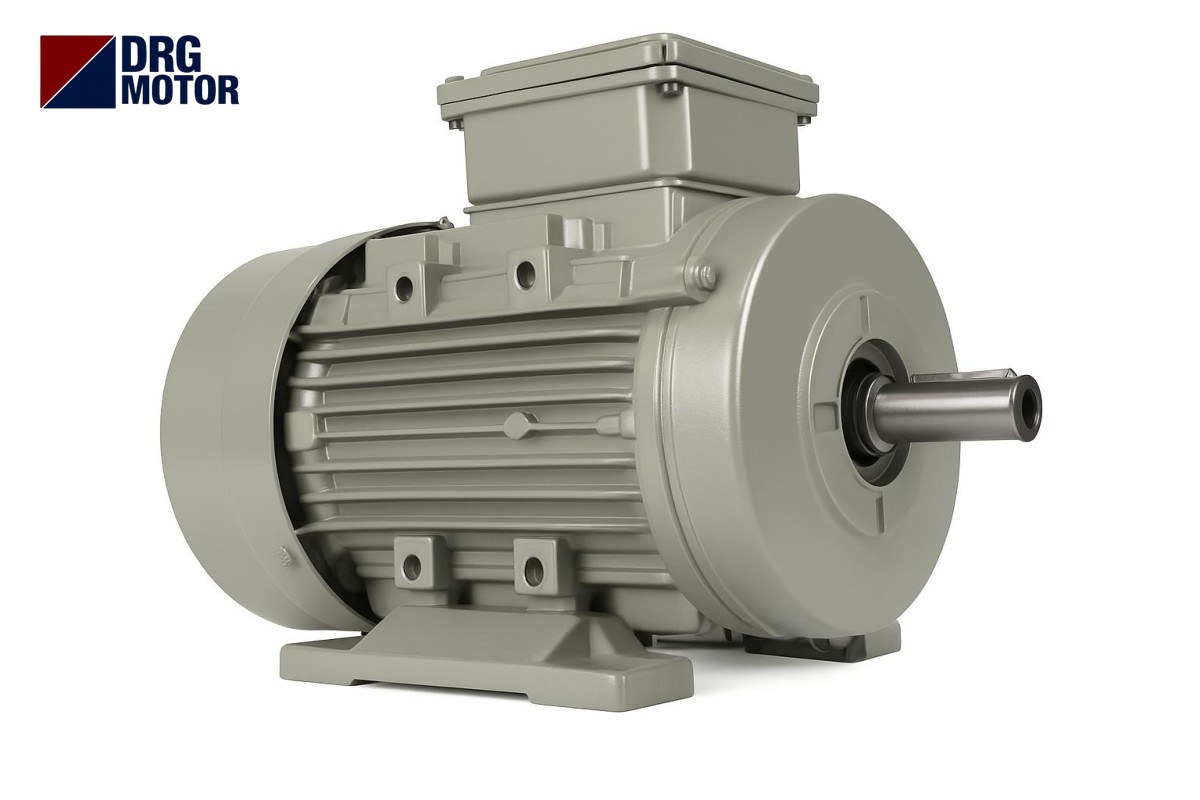

A screw conveyor (auger) motor is chosen between two extremes depending on the auger's size and the material it carries: on a heating boiler's fuel feed auger a small geared motor of 0.25–0.75 kW is usually enough, while wheat and grain augers typically carry 1.5–7.5 kW or more depending on length, diameter and incline. In both cases the auger shaft turns slowly, so the motor is 4-pole (1340–1460 rpm in the DRG catalogue) and the speed is reduced by a gearbox or belt. The exact power is the auger builder's data and the old motor's nameplate; the ranges below are conservative and the calculations are examples with stated assumptions.
Four factors raise the power: throughput (t/h), auger length, lifting height (incline) and the friction behaviour of the material. Dry, free-flowing wheat moves easily; moist, sticky or fine dusty material needs clearly more power in the same auger. Never run the motor with the auger casing open and have the connection made by a qualified electrician: a rotating auger draws in hands and clothing.
Once you have found the right motor, you can compare frame and power options among the 120 models on the Buy Electric Motors Online page.
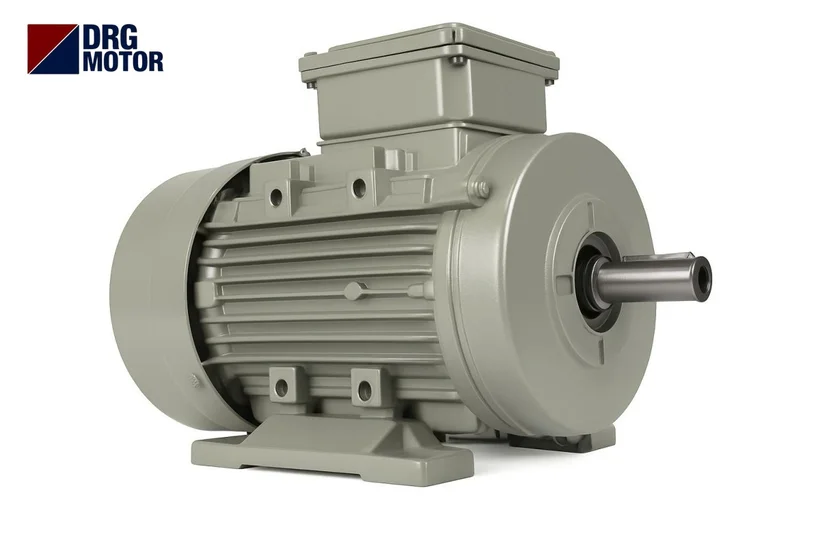
Boiler feed auger vs wheat auger
| Feature | Heating boiler fuel feed auger | Wheat / grain auger |
|---|---|---|
| Typical motor power (guidance) | 0.25–0.75 kW | 1.5–7.5 kW and above |
| Auger shaft speed | Very low, a few rpm | Low to medium, hundreds of rpm |
| Drive | High-ratio (often worm) gearbox | Gearbox or belt and pulley |
| Operation | Switched on and off by the boiler thermostat | Runs for long periods during filling/emptying |
| Mounting | B5 or B14 flange to the gearbox | B5 flange, B3 foot-mounted + belt or slide base |
| Risk | Coal lump jamming, frequent starts | Starting with a full auger, backflow on an incline |
Auger power calculation: concept and example
The simple approach used for screw conveyors splits the power into two parts: the power to drag the material horizontally and the power to lift it. Conceptually:
- Horizontal drag power ≈ Q × L × λ / 367 (kW)
- Lifting power ≈ Q × H / 367 (kW)
Here Q is the throughput (t/h), L the auger length (m), H the lifting height (m) and λ the material's friction/resistance factor. λ depends on the material and the fill level of the auger; for grain it is chosen from the values given in catalogues, and if unknown the builder should be asked.
Example (assumptions: wheat, Q = 20 t/h, L = 8 m, H = 3 m, λ = 2):
- Horizontal: 20 × 8 × 2 / 367 ≈ 0.87 kW
- Lifting: 20 × 3 / 367 ≈ 0.16 kW
- Total shaft power ≈ 1.04 kW
- Divide by 0.9 for gearbox losses, add a 1.25 margin for starting and fill: 1.04 / 0.9 × 1.25 ≈ 1.44 kW
- Next standard rating: 1.5 kW → DRG-90L-4 (1445 rpm, 9.91 Nm)
If λ = 3 is assumed, the same calculation rises to ≈ 2.1 kW and DRG-100L1-4 (2.2 kW) is needed; that is how strongly the factor matters. If the motor that ran on the old auger has a nameplate, trust it first.
Reducing speed: gearbox or belt?
The speed the auger shaft needs is far below the motor's rated speed; the ratio comes from a gearbox or a belt. In the wheat example assume the auger turns at 100 rpm: with DRG-90L-4 the ratio is i = 1445 / 100 ≈ 14.5. With a 0.9 factor for gearbox losses, output torque ≈ 9.91 × 14.45 × 0.9 ≈ 129 Nm. A belt and pulley could also be used, but ratios around 1:14 are difficult with a single belt stage, so most builders prefer a geared motor.
On a boiler auger the ratio is much higher. Example: the auger turns at 10 rpm with DRG-711-4 (0.25 kW, 1340 rpm, 1.78 Nm). The ratio is i = 1340 / 10 = 134. Worm gearboxes have high losses; assuming a 0.6 factor, output torque ≈ 1.78 × 134 × 0.6 ≈ 143 Nm. If you want a slower motor, the 6-pole DRG-712-6 (0.25 kW, 855 rpm, 2.79 Nm) works with a lower ratio for the same output speed. Try the ratio and torque with your own values in the gearbox output speed and torque calculator; gearbox selection is detailed in our article on how to select a motor gearbox.
B3, B5 and B14: how is the motor mounted on an auger?
Auger motors connected directly to a gearbox are flange-mounted. B5 is the large flange with through holes; B14 is the small face flange with tapped holes. On belt-driven augers a B3 foot-mounted motor sits on a slide base. B5 flange dimensions from the DRG catalogue (mm):
| Frame | M (bolt circle) | N (spigot) | P (flange OD) | S (hole) | Shaft D×E |
|---|---|---|---|---|---|
| 71 | 130 | 110 | 160 | 10 | 14×30 |
| 80 | 165 | 130 | 200 | 12 | 19×40 |
| 90S | 165 | 130 | 200 | 12 | 24×50 |
| 90L | 165 | 130 | 200 | 12 | 24×50 |
| 100L | 215 | 180 | 250 | 14.5 | 28×60 |
| 112M | 215 | 180 | 250 | 14.5 | 28×60 |
| 132S | 265 | 230 | 300 | 14.5 | 38×80 |
B14 small flange dimensions are not in our catalogue table; if you need a motor for a B14 gearbox, send us the gearbox flange dimensions and shaft bore before ordering. The logic of flange selection is explained in flange motor selection for gearboxes; dimensioned drawings are on the technical drawings page.
Frequent starts and protection on a boiler auger
The boiler thermostat may start and stop the auger many times an hour. At each start the motor draws several times its rated current; for DRG-711-4 the catalogue starting current ratio is Is/In = 5.2. With a rated current of 0.66 A at 400 V, about 3.4 A is seen at start. This is small, but very frequent starts raise motor temperature: keep the fan cowl clear of boiler-room dust and ash.
Stones, metal pieces or large lumps in coal or pellets can lock the auger. Here the overload relay protects the motor; set it to the rated current on the nameplate and do not turn it up. You can check overload and fuse selection with the overload relay, fuse and contactor selection tool.
Points to watch on an inclined grain auger
As the incline increases, the auger's capacity falls and more power is needed for the same tonnage; the lifting power in the calculation above shows this only partly. When a full inclined auger stops, material slumps back and the next start happens with a full casing; the motor's starting torque matters here. For DRG-90L-4 the starting torque ratio is Ts/Tn = 2.3. If the auger is habitually stopped without emptying, choosing the motor one size up and cutting the feed at start is safer.
Checklist before ordering an auger motor
- Record the kW, speed and voltage/connection on the old motor's nameplate.
- Determine the mounting: B5, B14 or foot-mounted B3.
- Measure the M, N, P dimensions of the gearbox flange and the shaft bore diameter.
- Note the auger shaft speed and the gear ratio.
- Write down the material, hourly throughput, auger length and incline.
- Set the overload relay to the new motor's rated current.
- Plan fan cowl cleaning for dust in the boiler room or silo area.
Suitable DRG models for augers
Values are from the DRG catalogue (400 V). The first five rows are small aluminium-frame ratings for boiler and light feed augers; the others are cast iron options for grain augers.
| Model | Power (kW) | Rated speed (rpm) | Frame | Current 400 V (A) | Rated torque (Nm) | Is/In | Shaft D×E (mm) |
|---|---|---|---|---|---|---|---|
| DRG-711-4 | 0.25 | 1340 | 71 aluminium | 0.66 | 1.78 | 5.2 | 14×30 |
| DRG-712-6 | 0.25 | 855 | 71 aluminium | 0.77 | 2.79 | 4 | 14×30 |
| DRG-712-4 | 0.37 | 1340 | 71 aluminium | 0.92 | 2.64 | 5.2 | 14×30 |
| DRG-801-4 | 0.55 | 1400 | 80 aluminium | 1.31 | 3.75 | 5.2 | 19×40 |
| DRG-802-4 | 0.75 | 1420 | 80 aluminium | 1.75 | 5.04 | 6.6 | 19×40 |
| DRG-90S-4 | 1.1 | 1445 | 90S cast iron | 2.48 | 7.27 | 6.8 | 24×50 |
| DRG-90L-4 | 1.5 | 1445 | 90L cast iron | 3.3 | 9.91 | 7 | 24×50 |
| DRG-100L1-4 | 2.2 | 1450 | 100L cast iron | 4.52 | 14.5 | 7.6 | 28×60 |
| DRG-100L2-4 | 3 | 1450 | 100L cast iron | 6.02 | 19.8 | 7.6 | 28×60 |
| DRG-112M-4 | 4 | 1450 | 112M cast iron | 7.95 | 26.3 | 7.8 | 28×60 |
| DRG-132S-4 | 5.5 | 1460 | 132S cast iron | 10.7 | 36 | 7.9 | 38×80 |
Motors in this power range
- DRG-711-4 – 0.25 kW – 1340 rpm – 71 aluminium
- DRG-712-4 – 0.37 kW – 1340 rpm – 71 aluminium
- DRG-90L-4 – 1.5 kW – 1445 rpm – 90L cast iron
- DRG-100L1-4 – 2.2 kW – 1450 rpm – 100L cast iron
- DRG-112M-4 – 4 kW – 1450 rpm – 112M cast iron
- DRG-132S-4 – 5.5 kW – 1460 rpm – 132S cast iron
Click to see current prices and order these motors nowSEE PRICES →
Frequently Asked Questions
What kW is a boiler auger motor?
Fuel feed augers on domestic and apartment boilers usually have a 0.25–0.75 kW geared motor. The exact value is the boiler builder's data and the old motor's nameplate.
What speed should an auger motor have?
The motor is mostly 4-pole (1340–1460 rpm in the DRG catalogue); the low speed the auger shaft needs comes from a gearbox or belt. If a very high ratio is needed, a 6-pole motor can also be chosen.
What kW motor does a wheat auger need?
It depends on length, diameter, incline and hourly throughput; usually 1.5–7.5 kW. In the example in this article, 1.5 kW was calculated for 20 t/h, 8 m and a 3 m lift.
How many amps does a 0.25 kW auger motor draw?
The 4-pole DRG-711-4 draws 0.66 A at 400 V and 0.7 A at 380 V at full load.
Send us the power, speed, shaft and mounting data from your machine nameplate and we will pin down the matching DRG model together. Phone: +90 (542) 666 11 11 · E-mail: [email protected] · Contact page. For all models and ordering: Buy Electric Motors Online.