English
 Le français
 Türkçe




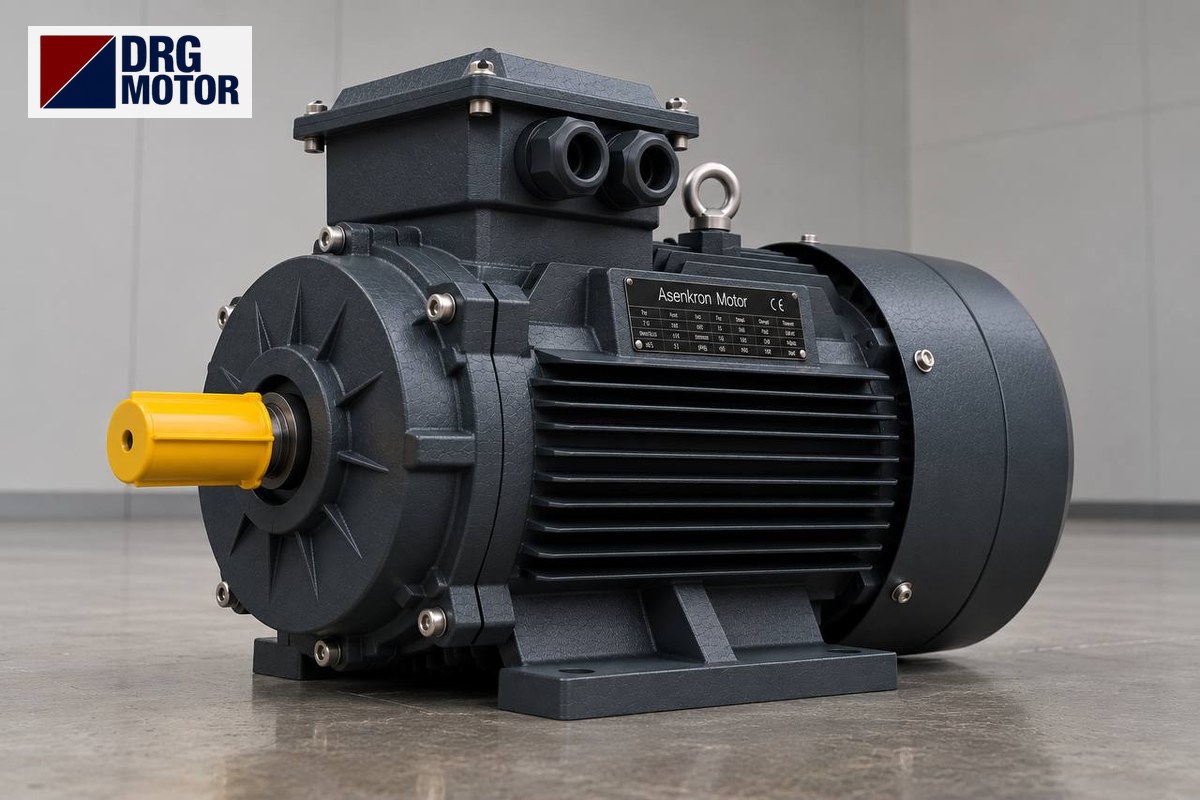

A bucket elevator motor is sized from the product of capacity (t/h) and lift height (m): the lifting power is P = Q·H/367 kW, to which a digging and friction margin and the gearbox loss are added. For example, an elevator lifting 30 tonnes of grain per hour over 20 m needs 1.63 kW of lifting power and roughly 2.36 kW at the motor shaft with margins; a 3 kW 4-pole motor (DRG-100L2-4, 1450 rpm, 6.02 A at 400 V) is the choice. This calculation is a guide; the exact power is on the elevator's nameplate and in its manufacturer's data.
The hardest moment for an elevator motor is not running but starting: when the line stops loaded, the buckets on the up-leg stay full, so in the first second the motor must carry the full load and accelerate it at the same time. That is why starting torque (Ts/Tn), starting method and the backstop matter as much as power. Wiring and rotation checks must be done by a qualified electrician; before maintenance the elevator must be isolated and locked out, because loaded legs can turn the drive backwards.
Once you have the figure, compare power and frame options among the 120 models on the Buy Electric Motors Online page; the tables below show which model suits which elevator.
How do you calculate bucket elevator motor power?
The 367 comes from unit conversion: lifting 1 t/h by 1 m takes 1000 kg × 9.81 m/s² × 1 m / 3600 s = 2.725 W, i.e. about 1/367 kW. That is the net lifting power. A real elevator adds two things: the power the buckets spend digging material out of the boot, and friction in the belt/chain, pulley bearings and buckets. In the examples below both are combined in a ×1.3 factor and the gearbox loss in a divisor of 0.9 (assumptions): Pmotor ≈ Q·H/367 × 1.3 / 0.9.
| Capacity × height | Q·H/367 | Motor power with margins | Selected motor |
|---|---|---|---|
| 20 t/h × 15 m | 0.82 kW | 1.18 kW | DRG-90L-4 (1.5 kW) |
| 30 t/h × 20 m | 1.63 kW | 2.36 kW | DRG-100L2-4 (3 kW) |
| 50 t/h × 25 m | 3.41 kW | 4.92 kW | DRG-132S-4 (5.5 kW) |
| 60 t/h × 30 m | 4.90 kW | 7.08 kW | DRG-132M-4 (7.5 kW) |
| 80 t/h × 35 m | 7.63 kW | 11.02 kW | DRG-160L-4 (15 kW) |
The last row shows why the result should be read without rounding: for 80 t/h × 35 m the power with margins is 11.02 kW, slightly above the rating of a 11 kW motor. If the elevator stops often and restarts loaded, the next size up (15 kW) is the safer choice. The digging margin depends on the material: sticky, damp or coarse material needs more than dry, free-flowing grain. Take the factor from the elevator manufacturer; if it is unknown, start from the old motor's nameplate.
Loaded start: Ts/Tn and starting method
When an elevator stops under load (power cut, emergency stop, choke), every bucket on the up-leg is full. On restart the motor must produce the torque to hold that load plus extra torque to accelerate the line. On DRG 4-pole motors the starting torque is 2–2.3 times rated torque:
| Model | Rated torque | Ts/Tn | Starting torque (≈) |
|---|---|---|---|
| DRG-90L-4 | 9.91 Nm | 2.3 | 22.8 Nm |
| DRG-100L2-4 | 19.8 Nm | 2.3 | 45.5 Nm |
| DRG-132S-4 | 36 Nm | 2.0 | 72.0 Nm |
| DRG-132M-4 | 49.1 Nm | 2.0 | 98.2 Nm |
| DRG-160M-4 | 71.7 Nm | 2.2 | 157.7 Nm |
| DRG-160L-4 | 97.8 Nm | 2.2 | 215.2 Nm |
Example: a 60 t/h × 30 m elevator needs 7.08 kW with margins; on the shaft of DRG-132M-4 (7.5 kW, 1460 rpm) that is 9550 × 7.08 / 1460 ≈ 46.3 Nm. With direct-on-line starting the motor gives ≈ 98.2 Nm, so a loaded start is easy. With star-delta, torque in the star step drops to about one third (≈ 32.7 Nm) and cannot carry the 46.3 Nm load: a loaded elevator will not start in star, the motor hums and the overload trips. Loaded-start elevators therefore use direct-on-line starting, an inverter that does not limit starting torque, or a stop sequence that empties the line first. Compare the options on the motor starting methods and star-delta page.
Check the connection too: in our catalogue motors of 3 kW and below are wound 230/400 V (Δ/Y) and are connected in star (Y) on a 400 V network, so they cannot be star-delta started. 4 kW and above are wound 400/690 V (Δ/Y), run in delta (Δ) at 400 V and are suitable for star-delta.
Backstop: when the loaded leg turns the drive backwards
In a vertical elevator the up-leg is loaded while the down-leg is empty; the moment the motor stops, this weight difference pulls the belt back. The remedy is a backstop (one-way clutch) on the gearbox or head shaft: the shaft can only turn in the working direction. The part does not belong to the motor, but a motor change affects it directly:
- Check the new motor's rotation unloaded, with the coupling or belt disconnected. Starting in reverse with the backstop fitted puts a shock load on the backstop and the gearbox.
- If the phase sequence changes (new panel, new cable), check rotation again; swapping two phases reverses the motor.
- A backstop is not a substitute for a motor brake, but on an elevator it often makes a brake unnecessary; if no positioning is needed, a brake motor is not required.
Our article on electric motor selection for cranes and lifting systems covers the effect of a suspended load on the motor in more detail; on an elevator the load sits on one unbalanced leg all the time, so a backstop is the simplest solution.
Gearbox output speed and head pulley peripheral speed
Bucket speed is v = π·D·n/60 (D pulley diameter in m, n pulley speed in rpm). On centrifugal-discharge grain elevators the buckets must turn fast enough at the head to throw material into the spout; too slow and material falls back into the down-leg before reaching the spout, too fast and it overshoots and the buckets throw part of the load back. The right speed depends on pulley diameter and material and is the manufacturer's value; the speeds below are example assumptions:
| Pulley diameter | Bucket speed (assumed) | Pulley speed | Ratio (1460 rpm) |
|---|---|---|---|
| 400 mm | 2.2 m/s | 105.0 rpm | ≈ 13.9 |
| 500 mm | 2.5 m/s | 95.5 rpm | ≈ 15.3 |
| 630 mm | 2.8 m/s | 84.9 rpm | ≈ 17.2 |
For example, a 500 mm pulley at 2.5 m/s must turn at 95.5 rpm; with a 1460 rpm motor the overall ratio is about 15.3. The gearbox output torque is chosen at this speed: if the 60 t/h × 30 m example needs 6.38 kW at the pulley shaft, the torque is 9550 × 6.38 / 95.5 ≈ 638 Nm; the gearbox output torque and service factor must be above this. Check ratio and torque with the gearbox output speed and torque calculator. Raising elevator speed with an inverter shifts the discharge point; adjust speed only with the manufacturer's approval.
Motor frame, shaft and flange: mounting on the head platform
The motor sits at the elevator head, often outdoors and in grain dust. A cast iron frame withstands vibration and knocks; the product pages in our store state IP55 protection. Dust build-up blocks the cooling fins and heats the motor, so regular cleaning is needed; grain dust carries an explosion risk, and if the area has a hazardous-zone classification that is a separate compliance matter which a standard motor does not cover.
Two drive layouts are common: a shaft-mounted gearbox on the head shaft with a flange motor, or a foot motor + belt + gearbox. With a flange connection the gearbox input flange must match the motor's B5 flange exactly. Two example frames:
- Frame 100L (DRG-100L2-4): shaft 28 × 60 mm, B5 flange P 250 / N 180 / M 215 mm
- Frame 132M (DRG-132M-4): shaft 38 × 80 mm, B5 flange P 300 / N 230 / M 265 mm
- Cable entry: 100L 1 × M25×1.5, 132M 2 × M32×1.5
Measure the old motor's shaft and flange with a caliper and compare with the DRG motor technical drawings; if the shaft or spigot diameter differs, the coupling and gearbox input will not fit.
Current, overload relay and the head cable
Because the elevator head is high up, the motor cable is long and voltage drop makes a loaded start harder. DRG-132M-4 draws 14.3 A at 400 V; with a starting current ratio of 7.5, ≈ 107 A flows at the first instant on direct-on-line starting. The overload relay is set to the rated current on the nameplate; on a loaded elevator with a long run-up, choose the trip class accordingly (overload relay, fuse and contactor selection).
Cable example (copper, PVC, sample values): for 14.3 A × 1.25 = 17.9 A a 2.5 mm² cable (25 A) is enough for current. But over 80 m the voltage drop is √3 × 14.3 × 0.08 × 7.41 × 0.84 ≈ 12.3 V, i.e. 3.1%, above the 3% accepted for the supply. With 4 mm² the drop stays at ≈ 7.7 V (1.9%). Try your own distance in the motor cable size calculator.
Bucket elevator motor selection checklist
- Have capacity (t/h) and centre-to-centre lift height (m) been confirmed with the manufacturer's data?
- Has the power with margins been calculated, is the motor rating above it, and was the next size chosen if the result is borderline?
- If a loaded start is possible, does the starting method (direct, inverter) deliver the starting torque?
- Is the backstop in place and working; was rotation checked with the coupling disconnected?
- Do pulley speed and overall ratio give the manufacturer's bucket speed?
- Are gearbox output torque and service factor above the pulley torque?
- Are shaft D×E, flange P/N/M and cable entry the same as the old motor's?
- Was the cable sized for both current and voltage drop; is the overload set to rated current?
- Is the motor frame accessible for dust cleaning and is the terminal box gasket intact?
Motors in this power range
All models in the table are 4-pole with a cast iron frame; currents are at 400 V.
| Model | Power / speed | Frame | Current 400 V |
|---|---|---|---|
| DRG-90L-4 | 1.5 kW / 1445 rpm | 90L cast iron | 3.3 A |
| DRG-100L2-4 | 3 kW / 1450 rpm | 100L cast iron | 6.02 A |
| DRG-132S-4 | 5.5 kW / 1460 rpm | 132S cast iron | 10.7 A |
| DRG-132M-4 | 7.5 kW / 1460 rpm | 132M cast iron | 14.3 A |
| DRG-160M-4 | 11 kW / 1465 rpm | 160M cast iron | 20.4 A |
| DRG-160L-4 | 15 kW / 1465 rpm | 160L cast iron | 27.3 A |
- DRG-90L-4 – 1.5 kW – 1445 rpm – 90L cast iron
- DRG-100L2-4 – 3 kW – 1450 rpm – 100L cast iron
- DRG-132S-4 – 5.5 kW – 1460 rpm – 132S cast iron
- DRG-132M-4 – 7.5 kW – 1460 rpm – 132M cast iron
- DRG-160M-4 – 11 kW – 1465 rpm – 160M cast iron
- DRG-160L-4 – 15 kW – 1465 rpm – 160L cast iron
Click to see current prices and order these motors nowSEE PRICES →
Frequently Asked Questions
What size motor does a bucket elevator need?
Lifting power is Q·H/367 kW; with digging and gearbox margins, 30 t/h × 20 m for example gives ≈ 2.36 kW and a 3 kW motor is chosen. The exact value is the elevator manufacturer's data.
Why won't my elevator motor start in star?
In the star step torque falls to about one third. In our 7.5 kW example the motor gives ≈ 32.7 Nm in star while the loaded elevator needs ≈ 46.3 Nm, so a loaded line cannot start in star.
What speed should a bucket elevator motor be?
Usually a 4-pole motor (1450–1465 rpm in the DRG catalogue) is used and the speed is reduced to pulley speed by a gearbox. Pulley speed follows from bucket speed and pulley diameter (v = π·D·n/60).
Is the backstop part of the motor?
No, the backstop is on the gearbox or the head shaft. When replacing the motor, check rotation with the coupling disconnected; starting in reverse can damage the backstop.
Send us your elevator's capacity and lift height and we will work out the right power and frame together. All models are on the Buy Electric Motors Online page. DRG Motor is a manufacturer, supplier and seller of electric motors. Phone: +90 (542) 666 11 11 · E-mail: [email protected] · Contact