English
 Le français
 Türkçe




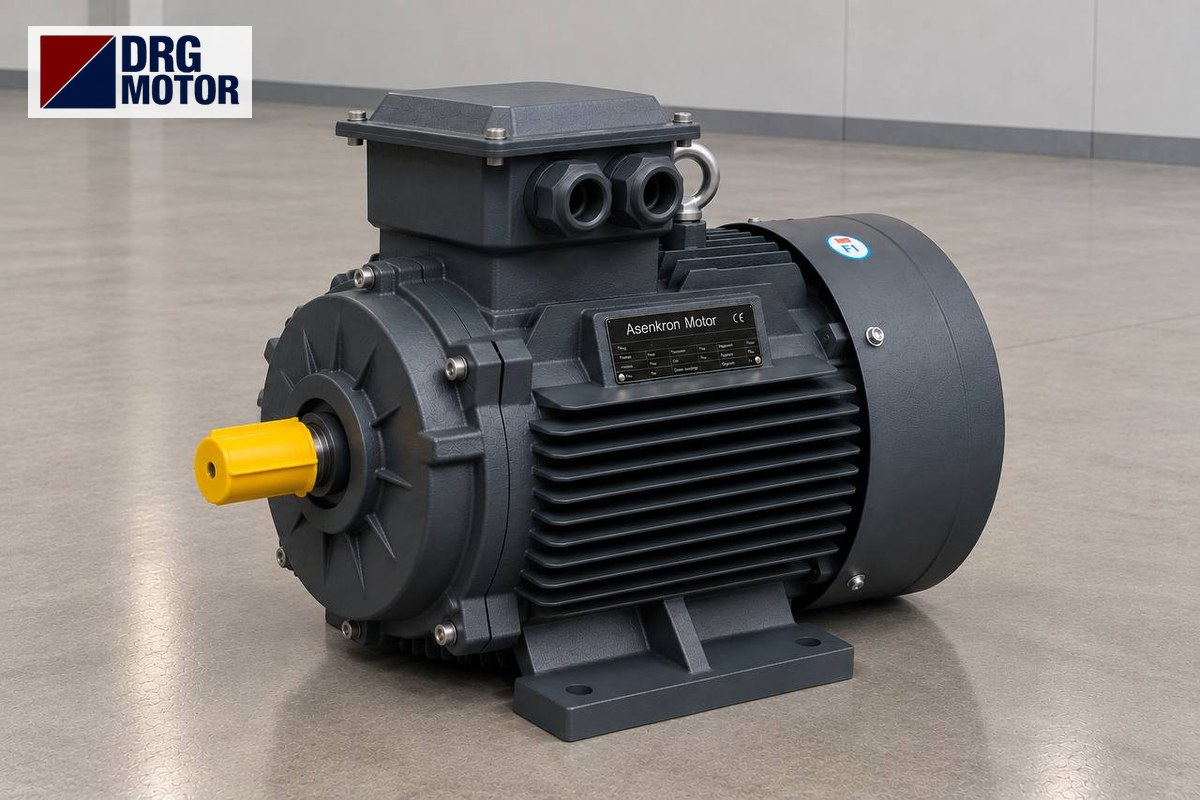

In sludge dewatering, motor selection splits into three separate questions depending on the machine: the main motor of a decanter centrifuge has to bring a heavy bowl up to high speed over a long start, so it is a 4-pole cast iron motor fed by an inverter; the scroll motor is smaller than the main motor and sets the differential speed through an inverter; belt presses and screw presses run on low-speed, geared, low-power motors. For example, the 18.5 kW 4-pole DRG-180M-4 draws 33.5 A at 400 V and delivers 120.2 Nm rated torque at 1470 rpm; in the worked example below, accelerating a 10 kg·m² bowl to 3200 rpm with this motor takes about 61 seconds at rated-torque level.
That start time is the core of the selection: started direct-on-line, the same motor would draw 7.8 times rated current, about 261 A, throughout the start and the overload relay would trip before the bowl got up to speed. Humidity and hydrogen sulphide (H2S) in the treatment building also affect the terminal box, cable entries and paint. You can see the technical data of 120 cast iron and aluminium models on the Buy Electric Motors Online page. The kW ranges and calculations in this article are based on example assumptions; the definitive value is the machine nameplate and the machine builder's data. Panel, inverter and motor connection work must be carried out by a qualified electrician.
Decanter, Belt Press and Screw Press: Why Are the Motors Different?
All three machines separate water from sludge, but they do it by different physical means, and what they demand from the motor changes accordingly:
| Machine | Motor task | Load character | Typical drive |
|---|---|---|---|
| Decanter main motor | Bring the bowl up to high speed | High inertia, long start | Belt + inverter |
| Decanter scroll motor | Bowl–scroll differential speed | Torque varies with sludge | Inverter + gearbox |
| Belt press | Drive the belts and rollers | Steady, light load | Gearbox + inverter |
| Screw press | Turn the screw very slowly | High torque, low speed | Multi-stage gearbox |
What they share is a wet, splash-prone, odorous environment and, in most plants, long daily operating hours. For the rest of the plant's motors (aeration blowers, pumps, mixers) see Electric Motor Selection in Wastewater Treatment Plants; this article focuses only on the dewatering unit.
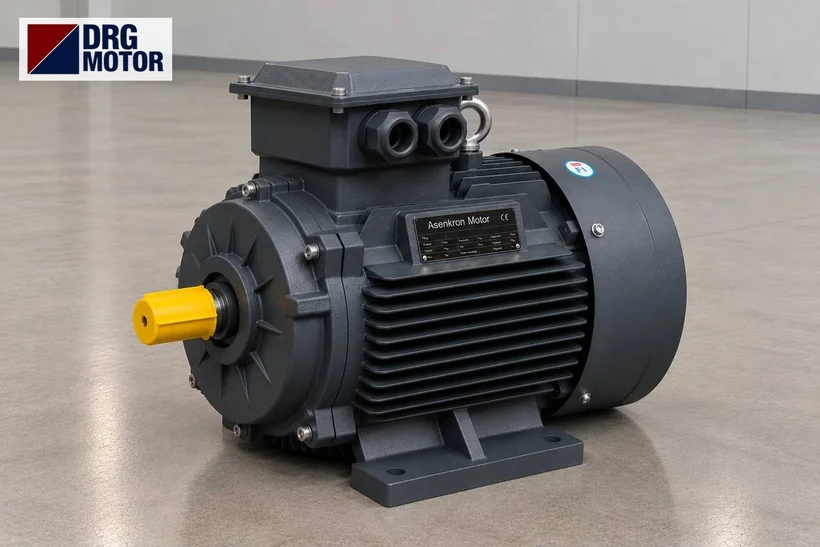
Decanter Main Motor: Bowl Inertia and Start Time
What stresses a decanter motor is the start rather than the running power. A long, heavy bowl needs a large amount of kinetic energy stored before it reaches high speed. Here is a worked example; inertia and bowl speed are assumptions, real values must come from the machine label or builder.
- Bowl inertia Jb = 10 kg·m² (assumption)
- Bowl speed 3200 rpm (assumption), belt drive
- Motor: DRG-180M-4, 1470 rpm, Tn = 120.2 Nm
Pulley ratio i = 3200 ÷ 1470 ≈ 2.18. The bowl inertia is reflected to the motor shaft by the square of the ratio: Jm = 10 × (3200 ÷ 1470)² ≈ 47.4 kg·m² (rotor and pulley inertia neglected). Motor angular speed ω = 2π × 1470 ÷ 60 ≈ 153.9 rad/s. If the inverter holds the accelerating torque at rated level, start time t = J·ω ÷ T ≈ 47.4 × 153.9 ÷ 120.2 ≈ 61 s. If the inverter allows 1.5 times rated torque for a short time, it drops to about 40 s.
The energy stored in the bowl is E = ½·J·ω² = ½ × 10 × (2π × 3200 ÷ 60)² ≈ 561 kJ, or about 0.16 kWh. That energy has to go somewhere when stopping: in a coast-down it dissipates slowly through friction; in a ramped stop it returns to the inverter DC bus and, without a braking resistor or regenerative unit, causes an overvoltage trip.
Why is direct-on-line starting unsuitable?
The DRG-180M-4 has a starting current ratio Is/In = 7.8; with 33.5 A rated current that is about 261 A. In a DOL start this current lasts tens of seconds until the bowl accelerates: the overload trips, the winding heats and the supply voltage dips. With star-delta starting the starting torque falls to one third, so an already long start gets even longer. Decanters therefore use an inverter or the soft starter specified by the builder. You can compare the methods on the motor starting methods and star-delta page.
Catalogue values of the motor in the example:
- Power: 18.5 kW
- Rated speed: 1470 rpm
- Current (400 V): 33.5 A
- cos φ: 0.86
- Rated torque: 120.2 Nm
- Ts/Tn: 2
- Tmax/Tn: 2.3
- Is/In: 7.8
- Shaft (D×E): 48×110 mm
- IEC frame: 180M (cast iron)
Scroll Motor and Differential Speed
In a decanter the scroll turns in the same direction as the bowl but at a slightly different speed; this small differential speed conveys the solids to the conical end of the bowl. On most machines the differential is set by a separate motor and inverter, and the operator or the automation changes it as sludge consistency changes. Three points stand out on the motor side:
- Torque varies: scroll torque rises with solids load; the motor should not stay above rated torque for long, and the inverter current limit must be set accordingly.
- Cooling at low speed: if the motor runs at low frequency for long periods, its own fan moves less air; check the builder's diagram for whether a forced-ventilation fan is required.
- Energy direction: in some designs the scroll drive is dragged by the bowl and the motor acts as a generator. The drive side then needs a braking resistor or a common DC bus; the motor itself does not change.
The scroll motor is smaller than the main motor and its exact rating is on the machine nameplate. When replacing it, keep the same kW, pole number, frame and mounting arrangement (foot or flange). You can check how torque and power vary with frequency using the VFD frequency–torque–power calculator.
Belt Press and Screw Press: Low Speed, High Torque
In a belt press the sludge is squeezed between two belts running over rollers; the drive motor moves the belts slowly through a gearbox and belt speed is set by an inverter. The load is steady and the start is easy; on most belt presses the drive motor is a small unit of a few kilowatts, with the exact value on the machine nameplate. The real risk here is environmental rather than mechanical: water and sludge from the belt wash nozzles splash onto the motor.
In a screw press the screw turns at a few revolutions per minute or less; torque is high and motor power is small. Worked example (assumptions: screw torque 6000 Nm, screw speed 2 rpm, gearbox transmission factor 0.85):
Power at the screw shaft P = T × n ÷ 9550 = 6000 × 2 ÷ 9550 ≈ 1.26 kW. Including gearbox losses the motor must supply ≈ 1.26 ÷ 0.85 ≈ 1.48 kW, which corresponds to a 1.5 kW motor. The 4-pole DRG-90L-4 runs at 1445 rpm, so the required gear ratio is 1445 ÷ 2 = 722.5. Its 9.91 Nm rated torque, with this ratio and the 0.85 factor, gives 9.91 × 722.5 × 0.85 ≈ 6086 Nm at the screw shaft, which covers the 6000 Nm. Ratios this high are usually achieved with multi-stage or planetary gearboxes; you can try the ratio and output torque in the gearbox output speed and torque calculator.
Humidity, H2S and Wash Water: Installation Checklist
The dewatering building is humid and the floor is wet; hydrogen sulphide from decomposing sludge slowly corrodes copper connections and metal surfaces where paint has come off. DRG store models are IP55: protected against dust and water jets from any direction, but not designed for direct high-pressure hose washing. Before commissioning the motor:
- Is the terminal box gasket in place and are the cover screws evenly tightened?
- Are the cable entries closed with correctly sized glands (2 × M40×1.5 on the DRG-180M-4) and is any unused entry plugged?
- Is the motor outside the splash zone of the belt wash nozzles and the decanter solids discharge; if not, is there a splash guard?
- Have paint scratches from transport and pulley fitting been touched up?
- Are the terminal nuts and earthing lug clean, free of oxide and tight?
- Have pulley alignment and belt tension been checked? On a decanter a slipping belt lengthens the start and heats the belt.
- Is there a plan to run the motor periodically or keep it dry during long maintenance shutdowns to prevent internal condensation?
Cable Size and Protection: 18.5 kW Example
The cable for a decanter main motor is chosen with the long start in mind. Rated current 33.5 A × 1.25 sizing factor = 41.9 A; for copper PVC cable 6 mm² carries 43 A, so 6 mm² covers this current (installation method, grouping and ambient temperature change the result). Over a 50 m run the voltage drop is ΔU = √3 × 33.5 × 0.05 × 3.08 × 0.86 ≈ 7.7 V, about 1.9% at 400 V, below the 3% limit accepted for the supply. At the inverter output, a shielded motor cable and the drive maker's cable length limit also apply. You can use the motor cable size calculator with your own values.
Which DRG Motor Should You Choose?
The table below shows 4-pole cast iron models matching the power ranges found in dewatering equipment. Main motors of medium-size decanters are mostly seen in the 15–30 kW range; screw and belt presses use drives of a few kilowatts. When replacing, keep the existing motor's kW, poles, frame and mounting exactly the same.
| Model | Power / speed | Frame | Current 400 V |
|---|---|---|---|
| DRG-90L-4 | 1.5 kW / 1445 rpm | 90L cast iron | 3.3 A |
| DRG-100L1-4 | 2.2 kW / 1450 rpm | 100L cast iron | 4.52 A |
| DRG-132M-4 | 7.5 kW / 1460 rpm | 132M cast iron | 14.3 A |
| DRG-160L-4 | 15 kW / 1465 rpm | 160L cast iron | 27.3 A |
| DRG-180M-4 | 18.5 kW / 1470 rpm | 180M cast iron | 33.5 A |
| DRG-180L-4 | 22 kW / 1470 rpm | 180L cast iron | 39.7 A |
| DRG-200L-4 | 30 kW / 1475 rpm | 200L cast iron | 53.8 A |
A 4-pole motor is preferred for the decanter main drive because bowl speed is obtained through the pulleys, and at the same power a 4-pole motor gives twice the torque: at 18.5 kW the DRG-180M-4 gives 120.2 Nm, the 2-pole DRG-160L-2 60.1 Nm. The starting current ratio is also lower on the 4-pole model (7.8 versus 8.2).
Motors in This Power Range for the Dewatering Unit
- DRG-90L-4 – 1.5 kW – 1445 rpm – 90L cast iron
- DRG-132M-4 – 7.5 kW – 1460 rpm – 132M cast iron
- DRG-160L-4 – 15 kW – 1465 rpm – 160L cast iron
- DRG-180M-4 – 18.5 kW – 1470 rpm – 180M cast iron
- DRG-180L-4 – 22 kW – 1470 rpm – 180L cast iron
- DRG-200L-4 – 30 kW – 1475 rpm – 200L cast iron
Click to see current prices and order these motors nowSEE PRICES →
Frequently Asked Questions
What kW should a decanter motor be?
It depends on bowl diameter, length and speed; on medium-size decanters the main motor is mostly seen in the 15–30 kW range. The definitive value is the machine nameplate and the builder's documentation; when replacing, keep the same kW and pole number.
Why does a decanter take so long to start?
The bowl inertia is reflected to the motor shaft by the square of the pulley ratio. In our example a 10 kg·m² bowl acted as about 47.4 kg·m² on the motor shaft, and with an 18.5 kW motor at rated-torque level the start took about 61 s. This is normal for the machine; the inverter ramp is set accordingly.
How many amps does an 18.5 kW motor draw?
The 4-pole DRG-180M-4 draws 33.5 A at 400 V and 35.3 A at 380 V at full load. With a starting current ratio Is/In = 7.8, the DOL starting current rises to about 261 A.
Can a sludge dewatering motor be started star-delta?
On belt presses and screw presses it is possible because the start is light, but these machines need speed control so an inverter is usually present anyway. On the decanter main motor, star-delta cuts starting torque to one third and lengthens an already long start; unless the builder states otherwise, an inverter or soft starter is used.
Send us the nameplate or the machine's hydraulic/mechanical data and we will pin down the right DRG model with you: phone +90 (542) 666 11 11, e-mail [email protected], or our contact page. To browse the models directly, go to Buy Electric Motors Online.