English
 Le français
 Türkçe




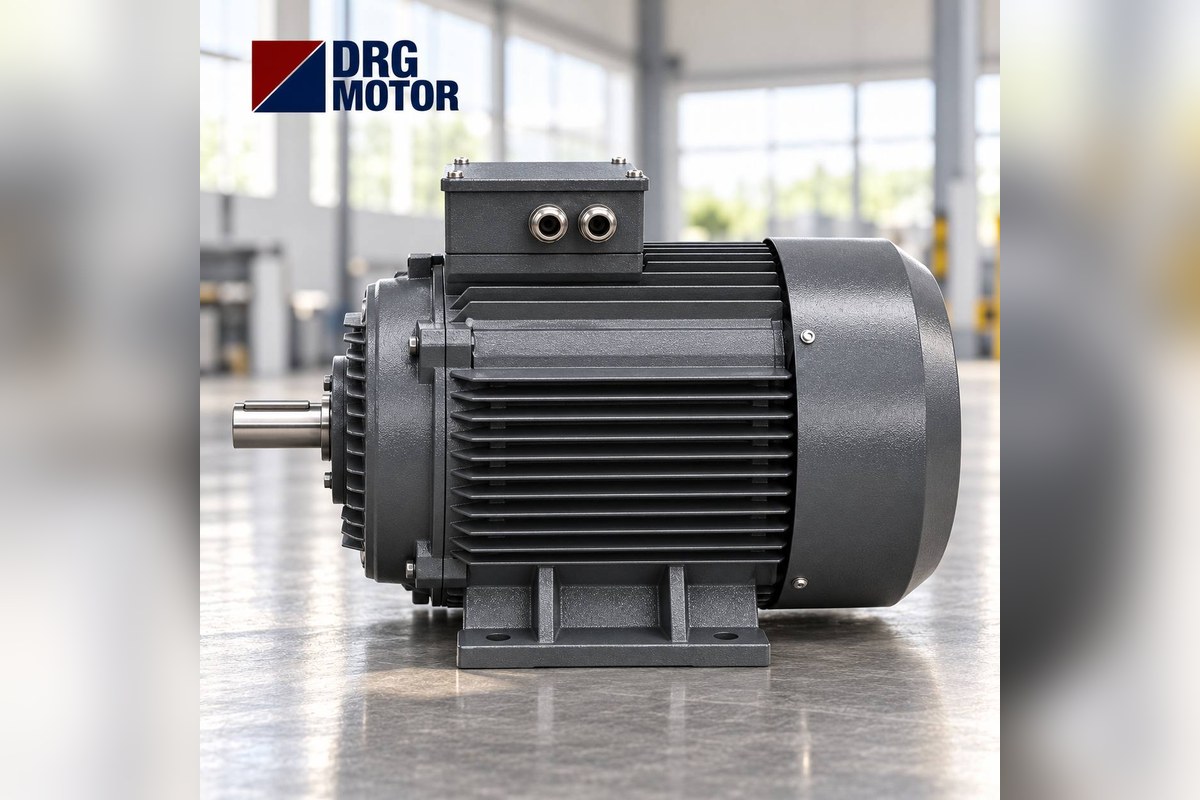

The agitator motor of a milk cooling tank is a small three-phase motor mounted vertically (shaft down) on top of the tank lid, turning the agitator paddle at a few tens of rpm through a gearbox; on most tanks a 0.25–0.75 kW, 4-pole (1500 rpm class) motor is enough. For example, the DRG-712-4 is 0.37 kW, 1340 rpm and draws only 0.92 A at 400 V. On replacement the deciding factor is not power but the flange and shaft by which the motor joins the gearbox: the small flange (B14) common on tank agitators is not tabulated in the catalogue, so it must be measured on the existing motor and confirmed before ordering.
So to find the right motor you look first at the gearbox input, then match power and speed. If the agitator stops while the tank is full, cream separates and cooling becomes uneven; the replacement should therefore be quick but based on measurements. Motor connection and earthing must be done by a qualified electrician; barns and milking parlours are damp, with plenty of wash water. You can see suitable models with current prices among the 120 models on the Buy Electric Motors Online page.
The 3 most common mistakes when replacing an agitator motor
- Looking only at kW and not measuring the flange: Different small-flange sizes can be used on the same frame. A 0.37 kW motor arrives as “the same power” but does not fit the gearbox spigot.
- Fitting a 2-pole motor to mix faster: With a fixed gearbox ratio, doubling motor speed doubles agitator speed; milk foams, fat globules are damaged and the gearbox runs hot.
- Treating a vertical motor like a horizontal one: On a shaft-down motor, condensation and wash water collect at the lowest point, the shaft and flange end. Not stating in the order that the motor will run vertically (shaft down) is the most common cause of moisture-related failures.
How does the agitator work? Gearbox ratio and output torque
Tank agitators turn milk slowly: paddle speed varies by maker and in practice is a few tens of rpm. Mostly a worm or helical gearbox is used to bring motor speed down to this level. The ratio is i = nmotor / nagitator, and output torque is Tout ≈ Tn × i × (1 − loss allowance).
Below, agitator speed is assumed at 30 rpm and a 30% allowance is left for worm gearbox losses (the real value is on the gearbox label and maker's documents). Tn values are from the DRG catalogue:
| Motor | Ratio (30 rpm output) | Output torque (≈) | Current 400 V |
|---|---|---|---|
| DRG-711-4 · 0.25 kW | i ≈ 44.7 | 55.7 Nm | 0.66 A |
| DRG-712-4 · 0.37 kW | i ≈ 44.7 | 82.5 Nm | 0.92 A |
| DRG-801-4 · 0.55 kW | i ≈ 46.7 | 122.5 Nm | 1.31 A |
| DRG-802-4 · 0.75 kW | i ≈ 47.3 | 167 Nm | 1.75 A |
The 0.37 kW motor, with a ratio around 44.7, gives about 82.5 Nm at the output; for a tank agitator this is a margin that also turns cream settled at the bottom of the tank at start-up. A bigger motor does not mix faster; it only sends more torque to the gearbox, since speed is set by the gearbox ratio. On tanks wanting lower agitator speed, the 6-pole DRG-712-6 (855 rpm) brings the ratio for the same 30 rpm down to 28.5. For your own values, use the gearbox output speed and torque calculator.
How many kW? A cautious range by tank size
Agitator power depends on tank volume, paddle diameter and number of paddles; since these vary from maker to maker, a single table would be misleading. The range commonly seen in the field:
- Small and medium tanks: 0.25–0.37 kW, 4-pole.
- Large tanks or twin-paddle agitators: 0.55–0.75 kW.
- Very large horizontal cylindrical tanks: 1.1 kW and above, sometimes two separate agitators.
The exact value is on the old motor's nameplate and the tank label. If the nameplate is unreadable, the frame number (71, 80, 90) and shaft diameter are the most reliable clues: in the DRG catalogue, 4-pole powers are 0.25–0.37 kW in frame 71, 0.55–0.75 kW in frame 80 and 1.1 kW in frame 90S.
Click to see current electric motor prices and order nowSEE PRICES →
Flange and shaft fit: B14 or B5?
The gearbox on top of the tank carries the motor in one of two ways. With a B5 (large flange) connection the flange overhangs the housing and bolts pass through its holes; with B14 (small flange) the flange stays within the housing diameter and bolts screw into tapped holes in the motor. B14 is common on small agitator gearboxes.
| Frame | Shaft D × E / key F | B5 flange P / M / N | Example model |
|---|---|---|---|
| 71 | 14 × 30 / 5 mm | 160 / 130 / 110 mm | DRG-712-4 |
| 80 | 19 × 40 / 6 mm | 200 / 165 / 130 mm | DRG-801-4 |
| 90S | 24 × 50 / 8 mm | 200 / 165 / 130 mm | DRG-90S-4 |
B5 dimensions are from the DRG catalogue. For a B14 connection, take these measurements from the existing motor and confirm them with us before ordering:
- Flange outer diameter P and spigot (pilot) diameter N.
- Tapped hole pitch circle M, number of holes and thread size.
- Shaft diameter D, shaft length E and key width F.
- Is the gearbox input a hollow shaft (the motor shaft goes straight into the gearbox) or a coupling?
How a flanged motor connects to a gearbox is detailed in our article on choosing a flange motor for a gearbox; frame drawings are on the technical drawings page.
Intermittent running, moisture and washing
On most tanks the agitator motor does not turn all the time; it starts and stops at intervals during cooling and between milkings. Frequent starting is no problem for a small motor: the DRG-712-4 briefly draws 5.2 times rated current at start, under 5 A. The real risk is moisture condensing inside the motor as it cools while stopped.
- State in the order that the motor will run vertically, shaft down; for the bearing and lubrication differences of vertical mounting, see our article on horizontal vs vertical motor mounting.
- Point the cable gland downwards and connect the cable with a drip loop; keep the terminal box lid gasket in place.
- Do not hose the motor directly when washing the tank; DRG motors are IP55, protected against splashing, but not a target for pressurised water.
- Keep the top of the fan cover clear of dust and straw; on a vertical motor the fan cover faces up, so debris falls straight into the air intake.
- If needed, fit a rain canopy over the fan cover; on outdoor tanks it stops rainwater filling the fan cover.
Replacing the motor step by step
- Switch off the cooling unit and agitator at the panel, lock and tag the breaker.
- If the tank is full, allow for the milk staying unstirred for a short time; plan the change when the tank is empty or right after milking.
- Photograph the old motor's nameplate and the gearbox label; take the flange and shaft measurements.
- When separating the motor from the gearbox, take care the coupling or key does not drop; the key goes on the new motor as is.
- Clean the new motor shaft and the gearbox bore, apply a thin coat of assembly paste and seat the motor on the spigot without forcing.
- Tighten bolts in a cross pattern; do not pull the flange in with the bolts before it is fully seated.
- DRG motors from 0.25 to 3 kW are rated 230/400 V: star-connected on a 400 V three-phase supply. Check agitator direction at first start; if reversed, swap two phases.
- Set the overload to the rated current on the nameplate; for a low-current motor choose an overload with a suitable setting range.
For overload and contactor selection at low currents, see the overload, fuse and contactor selection tool.
Which DRG motor should you buy?
For tank agitators, the light, corrosion-resistant aluminium frame stands out; small 4-pole powers:
| Model | Power / speed | Frame | Current 400 V |
|---|---|---|---|
| DRG-711-4 | 0.25 kW / 1340 rpm | 71 · aluminium | 0.66 A |
| DRG-712-4 | 0.37 kW / 1340 rpm | 71 · aluminium | 0.92 A |
| DRG-801-4 | 0.55 kW / 1400 rpm | 80 · aluminium | 1.31 A |
| DRG-802-4 | 0.75 kW / 1420 rpm | 80 · aluminium | 1.75 A |
| DRG-90S-4 | 1.1 kW / 1445 rpm | 90S · aluminium | 2.48 A |
| DRG-712-6 | 0.25 kW / 855 rpm | 71 · aluminium | 0.77 A |
Data of the 0.37 kW model common on mid-size tanks:
- Power: 0.37 kW
- Rated speed: 1340 rpm
- Frame: 71 · aluminium
- Voltage: 230/400 V (Δ/Y)
- Current 400 V: 0.92 A
- cos φ: 0.75
- Rated torque: 2.64 Nm
- Starting torque: 2.1 × Tn
- Starting current: 5.2 × In
- Shaft D × E: 14 × 30 mm
- Bearing: 6202-ZZ-C3
- Cable entry: 1 × M20×1.5
DRG Motor is a manufacturer, supplier and seller of electric motors; DRG MOTOR motors are guaranteed for 2 years from the delivery date against material and manufacturing defects (warranty certificate). Shipping is by contracted freight or cargo carriers and is paid by the buyer; details are on the sales, delivery and return terms page.
The vacuum pump motor in the same milking parlour is a different calculation; for that, see our article on how many kW a milking machine motor needs.
Motors in this power range
- DRG-711-4 – 0.25 kW – 1340 rpm – 71 aluminium
- DRG-712-4 – 0.37 kW – 1340 rpm – 71 aluminium
- DRG-801-4 – 0.55 kW – 1400 rpm – 80 aluminium
- DRG-802-4 – 0.75 kW – 1420 rpm – 80 aluminium
- DRG-90S-4 – 1.1 kW – 1445 rpm – 90S aluminium
- DRG-712-6 – 0.25 kW – 855 rpm – 71 aluminium
Click to see current prices and order these motors nowSEE PRICES →
Frequently Asked Questions
How many kW is a milk tank agitator motor?
Most tanks use a 0.25–0.75 kW 4-pole motor; very large tanks use 1.1 kW and above. The exact value is on the old motor's nameplate; without one, the power range is found from the frame number and shaft diameter.
What speed should the agitator motor have?
The motor is usually 4-pole, 1340–1445 rpm; the gearbox sets the paddle speed. Changing motor speed changes agitator speed in the same proportion.
How do I find the B14 flange size of a milk tank motor?
Measure it on the existing motor: flange outer diameter P, spigot diameter N, pitch circle M, thread size and shaft D × E. Small flange dimensions are not tabulated in the catalogue; send the measurements and get confirmation before ordering.
How many amps does a 0.37 kW motor draw?
The DRG-712-4 draws 0.92 A at 400 V and 0.97 A at 380 V; it is rated 230/400 V and is star-connected on a 400 V supply.
Send us the nameplate of your current motor, the pump or machine label and a few measurements, and we will narrow down the right DRG model together: phone +90 (542) 666 11 11, e-mail [email protected], contact page. For all models and current prices, see Buy Electric Motors Online.