English
 Le français
 Türkçe




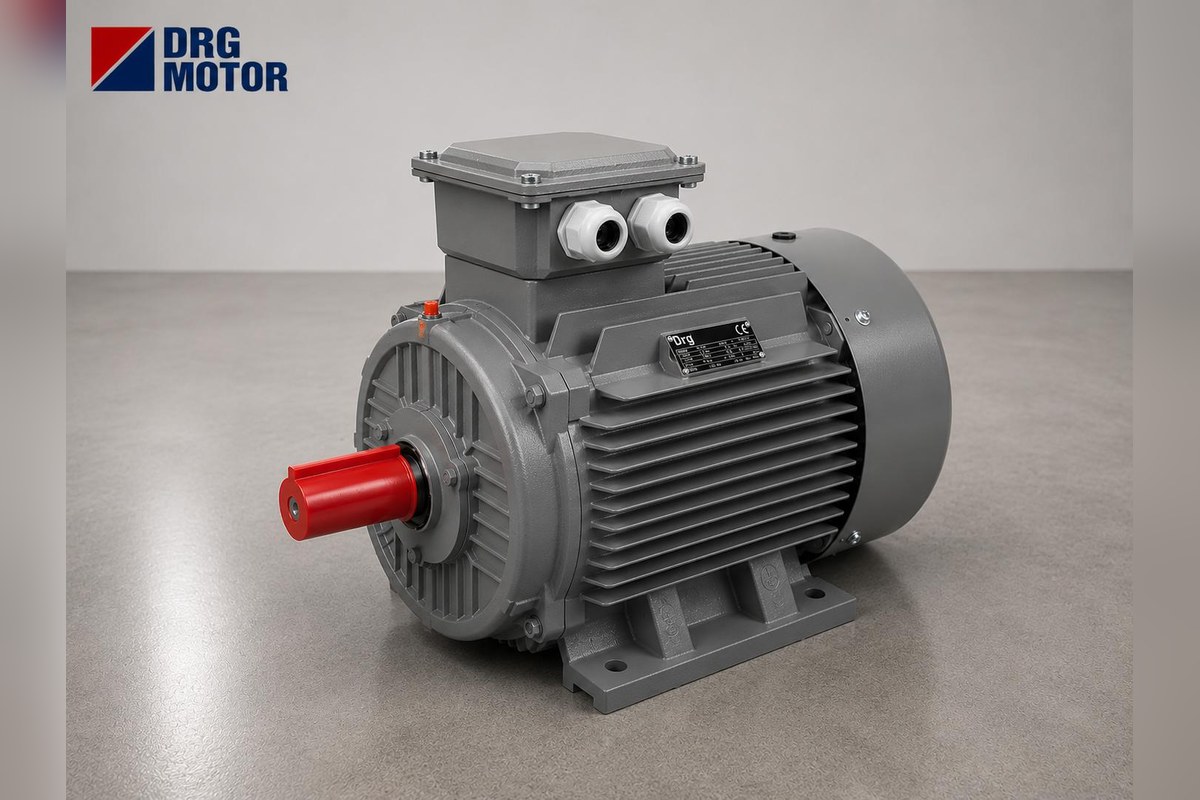

In a milking machine the motor has one job, turning the vacuum pump, and its power depends on the pump's air flow: on single or double portable (bucket) machines it is generally 0.55–1.1 kW, while fixed pipeline milking systems use 2.2 kW and above; the exact value is in the vacuum pump maker's data. A 0.75 kW, 1500 rpm motor often used on portable machines (DRG-802-4) draws 1.75 A at 400 V and 1.84 A at 380 V; the 3 kW DRG-100L2-4 on a fixed system draws 6.02 A at 400 V.
Motor power is set not by the number of animals but by the number of milking units running at the same time and the leakage allowance of the pipeline; adding a second unit or extending the milk line increases pump flow and therefore the motor. In the barn, moisture, manure ammonia and wash water are the motor's worst enemies, so IP55 protection and a correctly set overload relay are essential. Wiring and protection settings must be done by a qualified electrician. You can choose the right power by output and speed from the models on our Buy Electric Motors Online page.
Portable vs Fixed Milking Systems: What Changes for the Motor?
A portable (trolley) milking machine consists of a vacuum pump, motor, vacuum regulator, bucket and one or two milking units. The machine is taken to the animal and wheeled to the next stall when milking is done. As the motor sits on a wheeled chassis, low weight matters; it runs in short spells during the two daily milkings.
In a fixed system the vacuum pump and its motor stand permanently in a separate machine room. The vacuum line runs through the barn in pipes, the milking units connect to it, and the milk usually travels through a separate milk line to the cooling tank. Because of the long pipeline, many connection points and many units working at once, pump flow is much higher in this system. The motor grows accordingly and runs without a break during milking, so overload protection and ventilation are more critical than on a portable machine.
Motor Power from Vacuum Pump Flow
Conceptually, motor power for a vacuum pump is estimated with P = Q · Δp / ηp. Q is the air flow drawn by the pump (m³/s), Δp the working vacuum (Pa) and ηp the pump efficiency. Pump efficiency varies with pump type (rotary vane, liquid ring or piston) and wear. The assumptions in the two examples below are stated openly: working vacuum 50 kPa, pump efficiency 0.30 for the portable example and 0.35 for the fixed one. Real values are on the pump label and in its maker's catalogue.
| Example | Flow Q (L/min) | Vacuum Δp (kPa) | Pump efficiency ηp (assumed) | Calculated power (kW) | Standard power to choose (kW) |
|---|---|---|---|---|---|
| Portable, single/double | 250 | 50 | 0.30 | 0.69 | 0.75 |
| Fixed pipeline system | 1000 | 50 | 0.35 | 2.38 | 3 |
In the portable example the calculation is 250 / 60000 m³/s × 50000 Pa / 0.30 ≈ 694 W, i.e. about 0.69 kW; the next standard size up is 0.75 kW. In the fixed example a flow of 1000 L/min gives about 2.38 kW, and since 2.2 kW would be borderline, 3 kW is chosen. Use this table as an order-of-magnitude check, not an order list: if your pump label states a "required motor power", that value prevails. To try pump and fan motor power with your own values, use the pump-fan motor power calculator.
1500 rpm Motor, Belt or Direct Coupling
On milking machines the vacuum pump mostly runs with a 4-pole motor of about 1500 rpm. If the pump is coupled directly to the motor shaft, pump speed equals the motor's rated speed; for the 0.75 kW DRG-802-4 this is 1420 rpm. If the pump is designed to run slower, a belt and pulleys are used.
Belt example: motor pulley 90 mm, pump pulley 125 mm. Pump speed = motor speed × motor pulley / pump pulley = 1420 × 90 / 125 ≈ 1022 rpm. If you enlarge the motor pulley to 100 mm without changing the pump pulley, pump speed rises to about 1136 rpm; flow increases, but the motor is loaded more and the pump vanes wear faster. Choose pulley diameter for the speed recommended by the pump maker; you can verify the calculation with the pulley and belt calculator.
A 2-pole (3000 rpm) motor, even when compensated by pulley ratio, is rarely preferred on a milking pump: belt and bearings spin faster, noise rises and belt slip appears on a small motor pulley.
Single-Phase or Three-Phase?
On small farms only a single-phase line may reach the barn, which is why some portable machines are sold with single-phase motors. If a three-phase supply is available, a three-phase motor is preferred: it draws lower phase current at the same power, has no extra parts that can fail such as a start capacitor or centrifugal switch, and its starting torque copes more easily with pump oil thickened by cold. When deciding which supply to keep, see single-phase or three-phase motor: which to buy.
Extension leads are common on three-phase portable machines; if the cross-section is small and the lead long, the motor runs at low voltage and heats up. Example: if a 3 kW fixed pump motor draws 6.02 A at 400 V and is fed from the panel to the machine room through 100 m of 2.5 mm² copper cable, the voltage drop is ΔU = √3 × 6.02 × 0.1 × 7.41 × 0.82 ≈ 6.3 V, i.e. about 1.6%; this is below the 3% acceptance limit. For your own length use the motor cable size calculator.
Barn Conditions: Moisture, Ammonia and Overload Protection
In the milking parlour the motor shares the space with wash-water splashes, condensation, ammonia rising from manure and dust. IP55 protection, class F insulation and electrostatic powder coating are standard on DRG motors; even so, it is installation and maintenance habits that decide the motor's life.
- Do not place the motor where the wash hose will be aimed directly at it; pressurised water is outside the scope of IP55.
- Have the terminal box cable entry face down; tighten the gland and plug any unused entry.
- Clean dust, straw and cobwebs from the fan cover every week; a clogged cover heats the winding while the current still looks normal.
- Set the overload relay to the rated current on the motor plate: for the 0.75 kW DRG-802-4, 1.84 A at 380 V and 1.75 A at 400 V. Check the setting with the overload, fuse and contactor selection tool.
- Use a phase-failure relay; loss of one phase is common on rural lines and a motor left on two phases burns out quickly.
- If the pump is oil-lubricated, check the oil level; a dry pump strains the motor and raises the current.
- If the motor struggles on cold winter mornings, change the pump oil to the viscosity recommended by the pump maker.
- Earth the motor frame; an unearthed machine on a wet floor is dangerous for both people and animals.
Which DRG Motor Should I Buy? Model Table for Milking Machines
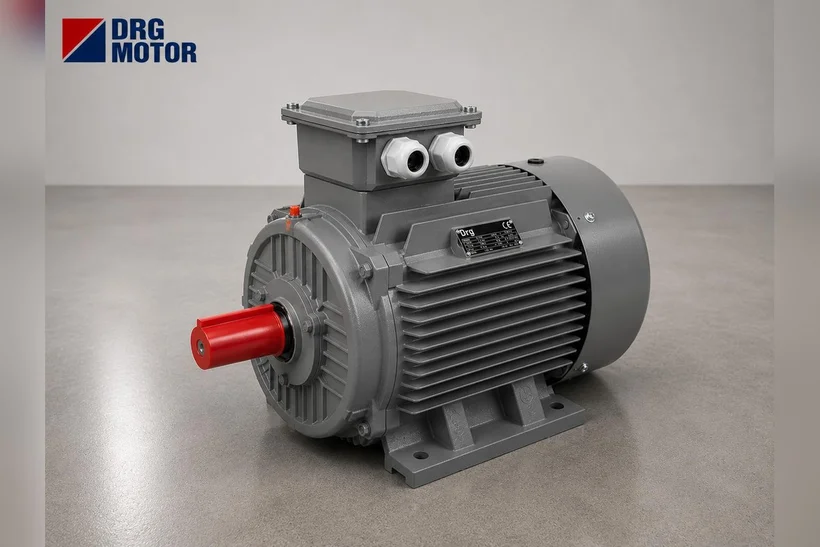
An aluminium frame suits portable machines for its low weight; a cast iron frame suits a pump standing in the machine room. The values in the table are catalogue data; match the row to the power and speed on the pump label.
| Model | Use | Power (kW) | Rated speed (rpm) | Frame | Current 400 V (A) | Shaft D × E (mm) |
|---|---|---|---|---|---|---|
| DRG-801-4 | Portable, single | 0.55 | 1400 | 80 aluminium | 1.31 | 19 × 40 |
| DRG-802-4 | Portable, double | 0.75 | 1420 | 80 aluminium | 1.75 | 19 × 40 |
| DRG-90S-4 | Portable, double with larger pump | 1.1 | 1445 | 90S aluminium | 2.48 | 24 × 50 |
| DRG-100L1-4 | Fixed system | 2.2 | 1450 | 100L cast iron | 4.52 | 28 × 60 |
| DRG-100L2-4 | Fixed system | 3 | 1450 | 100L cast iron | 6.02 | 28 × 60 |
| DRG-112M-4 | Large fixed system | 4 | 1450 | 112M cast iron | 7.95 | 28 × 60 |
The 0.55 kW and 0.75 kW models share the same 80 frame and 19 × 40 mm shaft; when going from one unit to two, power can be increased without changing the motor feet or pulley connection. If the pump changes too, base the choice on the power the new pump requires. Models of 3 kW and below are 230/400 V and are star-connected on a 400 V supply.
Motors in This Power Range
- DRG-801-4 – 0.55 kW – 1400 rpm – 80
- DRG-802-4 – 0.75 kW – 1420 rpm – 80
- DRG-90S-4 – 1.1 kW – 1445 rpm – 90S
- DRG-100L1-4 – 2.2 kW – 1450 rpm – 100L
- DRG-100L2-4 – 3 kW – 1450 rpm – 100L
Click to see current prices and order these motors nowSEE PRICES →
Frequently Asked Questions
How many kW is a double milking machine motor?
On double portable machines the motor is generally seen in the 0.75–1.1 kW range; the exact value is on the vacuum pump label. Without a pump label, the flow calculation above gives the order of magnitude; round the choice up to the next standard size.
What speed should a milking machine motor be?
Mostly a 4-pole motor of about 1500 rpm is used; at DRG the rated speed of the 0.75 kW model is 1420 rpm. On belt-driven machines pump speed is set by the pulley ratio, so keep the old motor's speed when replacing it.
Why does a milking machine motor trip its overload?
The most common causes are a clogged fan cover, a dry or worn pump, low voltage from a long thin extension lead, and phase loss. Also check that the overload is set to the plate current; a setting that is too low stops a healthy motor too.
How many amps does a 0.75 kW milking motor draw?
The 0.75 kW, 1500 rpm DRG-802-4 draws 1.84 A at 380 V and 1.75 A at 400 V at full load; its power factor is cos φ = 0.75. Starting current is around 6.6 times rated current.
Send us your vacuum pump label data and the plate of your current motor, and we will determine the right motor together: +90 (542) 666 11 11, [email protected] or our contact page. For all models see Buy Electric Motors Online.