English
 Le français
 Türkçe




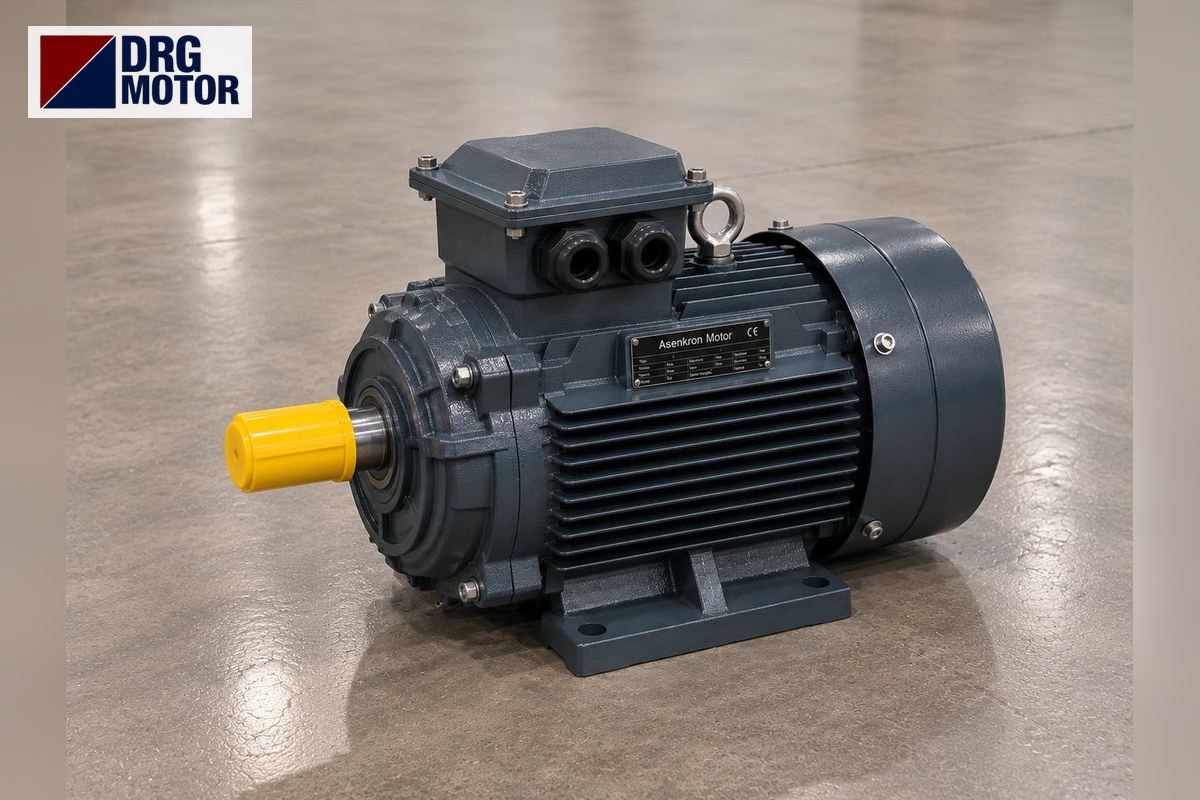

An industrial vacuum pump motor is sized for the highest point of the pump's power curve, not for its operating pressure. Example: for a vacuum pump with 250 m³/h suction capacity, ideal compression power peaks at about 370 mbar absolute; with an assumed pump efficiency the shaft power comes to ≈ 5.75 kW, and a 7.5 kW 4-pole motor is enough. The DRG-132M-4 runs at 1460 rpm for this job, draws 14.3 A at 400 V and can be close-coupled to the pump with a B5 flange. If the pump nameplate or catalogue states a motor power, that value comes first.
To see why a vacuum pump motor is sized for the top of the curve, think of one cycle: while a tank is evacuated, suction pressure falls from atmospheric to working vacuum, and along the way the power drawn by the pump first rises and then falls. A motor sized for the operating point is overloaded for a while at every pump-down. Connection, overload setting and rotation check must be done by a qualified electrician. This article covers motor selection and replacement for liquid ring, rotary vane and Roots vacuum pumps; small pumps on dairy farms are covered separately: milking machine motor – how many kW. To compare models, visit Buy Electric Motors Online.
Vacuum Pump Power Curve: Why the Motor Is Sized for the Peak
The ideal (isothermal) power needed to compress the gas up to atmosphere is P = p1 · Q · ln(patm / p1), where p1 is suction pressure and Q is suction flow. With constant flow this expression reaches its maximum at p1 = patm / e, about 373 mbar absolute. The table below assumes 250 m³/h and a pump efficiency η_p = 0.45; the real curve is in the pump manufacturer's catalogue.
| Suction pressure (abs.) | Ideal compression power | Shaft power (η_p = 0.45) | Condition |
|---|---|---|---|
| 100 mbar | 1.61 kW | 3.57 kW | deep vacuum |
| 200 mbar | 2.25 kW | 5.01 kW | operating point |
| 373 mbar | 2.59 kW | 5.75 kW | highest load |
| 600 mbar | 2.18 kW | 4.85 kW | during pump-down |
| 800 mbar | 1.31 kW | 2.92 kW | start of pump-down |
Shaft power at the peak is ≈ 5.75 kW, ≈ 6.33 kW with a 10% margin; the next standard rating is 7.5 kW. Someone looking only at the 200 mbar operating point would think a 5.5 kW motor is enough; that motor is loaded every time the pump passes the peak zone. To try other flow and pressure values, use the pump and fan motor power calculator.
The Load the Motor Sees by Pump Type
Liquid ring vacuum pump
A ring of water (or another service liquid) rotating in the casing provides the seal. Liquid ring friction is added to gas compression power, so the real curve is flatter than the ideal one and can stay high near atmospheric pressure. Size the motor for the highest value on the manufacturer's curve. Overfilling with service liquid raises starting torque; liquid level and temperature must follow the pump instructions. A gland or mechanical seal sits between pump and motor; if it leaks, water travels toward the motor end shield and flange. With these pumps an IP55 motor and a drainage gap under the flange matter.
Rotary vane (oil-lubricated or dry) vacuum pump
Vanes on the rotor are pressed against the casing by centrifugal force. In oil-lubricated pumps, cold oil is more viscous, so first-start torque rises; for a pump in a cold room, check the starting torque ratio (Ts/Tn). These pumps are usually close-coupled to a 4-pole motor and the power range is generally small; 1.5–7.5 kW is common, but the definitive value is the pump nameplate.
Roots vacuum pump (booster)
A Roots vacuum pump does not discharge to atmosphere on its own; it works with a backing pump and is switched on once pressure falls below a set value. Motor load is defined by the pressure difference across the two stages; a booster switched on too early overloads its motor. The cut-in pressure or by-pass valve must therefore be set correctly. Boosters like high speed, so a 2-pole motor (e.g. DRG-112M-2, 2905 rpm) is common.
Close-Coupled Mounting: Bell Housing and B5 Dimensions
Most vacuum pumps are connected to the motor with a coupling and a bell housing (adapter flange). The motor is B5 flange or foot-and-flange (B35); if pump and motor both stand on feet, the coupling is aligned by hand. For the bell housing to fit, three dimensions must match exactly: flange bolt circle M, spigot diameter N and shaft D × E. B5 large flange dimensions from the DRG catalogue:
| Frame | Shaft D × E | Flange M / N / P | Hole S |
|---|---|---|---|
| IEC 90L | 24 × 50 mm | 165 / 130 / 200 mm | 12 mm |
| IEC 100L | 28 × 60 mm | 215 / 180 / 250 mm | 14.5 mm |
| IEC 112M | 28 × 60 mm | 215 / 180 / 250 mm | 14.5 mm |
| IEC 132S | 38 × 80 mm | 265 / 230 / 300 mm | 14.5 mm |
| IEC 132M | 38 × 80 mm | 265 / 230 / 300 mm | 14.5 mm |
| IEC 160M | 42 × 110 mm | 300 / 250 / 350 mm | 18.5 mm |
Two practical points follow from the table: 100L and 112M share the same flange and the same 28 × 60 shaft, so a 3 kW pump and a 4 kW pump use the same bell housing; 132S and 132M are also identical with a 38 × 80 shaft. When the flange changes with a bigger frame, the bell housing and coupling must change too. All dimensions are on the DRG motor technical drawings page.
Long Running Hours and Heating
In most plants vacuum pumps stay on for the whole shift, and motor temperature depends more on cooling quality than on load. Conditions that raise temperature:
- The motor fan intake too close to a wall or pump enclosure (hot air recirculation).
- Warm service water in a liquid ring pump; the pump draws more power and motor current rises.
- A clogged filter or process leak: the pump keeps running near the peak zone.
- Low voltage: current rises for the same power. Compare current with the nameplate value; the motor current chart gives values for other ratings.
For the 7.5 kW DRG-132M-4, the ≈ 5.75 kW peak load means 9550 × 5.75 / 1460 ≈ 37.6 Nm on the shaft; it stays below the rated torque (49.1 Nm) and the motor runs with thermal reserve.
Starting Current and Starting Method
The DRG-132M-4 is wound 400/690 V (Δ/Y); on a 400 V supply it is connected in delta and is suitable for star-delta starting. Direct-on-line starting current is about 7.5 × 14.3 ≈ 107.2 A and starting torque 2.0 × 49.1 ≈ 98.2 Nm. DRG models of 3 kW and below are wound 230/400 V (Δ/Y): on a 400 V supply they are connected in star and are therefore not suitable for star-delta starting; at these ratings use direct-on-line starting or a soft starter. For choosing the method see star-delta starting.
Motor Replacement Checklist and Direction of Rotation
Mounting-relevant specifications of a 7.5 kW 4-pole replacement motor:
- Power: 7.5 kW (10 HP)
- Rated speed: 1460 rpm
- Current 380 V / 400 V: 15 A / 14.3 A
- cos φ: 0.84
- Rated torque: 49.1 Nm
- Starting torque ratio Ts/Tn: 2
- Connection (400 V supply): delta (Δ), 400/690 V winding
- Shaft D×E: 38 × 80 mm
- B5 flange M / N / P: 265 / 230 / 300 mm
- Bearing: 6208-ZZ-C3
Replacement sequence:
- Note power, speed, voltage/connection and mounting arrangement (B5, B35, B3) from the old motor's nameplate.
- Measure the bell housing spigot diameter (N) and bolt circle (M); check shaft D × E and key width.
- Fit the coupling hub tightly on the shaft; leave the gap between coupling halves at the coupling maker's value.
- Tighten flange bolts crosswise; if the motor weight hangs on the bell housing, support the motor.
- Set the overload relay to nameplate current (DRG-132M-4: 14.3 A at 400 V); the overload, fuse and contactor selection tool can be used.
- Verify rotation without running the pump. Disconnect the coupling and jog the motor, or jog as allowed by the pump instructions; compare with the arrow on the pump casing. A rotary vane pump running backwards can damage the vanes and oil circuit; a liquid ring pump must not run without service liquid. If reversed, swap two phases.
- Record vacuum level and motor current together on first start; use this record for comparison at later maintenance.
Motors in This Power Range: DRG Models for Vacuum Pumps
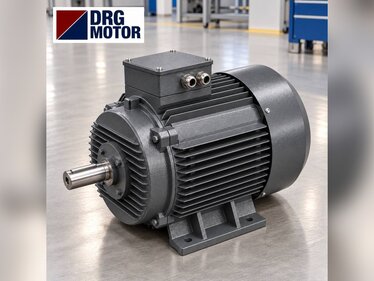
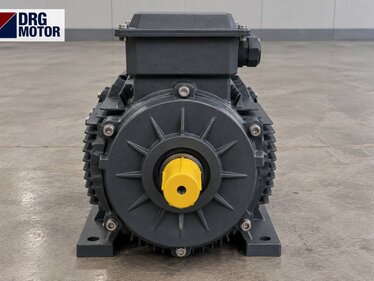
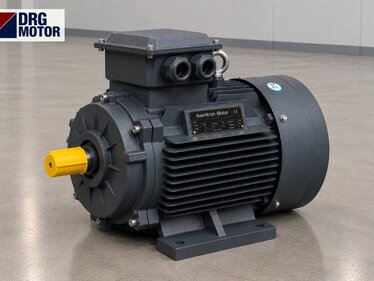
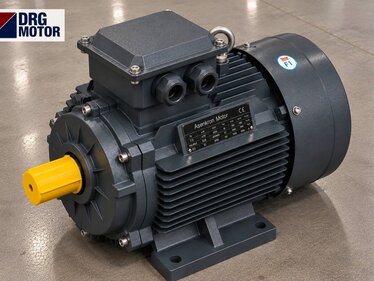
DRG Motor is a manufacturer, supplier and seller of electric motors. The cast iron models below cover the power range common on industrial vacuum pumps; aluminium-frame versions of the 1.5–4 kW models are also in the store.
| Model | Power / speed | Frame | Current 400 V |
|---|---|---|---|
| DRG-90L-4 | 1.5 kW / 1445 rpm | IEC 90L cast iron | 3.3 A |
| DRG-100L1-4 | 2.2 kW / 1450 rpm | IEC 100L cast iron | 4.52 A |
| DRG-100L2-4 | 3 kW / 1450 rpm | IEC 100L cast iron | 6.02 A |
| DRG-112M-4 | 4 kW / 1450 rpm | IEC 112M cast iron | 7.95 A |
| DRG-132S-4 | 5.5 kW / 1460 rpm | IEC 132S cast iron | 10.7 A |
| DRG-132M-4 | 7.5 kW / 1460 rpm | IEC 132M cast iron | 14.3 A |
| DRG-160M-4 | 11 kW / 1465 rpm | IEC 160M cast iron | 20.4 A |
| DRG-112M-2 | 4 kW / 2905 rpm | IEC 112M cast iron | 7.45 A |
| DRG-132S1-2 | 5.5 kW / 2930 rpm | IEC 132S cast iron | 10.1 A |
- DRG-90L-4 – 1.5 kW – 1500 rpm – IEC 90L cast iron
- DRG-100L2-4 – 3 kW – 1500 rpm – IEC 100L cast iron
- DRG-112M-4 – 4 kW – 1500 rpm – IEC 112M cast iron
- DRG-132S-4 – 5.5 kW – 1500 rpm – IEC 132S cast iron
- DRG-132M-4 – 7.5 kW – 1500 rpm – IEC 132M cast iron
- DRG-112M-2 – 4 kW – 3000 rpm – IEC 112M cast iron
Click to see current prices and order these motors nowSEE PRICES →
Frequently Asked Questions
What size motor does a vacuum pump need?
It is sized for the highest value on the pump's power curve. In the 250 m³/h example, with η_p = 0.45 assumed, peak shaft power is ≈ 5.75 kW and a 7.5 kW motor is chosen. The definitive value is the pump manufacturer's catalogue.
Why does a vacuum pump motor overheat?
The most common causes are hot air recirculation, warm service water, a leaking process (the pump stays in the peak zone) and low voltage. Measuring current and comparing it with the nameplate is the first step.
How do you check vacuum pump rotation?
With the coupling disconnected, jog the motor and compare with the arrow on the pump casing. If reversed, swap two phases; the work must be done by a qualified electrician.
How many amps does a 7.5 kW vacuum pump motor draw?
The 4-pole DRG-132M-4 draws 14.3 A at 400 V and 15 A at 380 V at full load; on direct-on-line starting current rises to about 107.2 A.
Send us the power, speed and shaft size from your machine's nameplate and we will help you pick the matching DRG model: phone +90 (542) 666 11 11, e-mail [email protected], contact page drgmotor.com/en/contact. To browse the models directly, go to Buy Electric Motors Online.